Schedule your Complimentary Design Consultation


Leather Sleeper Loveseat: A Complete Buyer’s Guide

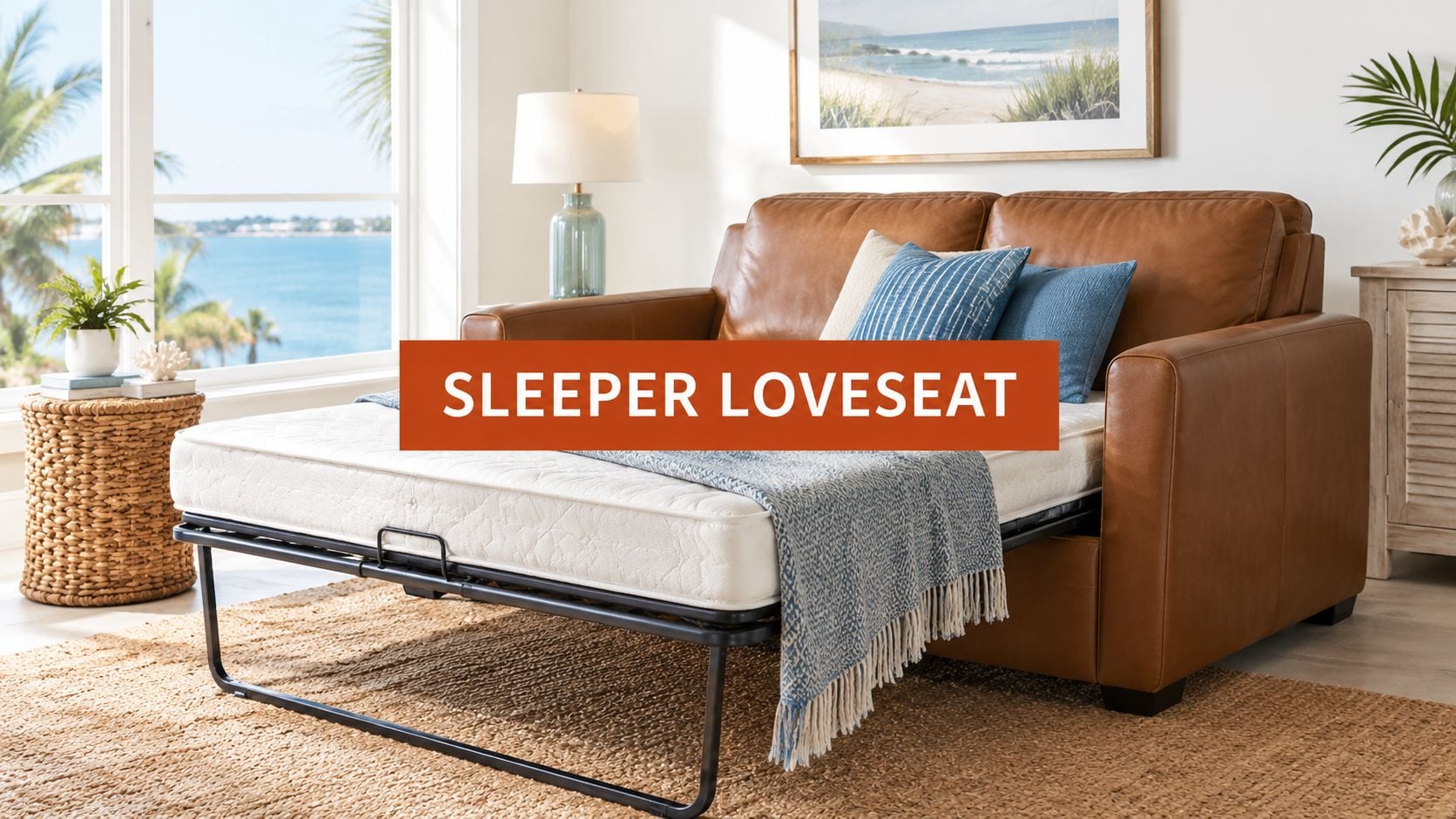
Your guest room still needs to feel like your home when nobody's visiting. Perhaps it's your afternoon reading spot, a quiet office, or the spare room in a Space Coast condo where a permanent bed would crowd out everything else. A leather sleeper loveseat can make that room more useful, but only if you're comfortable sitting on it, your guests can sleep on it, and the opened bed fits without rearranging the house.
My recommendation is simple: choose the sleeping system first, then the upholstery and silhouette. Coastal elegance should feel effortless, not require wrestling with a folding frame when company arrives.
When a Loveseat Has to Do Double Duty
In a Brevard County home, the spare room often carries several responsibilities. You might want a comfortable place to read beside the window, somewhere for visiting family to settle in, and enough open floor space to keep the room from feeling like storage for an unused bed.
A loveseat offers a considered middle ground. It's narrower than a sofa yet more substantial than a chair, giving you everyday seating without committing the whole room to a larger piece. The sleeper version adds overnight accommodation, although the actual sleeping capacity depends on its mattress and mechanism, not its name.

Start With the Guest, Not the Empty Corner
For an occasional solo visitor, a compact sleeper may be exactly right. For a couple staying regularly, don't assume the same piece will provide enough usable width. And if someone will sleep there nightly, I'd prioritize a proper sleeping surface over preserving a particular furniture outline.
Think about your daytime routine, too:
- Reading and conversation: Choose a seat pitch that supports you without requiring a pile of pillows behind your back.
- A working guest room: Keep access to the desk and storage practical when the bed is deployed.
- Vacation-rental use: Favor straightforward operation and care instructions that another person can follow without guesswork.
Practical rule: A piece hasn't earned its footprint until it works comfortably in both positions.
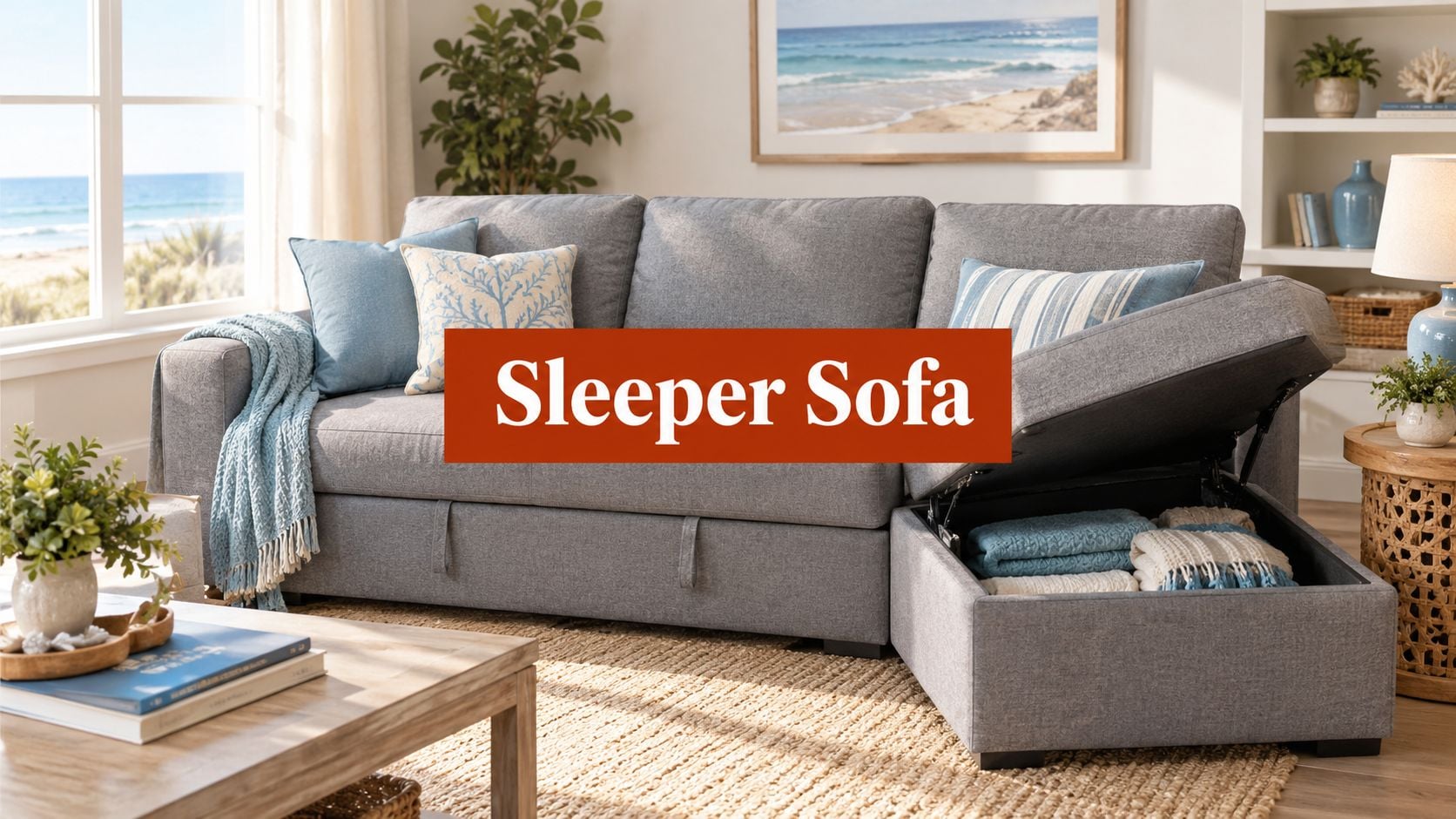
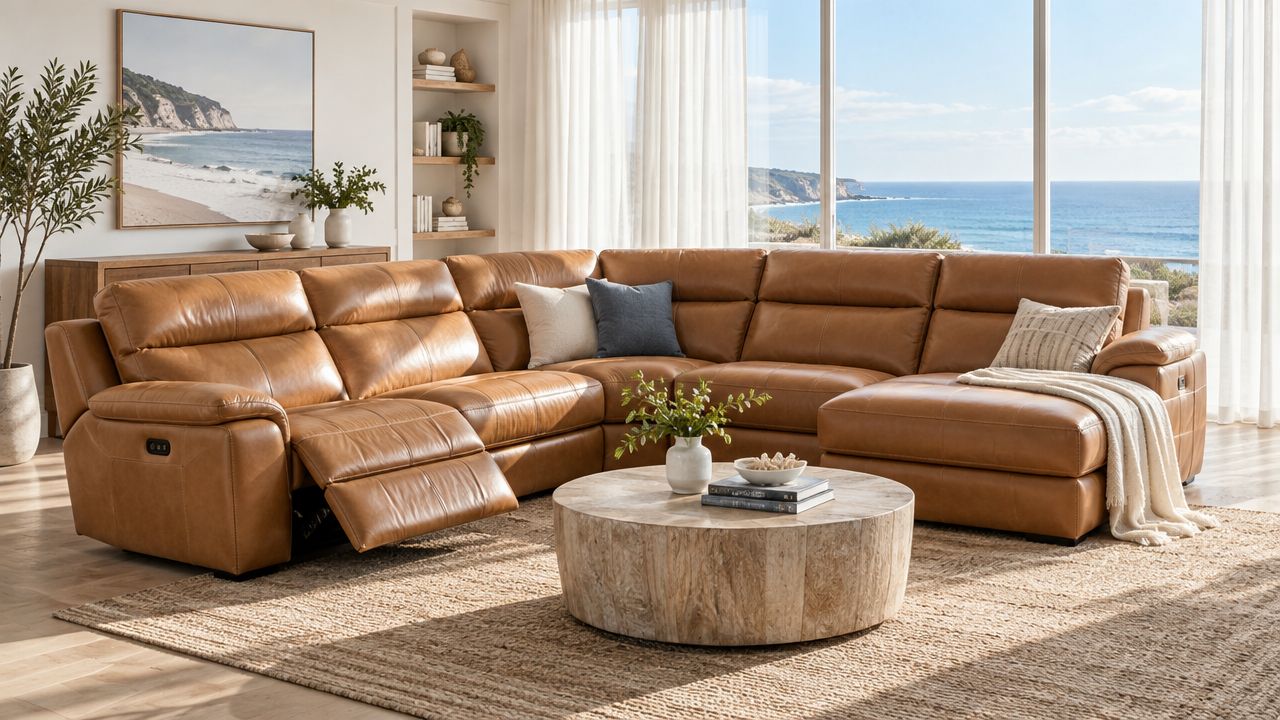
Our locally rooted approach starts with those questions, rather than an upholstery photograph. Established in 1939, our showroom has served homeowners across Brevard County, the Space Coast, and Central Florida through a continuing commitment to personal guidance and furniture selection. Explore our sleeper sofa and sectional options as a starting point, then bring your room measurements for a hands-on evaluation.
Once you've confirmed the mattress size, bedding becomes the finishing layer. SouthShore Fine Linens' faux fur bedding twin guide is a useful resource to consider when planning a softly textured guest-room look. Keep decorative bedding separate from the mechanism decision, and confirm what must be removed before closing.
What a Leather Sleeper Loveseat Actually Is
A leather sleeper loveseat combines upholstered seating with a convertible sleeping platform. Its essential parts are the structural frame, seat support, cushions, leather covering, conversion hardware, and either a separate mattress or a sleeping surface formed from the seating itself.
That distinction matters. You're not choosing a small sofa with something tucked underneath it. You're choosing a coordinated piece whose proportions, support geometry, and moving parts must work together.
An Established Furniture Tradition
Convertible seating has a substantial history. Patent records tracing sleeper-sofa development identify Herbert F. Sowle's divan-bed patent, filed in 1917 and granted in 1919, followed by Henry Arthur Fraser's chair-or-settee bedstead patent, filed in 1930 and granted in 1933; the record also identifies springless sleeper mattresses as a late-1950s innovation associated with a U.S. patent issued in 1962.
These developments reflect a familiar residential problem: how to accommodate sleeping without dedicating scarce floor space to a permanent bed. Later engineering attention to folding frames, mattress support, and conversion explains why a sleeper's hidden construction deserves as much scrutiny as its visible upholstery.
In a loveseat, compact proportions make that scrutiny especially important. Arm width can consume space that you'd rather have inside the sleeping area. Tight hinge clearances and the location of center supports can also change how the piece feels and operates.
Read the Upholstery Description Carefully
Leather adds another layer of craftsmanship, but the label alone isn't a buying specification. Genuine leather doesn't establish the finish, tested durability, or comfort of the particular upholstery. Likewise, top-grain leather shouldn't end your questions about how the surface will perform.
Ask the salesperson to connect the sample to the actual order:
- Leather identification: What exactly is being supplied, and is the same material used throughout the upholstered piece?
- Finish description: Is the surface protected or pigmented, and what care does the manufacturer permit?
- Construction details: How are seams, arm caps, and upholstery near the moving platform arranged?
- Tactile evaluation: Does the leather feel supple in your hand, and does it flex comfortably when you sit?
I'd choose a clearly documented leather specification over an impressive-sounding label. The goal is a piece whose surface and structure suit your household, not merely a handsome material name on an order sheet.
Leather and Performance Fabrics Side by Side
Choose upholstery for the room you live in. Wide coastal windows, children coming in from outdoors, pets sharing the cushions, and frequent overnight guests should influence the decision more than whether a leather sample looks luxurious under display lighting.
Our selection includes genuine leathers and performance fabrics, and neither category deserves an automatic win. I'd start with protected leather for someone who enjoys its tactile character and will follow its care requirements. For a vacation rental with frequent turnovers, I'd also examine a performance woven fabric closely, especially if its documented cleaning procedures better match the property manager's routine.
Leather vs Performance Fabric for a Sleeper Loveseat
| Criterion | Genuine Leather | Performance Fabric |
|---|---|---|
| Durability | Request leather-specific abrasion and finish documentation | Request performance documentation for the exact fabric |
| Cleanability | Protected finishes can improve cleanability; follow approved care | Compare permitted cleaning methods, not the category label |
| Feel | Hand-test suppleness, coating feel, and seated contact | Compare weave texture and cushion feel in person |
| Climate response | Evaluate placement, light exposure, and moisture management | Ask about suitability for the room's conditions |
| Ideal household type | Owners who want leather's character and accept its care routine | Active households or rentals whose needs match the fabric's documented performance |
Protected or pigmented leather can improve stain resistance and cleanability, but a heavy coating can change the hand feel and eventually show finish loss or cracking. For upholstery that receives concentrated contact, request ISO 17076 Martindale or ISO 5470 Taber testing, including the load, abrasive medium, cycle count, and failure criterion, as described in this guide to leather-quality testing methods.
If you're drawn to a full-aniline option, let the sample earn your preference through touch, appearance, and a clear explanation of its care expectations. Don't assume every leather marketed for softness will suit a demanding rental environment.
Include Odor in the Comparison
Leather isn't automatically a low-odor or low-emissions choice. A review of furniture-related indoor VOCs identifies leather and engineered boards as potential emission sources and explains that temperature, relative humidity, ventilation, coatings, and adhesives influence indoor concentrations.
Ask for foam documentation, adhesive specifications, and finish information, particularly for an enclosed bedroom or an odor-sensitive household. A brief showroom visit won't reproduce the conditions of your guest room.
Our leather-versus-fabric upholstery guide can help organize the comparison. My advice remains product-specific: compare the actual leather and fabric options available on the sleeper you've tested.
Sizing, Mechanisms, and Mattress Inserts
In a Florida guest room, a loveseat may fit neatly against the wall yet leave little room to open the bed or walk around it. Measure the deployed footprint before choosing by the closed silhouette. Compact dimensions can mean a shorter or thinner sleeping surface, so test comfort rather than assuming the smaller piece will work for overnight guests.
Typical pull-out mattresses measure approximately 36 × 72 inches for twin, 54 × 72 inches for full, and 60 × 72 inches for queen. Conventional residential mattresses are commonly longer, and folding decks generally restrict mattress thickness to roughly 4.5–5 inches. Treat these as reference dimensions and confirm the exact specifications of your selected piece.
Match the Mechanism to the Sleeper
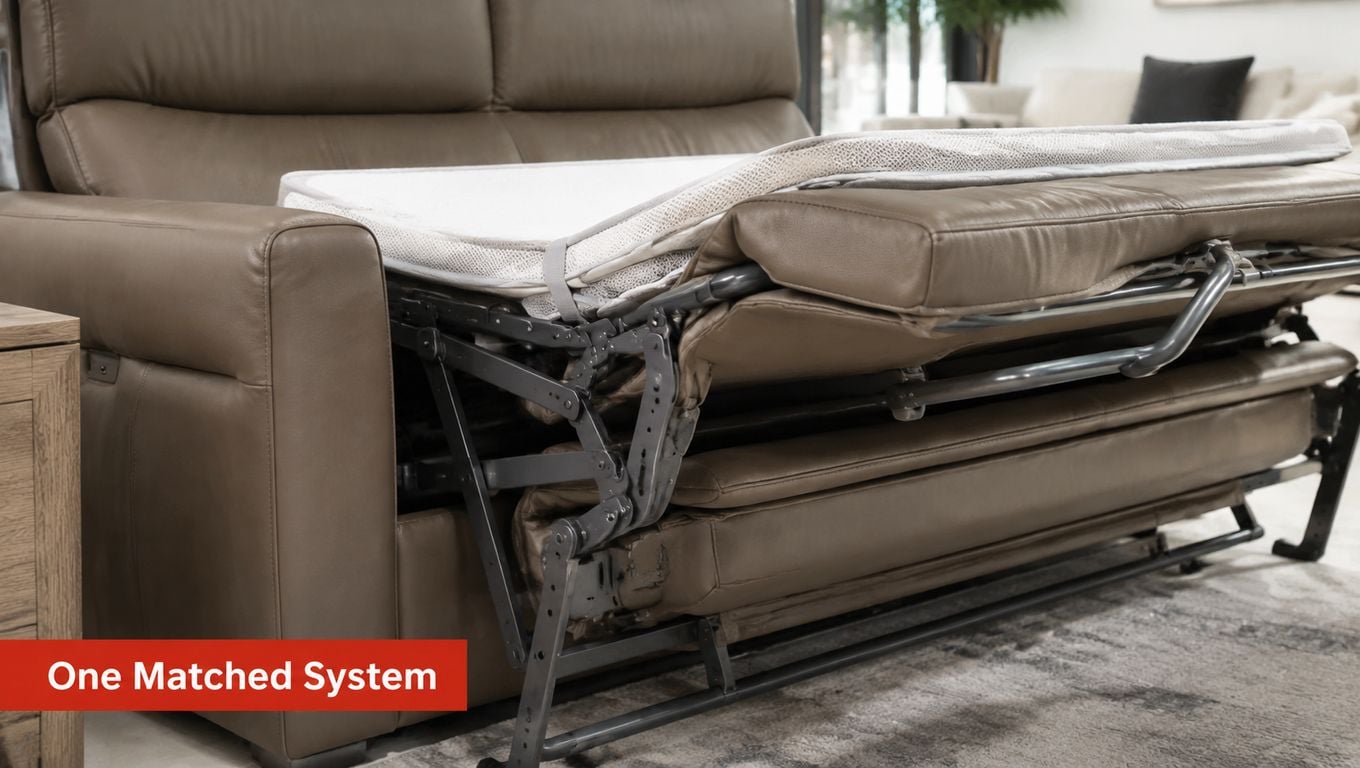
A pull-out unfolds a separate mattress from beneath the cushions. A click-clack or jackknife lowers the backrest to form the sleeping platform, making hinge alignment, firmness, and the center seam key comfort checks. With a pull-out, focus on how the mattress is supported and whether the frame beneath it feels even.
Lie down in your usual sleeping position. Check for bars, hinges, seams, or uneven support beneath your shoulders and hips. If mobility is a concern, test the seat height, transfer ease, opening force, and space to stand beside the deployed bed.
Saving floor space isn't a comfort improvement if the sleeper can't turn naturally or get out of bed easily.
Record the Complete Geometry
Bring a tape measure and a room sketch. Include:
- Closed dimensions: Width, depth, and height, including projecting arms or trim.
- Opened footprint: Full bed extension and any movement needed behind the back.
- Operating space: The swing path and room to reach and lift the mechanism.
- Sleeping surface: Usable width and length, mattress construction, and permitted replacement thickness.
Don't add a thicker mattress without written compatibility confirmation. Test the conversion with approved bedding in place, and confirm what must be removed before closing the bed.
Use our sleeper-sofa mattress-size guide to plan around measured dimensions, not the size name alone. For a UK bedding comparison, how full sizing works in the UK explains the local label. Check the selected sleeper's actual measurements before ordering bedding.
Frame Construction and the No Blind Ordering Test
The compact footprint of a leather sleeper loveseat comes with a trade-off: its frame must support daily seating and repeated conversion, while the compact seat may not suit every body for long periods. In a Florida home, look beyond the upholstery and test how the structure holds up under ordinary use.
Kiln-dried hardwood offers better dimensional stability, with moisture content of roughly 6–8%. Solid wood corner blocks secured with adhesive and screws provide stronger reinforcement than staples alone. Ask what the frame is made of and how its joints are secured. “Wood frame” is too vague, and a smooth exterior reveals little about concealed construction.
Ask What Holds the Corners Together
Corner joints take concentrated force as people sit, shift, and open the sleeper. Properly secured blocks help resist racking. Staples can assist assembly, but staples alone may loosen under repeated loading. Look for a clear explanation of the materials and joinery, not just a confident label.
Our emphasis on solid hardwood frames and time-tested joinery reflects the demands of Florida homes and active daily use. Then assess the actual piece:
- Sit firmly: Notice whether the frame stays stable beneath the cushion.
- Shift your weight: Move toward an arm, then back to the center, without bouncing.
- Complete the conversion: Open and close the platform fully. Listen and feel for binding or movement in the structure.
- Check the result: The loveseat should feel planted, not twist beneath you or require force to align.
Comfort Must Be Hand-Tested
Our No Blind Ordering promise means our ownership team hand-tests every seat, sofa, and recliner for pitch, structural integrity, and comfort before it reaches the 32,000-square-foot Rockledge showroom.
That evaluation is a useful screen, not a substitute for your own visit. Your height, preferred posture, and ease of movement determine whether the seat fits. Sit as you would at home, with your feet supported and your back relaxed. For a sleeper, also consider whether its compact proportions leave enough room for comfortable rest.
Buying advice: Ownership testing screens the furniture. Your own seated and lying-down evaluation confirms the fit.
Take time to assess both structure and comfort. An attractive leather sample cannot compensate for an uncomfortable seat pitch or a frame that feels unstable in use.
Caring for Leather in a Florida Climate
A leather sleeper loveseat near a sunny window in a Florida home faces different conditions from one in a shaded room with steady airflow. Start with placement, then build a care routine around the upholstery maker's instructions.
Summer humidity can leave leather holding moisture even when it feels dry, while winter heating can dry it out. For regularly used leather, conditioning approximately every 3–6 months can be a starting point, adjusted to the room's exposure and the manufacturer's guidance. Check the care directions before applying any product.
Build a Gentle Routine
Keep air moving around the loveseat, and avoid direct, strong sunlight on the arms and seat. Air conditioning does not remove the need for regular checks. Look at both frequently touched areas and surfaces that are less visible.
Use a restrained cleaning routine:
- Remove loose soil: Dust with a soft brush or microfiber cloth, including along seams.
- Use cleaner sparingly: Apply an approved product to the cloth rather than directly to the leather.
- Wipe gently: Work in small sections, then let the leather dry naturally.
- Blot spills: Act promptly and avoid rubbing liquid across the surface.
- Condition with care: Follow the supplier's directions for your specific leather and finish.
Our real-leather sofa cleaning guide can help you organize a routine before the loveseat arrives. For additional stain-care context, consult this guide to high-end sofa cleaning and stain removal. Your upholstery's own care instructions take priority.
Include the Hidden Upholstery
Open the sleeper and check the fold-out edge, seams, and exposed upholstery for dust, soil, or rubbing. Give arm caps and other high-contact areas regular attention. Keep cleaning products away from the mattress and conversion hardware unless their care instructions permit use there.
After delivery, ventilate the room and follow guidance for the specific materials. This matters especially when a new sleeper goes into a guest room that remains closed between visits. Avoid covering an unfamiliar odor with fragrance. If it persists or causes discomfort, ask the retailer or upholstery supplier for advice.
Customization and the Brevard County Showroom Experience
A loveseat may fit the room and still feel out of place. In a Brevard County showroom, compare the leather, wood finish, and proportions with the pieces you already own before settling on a configuration. A compact footprint can suit a Florida home, but it does not guarantee a comfortable bed, so judge the seating and sleeping functions separately.
Indian River Furniture offers sleeper seating, upholstery choices, and complimentary in-house interior design consultations. Its partnerships with over 300 trusted manufacturers provide access to thousands of performance fabrics, genuine leathers, and custom wood finishes. Available combinations depend on the model, so confirm that your preferred materials work with the sleeper mechanism.
Bring the Room Into the Conversation
Bring photos of your seating, rugs, flooring, and window treatments, along with room measurements. Point out walkways and other areas that must stay accessible when guests visit. Florida's coastal light can shift how a leather color reads, so compare the finish in person rather than relying on a small sample.
- Coordinate texture: Compare the leather surface with nearby woven materials and wood grain.
- Check proportion: Assess the arms and overall visual weight against the room's other furniture.
- Confirm availability: Ask which upholstery and finish options fit the selected sleeper mechanism.
Use the Vignettes as a Design Reference
Curated coastal room displays show how a leather surface works beside a textured rug, how a wood finish affects the room's warmth, and whether a substantial arm suits your intended scale. Look beyond color. Check how the loveseat's compact form balances with the surrounding furniture, then test the sleeper itself for usable support and room to stretch out.
A complimentary consultation can help turn those observations into a considered choice. Work through placement and product selection with a design professional who can account for the whole room, not just an upholstery swatch. Decide which trade-offs you can accept before choosing: the smallest footprint may save space, while a larger sleeping surface may serve overnight guests better.
White-Glove Delivery and the Long-Term Investment
Delivery deserves attention before the order is finalized. A convertible piece must reach its intended room, sit correctly in the planned position, and be ready for you to inspect without leaving packaging scattered through the house.
Our in-house white-glove delivery service provides unboxing, inspection, and full room setup by uniformed team members for a flat $99 within the service area. Confirm service-area eligibility and access requirements with the team before arranging delivery.
Make the Handover Useful
Walk through the placement while the delivery team is present. Check that the furniture matches the order and that the room arrangement leaves the operating space you planned. Keep the upholstery care information, mechanism instructions, and order documentation together for future reference.
- Before ordering: Confirm the room fit, upholstery specification, mattress, and available customization.
- Before arrival: Clear the access route and prepare the intended location.
- At setup: Review the piece and ask how to raise a service question if needed.
Heirloom is a useful aspiration, not a promise that any sleeper will last indefinitely. Craftsmanship, compatible components, thoughtful care, and accessible local support give you a stronger foundation for long-term ownership. Choose the piece because it supports your daily life and welcomes your guests comfortably, not because it happens to fill an empty corner.
Visit our Rockledge showroom with your room measurements, photographs, and a clear idea of who'll use the bed. Hand-test the seating, try the sleeping surface, and work with our in-house design team on a leather sleeper loveseat that fits your coastal home in both appearance and function.