Schedule your Complimentary Design Consultation


Sleeper Sofa Sectional Guide: Comfort, Styles, and Design

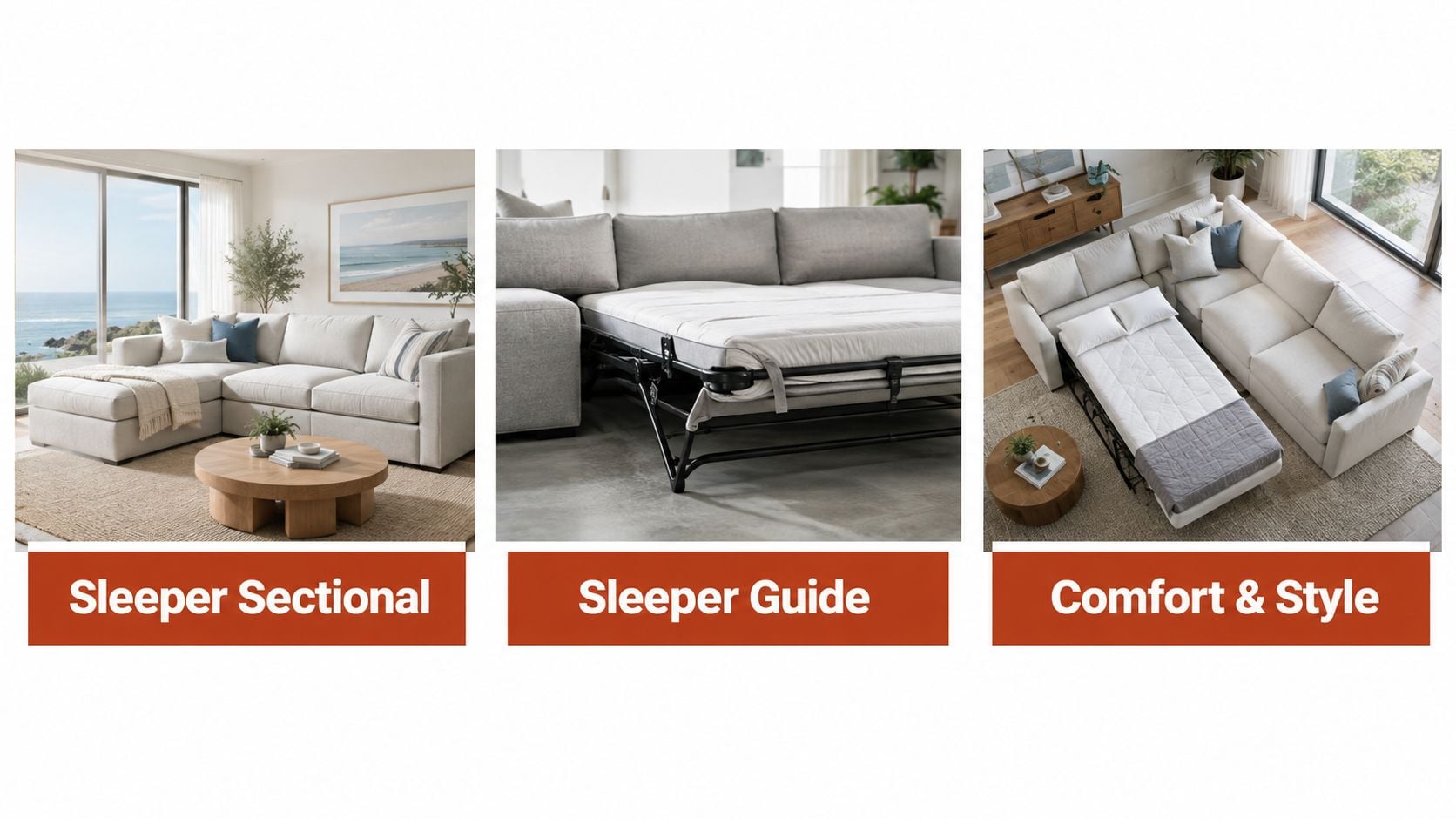
The overnight guests are arriving, the living room needs to welcome conversation tonight, and tomorrow it may need to become a comfortable bedroom. In a Florida home, that furniture also has to handle bright windows, air-conditioning cycles, sandy feet, pets, family gatherings, and the relaxed pace of coastal living. A sleeper sofa sectional can meet all those needs, but only when its seating ergonomics, conversion mechanism, frame, upholstery, and room proportions are evaluated together.
The right piece isn't just a sofa with a hidden bed. It's an investment in daily comfort, thoughtful hospitality, and lasting craftsmanship. Here's how to judge one with the same care you'd give any important piece of furniture.
The Heart of a Welcoming Home
A late afternoon gathering in a coastal living room rarely follows the floor plan. A few friends settle into the sectional, someone stretches out on the chaise, children move between the kitchen and the patio, and an overnight guest arrives with a bag that needs a place to land. The room has to feel serene without becoming precious, and the furniture has to work without announcing its utility.
That's where a well-designed sleeper sofa sectional earns its place. During the day, it creates a generous setting for conversation and rest. At night, it can provide a dedicated sleeping surface without requiring a separate guest room. The best versions feel composed in both roles, with cushions that support daily sitting and a bed mechanism that doesn't feel like an afterthought.

A piece with a working life
I've seen families choose furniture that looks beautiful in a photograph but becomes awkward once people use it. A chaise may be too deep for upright sitting. A back may be too low for an evening conversation. A bed may open smoothly but offer uneven support. Those details shape how often the furniture is enjoyed.
A sectional sleeper also has to suit the household's rhythm. It may serve visiting relatives, a multigenerational home, a vacation property, or a homeowner who wants a comfortable place to rest every day. Treating every sleeper as an “occasional guest” product overlooks the more useful question: how often will people sit, lounge, open, sleep, and store bedding on it?
Practical rule: Choose the sleeper based on its most demanding regular use, not its least frequent use.
Indian River Furniture has served Brevard County, the Space Coast, and Central Florida since 1939, helping local homeowners balance welcoming design with dependable construction. The ownership team hand-tests every seat, sofa, and recliner for pitch and comfort before it reaches the 32,000 sq ft Rockledge showroom floor. That approach reflects a simple belief: furniture should be experienced before it becomes part of your home.
A thoughtful room should support the people who live in it, not just photograph well. For more perspective on creating a home that feels personal and restorative, explore the art of coming home.
Understanding Sleeper Mechanisms and Comfort
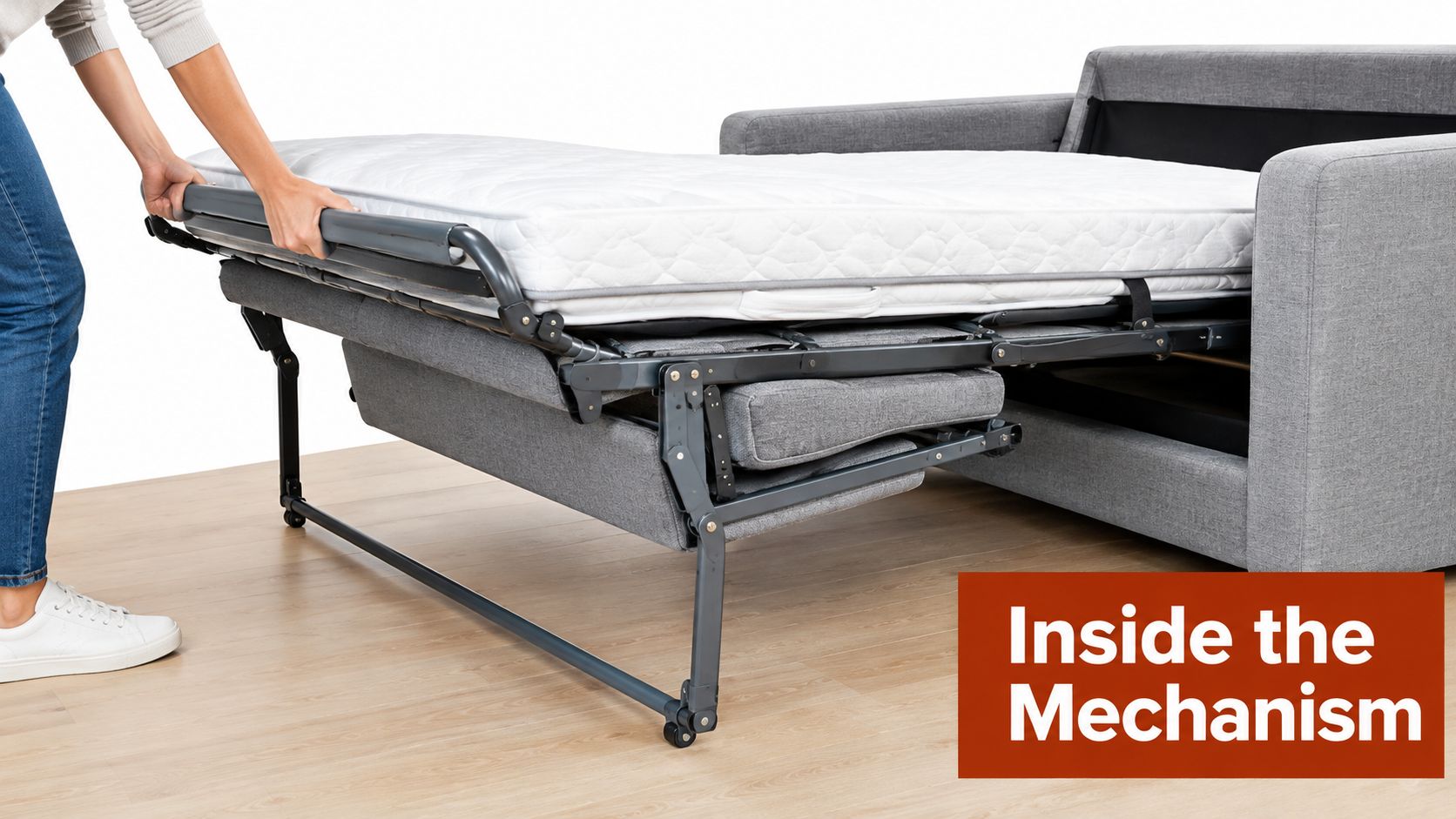
Mechanism type affects both the sleeping surface and the way the sectional feels as a sofa. A traditional pull-out stores a separate mattress beneath the seat cushions and unfolds into a more bed-like platform. A click-clack or fold-flat design changes the back and seat position together, often producing a simpler conversion. Other folding systems use engineered frames, support decks, and specialized mattresses to reduce the sensation of a joint or gap.
The category has developed through more than a century of convertible-furniture engineering. Sarah E. Goode received a U.S. patent for a folding bed incorporated into a writing desk in 1885, and Leonard C. Bailey patented a folding bed with a metal frame and folded mattress in 1899. Later patent activity included a foldable sofa-bed patent published in 1959, a springless sleeper-sofa mattress patent issued in 1962, and continuing developments in support systems and integrated mattresses, as documented in the history of sleeper-sofa development.
Test the sofa before the bed
Start with the closed seating position. Sit fully back, place both feet on the floor, and notice whether the front edge presses behind your knees. Cornell ergonomics guidance identifies approximately 16.5 inches, or 42 cm, as a reference depth for fixed seating, with adjustable seating accommodating roughly 14 to 18.5 inches, or 36 to 47 cm, depending on the user and design. The same guidance references a back angle near 15 degrees from vertical for comfort. See the Cornell seating ergonomics guidance for the underlying benchmarks.
A sectional's chaise requires its own test. Its extra depth may be perfect for reclining but unsuitable for upright conversation unless the back cushions or lumbar pillows bring the sitter forward. Don't assume a larger footprint means greater comfort. Seat depth, cushion compression, back pitch, and body proportions have to agree.
Next, operate the bed slowly. Pull-out mechanisms should move without catching, scraping, or requiring an awkward lift. Fold-flat systems should settle into a stable position rather than rocking under weight. Open the entire surface, lie down if the showroom allows it, and check shoulder, hip, and lower-back support. A useful resource on planning adaptable furniture arrangements is this guide to sectionals for tight floor plans.
Indian River Furniture's sleeper sofa mattress guidance can help organize the mattress conversation, but the hands-on test remains essential. Mechanism type alone doesn't predict comfort. A pull-out may feel more like a conventional bed for one sleeper, while a fold-flat platform may offer a flatter surface for another. Daily seating and overnight support should be judged as separate performance tests.
Engineering Durability for Coastal Living
A sleeper sofa sectional places unusual demands on its frame. The structure supports people in a fixed seating position, absorbs movement as cushions shift, and carries the mechanical forces created when the bed opens and closes. In a humid coastal home, the frame also responds to changes in indoor moisture.
Solid wood is strong, but it isn't dimensionally frozen. Purdue University Extension reports that moisture-content changes of only a few percentage points can cause significant wood shrinkage or swelling. For sugar maple, a 6-percentage-point moisture change may produce approximately 2.5% dimensional change in a furniture part, as explained in Purdue's wood-movement guidance.
What to inspect beneath the upholstery
Those movements can contribute to joint stress, squeaks, panel gaps, finish defects, and misalignment. A metal sleeper mechanism attached to a wood frame makes alignment especially important because a small shift can change the force required to deploy the bed.
Look for solid hardwood components, mechanically reinforced joints, and construction that allows appropriate clearance around the mechanism. Ask whether the wood has been properly dried and whether the hardware can be adjusted or serviced. A frame that feels rigid when you push across the seat is more reassuring than one that flexes or produces unexplained movement.
A sleeper sectional also needs upholstery that matches the household's activity. Performance fabrics can offer practical resistance to spills, everyday friction, and active family use, while genuine leather develops a distinctive patina when cared for properly. Neither material eliminates maintenance, and neither should be selected from appearance alone. Fiber content, weave, seam construction, colorfastness, cleaning requirements, and exposure to sunlight all matter.
Upholstery abrasion testing provides one useful comparison. One independent upholstery guide associates approximately 15,000 to 25,000 Martindale rubs with general domestic use, 25,000 to 30,000 with heavy-duty use, and 30,000 or more with commercial applications, as described in this technical fabric guide. The abrasion number doesn't measure every quality, but it gives you a more concrete starting point than hand feel alone.
Climate care is part of construction
ASTM D3597-02(2018)e1 evaluates woven indoor upholstery for breaking strength, tear strength, yarn slippage, surface abrasion, dimensional change, and colorfastness. Its listed minimum abrasion classifications include 9,000 cycles for medium-duty fabric and 15,000 cycles for heavy-duty fabric, alongside tests involving water, solvents, rubbing-related color transfer, light, and ozone. The ASTM upholstery specification shows why a fabric should be assessed as a complete system rather than by softness or color.
For Florida homes, stable indoor conditions support the frame and finished surfaces. The Museum of Florida History recommends household relative humidity between 35% and 65% for caring for wood objects, according to its wood artifact-care guidance. Sensible air-conditioning, protection from intense direct sunlight, and avoidance of wet cleaning or condensation near the frame all help reduce unnecessary stress.
For practical care ideas suited to family life, pets, and coastal weather, see performance fabrics for spills, splashing, and shedding.
Curating a Coastal Aesthetic
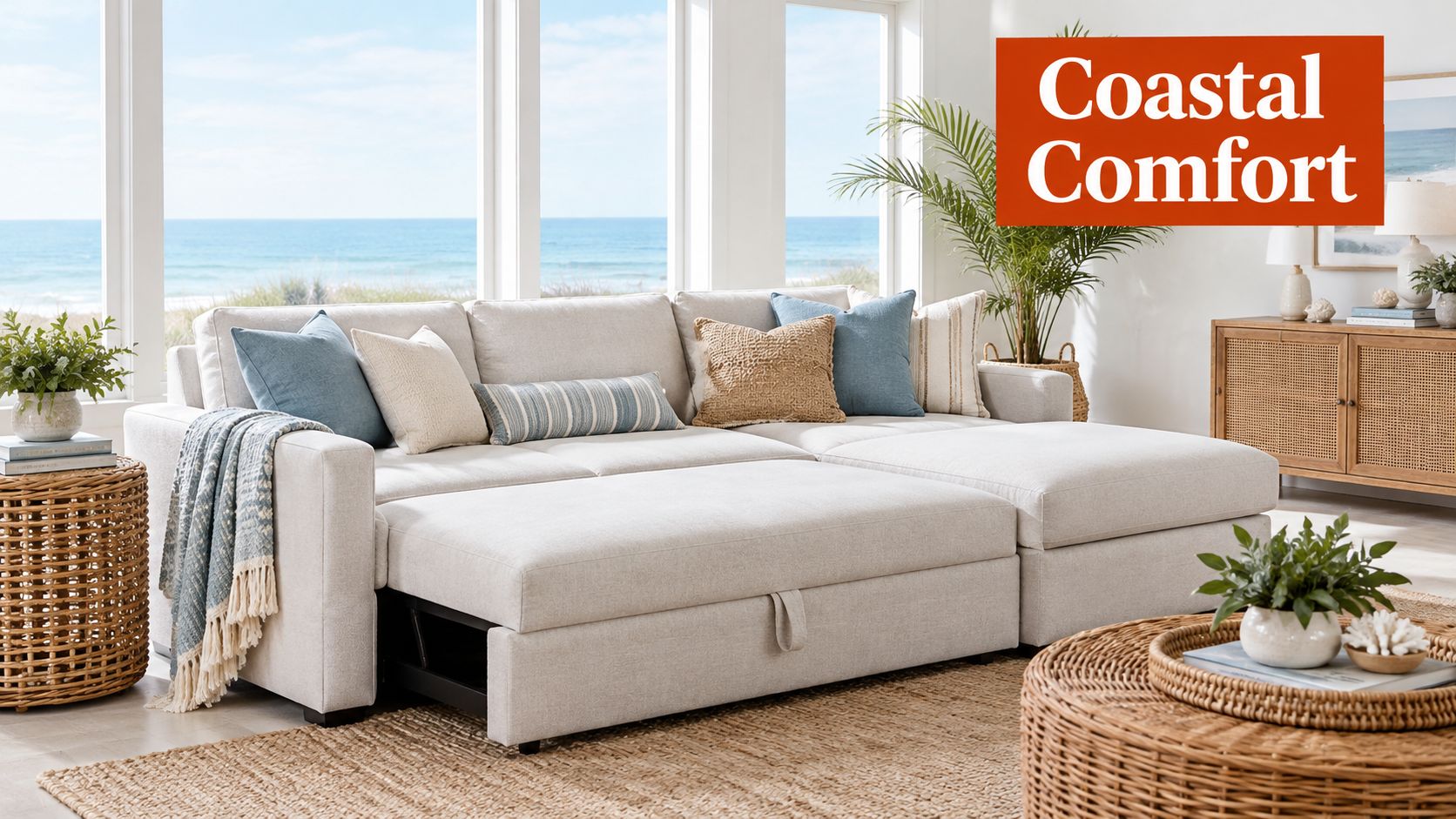
A sleeper sectional no longer has to look like a temporary compromise. The strongest designs use balanced proportions, quiet seams, soft tactile fabrics, and restrained silhouettes that work naturally in a light-filled Florida room. The bed function remains important, but it sits beneath a piece that can anchor the entire space.
Coastal elegance depends on balance. Pale performance upholstery can echo sand, shells, and sun-washed walls, while a deeper neutral or genuine leather can ground a room with stronger architectural lines. Natural wood details bring warmth, but the frame should complement the room rather than compete with the sectional's generous scale.
Proportion creates calm
In a beachfront condo, a modular configuration may help define the living area without making the room feel crowded. In a larger family room, a chaise can create a natural reading or television position, while the main seating run keeps conversation connected. The key is to measure both the closed and opened layouts, including walking paths, nearby tables, doors, and access to windows.
A sleeper sectional should also look intentional when the bed is stored. Check whether the mattress creates visible bulges, whether the seat cushions retain their shape, and whether the chaise and sofa modules align cleanly. Upholstery and consistent cushion proportions make the piece feel like a curated investment rather than a hidden utility.
Design insight: Coastal style is more convincing when texture and proportion do the work, not when every surface carries a nautical motif.
A restrained palette gives you room to layer personality through pillows, woven accents, artwork, and lighting. Consider how the fabric changes in morning sun, how the leather feels against bare skin, and whether the sectional's arms leave enough visual breathing room around the room. Relaxed luxury should feel touchable and lived in.
For homeowners shaping a cohesive palette, coastal design style guidance offers a useful starting point. The final room should support both polished entertaining and ordinary evenings, with materials that look better integrated into daily life rather than protected from it.
The Value of Hands-On Testing and Service
Online dimensions can tell you whether a sectional might fit. They can't tell you whether the seat edge presses behind your knees, whether the back supports your shoulders, or whether the bed mechanism catches halfway through opening. Those are physical questions, and a physical product deserves a physical test.
Visit a showroom prepared to sit as you would at home. Lean back, shift positions, place your feet where they naturally rest, and spend enough time to notice whether the cushion supports you or gradually forces you into an uncomfortable posture. Then open the sleeper and inspect the platform, mattress surface, seams, and clearance around nearby furniture.
EN 13759 identifies a furniture test method for operating mechanisms in seating and sofa-beds. Related upholstery standards address abrasion, tear resistance, tensile strength, colorfastness, and dimensional stability. That distinction supports a practical inspection routine: test the mechanism as a mechanism, and test the sofa as a sofa, as outlined in the European furniture testing documentation.
Service reduces uncertainty
A furniture consultant should help you compare comfort, room proportions, upholstery performance, and delivery access without rushing the decision. Indian River Furniture provides complementary in-house interior design consultations, allowing the design team to help coordinate the sectional with rugs, tables, lighting, wall color, and the practical needs of the room.
Delivery matters just as much. A large sleeper sectional needs careful handling through doors, halls, elevators, and finished rooms. The in-house uniform white-glove delivery service includes unboxing, inspection, and room setup, with a standard $99 delivery fee within the service area. To begin a measured conversation about your space, schedule an appointment before visiting.
Creating a Legacy of Comfort
A quality sleeper sofa sectional becomes part of the home's daily story. It's where family members stretch out after a beach day, where guests share coffee in the morning, and where a spare sleeping arrangement appears when someone needs it. Its value comes from doing those jobs comfortably and gracefully over time.
The strongest choice combines several decisions that are easy to overlook when shopping by appearance alone:
- Ergonomic seating: The seat depth, back pitch, cushion firmness, and chaise position should support the people who use the room most.
- Reliable conversion: The mechanism should open smoothly, rest securely, and leave a stable, level sleeping surface.
- Climate-aware construction: Solid hardwood components, reinforced joinery, suitable clearances, and appropriate indoor humidity care support long-term performance.
- Selected upholstery: Performance fabrics and genuine leathers should be chosen according to sunlight, pets, guests, cleaning habits, and the desired coastal texture.
- Complete service: Design guidance, careful delivery, inspection, and room placement protect the investment from showroom to living room.
Safety documentation deserves attention, too. Sofa beds are included within UK upholstered-furniture fire-safety rules covering filling ignition performance, cigarette resistance, cover requirements, and labeling. The UK's 2025 amendment, effective October 30, 2025, changed parts of that regulatory framework while retaining broader flammability obligations for covered products, as described in the relevant upholstered-furniture guidance. Requirements differ by market, so vacation-rental owners, importers, second-hand buyers, and anyone relocating furniture should request applicable safety documentation rather than assume compliance transfers between countries.
Indian River Furniture's Rockledge showroom brings together curated coastal vignettes, living-room furniture, sleeper options, performance fabrics, genuine leathers, and design support for homeowners across Brevard County and Central Florida. Visit the 32,000-square-foot showroom, sit in the furniture yourself, open the bed, discuss your room with the design team, and choose a sleeper sectional that feels as comfortable on an ordinary Tuesday as it does when welcomed guests arrive.
Bring your room measurements and your everyday comfort preferences to Indian River Furniture in Rockledge. The team can help you hand-test sleeper mechanisms, compare custom upholstery, plan the full coastal setting, and arrange white-glove delivery for a finished room built around lasting comfort.