Schedule your Complimentary Design Consultation


White Accent Cabinet Buying and Styling Guide


A white accent cabinet can work beautifully in Florida, but construction decides its life more than color does. Keep daily-use storage between roughly 16 and 61 inches from the floor, and choose a properly sealed cabinet for a climate where indoor humidity should stay around 30–50%.
The hesitation is understandable. A white accent cabinet looks effortless in photographs, with clean lines, pale finish, and just enough coastal brightness. In a Brevard County home, though, the wrong substrate can swell, stick, or crack through a humid summer. The decision isn't just about finding the right paint chip. It's about construction, finish chemistry, placement, and reach.
Why a White Accent Cabinet Deserves a Closer Look
A homeowner once brought a beautiful white cabinet into a bright coastal living room because it looked perfect in the catalog photograph. Within a season, the doors no longer aligned cleanly. The lower edge showed water staining, the finish had begun to crack near a joint, and the cabinet felt less like an heirloom and more like a reminder that appearance can hide construction.
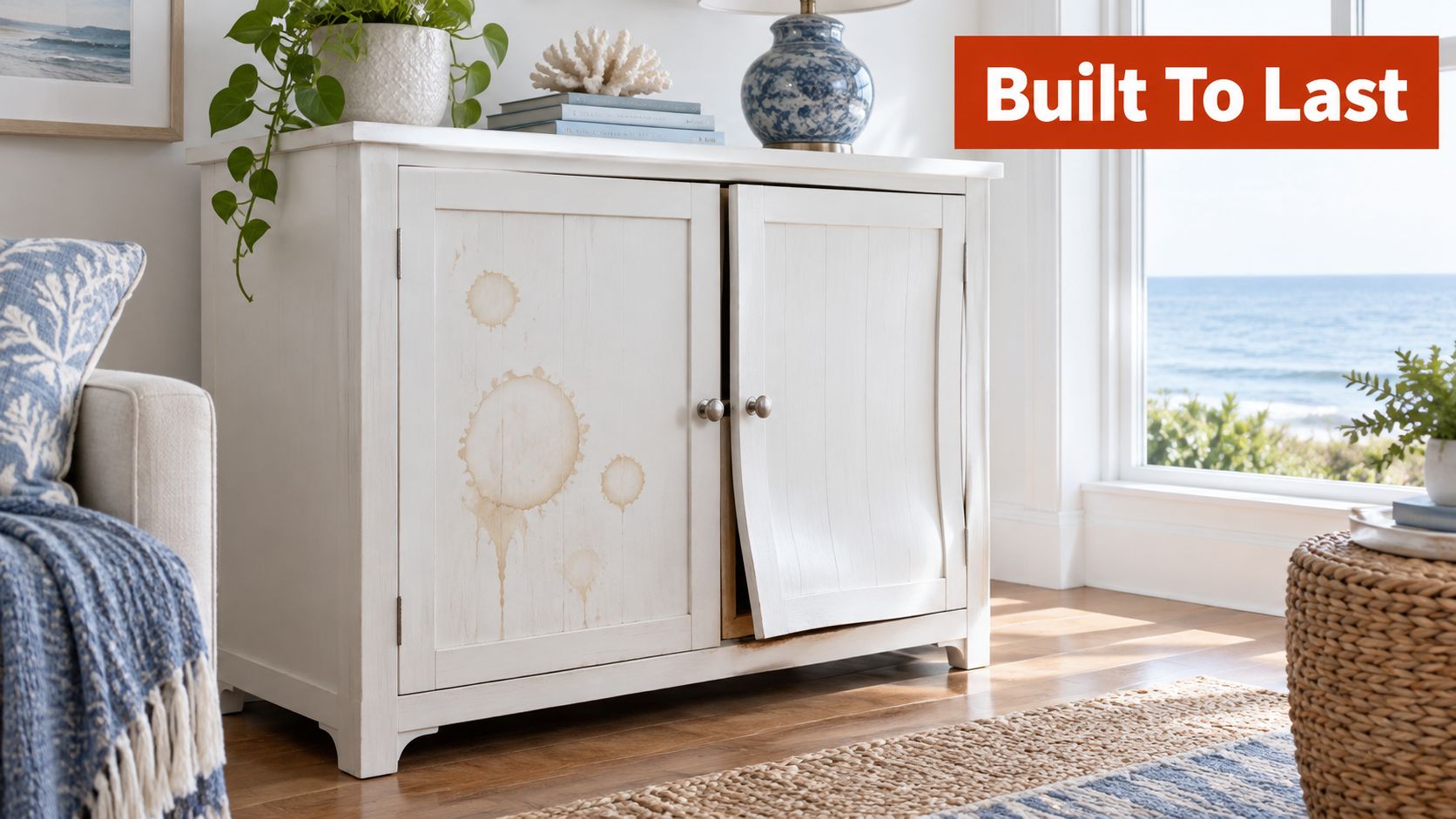
That experience is avoidable. Before you choose a white accent cabinet, ask four direct questions:
- What is it made of? The box, doors, back, shelves, and edge treatments should all be part of the conversation.
- How is it finished? White paint can look smooth and refined, but coating quality, film thickness, curing, and sheen determine how it ages.
- Where will it live? A cabinet beside a damp exterior wall faces a different environment from one in a conditioned hallway.
- Who will reach into it? A tall cabinet may offer display height while placing everyday dishes, linens, or media accessories beyond comfortable reach.
The EPA's moisture-control guidance explains that wood moisture content responds to indoor relative humidity, ventilation, and dehumidification. That makes climate management part of furniture selection, not an afterthought.
For Brevard homes, value means reliable craftsmanship, a custom fit, and serviceable construction. A cabinet should feel steady when a door closes, glide smoothly when a drawer opens, and sit confidently against the room rather than appear dropped into it. Since 1939, Indian River Furniture has served Brevard County, the Space Coast, and Central Florida with that practical view of furniture. The ownership team hand-tests every seat, sofa, and recliner for pitch and comfort before it reaches the 32,000-square-foot Rockledge showroom floor. That same no-blind-ordering mindset belongs in cabinet selection too. You should understand what you're bringing home before delivery day.
Where the White Accent Cabinet Sits in Today's Coastal Homes
White still has a firm place in coastal interiors, but its role has changed. The strongest rooms no longer depend on every cabinet, wall, and surface being the same pale tone. They use white as a visual lift, a separator, or a quiet counterpoint to wood, blue, green, stone, woven textures, and natural finishes.
The 2024 National Kitchen & Bath Association trend report found that 43% of respondents believed all-white kitchens were declining in popularity, while 30% anticipated increased use of wood-look and natural materials and 17% expected greater use of colorful cabinetry. The report also identified large islands for serving and dining as the leading design trend for the following three years, cited by 49% of respondents. These figures describe diversification, not the disappearance of white. Read the NKBA trend reporting as a shift from uniformity toward layering.
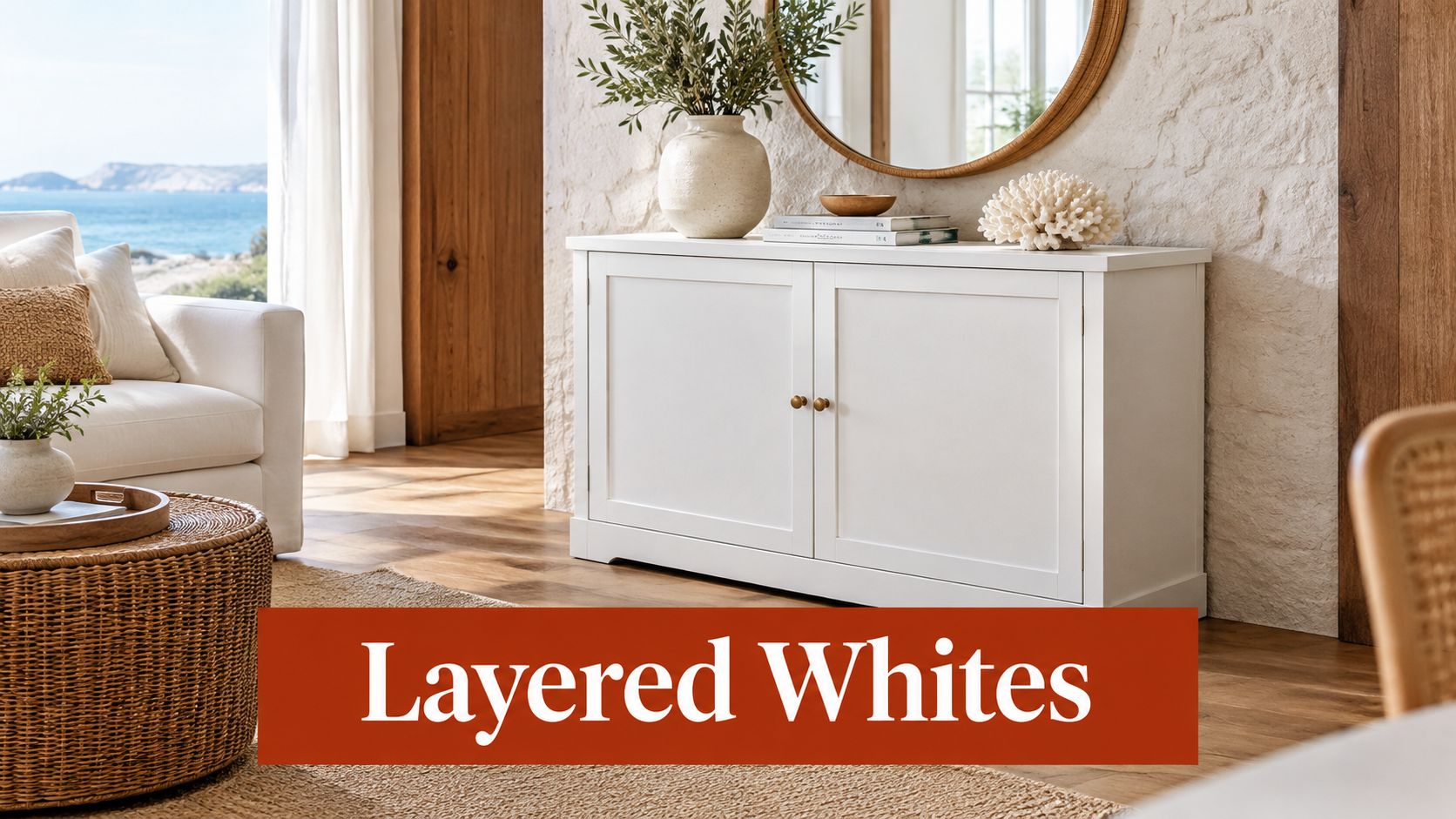
That shift suits a white accent cabinet particularly well. A white upper cabinet can keep a kitchen open while lower cabinetry carries wood grain. A white sideboard can brighten a dining room with a darker table. In a living room, a pale cabinet can separate a saturated wall color from a natural-fiber rug without competing for attention. The finish becomes a bridge between materials.
Use white to create balance
Recent homeowner data supports this layered approach. In the 2026 Houzz Kitchen Trends Study, wood-toned cabinetry was selected by 29% of respondents, narrowly ahead of white at 28%, based on 1,780 U.S. homeowners who had completed or were undertaking kitchen renovations. White remains present in more than one out of every four renovated kitchens, and the same reporting notes its continued use in two-tone schemes. Real Simple's coverage of the Houzz study also notes that off-white was the most popular wall color, selected by 29%, compared with 21% for pure white.
The practical lesson is simple. Choose white when the room needs air, contrast, or continuity, not because every surrounding surface must match. In a coastal or transitional room, the most successful white accent cabinet usually has companionship nearby, perhaps a warm wood table, woven seating, aged brass hardware, or a blue-green textile. For more guidance on balancing those elements, explore coastal design style before you finalize the cabinet's finish.
Choosing a White Finish That Actually Holds Up
Two cabinets can leave the showroom looking nearly identical and age very differently. The difference often sits in the coating system, not the color name. A professionally sprayed white finish with controlled film build, smooth leveling, and proper curing will generally present a cleaner surface than a cabinet painted hurriedly on site.
A representative waterborne urethane-reinforced acrylic cabinet coating specifies 35% ±1% volume solids, coverage of approximately 350–450 square feet per gallon, a recommended dry-film thickness of 1.3–1.6 mils, and a full cure time of 14 days at 77°F and 50% relative humidity. Those specifications appear in the technical data for the coating system. They're useful because they translate a vague promise of “durability” into measurable finishing requirements.
What the finish numbers mean at home
A surface may feel dry after about an hour and still need the full cure window to develop service resistance. During that period, don't aggressively scrub the cabinet, leave standing water on it, or put unusually heavy use on the doors and hardware. High humidity and cool temperatures can extend drying, recoating, and service time.
Semi-gloss is often a practical choice for a cabinet that will be wiped regularly. It gives the white surface definition and makes routine cleaning straightforward, but it also reflects more light. That reflection can reveal dents, uneven substrate preparation, roller texture, and imperfect repairs. A lower sheen is more forgiving visually, though it may not offer the same easy-wipe feel.
Practical rule: Ask for the exact coating system, repair method, cleaning instructions, and cure requirements. “White painted” isn't a finish specification.
Factory-applied or professionally sprayed finishes are my preference for a statement cabinet. They provide better control over preparation and film consistency, especially across doors, edges, and corners. If you're comparing sheen choices in another regional kitchen context, this resource on paint finishes for Colorado kitchens offers useful terminology for evaluating gloss, cleaning load, and surface appearance. The climate is different, but the finish questions remain relevant.
Construction Choices for Humid Florida Homes
Color rarely fails first. The substrate does. Florida furniture must handle moisture movement, air-conditioning cycles, and the occasional period when a home sits closed. The EPA's moisture guidance cites USDA Wood Handbook guidance of approximately 15% average moisture content or less, with readings no higher than 19%, to reduce shrinkage and expansion problems.
That doesn't mean solid wood is a poor choice. It means solid wood isn't automatically the most climate-resilient choice in every cabinet component. Wide solid-wood panels can move substantially across the grain. Properly constructed engineered or veneered panels can remain more dimensionally stable, particularly when the manufacturer seals exposed surfaces and designs the joinery for movement.
Cabinet construction compared for Florida conditions
| Construction | Moisture Response | Stability | Best Fit |
|---|---|---|---|
| Solid wood | Absorbs and releases moisture; wide panels can move across the grain | Strong when properly conditioned and joined, but movement must be allowed | Doors, trim, legs, and furniture with thoughtful joinery |
| Engineered panels | Usually more consistent across changing conditions when properly sealed | Stable for cabinet boxes, shelves, and broad surfaces | Coastal living rooms, dining rooms, and conditioned interiors |
| MDF cores | Smooth and uniform, but vulnerable if water reaches unsealed edges | Reliable when fully sealed and kept dry | Painted doors and panels away from persistent splash or damp flooring |
| Veneered panels | Uses a real wood surface over a stable core | Can limit broad-panel movement while preserving wood character | Tailored cabinetry with natural interiors or painted exteriors |
| Sealed edges and backs | Reduce rapid moisture absorption at vulnerable points | Essential regardless of core material | Sink-adjacent areas, lower cabinets, backs, undersides, and floor-level components |
What to inspect before ordering
Look closely at the bottom edge, back, shelf edges, and interior corners. Unsealed end grain and panel edges absorb moisture faster than finished faces, and a white surface makes small gaps and shadow lines more visible. Keep the cabinet away from damp exterior walls and unvented humidifiers, and maintain indoor relative humidity around 30–50% and below 60%.
Ask the manufacturer or designer:
- What material forms the box, doors, back, and shelves?
- Are hidden surfaces sealed as carefully as visible surfaces?
- What humidity range does the cabinet require?
- Can the hinges and drawers be adjusted after seasonal movement?
- What care products are compatible with the finish?
For a deeper understanding of wood behavior and longevity, review this guide to choosing the right hardwood for longevity and style. In Central Florida, a cabinet becomes an investment when construction, finish, delivery acclimation, and room conditions work together.
Sizing and Ergonomic Placement for Daily Use
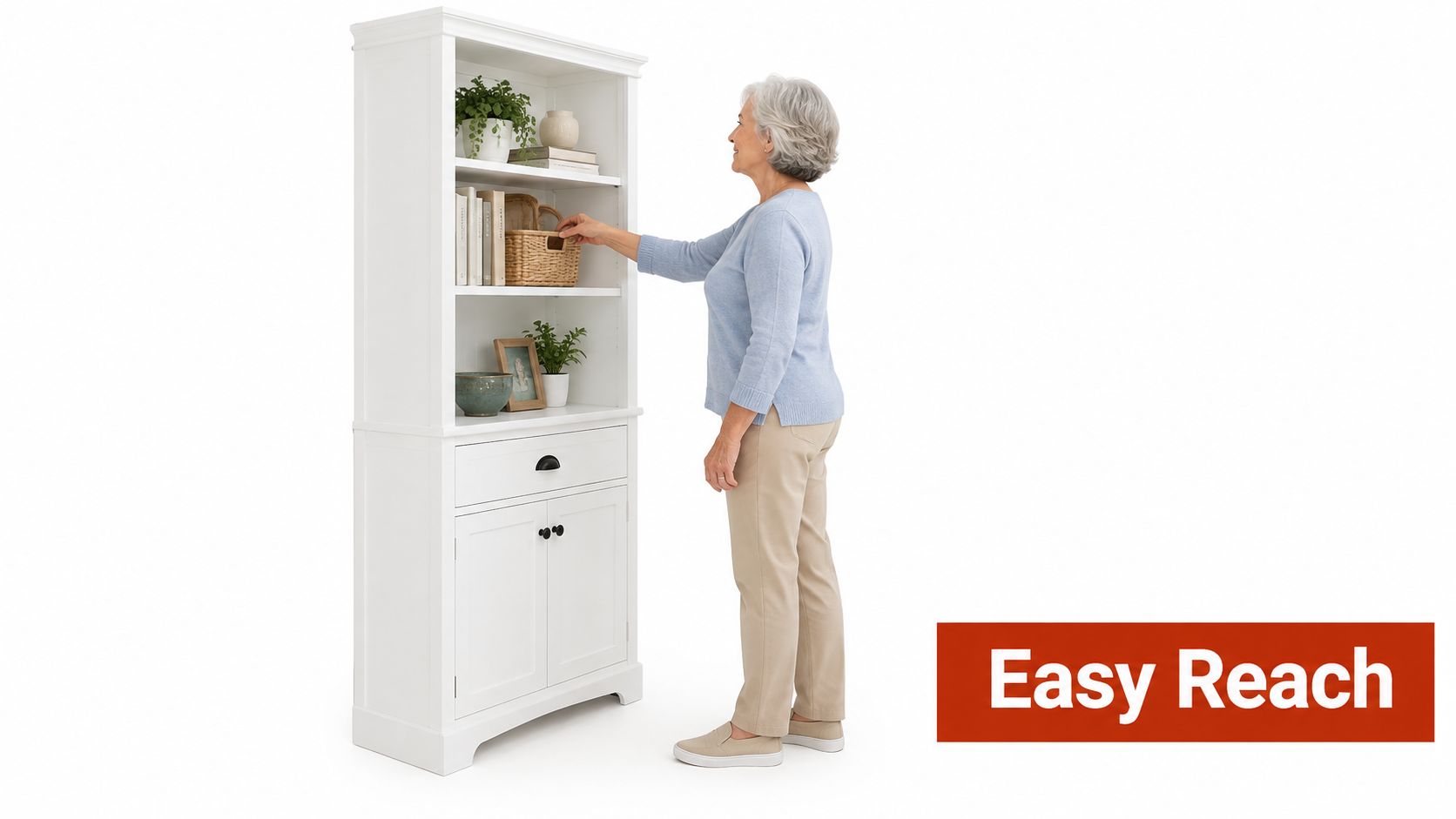
A cabinet is successful only when the person using it can reach the right shelf without stretching, bending, or climbing. Age-friendly cabinet design research identifies an optimal working zone for older adults extending roughly 400 to 1,550 millimeters above the floor, about 16 to 61 inches, where daily-use items should be placed to reduce those demands. The research is available in this age-friendly cabinet design study.
Start by separating display storage from daily-use storage. Decorative pottery, framed pieces, and occasional servingware can live higher. Heavy platters, linens, glassware, and frequently used household items belong between waist and shoulder height, preferably in drawers or pull-out compartments that bring the contents forward.
Fit the cabinet to the room
Measure more than the wall width. Check the relationship between the cabinet and the ceiling line, baseboard, nearby millwork, outlets, vents, and doorways. A cabinet that's technically narrow enough can still feel awkward if its depth pinches a walkway or its door swing collides with a dining chair.
For a single user, measure comfortable reach while standing and place the most-used contents accordingly. In a multigenerational home or vacation rental, design for the shortest comfortable reach among regular users. Handles should be easy to operate without demanding strong grip strength, and pathways should remain clear when doors or drawers are open.
Daily-use storage should serve the body first. Display height can be dramatic, but it shouldn't force anyone onto a step stool for ordinary tasks.
Before delivery, mark the cabinet footprint on the floor with painter's tape. Open the proposed doors, extend drawers, and stand where users will approach it. This simple test catches blocked outlets, cramped circulation, and uncomfortable reach before the cabinet becomes part of the room.
Room Placement Ideas for Coastal Interiors
A white accent cabinet earns its place by solving a room's practical problem while strengthening its atmosphere. In coastal homes, I usually start with the room's visual weight. Where does the eye need brightness? Where does clutter collect? Which finish needs a calm companion?
Entryway
An entryway cabinet should greet guests without becoming a drop zone for every object that comes through the door. Choose a proportion that leaves the walkway open, then use the top for a restrained vignette, perhaps a ceramic vessel, a low arrangement of greenery, and one framed coastal image. Inside, assign zones for keys, mail, dog accessories, or lightweight household items.
White works well here because it catches natural light and makes the arrival space feel cared for. Pair it with woven texture, pale oak, aged metal, or a blue-green accent rather than repeating white everywhere. Keep the styling edited. The cabinet should feel welcoming, not crowded.
Dining room
In a dining room, the cabinet becomes a buffet, serving station, and visual anchor. Position it where guests can approach without cutting through the main seating path. Store serving pieces close to the table, and reserve the upper area for objects that add height without creating a fragile obstacle during gatherings.
A white cabinet beside a darker dining table creates useful contrast. It can also soften a room with substantial wood flooring or a stone surface. Use warm lighting to keep the finish from feeling stark, and style the top with a combination of texture and restraint: one substantial vessel, a long low object, and enough open space for serving use.
Bedroom or guest room
A bedroom cabinet should carry less visual weight than a dining buffet. Use it for folded linens, books, guest supplies, or clothing accessories, keeping the top quiet so the room remains restful. A white finish can balance a darker upholstered bed, woven bench, or painted wall while preserving the relaxed luxury associated with coastal interiors.
Vacation-rental owners should label the interior zones clearly and keep heavier objects lower. Guests shouldn't need to move decorative items to find essentials. For additional styling guidance, use this practical resource on how to decorate shelves in any room. The best result feels curated but usable, with craftsmanship visible in the proportions, hardware, and way the doors close.
From Showroom Floor to Your Living Room
The showroom visit should resolve questions that photographs can't answer. Open every door, test every drawer, examine the finish under different light, and stand in the room position you're trying to furnish. A white accent cabinet can look cool in one lighting condition and warm in another, while a wall or countertop may expose an undertone you didn't notice online.
The No Blind Ordering promise matters because comfort and ergonomics are physical decisions. At Indian River Furniture, ownership hand-tests every seat, sofa, and recliner for pitch and comfort before it reaches the 32,000-square-foot Rockledge showroom floor. For cabinets, the same service-first approach means discussing reach height, door swing, construction, finish, and placement with a design team rather than relying on a flat image. A relevant example of the category is the Westport glass accent cabinet, which can be evaluated in relation to your room's storage and display needs.
Prepare for delivery and acclimation
A white-glove delivery should protect the cabinet through the most vulnerable part of its journey. Indian River Furniture provides a uniform, in-house delivery team that unboxes, inspects, and completes room setup, with a flat $99 delivery fee within the service area. That inspection matters because edges, corners, doors, and hardware should be checked before the team leaves.
After placement, give the cabinet time to adjust to the home's interior conditions before loading it heavily. Keep air conditioning or dehumidification operating in an unoccupied Florida home, and don't place the cabinet directly on damp flooring. Felt or rubber feet can help separate the base from moisture-prone surfaces, provided they're appropriate for the cabinet's weight and floor type.
Keep cleaning gentle during the finish's cure period. Don't trap moisture inside the cabinet, and report alignment or finish concerns promptly. Good service doesn't end at the threshold. It includes making sure the piece settles into the room safely and functions as intended.
A Short Buying Checklist You Can Carry Into the Showroom
Bring these four questions with you:
- What is it made of? Request the substrate breakdown for the box, doors, shelves, and back.
- How is it finished? Ask about coating chemistry, sheen, film build, curing, cleaning, and repair.
- Where will it live? Confirm wall conditions, flooring, sunlight, ventilation, and the recommended humidity range.
- Who will reach into it? Test shelf height, handles, drawer access, and door-swing clearance for everyone who uses it.
Ask how exposed and hidden edges are sealed, whether hardware can be adjusted after seasonal movement, and how the cabinet should be acclimated after delivery. For more practical cabinet selection guidance, review these things to look for when buying chests, dressers, and cabinets.
Since 1939, Indian River Furniture has helped Central Florida households create durable, curated interiors. Visit the 32,000-square-foot Rockledge showroom, hand-test the piece, view the coastal vignettes, and use the complimentary in-house design consultation to confirm construction, ergonomics, and placement before delivery.
Bring your room measurements and a few finish samples to Indian River Furniture in Rockledge, then work with the design team to select a white accent cabinet that suits your home's humidity, storage needs, and coastal character. You'll leave with a clear placement plan and the confidence that your investment is built for everyday Florida living.