Schedule your Complimentary Design Consultation


Right Arm Facing Sectional Guide to Choosing Confidently

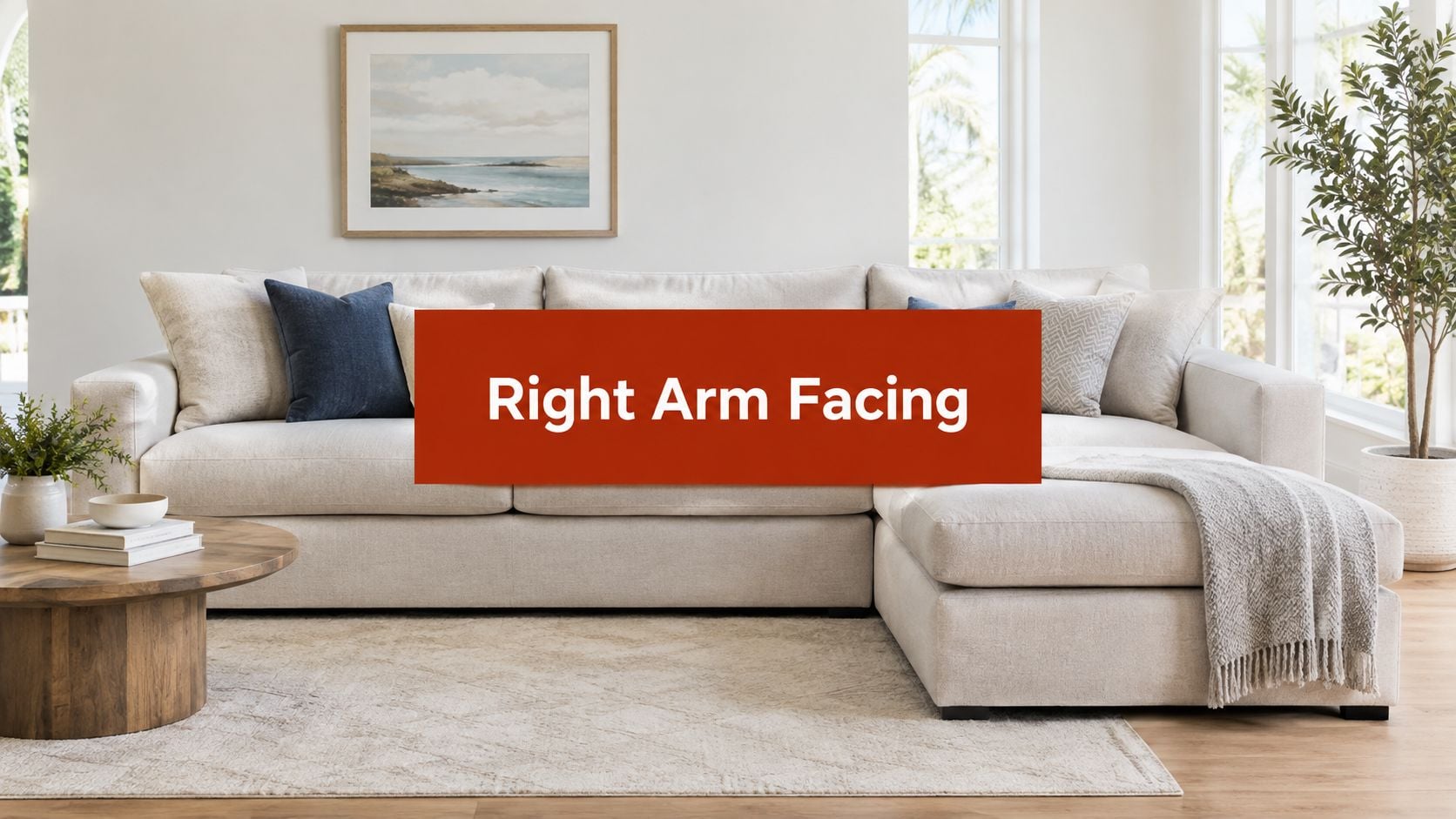
You're standing in a showroom, looking at a beautifully made sectional with a tag that reads RAF. The fabric feels substantial beneath your hand, the chaise looks inviting, and the proportions seem right. Then the question appears: does “right” mean your right while you're sitting down, or the right side as you face the sofa?
That small label controls how the sectional meets a wall, where the chaise extends, and whether your main walkway stays open. In a coastal Florida home, where bright windows, open living areas, ceiling vents, entry doors, and relaxed everyday movement all compete for space, orientation deserves more than a quick glance at a product tag.
A right arm facing sectional can be an elegant, ergonomic choice when its return works with your room. It can also become an awkward investment if the label is interpreted from the wrong viewpoint or if the deeper chaise side blocks circulation. Indian River Furniture has served Brevard County, the Space Coast, and Central Florida since 1939, and the practical lesson remains simple: comfort starts with correct planning.
This guide will help you identify RAF and LAF, verify the orientation at home, compare the layout against your traffic pattern, and decide whether a fixed configuration or flexible modular design better suits the years ahead. For broader planning context, start with this sectional buying guide.
Introduction to Right Arm Facing Sectionals Without the Confusion
A sectional's orientation affects more than appearance. The arm or chaise determines where the piece returns into the room, which side remains open, and how naturally people move between the front door, kitchen, seating, and adjoining spaces. A label error may not reveal itself until delivery day, when the sectional is unwrapped and the chaise reaches toward the very path you needed to keep clear.
The showroom moment that causes trouble
A shopper may see “right arm facing sofa” and instinctively think about the side of the sofa they'll use while seated. That interpretation feels natural because you're imagining yourself relaxing, stretching out, and looking toward the television or windows. Furniture retailers, however, usually define RAF from the front-facing viewpoint, while you're standing and looking directly at the piece.
That difference reverses the apparent side once you sit down. A chaise that's on your right while you face the sofa will be on your left when you're seated. The arm position follows the same visual rule.
Practical rule: Never approve a sectional orientation from the letters alone. Confirm the view used by the retailer, then compare the actual footprint with your room.
Why the decision matters in Florida homes
Many Rockledge and Central Florida living rooms balance comfort with clear circulation. A sectional may sit near a window, a sliding door, a hallway opening, or an entertainment wall. The deeper chaise return can influence how easily someone passes through the room, opens a nearby door, reaches an outlet, or moves around a coffee table.
Material selection matters, too. Performance upholstery, genuine leather, and solid hardwood frames support the kind of everyday use that makes a sectional part of family life rather than a decorative object. A soft, supportive seat should invite you to settle in, while the frame and covering should feel prepared for active households, pets, guests, and Florida sunlight.
The right decision combines orientation, ergonomics, craftsmanship, and future use. Once you know which side the label describes, you can make the room work around the sectional instead of forcing the room to accommodate a mistake.
What Right Arm Facing Really Means When You Face the Sofa
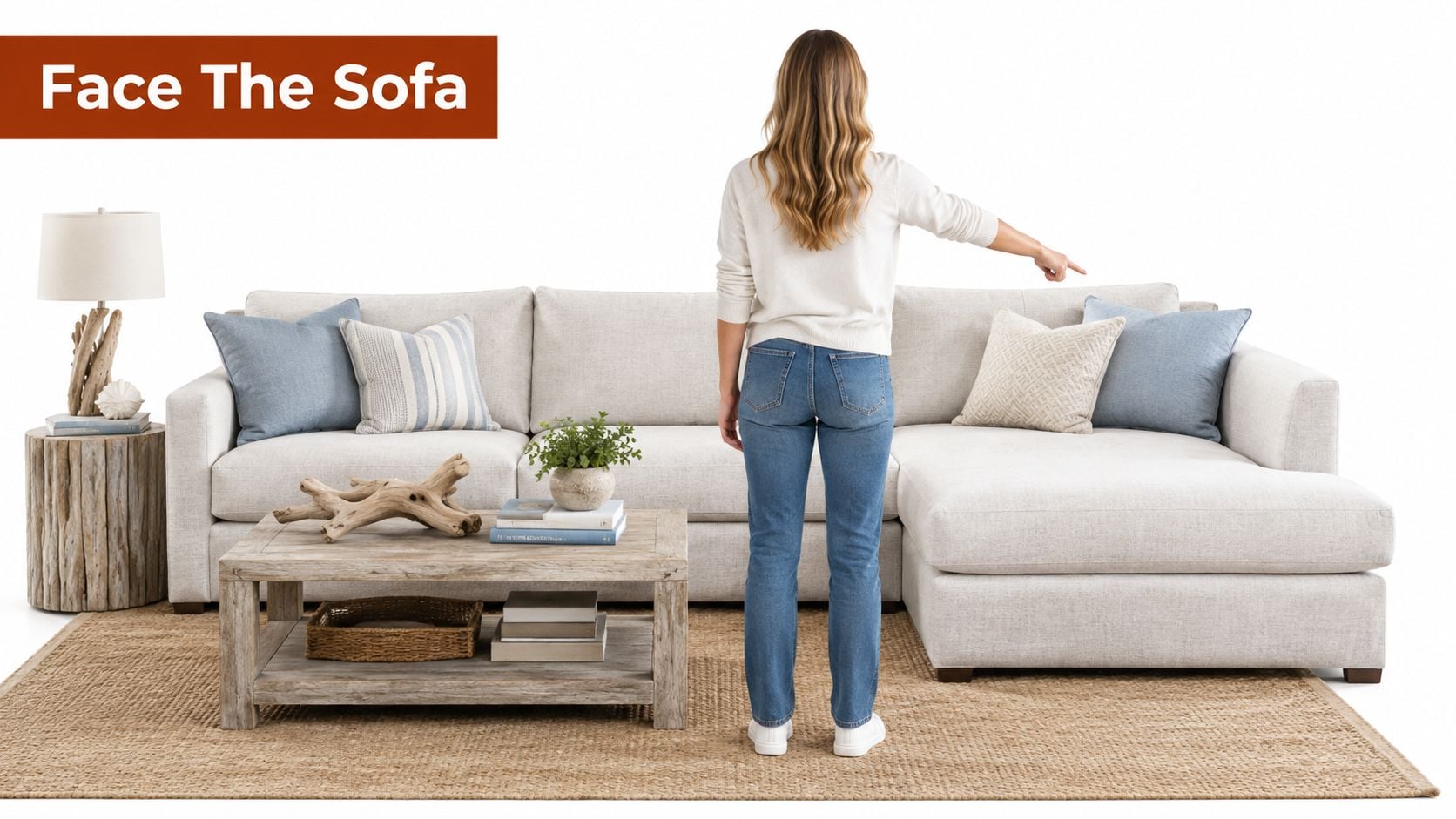
Right arm facing, commonly shortened to RAF, describes the position of an arm or return when you're standing in front of the sectional and looking toward its seats. If the single arm, chaise, or return sits on your right in that front view, the piece is right-arm facing.
Use the same perspective you'd use when facing another person. If you're standing across from a friend, their right side appears on your left. Furniture orientation doesn't ask you to use the seated person's body. It asks you to look at the piece from the front and identify what appears on your right.
The front-view test
Stand several feet in front of the sectional, facing the cushions.
- Look directly at the seating surface. Don't stand behind the sofa and don't sit down.
- Identify the single arm or chaise return. This is the part that establishes the orientation.
- Check which side it occupies. If it's on your right from that front view, it's RAF under the dominant retail convention.
- Remember the seated reversal. Once you sit, that same chaise will feel as though it's on your left.
This is why product photography can sometimes confuse buyers. A mirrored image, an angled room scene, or a photo taken from behind can make the configuration appear reversed. The letters RAF and LAF are useful shorthand, but the front-view check remains more dependable than a casual glance at an image.
RAF and LAF work as a pair
RAF means right-arm facing, while LAF means left-arm facing. Retailers use the pair to describe asymmetrical sectional components, including chaise pieces, one-armed sofas, and modular units. The terms became durable industry language as upholstered modular seating expanded into broader retail markets, and independent furniture guides continue to use the same front-facing convention.
A right-facing sectional usually places its deeper return on the right side as you look at it. That often leaves the left side more open for access, although the best choice still depends on your exact floor plan. An LAF configuration reverses that relationship.
Some manufacturers have simplified the wording by dropping the “F” and using right-arm or left-arm instead. The shorter wording may look clearer, but you should still ask which viewpoint the maker uses. Terminology is only helpful when everyone involved means the same thing.
Why your viewpoint must be confirmed
Most retail guidance uses the viewer's front-facing perspective, but some manufacturers and style resources describe orientation from the sitter's perspective. That inconsistency creates a genuine ordering risk when you compare product listings across brands or request a replacement component.
Before placing an order, ask one direct question: “When you say right-arm facing, do you mean the arm is on my right while I'm standing in front of the sofa?” Request a front-view diagram or photograph if the answer remains unclear. A careful confirmation protects the room plan, delivery route, and long-term comfort of the investment.
How RAF Labels Apply to Chaise Pieces and Modular Components
The RAF label belongs to a sectional component, not only to the complete arrangement. That distinction matters when you're selecting a chaise, adding a seat, replacing a damaged module, or building a larger configuration from separate pieces.
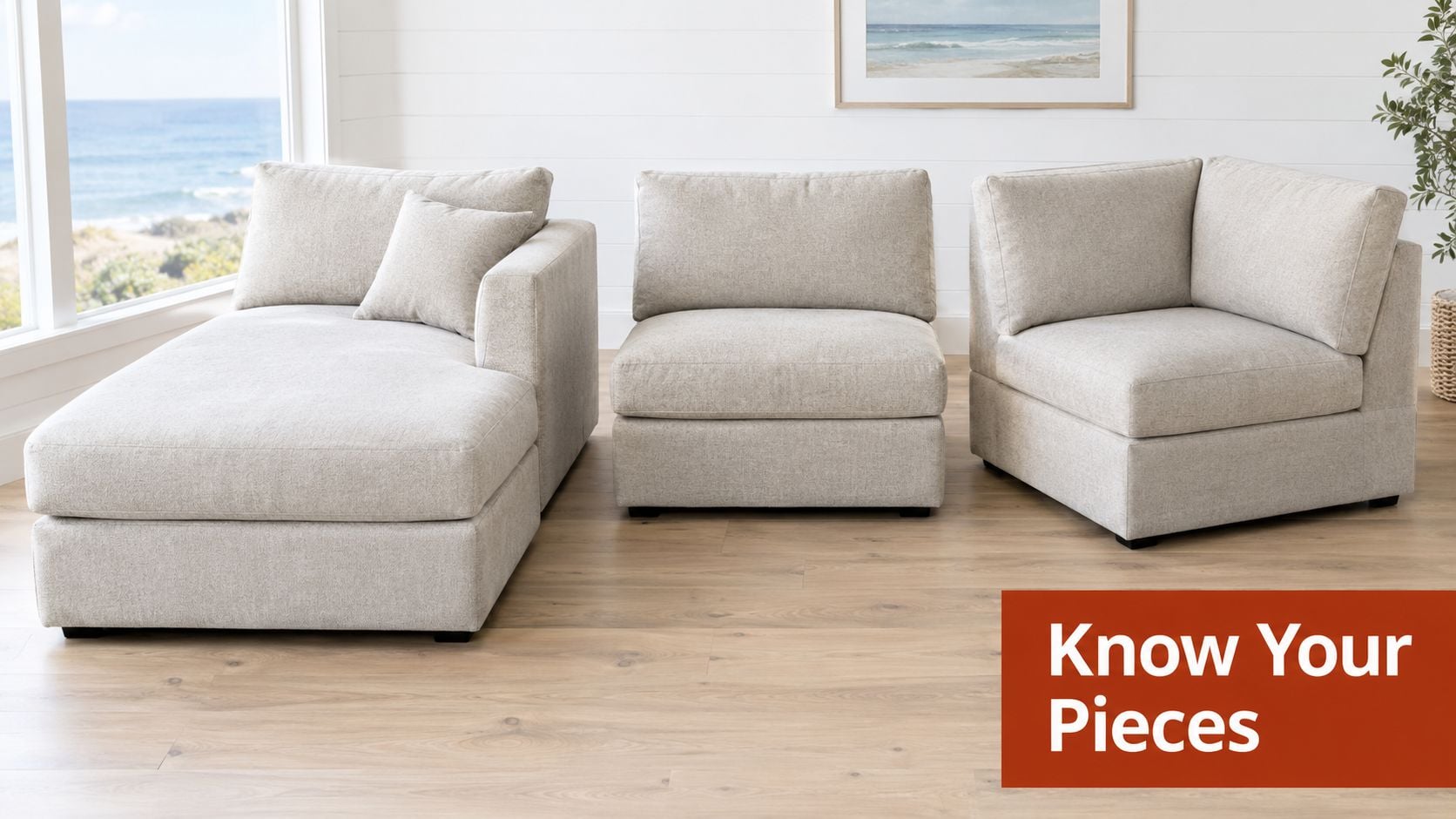
An RAF chaise has its arm or return on the right when you face that individual piece from the front. An LAF chaise places the arm or return on the left. An armless center seat doesn't receive either label because it has no single arm defining its orientation.
Read the configuration from the individual piece
Consider a two-piece L-shaped sectional. The chaise may be described as LAF because its arm is on the left when viewed independently, while the adjoining sofa may carry an RAF arm on its outside end. The pieces meet through their armless sides, and the finished arrangement creates the familiar L shape.
That pairing explains why a buyer may see both RAF and LAF in one sectional description. The labels don't necessarily contradict each other. They can identify the two separate components that form the complete seating group.
A modular collection may include:
- Single-arm chaise pieces, identified as RAF or LAF according to the arm position.
- Armless chairs or center seats, which can often sit between other modules without a facing label.
- Corner units, which help create turns but require confirmation of how their connectors align.
- Replacement or add-on sections, which must match the existing arm, connector, upholstery, and frame specifications.
The construction determines how much freedom you have. A fixed sectional may allow only one arrangement. A reversible chaise may support a side change through a specified assembly method. A modular system may offer more layouts, but only if the arms, connectors, and any powered components are compatible.
Why makers can describe the same piece differently
The most important source of confusion is the viewpoint. One maker may use the standard viewer-facing convention. Another may describe the orientation as it appears to a person sitting on the sofa. A product photograph may also be reversed or shown from an angle that hides the defining arm.
For that reason, don't rely on a product title when ordering across collections. Request the front-view orientation, identify the arm on the actual component, and confirm whether the chaise can be moved later. A written answer from the showroom or manufacturer gives you a clear reference if questions arise during delivery or a future addition.
For more guidance on how sectional construction affects comfort and everyday use, review these sectional sofa features. The details beneath the upholstery, including support, joinery, seat pitch, and component design, shape how the furniture feels long after the room photograph is forgotten.
How to Measure and Verify Your Right Arm Facing Orientation
A room can feel perfect on paper and still fail once the sectional lands. The fix is to map the furniture on the floor before you order, so the right arm facing label matches the space you have.
Start with a simple sketch of the room, then confirm the sectional against it. Stand where the front of the piece will face, toward the wall, fireplace, TV, or conversation area you plan to use. From that viewpoint, the right side of the sectional is where the RAF arm or chaise belongs.
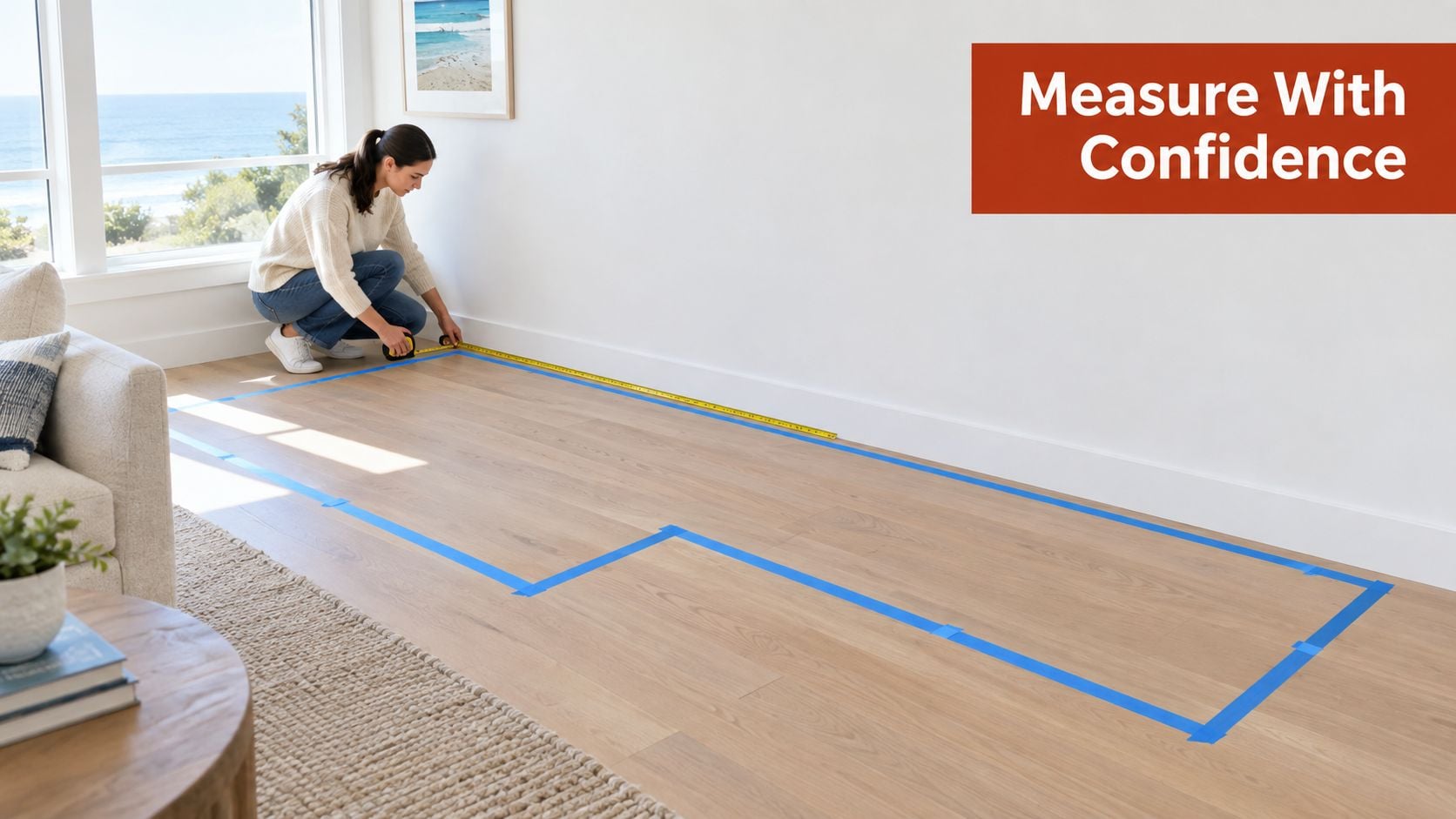
Tape the full footprint on the floor, including the longest return. Do not trace only the straight sofa width. As shown in sectional product dimensions, sectional listings can present the same style with very different width and depth measurements, so a quick glance at the title is not enough. Measure the deepest point from the back edge to the end of the chaise or return, then record overall width, maximum depth, height, arm height, and seat height when those details are available.
Test movement, not just fit
A sectional can fit and still crowd the room. Mark door swings, windows, vents, outlets, and the main walking route. Open doors and drawers fully. Walk the same path someone uses every day, from the entry to the kitchen, from the seating area to adjoining rooms, and around the coffee table. If the sectional reclines, leave room for the footrest and back to move without bumping a wall or side table.
Use the tape outline to see whether the room keeps its comfort zone open. A clear main walkway should feel easy to pass through, not tight enough that shoulders turn sideways. For a second check, use accurate flooring measurements from Flacks as a room-measurement reference. The same careful habit helps here, because both flooring and furniture planning depend on measuring the actual boundaries, not guessing from one wall.
Ask for the retailer's definition
Labels can still confuse buyers, so confirm the orientation in writing before you order. Ask for the front-view definition of RAF, because the right arm is identified while facing the piece, not while sitting on it. Then verify which exact module carries the arm and how it connects to the adjoining seat. A fixed arm behaves like a built-in corner of the room. A modular or reversible setup gives you more room to change the layout later.
Use this furniture measurement guide to cross-check the sectional against walls, openings, and nearby pieces. If you are comparing RAF and LAF for a long-term setup, ask one more question: can the chaise be moved, or is the shape locked in? A fixed RAF sectional can be the wrong choice when the room may change, but a modular system gives you more flexibility if you expect to rearrange the space or add pieces later.
Choosing Between Right and Left Facing for Your Room Layout
A family enters through the left side of the living room, passes the window, and gathers around the television. In that setting, a right arm facing sectional may keep the main route open while the chaise occupies the quieter side of the room. Reverse the traffic pattern, and a left arm facing arrangement may feel more natural. The better choice comes from how people move, not from the label alone.
Start with the room's working paths. Mark the entry, doorway, hallway, windows, and the route to frequently used furniture. Then compare which side can accommodate the chaise without making the room feel pinched. For more guidance, use a layout-planning guide for your home while reviewing the room's fixed features and daily routines.
Compare the room conditions
| Layout Factor | Right Arm Facing Works Best When | Left Arm Facing Works Best When |
|---|---|---|
| Main walkway | The primary route runs along the left side and needs to stay open | The primary route runs along the right side and needs to stay open |
| Door or opening | A door, window, or passage needs clearance on the left | A door, window, or passage needs clearance on the right |
| Focal point | The chaise can extend right without blocking the preferred view | The chaise can extend left without interrupting the room's focus |
| Natural light | The deeper return can sit away from a bright window or access point on the left | The deeper return can sit away from a bright window or access point on the right |
| Daily movement | Household traffic approaches from the left and benefits from an open edge | Household traffic approaches from the right and benefits from an open edge |
| Future changes | The right side remains practical for the room's expected furniture arrangement | The left side remains practical for the room's expected furniture arrangement |
A simple test can prevent an expensive misorder. Stand at the front of the intended sofa position and face the seating, as though you are viewing it in a showroom. The arm on your right identifies RAF. The arm on your left identifies LAF. Repeat the check with the product drawing, then confirm that the chaise, corner, or end module matches the orientation shown.
Let comfort and materials support the plan
The layout should feel good in use, not only look balanced from the doorway. Sit with both feet supported and notice whether the seat pitch keeps your posture relaxed. Check whether the back angle suits reading, conversation, or television viewing. A chaise placed on the wrong side can make a comfortable sofa harder to approach, even when its cushions and frame are well made.
Florida rooms also call for thoughtful upholstery selection. Performance fabrics are built around abrasion resistance, tight construction, and resistance to yarn catching, pulling, fiber breakdown, and thinning. One industry guide discusses durability testing at about 30,000 double rubs or more, while consumer guidance identifies 15,000 to 20,000 rubs as sufficient for most home use and 30,000 rubs or above for high-traffic areas. See the performance fabric construction guidance for the testing considerations behind those figures.
Solid hardwood frames and established joinery create a dependable base. Genuine leather adds a smooth, substantial feel and a refined coastal character. In a bright room, fabric construction, cleaning habits, and sun exposure affect how the sectional ages. A performance-upholstery source notes that heavy-duty fabric with 15,000 or more double rubs or equivalent Martindale cycles may provide roughly 10 to 15 years of useful life with proper maintenance. Solution-dyed fabrics in strong sunlight may retain color and structure for 8 to 12 years under demanding conditions, as discussed in this performance upholstery durability guide.
Choose the facing direction that supports movement first, then select materials that keep the seating comfortable and durable for your household.
When a Fixed RAF Sectional Is Not the Best Long Term Choice
A fixed RAF sectional can be exactly right for a settled room. The proportions are precise, the arms align cleanly, and the chaise creates a dependable place to stretch out. But a configuration that fits beautifully today may become restrictive if your home, household, or use of the room changes.
Consider a move within Central Florida, a vacation rental that may be rearranged between guests, or a flex room that alternates between media use, entertaining, and work. A fixed chaise may force the same footprint through every change. In those situations, the question isn't whether RAF is attractive. The question is whether a permanent right-side return will remain useful.
Fixed, reversible, and modular serve different lives
A fixed arrangement favors immediate certainty. You select the correct side once, and the frame, cushions, upholstery, and connections are built for that intended layout. It can offer a composed, finished appearance, especially when the sectional anchors a dedicated living room.
A reversible chaise offers a middle path. The side may change, but only if the construction supports that movement and the manufacturer provides the correct method. Check the base, cushion orientation, connectors, and any reclining or powered features before assuming the change is simple.
A modular system offers the broadest adaptation. Separate pieces may allow you to create a different arrangement after a move, add seating as needs evolve, or divide the group between rooms. That flexibility still depends on compatible arms, connectors, upholstery, and electrical placement.
Think like an heirloom owner
Long-term value comes from more than keeping a sectional intact. It comes from choosing craftsmanship that can remain useful as the room changes. A solid hardwood frame, precisely fitted upholstery, resilient performance fabric, or genuine leather may support a longer relationship with the piece, while modular construction can help the layout evolve around it.
A flexible system doesn't automatically deliver better comfort. Each module still needs the right seat pitch, support, depth, and tactile finish. For a broader perspective on adaptable rooms, explore this guide to multi-functional furniture for modern homes.
Choose fixed RAF when the room and lifestyle are stable. Choose modular flexibility when the furniture must move, divide, expand, or adapt. That distinction can protect the sectional as an heirloom investment rather than turning a beautiful piece into a permanent obstacle.
Bringing Your Ideal Sectional Home With Confidence
You now have a practical way to read RAF, but the most dependable decision combines three checks. First, confirm the viewpoint from which the retailer defines orientation. Second, tape the full footprint and test doors, windows, vents, and walkways. Third, sit in the actual piece and evaluate whether the pitch, depth, back support, and chaise feel natural for your body.
A photograph can't tell you whether your shoulders settle comfortably against the back or whether your knees feel supported by the seat depth. It can't reveal the difference between a crisp, well-shaped cushion and one that feels too firm, too soft, or poorly balanced. Your hands and body can.

A more personal way to choose
Indian River Furniture applies a No Blind Ordering promise. Ownership hand-tests every seat, sofa, and recliner for pitch and comfort before it reaches the 32,000-square-foot Rockledge showroom floor. That hands-on standard gives shoppers a chance to compare ergonomic support, cushion feel, frame presence, upholstery texture, and chaise comfort in person.
The showroom also presents curated coastal vignettes, so you can consider how a sectional's scale and finish work with the atmosphere of an entire room. Complimentary in-house interior design consultations can help you test the orientation against your floor plan, select performance fabrics or genuine leather, and coordinate a polished look without guesswork.
Take the final step
Bring your room measurements, a simple sketch, and photographs of the entry path. Ask to see both RAF and LAF possibilities when the space allows, then walk the route you use every day. Pay attention to how the sectional feels when you sit upright, lean back, stretch out, and share the seating with another person.
Indian River Furniture has served Brevard County, the Space Coast, and Central Florida since 1939, with a service-first approach that continues through delivery. Uniform in-house white-glove delivery includes setup and inspection for a $99 fee within the service area, so the furniture arrives ready for the room rather than left as an unfinished project.
Visit the 32,000-square-foot Rockledge showroom with your measurements, hand-test the seating, explore the curated coastal displays, and schedule a complimentary interior design consultation. Let the team help you confirm the right-facing orientation, select Florida-friendly craftsmanship, and bring home a sectional that feels correct from the first day and remains useful for the years ahead.
Before you order, write down the retailer's definition of RAF, mark the full chaise footprint with painter's tape, and walk every route around it. Then visit Indian River Furniture in Rockledge to test the seats in person and speak with the in-house design team about your room, upholstery, frame construction, and delivery path. That simple process can turn a confusing label into a confident, comfortable investment.