Schedule your Complimentary Design Consultation


How to Choose Swivel Recliners for Small Spaces


You've found a comfortable-looking chair for the corner beside the window, but there's a coffee table in front of it, a lamp beside it, and a busy route to the balcony. The chair's listed width looks promising. What's harder to tell is whether you'll still be able to walk through the room when someone turns toward the view and puts their feet up.
The best swivel recliners for small spaces fit the room while they're being used, not just while they're sitting upright. Start with the chair's operating zone, then consider the mechanism, delivery access, supportive fit, and upholstery. That's how you create a relaxed coastal retreat without making everyday movement awkward.
Measure the Full Operating Zone Before You Shop
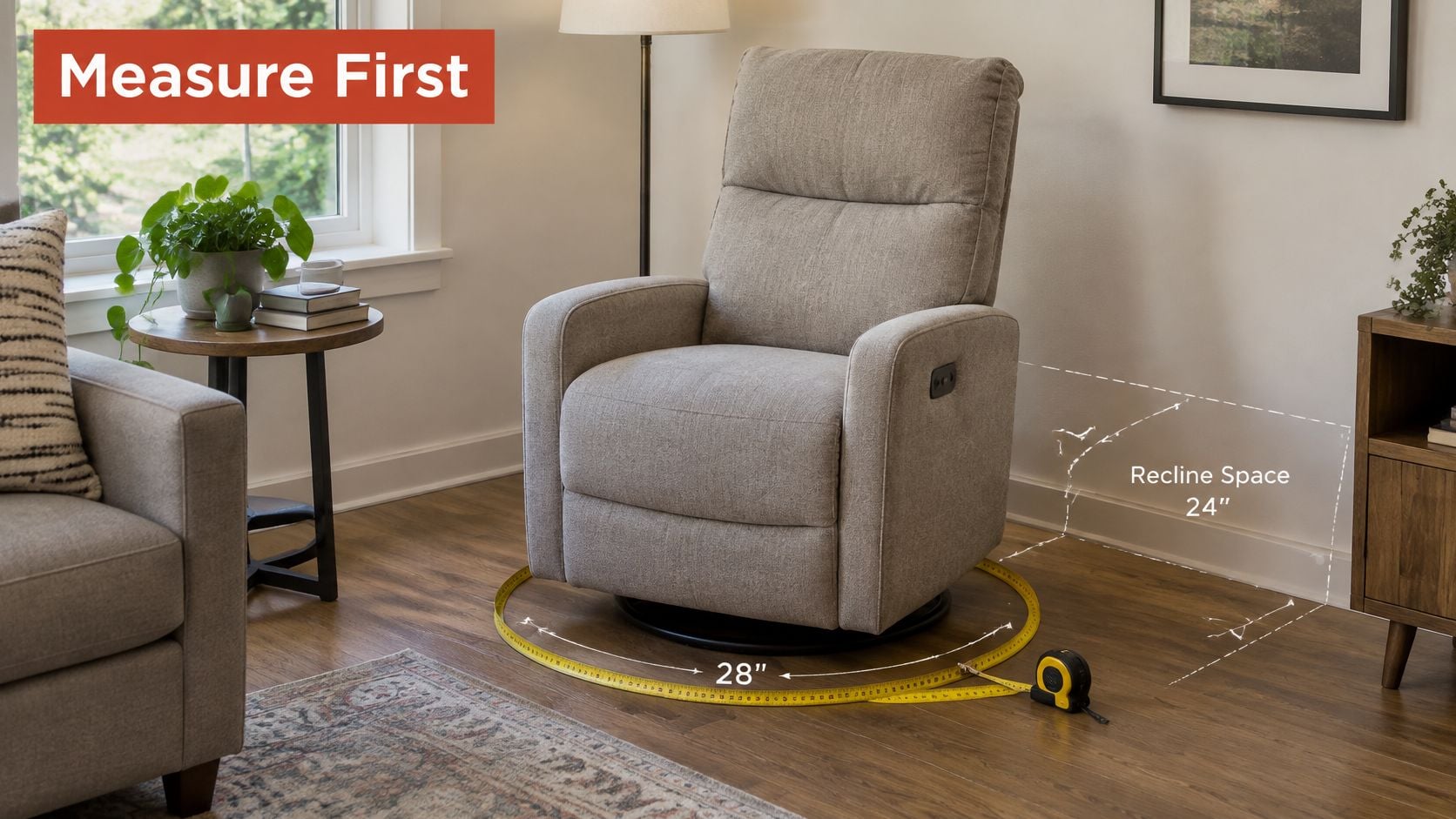
A chair can fit its listed width and still block a walkway once the footrest is out. Mark the full operating zone on the floor before you compare models: the upright footprint, swivel circle, recline path, footrest reach, and the route people need to use. When plotting rotation, measure from the swivel post rather than assuming the seat turns around the middle of its upholstered outline.
Clearance zones to measure before ordering
| Zone | Planning range | What it protects |
|---|---|---|
| Closed footprint | Manufacturer width and depth | Seat and arms in the upright position |
| Swivel turn circle | 36 to 48 inches in diameter, as shown in this compact-recliner planning guide | Arms, seat, and nearby lamps or tables during rotation |
| Recline behind upright | Confirm the model's drawing | Wall gap and rear clearance |
| Footrest extension | Confirm the model's drawing | Walkway and facing seats |
| Primary walkway | About 36 inches, as recommended in the compact-recliner planning guide | Traffic route past the chair |
Use these ranges to narrow your options, then confirm clearances against the manufacturer's drawing. Favor the roomier end of the swivel range near lamps and tables. Check the backrest and footrest paths separately when they move independently.
Keep accessibility separate from furniture fit
The U.S. Department of Housing and Urban Development design guide identifies a 30-by-48-inch clear floor area for a stationary wheelchair and a 60-inch-diameter circle for a wheelchair user's 180-degree turn. These are access dimensions, not recliner-fitting rules. Keep the chair's operating zone clear of space needed for access.
Use this guide to measuring furniture to organize your floor plan, including nearby door swings and furniture edges.
Finish with a practical test:
- Tape the outlines. Mark the maximum movement envelope, not just the base.
- Check the occupied position. Use an existing reclining seat, if available, to assess where your feet and body will be. Don't sit on an improvised, unsupported mock-up.
- Walk the route. Carry a laundry basket past the extended outline and approach the neighboring seats.
Choose a location where the chair can turn and recline without interrupting everyday movement.
Choose a Mechanism Your Room Can Live With
A compact chair can offer several motions, but they aren't interchangeable. Swivel changes your direction. Recline changes your resting posture. Lift assists the transition toward standing. A wall-hugging mechanism changes how the seat travels as the back lowers.
Choose the functions you'll use daily rather than collecting features that sound appealing on a specification sheet.
Match the motion to the room
In a condo living room, a swivel can let you face the television and then turn toward the balcony view. Positioning matters: you should be able to enjoy that view without parking the chair across the balcony entrance. Confirm whether rotation is permitted with the footrest extended, because that's a model-specific operating question.
In a guest bedroom, a wall-hugging design may be more useful than a generous rotation range. Its seat travels forward as it reclines, reducing the rear space it needs, although you must still allow room ahead. Our wall-hugger recliner guide explains the placement considerations.
For someone who needs assistance standing, prioritize a suitable lift function and an unobstructed standing area. Don't assume a lift chair also swivels, or that every swivel base locks for entry and exit.
Selection rule: Choose the fewest mechanisms that meet your actual needs, then verify how they work together.
A manual mechanism avoids a power cord, but it still needs comfortable lever access and enough strength to close the footrest. Power adjustment can make positioning easier, provided the controls are reachable and the cord stays outside the walking and rotation paths.
Before choosing, record:
- Daily motions: Which functions will you use?
- Reclined depth: What does the manufacturer specify in inches?
- Control access: Can you operate it without twisting or reaching?
- Base behavior: Does it lock, and when is rotation restricted?
Added mechanisms can change weight, dimensions, and maintenance needs. Compare actual models rather than assuming the more elaborate chair is the better fit.
Plan the Delivery Route Before You Order
The chair fits beside the sofa, but will it clear the condo's hallway turn? Check the delivery route as well as the room. A swivel recliner's operating zone determines how it works once placed; the route determines whether it can get there.
Build a route sheet
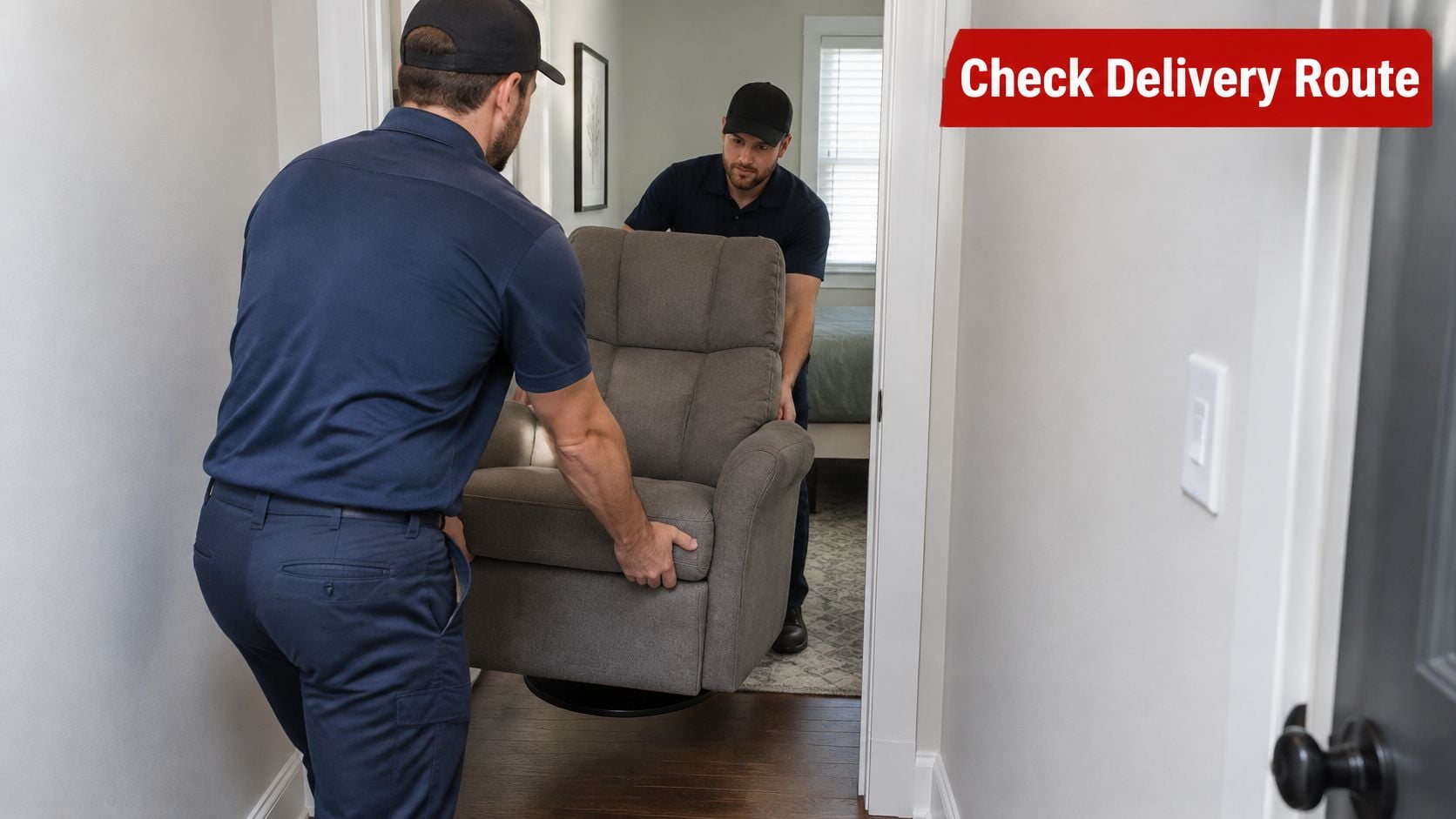
Map the full route. Start at the entrance the delivery team will use. Include exterior and interior doors, hallways, stairs, elevators, thresholds, and overhead obstructions. In a condo, confirm the permitted delivery entrance rather than assuming furniture can come through the lobby.
Measure usable openings. Hold each door in the position it will occupy during delivery. Measure the narrowest clear point, accounting for handles, hinges, trim, railings, and fixtures. The frame's outside dimensions do not tell you how much space is available.
Compare transport dimensions. Get the chair's packaged and unpackaged measurements, including its diagonal depth if available. Check those dimensions against each opening and the approach space needed to angle the chair through.
Check every turn. A wide doorway won't solve a tight elevator interior or a corridor that turns immediately after the entrance. Record the landing or approach area on both sides of each opening so the delivery team can assess the maneuver.
Mark the final position. Add the chair's closed footprint to the room plan, along with the wall gap and access needed for placement. Keep this delivery check separate from the operating zone: the recliner still needs room to swivel and travel through its recline path once it is in place.
List each opening, its usable width and height, approach space, obstructions, and whether the route appears clear. Flag uncertain measurements for review instead of treating them as a pass.
The tightest usable point sets the limit. A roomy destination cannot make up for an unmeasured bottleneck.
Share the route sheet when discussing white-glove delivery service. Indian River Furniture also offers complimentary home measurement services for complex or difficult room dimensions, which can help resolve uncertainties before you commit to a chair.
Frames and Fabrics That Hold Up in Florida
Joinery methods and what they mean for a recliner
The furniture construction quality guide rates mortise-and-tenon construction as premium, with an expected service life of 20 or more years in its comparison. That's a construction benchmark, not a lifespan guarantee for an entire reclining chair or its mechanism.
| Construction | Rating in research | Expected life | Best use |
|---|---|---|---|
| Mortise-and-tenon joinery | Premium method | 20+ years in the guide's comparison | Chair frames and recline base, with appropriate mechanism attachment |
| Dowel-reinforced joinery | Good method | Not specified in the comparison | Bed frames and shelving; confirm reinforcement for chair use |
| Staples and glue assembly | Lower quality | Not specified in the comparison | Avoid as the primary structure for reclining and rotating loads |
A recliner's frame must support changing loads as you lean back and rotate. Sound joints should feel settled beneath you, without shifting, knocking, or a base that rocks during ordinary operation. Florida humidity also makes stable indoor conditions important for wood components.
Look beneath the upholstery
Ask what forms the frame and how the mechanism attachment points are reinforced. Mortise-and-tenon joinery describes a wood connection, not the quality of the swivel bearing or motor. Those components deserve their own questions about support, maintenance, and warranty coverage.
Our material priorities include solid hardwood frames, time-tested joinery, performance fabrics, and genuine leathers selected for Florida's climate and active lifestyles. Pieces with a sagging frame, leather that doesn't wear well under Florida sun, or a spring assembly that compromises posture never make it past our showroom doors.
Choose texture with daily use in mind
Run your hand across a performance fabric, then inspect its weave. A soft hand doesn't establish stain resistance or colorfastness, so request the actual fabric specifications, particularly beside sunny windows. Our performance-fabric upholstery guide offers useful context for matching material to household activity.
Genuine leather brings a supple surface and develops character with use, but it isn't permission to ignore strong sunlight. Use window treatments and the specified leather care products. Velvet adds soft depth to coastal neutrals, while linen introduces an airy texture; for pets, inspect loose loops, snag potential, and cleaning requirements rather than choosing by appearance alone.
Keep indoor humidity steady, follow the manufacturer's cleaning instructions, and request frame and upholstery specifications in writing. Heirloom aspirations begin with craftsmanship, but everyday care helps preserve the investment.
Test the Recliner Hands On in the Showroom
A swivel recliner can fit its listed width and still crowd a room once it turns, reclines, and extends its footrest. Judge the chair by its operating zone, then check that its support and controls suit your body.
Follow a seated test sequence
Sit fully back. Your lower back should meet the backrest without an uncomfortable gap. Notice whether the chair supports your posture naturally.
Settle your feet. Upright, your feet should rest flat on the floor, with no pressure from the seat edge behind your knees. A narrow chair isn't necessarily a shallow chair.
Recline slowly. Check that the headrest supports your head without pushing your chin forward. Try both a reading position and a resting position.
Operate the footrest. Feel for controlled movement. Return upright and close it without straining or sliding forward.
Rotate through the range you expect to use. Check the chair's balance and whether you can reach the controls while seated. Ask the showroom team to explain any locks or limits before testing unfamiliar functions.
Compare cushion feel. Notice how the seat supports your hips after you settle in. Feel the upholstery against your hand and forearm, where texture will matter during everyday use.
Give comfort time to become clear
Spend at least twenty minutes in the chair as a practical test, rather than deciding after a quick perch. Bring the person who will use it most often. Two people can prefer different seat depths, head support, and cushion firmness.
At Indian River Furniture, ownership personally hand-tests every sofa, recliner, and chair before it enters a customer's home. In the Rockledge showroom, you can feel leathers, touch solid hardwoods, and compare cushion firmness. Bring your floor plan and check how the chair's turn, recline, and footrest travel relate to nearby furniture.
Style a Compact Swivel Recliner for Coastal Rooms
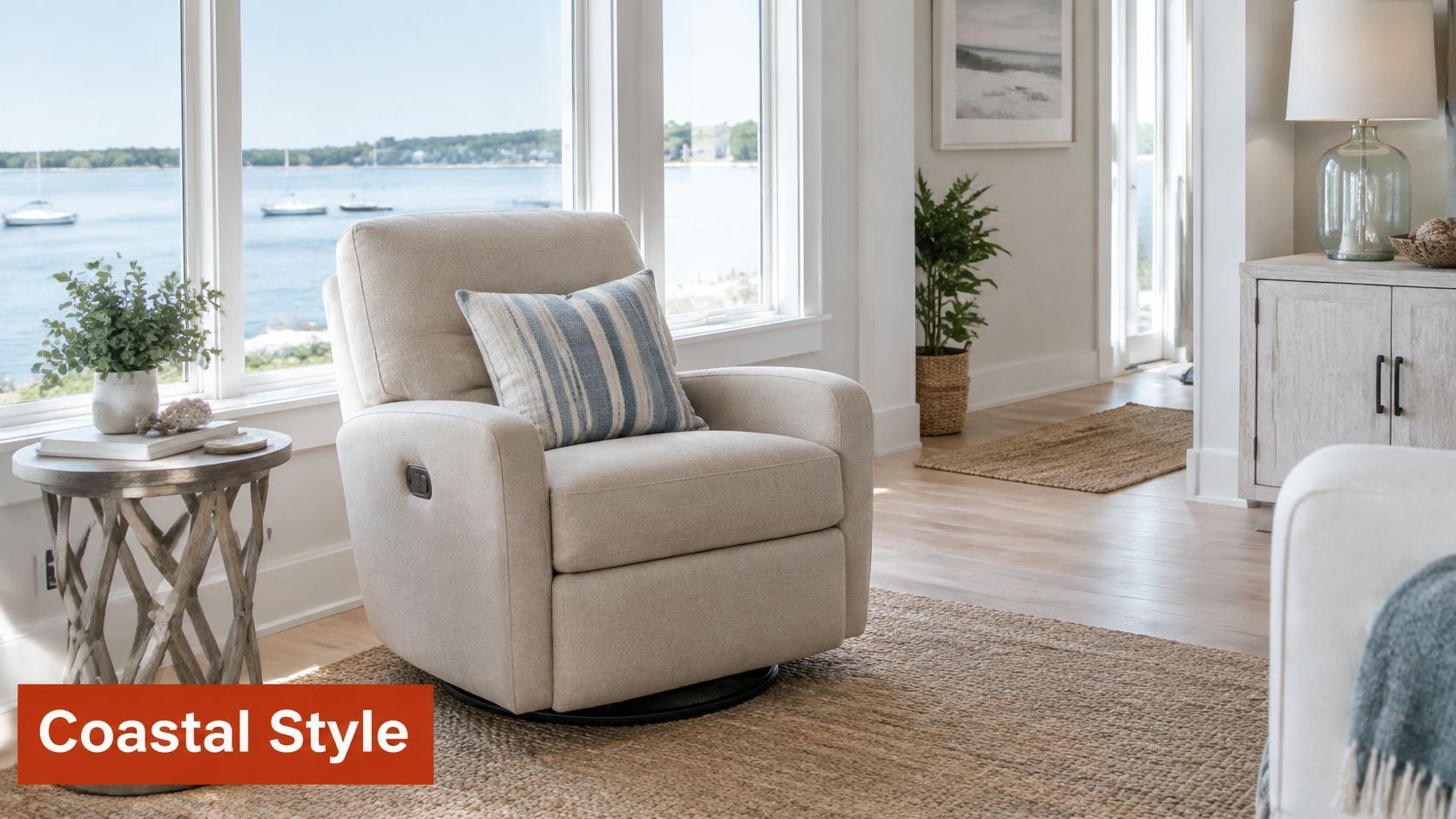
Consider a two-bedroom rental on the Space Coast with a balcony beyond the living room. A corner swivel recliner can become the reading spot guests gravitate toward, provided its position leaves a direct route from the entry to the glass doors.
Start with the view rather than automatically aiming every seat at the television. Turn the recliner toward the balcony, then place the sofa so someone seated there can comfortably join a conversation. A narrow coffee table can serve the sofa without occupying the footrest's landing area.
Keep the supporting pieces light
Choose a side table near arm height, positioned outside the turning envelope. Check the lamp shade as well as the table edge, since a broad shade can project farther into the chair's path than its base.
Sand-colored upholstery, sea-glass accents, or soft blue textiles can create a cohesive coastal palette without making the chair feel heavy. Add a linen throw and a textured rug, keeping fringe and loose fabric away from moving components. For coordinating wall color with upholstery and finishes, Flawless Painting's practical guidance for refreshing home interiors is a useful companion to your room planning.
Our in-house designers help with scale, fabric, and finish selections, and our curated showroom vignettes let you see those relationships together. Explore our coastal living room planning ideas with your own room's light and architectural details in mind.
If the room looks balanced with the chair turned toward the view and the walking path remains open, the placement is working.
Book Your Showroom Visit Before You Decide
A chair can fit by width and still crowd the room once it swivels or reclines. Use your visit to compare how different models operate, then check the option that suits your space and seating preferences.
Designers are on the showroom floor seven days a week to pull swatches, check dimensions, and help you test seat comfort. For a single chair, bring room photographs and any fabric or finish samples you want to coordinate. For a full room or home, schedule a complimentary appointment so your designer can prepare swatches and give the project undivided attention.
Full interior design consultations, including scale floor planning, fabric and finish selections, and room styling, are completely complimentary when you purchase your furniture through Indian River Furniture.
For access details, refer to the route sheet you prepared before shopping. Within the service area, the in-house delivery team handles unboxing, inspection, and full room setup.
Indian River Furniture has served Brevard County and Central Florida since 1939. Before leaving for the Rockledge showroom, pack your room measurements, photographs, fabric or finish samples, and notes on the chair features you want to compare.