Schedule your Complimentary Design Consultation


Performance Fabric Sectional Guide for Florida

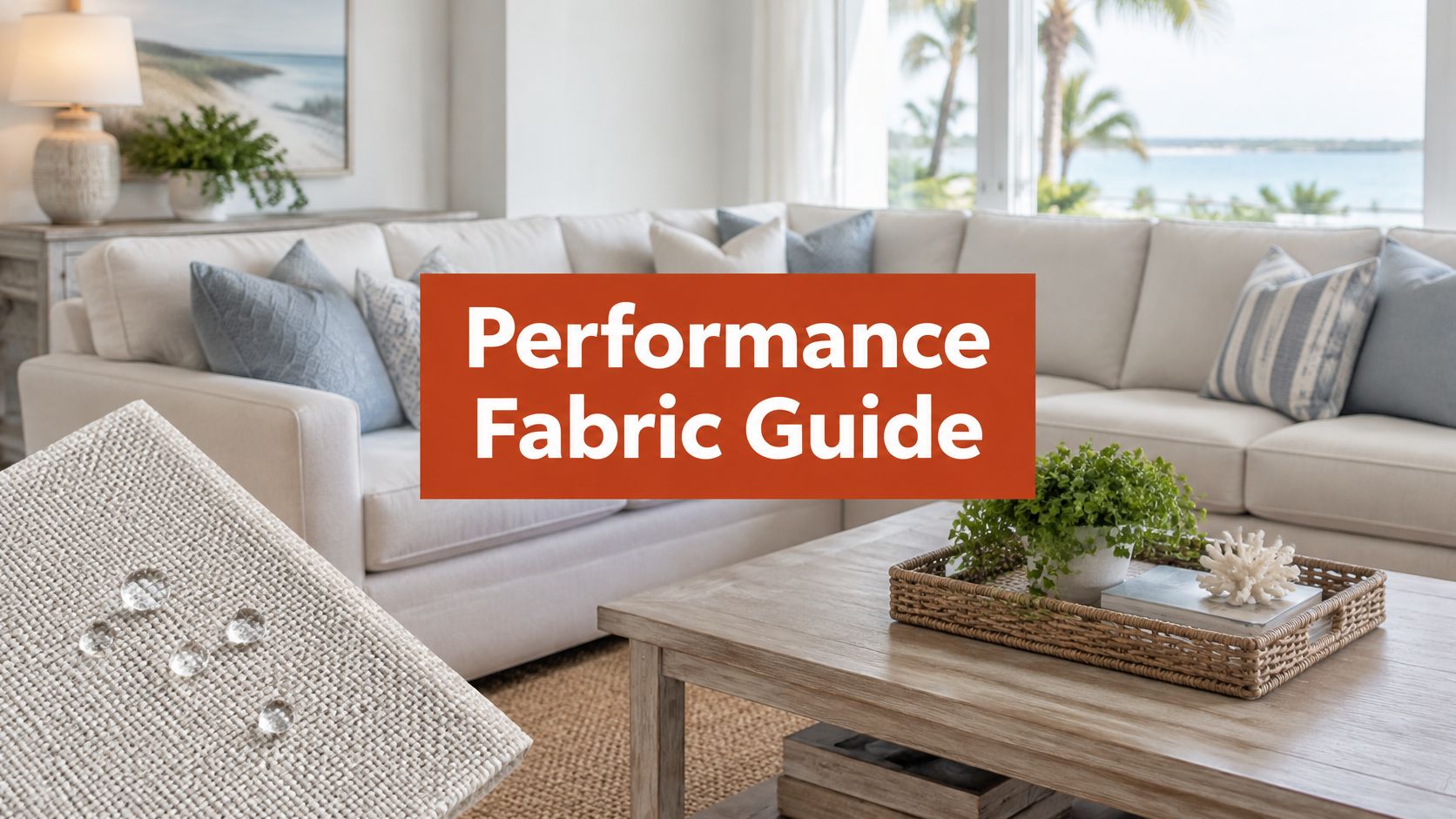
The usual advice for choosing a performance fabric sectional is to find the highest abrasion rating and a fabric that makes spills bead. That's a useful start, but it misses what matters after the furniture comes home. A fabric can withstand repeated rubbing yet fade beside a sunny window, hold oily soil, or require cleaning products your household won't comfortably use.
For a Florida home, the better question is performance against what? Sandy feet, afternoon sun, damp swimsuits, pet claws, and spilled coffee present different challenges. Choosing well means matching specific protections to daily life, then making sure the sectional feels as inviting as it looks.
What a Performance Fabric Sectional Really Is
Say you're choosing a softly textured sectional for a family room in Brevard County. The pale upholstery looks coastal, the chaise feels generous, and the tag says performance. That label still doesn't tell you whether the fabric's strongest feature is spill resistance, resistance to rubbing, or color retention.
A performance fabric sectional is connected seating upholstered in an engineered textile selected for how it behaves. The Econ Market Research performance-fabric overview describes functional properties including resistance to abrasion, moisture, chemicals, ultraviolet exposure, and dimensional change. These are separate characteristics, not a universal promise.
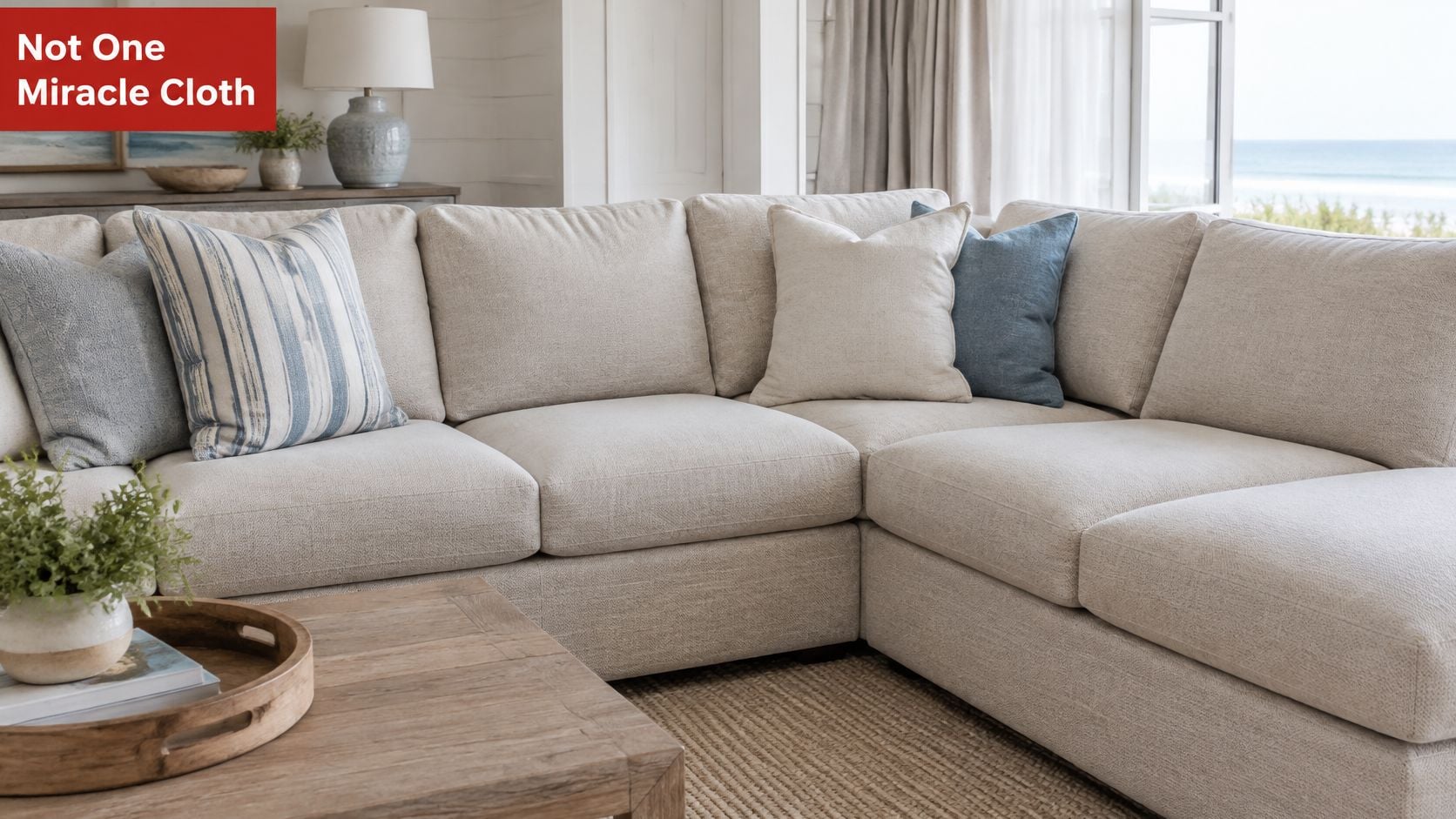
Think of a work jacket compared with a light linen shirt. Both can look beautiful, but the work jacket is selected for demanding use. Even then, protection against friction doesn't automatically mean protection against every liquid or sharp object.
A sectional raises the stakes because family members, guests, and pets often share it daily. It's a long-term investment, not just a decorative surface.
Start with the household: Choose the protections you need before choosing the color you love.
Our guide to upholstery materials offers a useful foundation for comparing textures and compositions. The practical questions are straightforward: which fabric family fits your room, what do its ratings measure, how will Florida conditions affect it, and can you maintain it comfortably?
How Common Performance Fabrics Compare
Performance fabric types for a sectional
| Fabric family | Known for | Moisture and sun | Typical household fit | Watch-out |
|---|---|---|---|---|
| Polyester | Dimensional stability and compatibility with protective finishes | Moderate moisture behavior; UV protection requires dye and finish details | Family rooms and broad custom color selections | A surface finish can wear first on arms and seat fronts |
| Nylon | Toughness and often strong abrasion performance | Confirm finish compatibility and oily-soil cleaning response | Pets, children, and high-traffic seating | Yarn and weave affect pilling and visible oily soil |
| Olefin (polypropylene) | Water repellency and use in moisture-exposed furnishings | Strong moisture resistance; seek solution-dyed color where fading matters | Coastal rooms and indoor-outdoor living | Some weaves feel less soft; verify dye method |
| Solution-dyed acrylic | Color incorporated into the fiber and an outdoor upholstery heritage | Strong UV and moisture performance when properly specified | Bright Florida windows and covered lanai-adjacent rooms | Not every acrylic is solution-dyed |
| Tight performance weave or blend | Dense construction and patterned soil concealment | Evaluate the actual fiber mix and finish | Patterned coastal interiors and active households | Identify which fiber supplies the claimed protection |
Start with fiber, then judge the finished cloth
Polyester is a practical starting point for a busy family room. In the global stain-resistance performance-fabric market, Dataintelo's material breakdown assigns polyester 38.5%, nylon 26.7%, and olefin 18.2% of material share. Those figures describe the broader market, not a quality ranking for individual sectionals.
Polyester's dimensional stability helps explain its wide use, but the finished cloth still deserves close attention. Rub the sample gently with your fingertips, bend it, and examine its backing. A plush texture and a crisp, refined weave can share the same fiber name while feeling quite different against bare arms.
Nylon is often selected for toughness. In a pet household, however, don't treat that reputation as a claw-proof guarantee. Inspect whether the surface has exposed loops or yarns that can catch, and ask how the particular fabric handles pilling and oily soil.
Match moisture and sunlight protection separately
Olefin deserves consideration where damp towels, pool traffic, or frequent indoor-outdoor movement shape daily use. Water repellency is useful in these rooms, but softness remains a personal preference. Hold the sample against your forearm rather than judging its hand from a photograph.
Solution-dyed acrylic is another candidate for bright rooms. Solution-dyed describes how color enters the fiber, not a separate cleaning code or an assurance that the entire sectional belongs outdoors. Verify the exact upholstery's lightfastness documentation and the furniture's approved setting.
A tight blend can offer a beautifully refined coastal pattern while making everyday soil less conspicuous. Ask for the fiber percentages and identify whether the stated protection comes from the fiber, the weave, an applied finish, or their combination.
For another lifestyle-focused perspective, The Sofa Cover Crafter's sofa fabric advice for busy households can help organize practical questions before a visit. When coordinating a sectional with a swivel fabric chair, compare actual samples together rather than expecting matching fiber names to produce matching textures.
There's no single best row. Choose around traffic, sunlight, touch, and whether your recurring spills are watery or oily.
How to Read Abrasion and Stain Ratings
Abrasion benchmarks that are not a lifespan
| Use or method | Standard | Screening level | What it does not tell you |
|---|---|---|---|
| Low-traffic private woven | ASTM D4157 Wyzenbeek | 15,000 double rubs | Not years of wear or a conversion to Martindale |
| Low-traffic private woven | ASTM D4966 Martindale at 12 kPa | 20,000 cycles | Different abradant, motion, and pressure |
| High-traffic public woven | ASTM D4157 Wyzenbeek | 30,000 double rubs | Not stain resistance, sunlight protection, or cushion life |
| High-traffic public woven | ASTM D4966 Martindale | 40,000 cycles | Not seam strength, pilling, or colorfastness |
| Busy family sectional | Compare within the same method | Use the high-traffic benchmark as a screen | Pets, grit, cleaners, and seating habits still affect wear |
The benchmark figures in this table follow the Association for Contract Textiles woven-upholstery abrasion guidance, which cautions that abrasion results aren't necessarily reliable indicators of fabric lifespan.
What the machine actually measures
Under ASTM D4157, fabric is held taut and rubbed repeatedly with an approved cotton-duck abradant; ACT's Wyzenbeek explanation describes approximately 3 pounds of pressure and 4 pounds of tension. The double-rub result records repeated back-and-forth rubbing before the test's wear endpoint.
Martindale uses a different test arrangement. Because the methods use different motions, abradants, pressures, and failure criteria, you can't convert their results into equivalent scores. Compare Wyzenbeek with Wyzenbeek and Martindale with Martindale.
Neither machine recreates your entire living room. ACT's abrasion guidance for woven fabrics distinguishes surface-wear testing from other characteristics such as pilling, colorfastness, and related performance requirements. A sectional can pass an abrasion screen and still have an unsuitable cleaning method or an uncomfortable cushion.
A double-rub result is a screening tool, not a calendar.
Ask what happens after the finish wears
Fiber-level resistance and an applied finish aren't interchangeable. A fresh surface treatment may encourage liquid to bead, but high-contact seating areas experience repeated rubbing. Ask for stain-cleaning information that reflects wear, not just a demonstration on an unused swatch.
Water-based spills and oily soils also require separate consideration. Don't assume that a successful water demonstration predicts how sunscreen, food grease, or transferred clothing dye will clean.
Request the exact test method, rating, dye method, finish description, and manufacturer's cleaning code together. For help interpreting the care terminology before comparing specifications, the Top Cleaners guide to sofa codes offers a useful reference.
Finish chemistry deserves a direct question. The Interstate Technology and Regulatory Council's PFAS indoor-exposure fact sheet identifies treated materials as potential indoor PFAS sources and discusses dust and material-abrasion pathways. That doesn't establish that every performance sectional contains PFAS or creates harmful exposure.
Ask whether the stain- or water-repellent treatment is PFAS-based, request written composition or PFAS-free documentation where available, and consider fiber-level protection when it meets your needs. Specific disclosure is more useful than an unsupported reassurance.
Why Florida Climate Changes the Fabric Choice
Florida upholstery needs more than a spill-resistant face. The Florida Department of Health advises maintaining indoor relative humidity below 60% to discourage mold-supporting conditions and notes that below 50% is better for controlling both mold and dust mites.
That makes room conditions part of furniture care. A fabric may release a small surface spill readily while the cushion beneath it remains damp after a larger soaking.

Sun, salt, and trapped moisture are different problems
Sun exposure affects color, so request product-specific lightfastness information for a sectional beside bare west- or south-facing windows. Solution-dyed upholstery can be an appropriate candidate, but it shouldn't replace sensible shading. Check the room during the afternoon, not just when the morning light looks gentle.
Sand and salt residue add friction. Grit settles along piping, between cushions, and in the inside corner where people gather. A household that moves constantly between the beach, patio, and living room should consider accessible cushion edges and a texture that's straightforward to vacuum.
Trapped moisture affects the whole assembly. Wet swimsuits, a soaked throw, or repeated damp cleaning can wet padding and decking beneath the visible fabric. A tightly placed sectional against a damp exterior wall also leaves little room for air movement.
Design the room to support the upholstery
Leave breathing space behind the sectional and keep air paths clear. Vent showering and cooking moisture outdoors, and use a humidity monitor rather than judging indoor dampness by feel alone. Climate control matters even in a vacation property that sits unoccupied.
For lanai-adjacent seating, establish a dry-towel routine and keep wet belongings off upholstered cushions. An indoor sectional doesn't become outdoor furniture because its cloth resists water.
- Check sunlight on site: Note where direct rays reach the seat and back cushions.
- Plan cushion access: Choose a design you can inspect and maintain without struggling.
- Question broad labels: Breathable, hypoallergenic, and low-emission claims need product-specific support.
A deeper coastal tone or small-scale pattern may suit a room where concealment matters more than an uninterrupted pale surface. The goal isn't to abandon relaxed coastal elegance. It's to pair attractive upholstery with a room that stays dry, ventilated, and thoughtfully shaded.
How to Care for a Performance Fabric Sectional
Care codes and what they allow
| Care code | Meaning | What to use |
|---|---|---|
| W | Water-based cleaning allowed | Mild soap and water when approved, blotted dry |
| S | Solvent cleaning only | Approved solvent, tested in a hidden area |
| WS | Water or solvent as the label permits | The manufacturer-approved method, tested first |
| X | Vacuum only | Vacuum and gentle brushing; no liquids |
Keep the manufacturer's full instructions with your furniture records. A code identifies a cleaning category, not permission to use every product within it.
- Find the code before a spill. Confirm the approved cleaner and whether covers may be removed. A zipper doesn't establish washability.
- Vacuum weekly. Use an upholstery attachment along crevices, cushion edges, and piping to remove abrasive grit.
- Blot fresh spills. Lift liquid with a clean white cloth. Don't scrub, soak, or improvise with steam.
- Clean W or WS fabric cautiously. If approved, use a small amount of mild soap and water. Blot away residue and allow airflow around damp areas.
- Respect an S label. Use only an approved solvent and test an inconspicuous area first.
- Avoid unapproved treatments. Bleach, aggressive solvents, and aftermarket protectors can damage upholstery or conflict with warranty terms.
- Redistribute everyday use. Rotate reversible cushions and fluff loose fills according to their instructions.
- Address oil and dye transfer promptly. Don't wait because nearby fabric still beads water.
The Green Science Policy Institute's upholstery-study summary reports that five of six PFAS-finished fabrics showed only small stain-performance improvements over unfinished controls, with fabric differences more important and repellency declining after moderate abrasion. Quick, suitable cleaning matters more than a reassuring label.
For rental turnover planning, Canes Cleaners' guidance on sofa care between rental guests provides additional context. Build inspection into turnover rather than leaving spills until the next arrival.
Our summer furniture care guide also addresses active coastal households. Cleanable isn't maintenance-free, and the manufacturer's care instructions outrank any general cleaning suggestion.
Frame Comfort and a Clean Coastal Look
A performance fabric can resist specific kinds of wear, but it cannot compensate for a frame that shifts or a cushion that loses support. Construction and comfort belong in the same decision as upholstery.
The sofa-construction guide from Build Construct identifies kiln-dried hardwoods such as oak, maple, ash, and beech, along with reinforced joinery and supportive internal construction, as durability considerations. The guide also describes a BIFMA endurance benchmark of more than 100,000 front-to-back and side-to-side loading cycles, a reminder that frame evaluation is distinct from fabric testing.
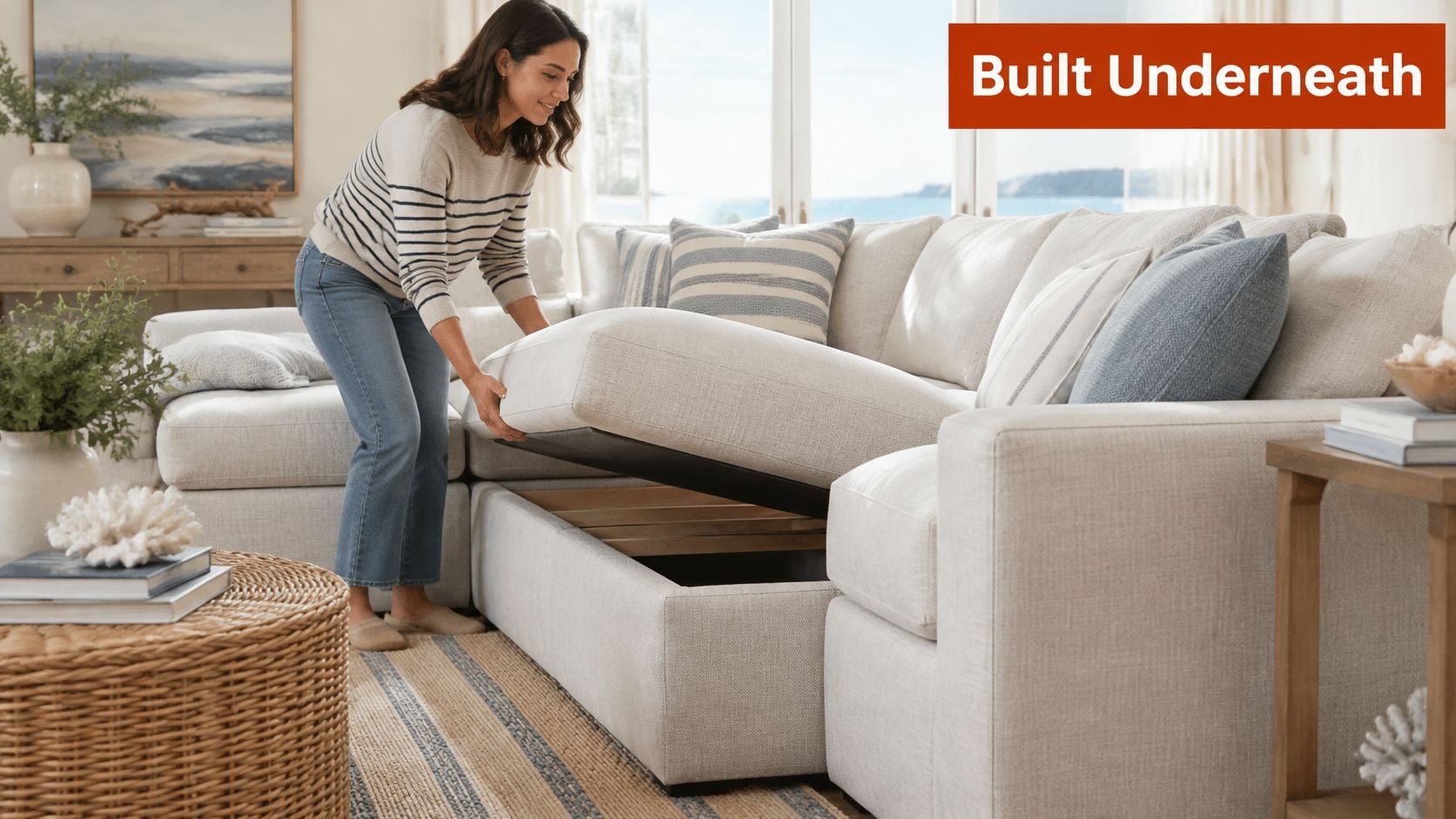
Look beneath the visible surface
Kiln drying reduces wood moisture, helping limit movement that can contribute to warping, cracking, and loose joints. At load-bearing corners, glued-and-screwed blocks, dowels, or mortise-and-tenon connections help a frame resist the sideways forces of sitting, shifting, and reclining.
Ask how the suspension supports the cushions and whether their interiors can be serviced. Replaceable or restuffable cushions offer a practical way to restore support while keeping upholstery that still suits your room.
Comfort test: Sit upright, lean back, then stand. Notice how the seat supports you through each movement, not only how soft it feels at first.
Comfort depends on fit. Your feet should feel supported in your preferred position, and your lower back should not need constant adjustment. Test the corner and chaise as well as the straight seats.
Make coastal style feel intentional
Start with scale. A generous sectional should leave comfortable walking routes, space for useful side tables, and room for conversation without requiring everyone to face a screen.
Slope arms give a sectional a neat outline, while shelter arms create a more enveloping profile. If you prefer nailhead detailing, check its placement where clothing or throws could catch.
For color, consider sand, soft blue, warm white, or a quiet pattern with variation for everyday use. Run your hand across a broad area of fabric; pinching a small swatch can hide how its texture feels across a seat.
Top-grain leather has a different feel from woven upholstery and develops a patina over time. It still needs protection from direct Florida sunlight and a care routine suited to leather. Whether you choose leather or fabric, craftsmanship, serviceability, and comfort matter as much as appearance.
A Florida Buying Checklist Before You Choose
Before choosing a sectional, check how the fabric, room, and delivery path work together. Bring room photographs and doorway measurements, then use this checklist to turn those details into practical questions.
- Match the fiber to the setting. Consider household routines and moisture exposure, and ask for the abrasion report on the specific fabric rather than relying on the product line.
- Check the cleaning routine. Read the care instructions and decide whether your household can follow them consistently.
- Account for Florida conditions. Review the sun guidance in this sectional buying guide, then note where the room needs protection.
- Plan for moisture. Leave room for air circulation, manage indoor humidity, and keep a place for damp towels away from the seating.
- Inspect the support system. Ask about frame materials, corner reinforcement, suspension, and options for maintaining cushion interiors.
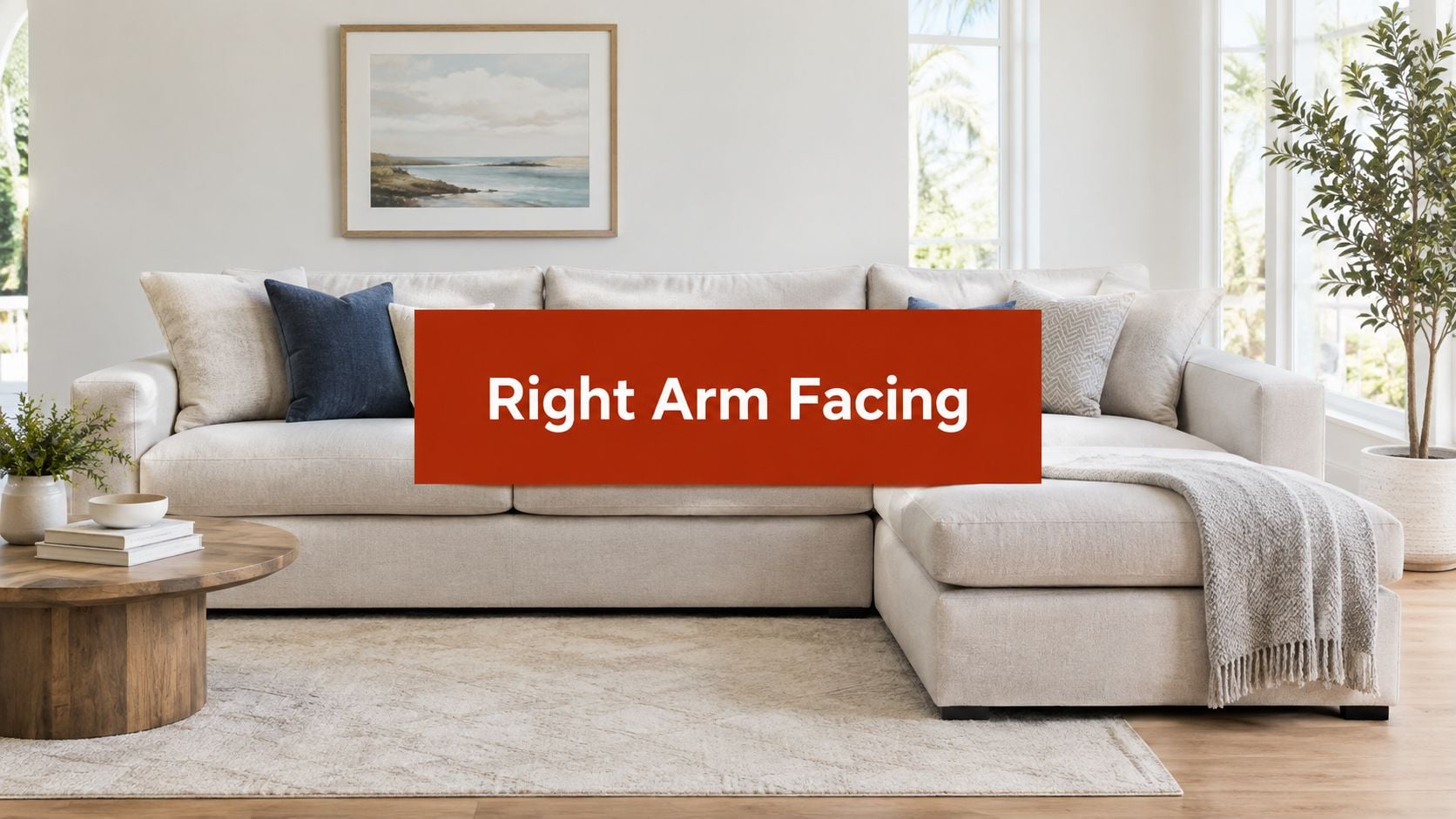
- Check the full route and arrangement. Confirm the sectional's orientation and walking clearances, then measure the path from the front door to the final position.
Bring the room, not just the inspiration photograph
Include the less picturesque details: a favorite lounging position, a doorway that must stay open to the patio, and any tight turn on the way to the room. Those details can affect both the layout and whether the sectional can be brought inside.
A floor plan is only part of the fit. Measure the route from the entrance to the sectional's intended seat, including narrow doorways and turns, before settling on a configuration. That simple check can prevent a layout that works on paper but cannot reach its place.
Choose and Sit Test Your Sectional in Rockledge
A performance label cannot tell you whether a sectional feels comfortable or suits your room. Sitting in person reveals details that fabric ratings cannot: seat depth, cushion firmness, and how well each position supports your body. Indian River Furniture's Rockledge showroom offers a place to compare those qualities alongside upholstery options.
Ownership hand-tests every sofa, sectional, chair, and recliner before it reaches the showroom, evaluating pitch, lumbar support, cushion resiliency, and structural comfort. That gives you a useful starting point, but your own fit matters too. Sit upright, then try your usual lounging position.
Compare with a designer beside you
Designers are available on the showroom floor 7 days a week to pull swatches, check dimensions, and help compare seat feel. The custom fabric and leather library includes over 1,000 performance upholstery options, genuine top-grain leathers, and hand-finished wood swatches. Touching the fabric helps you judge its texture against the comfort you want from the seat.
Bring room dimensions and photographs, along with notes about sunlight and cleaning habits. These practical details can help narrow fabric and sectional choices. For a full-room project, complimentary interior design consultations cover scale floor planning, fabric and finish selections, and room styling when you purchase furniture through Indian River Furniture.
Delivery details also belong in the decision. The in-house white-glove delivery team handles unboxing, inspection, and setup within the service area for a $99 delivery fee. Confirm that the sectional can reach its intended spot and that its layout suits the room.
Use the coastal living room furniture selection as a starting point, then judge a sectional in person: test each seat, compare cushion firmness, and choose upholstery by both feel and practical needs.