Schedule your Complimentary Design Consultation


Swivel Fabric Chair Buying Guide for Florida Homes

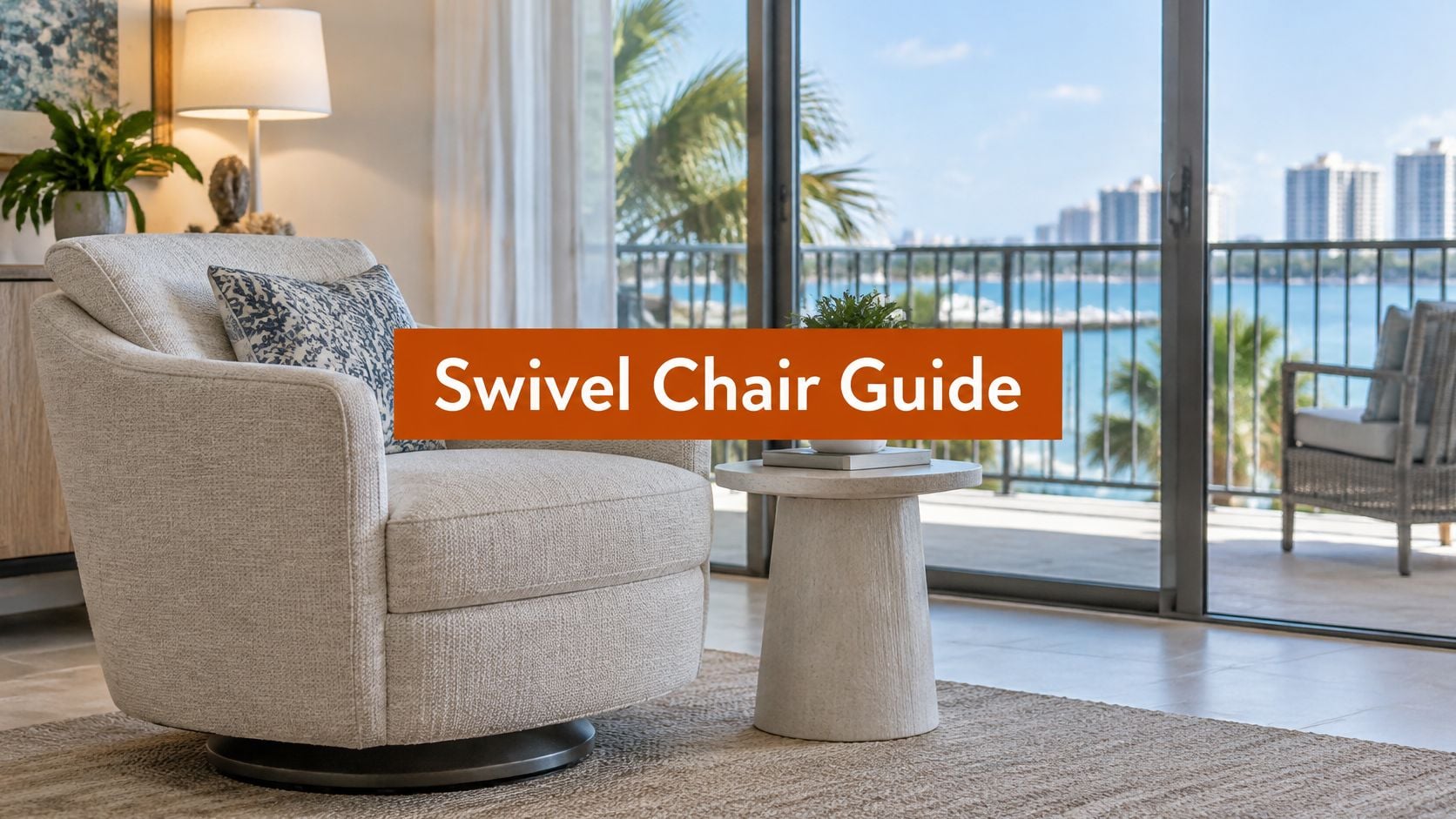
You're standing in a living room that has to do three jobs at once. There's a television on one wall, sliding doors to the lanai on another, and an open kitchen behind you where conversation keeps going while dinner cooks. A fixed chair forces you to choose one direction and drag it across the rug for the others. A well fitted swivel fabric chair solves that small daily friction, but only if the fabric, base and posture work together. Rotation alone doesn't make a chair comfortable for an hour of reading, and the most stain resistant covering isn't always the one you'll enjoy in Florida humidity.
Swivel Fabric Chair Types at a Glance
Say a friend in a Rockledge condo wants one chair that turns toward the balcony doors for morning coffee, swings to the kitchen for conversation, then faces the television at night. She doesn't want to scrape legs across tile or wrestle a heavy accent chair around a rug. That single request narrows the field quickly, but it doesn't pick the chair. Five types cover most Florida homes, and they differ less in how they turn than in how long you sit and what you do while you're seated.
A swivel accent chair in a barrel or club shape sits low, wraps around your back, and fits corners and reading nooks where space is tight. A swivel club chair with ottoman stays more upright, which suits conversation groupings where you want your feet up without leaning back. A swivel motion recliner adds multi position recline for family rooms. An upholstered swivel task chair brings height and tilt controls to a home office. An upholstered swivel dining chair keeps a compact footprint for condos with round tables, where guests need to turn toward the table and then toward the room.
| Chair type | Swivel and motion | Recline | Best room and use |
|---|---|---|---|
| Swivel accent chair (barrel or club) | 360-degree swivel on a fixed back | No | Living room corners, reading nooks |
| Swivel club chair with ottoman | 360-degree swivel with upright back | No | Living rooms, conversation groupings |
| Swivel motion recliner | Swivel plus multi-position recline | Yes | Family rooms, TV viewing |
| Upholstered swivel task chair | Swivel with height and tilt controls | Tilt | Home offices, desk work |
| Upholstered swivel dining chair | Swivel on a compact base | No | Dining areas, condos with small tables |
How to Read the Differences
Read the table from right to left. The room and task tell you how long someone sits, and that decides whether recline or height adjustment matters. A barrel chair that feels cozy for twenty minutes of conversation can leave your lower back unsupported during a long movie. A task chair that serves a desk all day can look and feel too upright beside a sofa.
Practical rule: Pick the chair for the longest sit it will see each week, not the shortest.
The swivel itself is standard across all five. What changes is pitch, seat depth and back support. I'd start with one question and let it do the sorting. What will the person do in this swivel fabric chair, and for how many hours at a stretch?
How the Swivel Base Works and Why It Matters
Think of a lazy Susan on a dining table. A heavy plate turns smoothly because a central bearing carries the load while the base stays still. A swivel fabric chair works the same way. A spindle and bearing sit under the seat, a base plate spreads your weight across the floor, and the seat above rotates without the feet moving. When it's well built, you hear almost nothing. You feel a quiet, controlled turn rather than a loose spin.
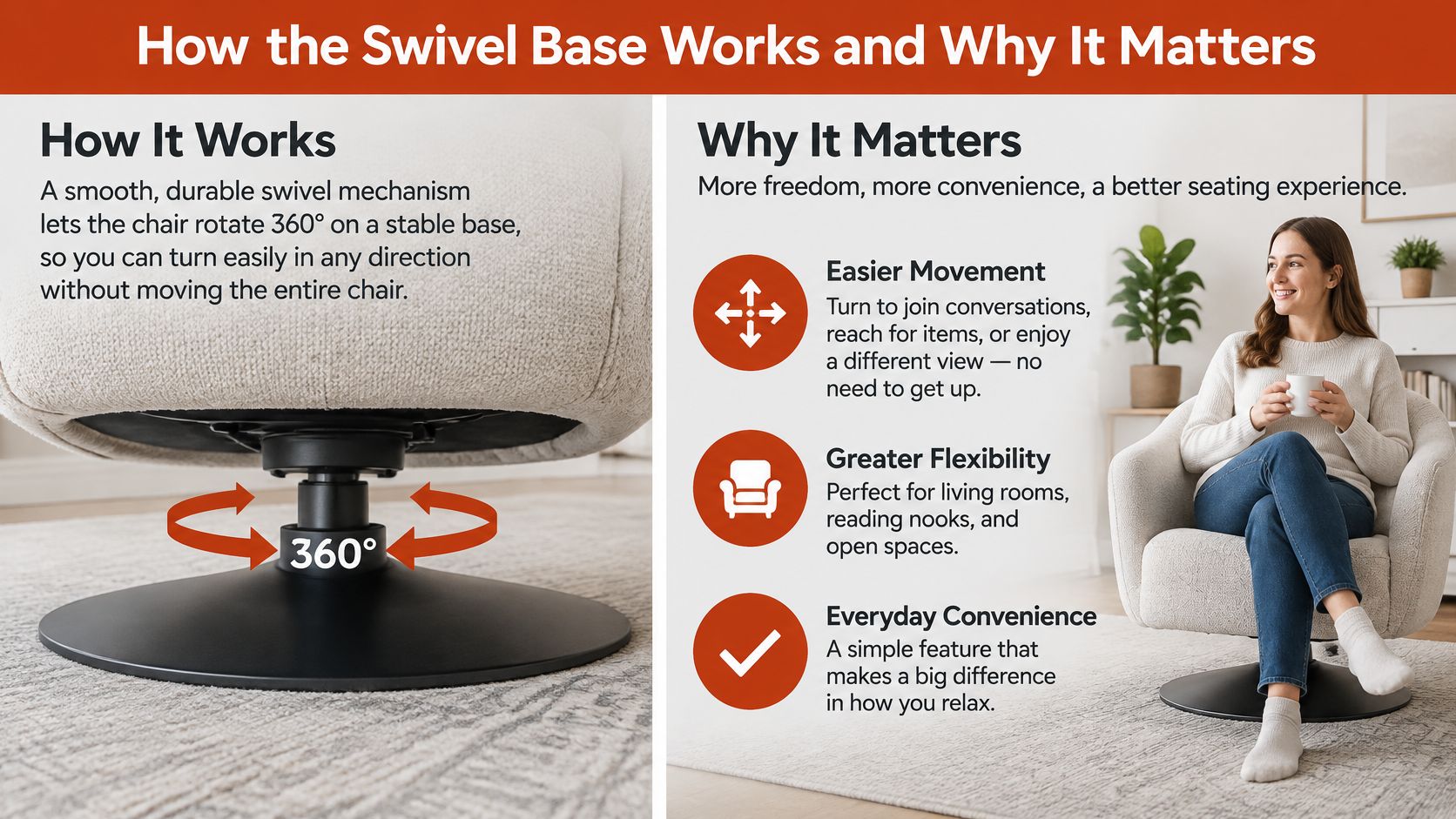
That mechanism has a long lineage. Thomas Jefferson built a functional swivel chair in 1775 by modifying an English style Windsor chair with a central iron spindle and casters, and Peter Ten Eyck patented an American swivel chair in 1853 using wooden construction and steel rockers, milestones traced in the swivel chair patent record. Broad production waited on stronger mechanisms that could support a seated person while allowing rotation.
Casters, Glides and Your Floor
The bottom of the base decides how the chair behaves in your room. Glides suit tile and hardwood because the chair turns in place without rolling away as you sit down. Casters help on carpet or in an office where you also need to move across the floor, but they can drift on smooth tile. In most coastal living rooms I'd choose glides. The chair stays planted, guests feel secure getting in and out, and the base doesn't wander toward sliding doors.
What Makes a Base Trustworthy
Ask for test data rather than a general promise of sturdiness. An ANSI/BIFMA X5.1 test report lists a cyclic swivel test using a 122-kg (270-lb) seat load for 120,000 cycles, plus a structural durability test using a 109-kg (240-lb) load and 25,000 cycles, figures summarized alongside textile quality standards for contract upholstery. Ask whether that testing covers the complete chair or only the mechanism, because a strong bearing bolted to a weak frame still fails early.
In the showroom, turn the chair slowly through a full circle. It should rotate without wobble, clicking or binding, sit level without rocking, and settle consistently. If you're comparing motion styles, our overview of high leg recliner chair options helps you see how a custom-fitted recline differs from a simple swivel. A base that feels loose on day one won't tighten up at home.
Performance Fabric and Genuine Leather Compared
Performance fabric no longer means one thing. The category now includes washable covers, pet friendly textiles, breathable weaves and UV resistance, a broader definition reflected in the Spring 2025 High Point Market furniture trend report. Durable labels rarely tell you how a cover handles claws or afternoon sun in Brevard County.
Here's the contrarian point I share with friends. The strongest stain resistance usually trades away comfort. A tightly coated textile may wipe clean in seconds, yet it can feel warmer and less natural during extended sitting, especially when humidity is high and the air conditioning cycles off. A breathable weave with good spot cleaning often wins over a full afternoon, even if it asks for a little more care after a spill.
If you want proof before you buy, take a swatch home and leave it draped over a chair near your sliding doors for a week. Press your palm against it on a humid afternoon, then again in the evening when the air conditioning rests. The cover that still feels dry and inviting is the one worth ordering.
What the Labels Actually Guarantee
PFAS-free speaks to chemical content in the finish, not to abrasion strength or fading. Recycled polyester describes fiber source, not how the weave handles claws or sunlight. Washable means a cover can be removed and cleaned as directed, with no promise that repeated washing will leave texture or color unchanged. The cleaning code carries the most useful answer, because it tells you whether water based products or stronger agents are permitted at all.
Genuine leather splits into two very different experiences. Full-aniline leather shows natural grain, warms to your body, and softens beautifully, but it fades and marks in direct sun and asks for gentle care. Pigmented top-grain leather carries a protective finish that handles spills and bright rooms better, with a slightly more uniform hand. If leather is on your list, practical guidance on removing stains from leather upholstery from J.G. Carpet Cleaning LLC is worth reading before you choose a finish for a sunny room.
| Material | Breathability | Cleaning | Sun and UV | Pets | Maintenance |
|---|---|---|---|---|---|
| Solution-dyed performance polyester | Good, varies by weave | Check cleaning code before water-based products | Strong, color is built into the fiber | Good with a tight weave | Routine vacuuming and prompt spot care |
| Performance blend of polyester and cotton | Good | Spot clean; check cleaning code | Moderate; test in direct light | Good | Routine vacuuming and prompt spot care |
| Coated performance fabric | Lower; can feel warm | Wipe clean | Moderate; keep out of constant direct sun | Easy to wipe | Low; watch seams over time |
| Pigmented top-grain leather | Moderate | Damp wipe with leather-safe cleaner | Protective finish resists fading | Wipes clean; scratches show | Periodic conditioning |
| Full-aniline leather | High; warms to the body | Gentle cleaning only | Fades and darkens in direct sun | Claws can mark it | Regular conditioning; natural patina |
Run your hand across a swatch and press it. A tight weave resists snagging and sandy clothing better than a loose, lofty one, no matter how soft it feels at first touch. Our longer comparison of leather versus fabric upholstery walks through that hand test in detail.
Judge the covering as one part of the whole chair. It sits on top of the base you already tested and the seat height that fits your posture, so the right choice is the one that keeps the entire swivel fabric chair comfortable and attractive through years of humidity, spills, pets and strong light.
Caring for Fabric and Swivel Hardware in Florida
In Florida, humidity is a durability issue; it wears out fabric and wood as steadily as sun does. The Florida Department of Health mold guidance recommends keeping indoor relative humidity below 60%, with levels below 50% considered better for controlling both mold growth and dust mites. Those numbers matter because upholstery, padding and wood retain moisture, especially near sliding doors, screened porches and kitchens where humid air moves in and out all day.
Stable humidity preserves the hand of the fabric, reduces conditions that support musty odors, and protects solid hardwood frames and other moisture sensitive parts inside the chair. It protects the hardware too. The same damp air that sags a cushion works into the swivel bearing, where grit and moisture together shorten the life of a smooth, quiet turn. A chair can carry an excellent performance finish and still age poorly in a damp room, so ventilation and dehumidification do as much for the whole seating system as any fabric treatment applied later.
Reading Abrasion Numbers Honestly
The Wyzenbeek double rub test rubs cotton duck against a fabric sample, with each back and forth motion counted as one double rub. Common guidance places approximately 15,000 double rubs in a light traffic range, 30,000 or more in a heavier domestic use range, and roughly 3,000 double rubs may correspond to about one year of use, as explained in the fabric rub test guide. Use that conversion to screen fabrics rather than to predict service life. Abrasion results say little about pilling, seam slippage, UV fading or moisture damage, and real households vary widely.
The highest rub count is rarely the most comfortable answer in a humid room. A tightly coated fabric that tops the chart can feel warm and clammy through a long Florida summer, while a breathable performance weave that still cleans well often proves more pleasant in daily use. Judge the number beside the weave, the cleaning code and the room itself, the same way you judge the base and the fit.
For seasonal specifics, our notes on summer proofing furniture with performance fabrics cover spills, splashing and shedding in coastal homes.
A Care Routine You Can Keep
- Vacuum weekly: Use the upholstery tool along seams and under cushions where sand collects.
- Treat spills at once: Blot, don't rub, and test any cleaner on a hidden area first.
- Read the cleaning code: Confirm it before using water based products or bleach on the fabric.
- Dry damp cushions promptly: Never leave a wet cushion sitting against padding overnight.
- Check the base seasonally: Tighten fasteners, inspect glides or casters, and wipe grit away from the bearing.
- Rotate sun exposure: Reposition the chair so direct light doesn't hit the same panel every day.
Humidity control and ventilation protect the whole chair at once: fabric, foam, wood and the swivel hardware it turns on.
Ergonomic Fit and Size Targets for Swivel Chairs
Backrest angle shapes spinal loading more than seat depth does. A domestic chair simulation study found increasing the backrest angle from 90° to 105° reduced modeled L5–sacrum joint reactions by approximately 50%, while Cornell ergonomics sitting guidance places a practical supported back range around 100–110° with lumbar support depth of approximately 1.5–5.1 cm. A straight backed chair that photographs beautifully can load your lower spine far more than a slightly reclined one.
Treat the recline band as a test range for motion chairs, not a fixed target. Cornell ergonomics materials summarized in a systematic review of workplace chair interventions report that supported reclining between 110° and 130° was associated with the lowest lumbar-disc pressure and back-muscle activity. Conversation still asks for a more upright posture, and no single setting suits every body. Run the chair through its range, then trust how your pelvis and lower back feel after several minutes.
These figures never work alone. A backrest set at the right angle still fails you if the seat is too deep for your legs, or if the cover holds humid heat against your back and nudges you forward off the lumbar contour. Judge fabric, base and posture numbers as one seating system.
| Specification | Guideline | Why it matters | Source |
|---|---|---|---|
| Backrest angle | 100 to 110 degrees, slightly reclined | Lowers modeled spinal loading | Cornell ergonomics sitting guidance |
| Lumbar support depth | About 1.5 to 5.1 cm | Fills the lower-back curve | Cornell ergonomics sitting guidance |
| Seat height | Feet flat with clear space behind the knees; adjustable for mixed households | Avoids pressure that can impair circulation | Practical fit check |
| Recline range for motion chairs | 110 to 130 degrees | Lowest lumbar-disc pressure in cited research | Workplace chair interventions review |
| Foot support | Both feet flat on the floor | Keeps the pelvis stable against the back | Practical fit check |
| Swivel clearance | Room to turn without striking walls, tables or doors | Safe entry and exit | Room measurement |
Height, Depth and the Front Edge
A fixed-height seat is always a compromise across different statures, which is why mixed households do better with adjustable height: a seat set too high increases pressure behind the knees and can impair circulation. Sit all the way back so your pelvis contacts the backrest. Keep both feet supported, feel the lumbar contour low in your back, and leave clearance behind your knees so the front edge doesn't compress your thighs.
Seat depth carries the same trade off. Too deep, and shorter sitters perch forward without back support. Too shallow, and taller sitters lose support under the thigh. A waterfall front edge softens pressure, but it can't rescue a seat that's plainly the wrong depth for the person using it daily. In a humid Florida room the covering plays into this too: a breathable performance fabric keeps you settled back where the lumbar support can work, while a dense, heat-holding weave tempts you to perch forward.
Turning Room Is Part of Fit
Measure the chair's overall width, depth and height, then add turning clearance so the full rotation fits the room. A chair that looks right facing forward can still strike a wall, side table or sliding door when it turns. Our guide on how to measure furniture shows how to tape out that footprint on your floor before you commit.
The base belongs in the same judgement as the seat. A well-built swivel turns silently and stays planted while you rotate; a base that wobbles or drags makes even a correctly sized chair feel wrong. Dynamic seating that encourages small posture changes can suit a home office, where you shift and reach throughout the day. The same busy feel can annoy you in a reading chair, where you want to settle and stay. Match the swivel fabric chair to the posture the task requires, and the numbers above become a working filter.
Matching Swivel Chairs to Rooms and Customization
Rooms ask different things from the same mechanism. A living room wants conversation and daily comfort. A home office wants task posture over long stretches. A condo wants a small footprint that still turns freely, and a vacation rental wants fast cleaning between guests. A swivel fabric chair only earns its place when the fabric, base and posture suit the same job, so the room decides the chair.
| Room | Main priority | Chair type | Fabric direction | Fit focus |
|---|---|---|---|---|
| Living room | Conversation and daily comfort | Swivel accent or club chair | Breathable weave in a tone that suits the sofa grouping | Back low enough to keep sightlines open for conversation |
| Home office | Long sitting and task posture | Upholstered swivel task chair | A cover that stays cool through hours at a desk | Arms and base that let you pivot between desk and shelves |
| Condo or small space | Footprint and turning clearance | Slim-base swivel accent chair | A lighter tone that keeps a tight room feeling open | A base that rotates fully inside the footprint the floor allows |
| Family room with TV | Recline and rotation | Swivel motion recliner | A durable cover that forgives snack spills | Clear wall and table space behind the chair for full recline |
| Coastal home or vacation rental | Cleaning turnover and sun | Swivel club chair | UV-resistant cover in a sun-friendly color | Glides that stay put on tile and wipe down quickly |
Choosing the Covering by Room
In a family room that sees heavy daily wear and wants a warm, polished look, pigmented top-grain leather earns its place. It wipes clean, resists fading better than aniline hides, and pairs well with recline for television viewing. In a sunny condo where pets nap on the seat and grandchildren visit with snacks, a tight performance weave is usually the calmer choice. It breathes better in humidity, hides minor marks in its texture, and tolerates prompt spot cleaning without special conditioners.
The toughest cover on the rack is not automatically the most comfortable one in a humid Florida room. A surface built to block every spill can sit warm and stiff through summer, while a breathable weave keeps the same chair pleasant in August.
For a reading corner, I'd prioritize cushion recovery over either label. Press the seat firmly and watch it rebound. A cushion that springs back evenly will support you through a chapter. One that stays dented will feel tired within months, whatever covers it.
Customization in a Coastal Palette
Custom order options let you choose from thousands of performance fabrics, genuine leathers and custom wood finishes, so the covering, base and color answer to the same room and the same climate. Curated coastal vignettes in the showroom place a swivel fabric chair beside sofas, tables and rugs in a real arrangement, so you can judge scale and color relationships instead of imagining them from a swatch book alone. If you need placement ideas first, five ways to use an accent chair shows how one chair anchors different groupings.
The complimentary in-house interior design consultation covers room planning and product selection, so a designer can coordinate the covering with pieces you already own and flag a chair whose scale would crowd the grouping. That planning step turns a single chair purchase into a room that feels finished.
Test, Measure and Visit the Rockledge Showroom
Our No Blind Ordering promise shapes how we stock the floor. Ownership hand tests every seat, sofa and recliner for pitch and comfort before it reaches the 32,000 sq ft Rockledge showroom, because a specification sheet cannot describe how a chair receives your pelvis or lets your feet rest naturally. Indian River Furniture has served Brevard County, the Space Coast and Central Florida since 1939, and the same testing standard still decides what earns a place on the floor.
A visit works best when you arrive with a few facts from home. You do not need a full floor plan. You need honest measurements and an honest account of daily life in the room.
Measure Before You Come
- Available footprint: Record width and depth where the chair will sit, plus turning room on every side.
- Nearby obstacles: Note doors, walkways, side tables and sliding door tracks the chair might strike.
- Primary sitter: Write down who sits there most, their height, and how long a typical sit lasts.
- Daily realities: Note pets, children, strong sun, and whether food and drinks regularly reach the chair.
- Floor type: Tile, hardwood, low pile carpet or a thick rug changes whether glides or casters feel right.
Tape the footprint on your floor with painter's tape and walk around it. A cramped walkway shows up in seconds, and you save a return trip with new numbers.
The Showroom Test Routine
Run this routine on three or four candidates and give each chair 10 to 15 minutes. Short sits hide pressure points that long sits expose, and small annoyances grow larger at home. For the posture side of the test, seat depth, lumbar contact and knee angle, work from the fit targets earlier in this guide.
- Settle in and stay seated: A cushion that feels fine at two minutes can bottom out or push you forward by fifteen.
- Stand up without pulling on the arms: Easy exit matters every single day, especially for older adults.
- Press behind your knees: The seat edge should not cut in or press sharply against your thighs.
- Test on a similar floor surface: Glides and casters behave differently on tile than on carpet.
- Ask about the task: A barrel chair may suit conversation beautifully but not an eight hour desk day.
A swivel fabric chair should feel stable mid turn, quiet at the bearing, and supportive the moment you settle back.
Take fabric and leather samples to a window before you decide. Coastal light is strong and slightly blue, and a beige that looks warm under showroom lighting can turn gray at home. Hold the swatch against your skin too. You will live with that texture against bare arms and legs through long Florida summers, so the hand of the material matters as much as its color. A covering that survives every spill can still feel slick and hot in July, and the toughest label loses to the fabric you want to sit on.
Design Help and White Glove Delivery
Bring your photos, measurements and short list to our in-house design team. The complimentary interior design consultation covers room planning and product selection, so the chair you love also fits the sofa, rug and tables around it. Designers who work in Brevard County homes every week know which coverings tolerate west facing glass and which bases behave on the tile floors common in Space Coast condos.
After you choose, our uniform white glove delivery team handles unboxing, inspection and full room setup within our service area for a flat $99 delivery fee. The chair arrives placed, level and turning freely, with packaging removed. Help center and service request tools remain available after delivery if a glide needs attention or you want care guidance for a new covering.
The chair that earns its place is the one where fabric, base and fit agree. Visit the Rockledge showroom this week with your measurements and room photos, sit in three or four swivel chairs for a full test, and let our design team help you match fabric, fit and finish to your Florida home.