Schedule your Complimentary Design Consultation


36 X 80 Mattress Guide: Size, Fit and Who It Suits

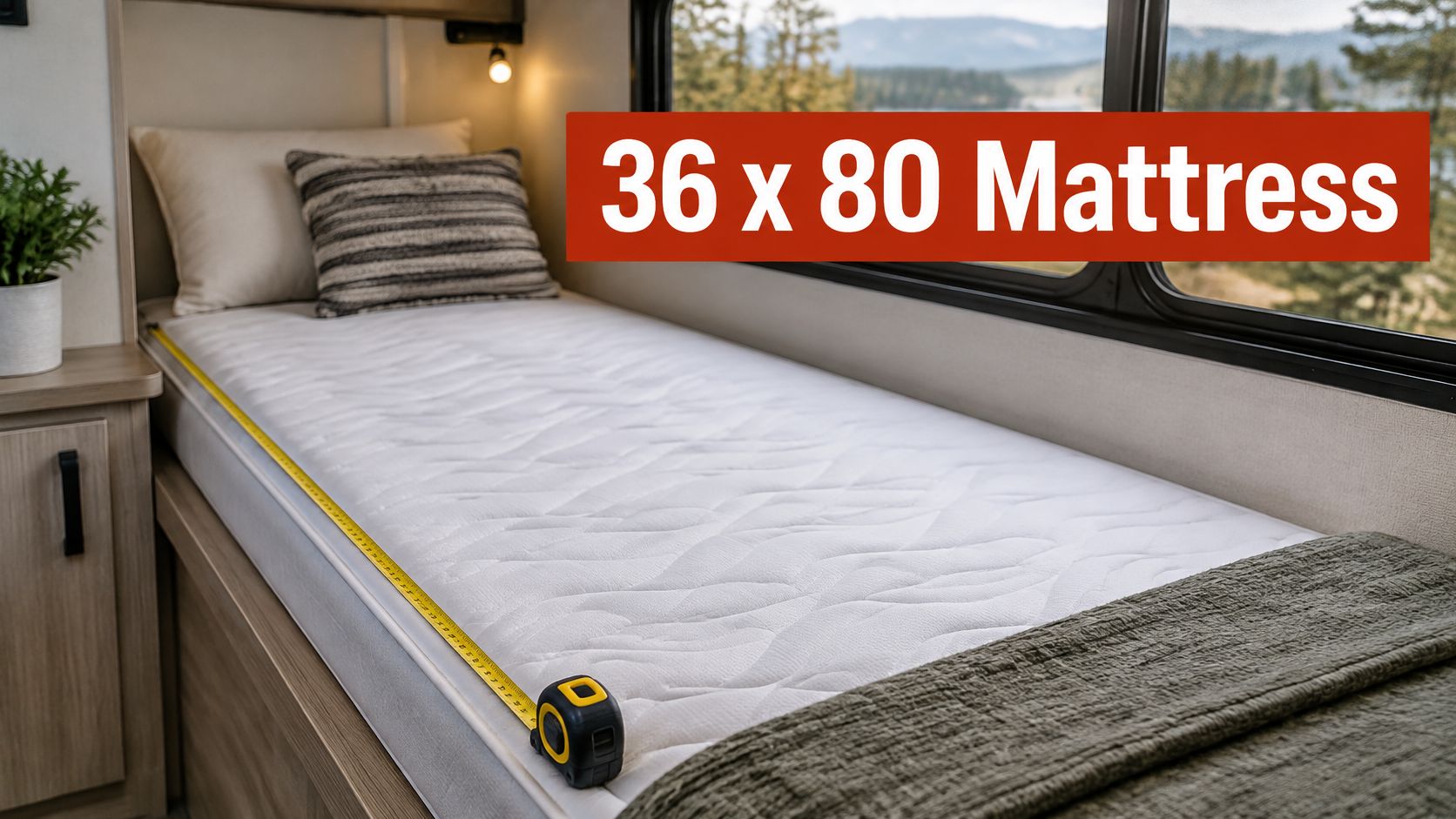
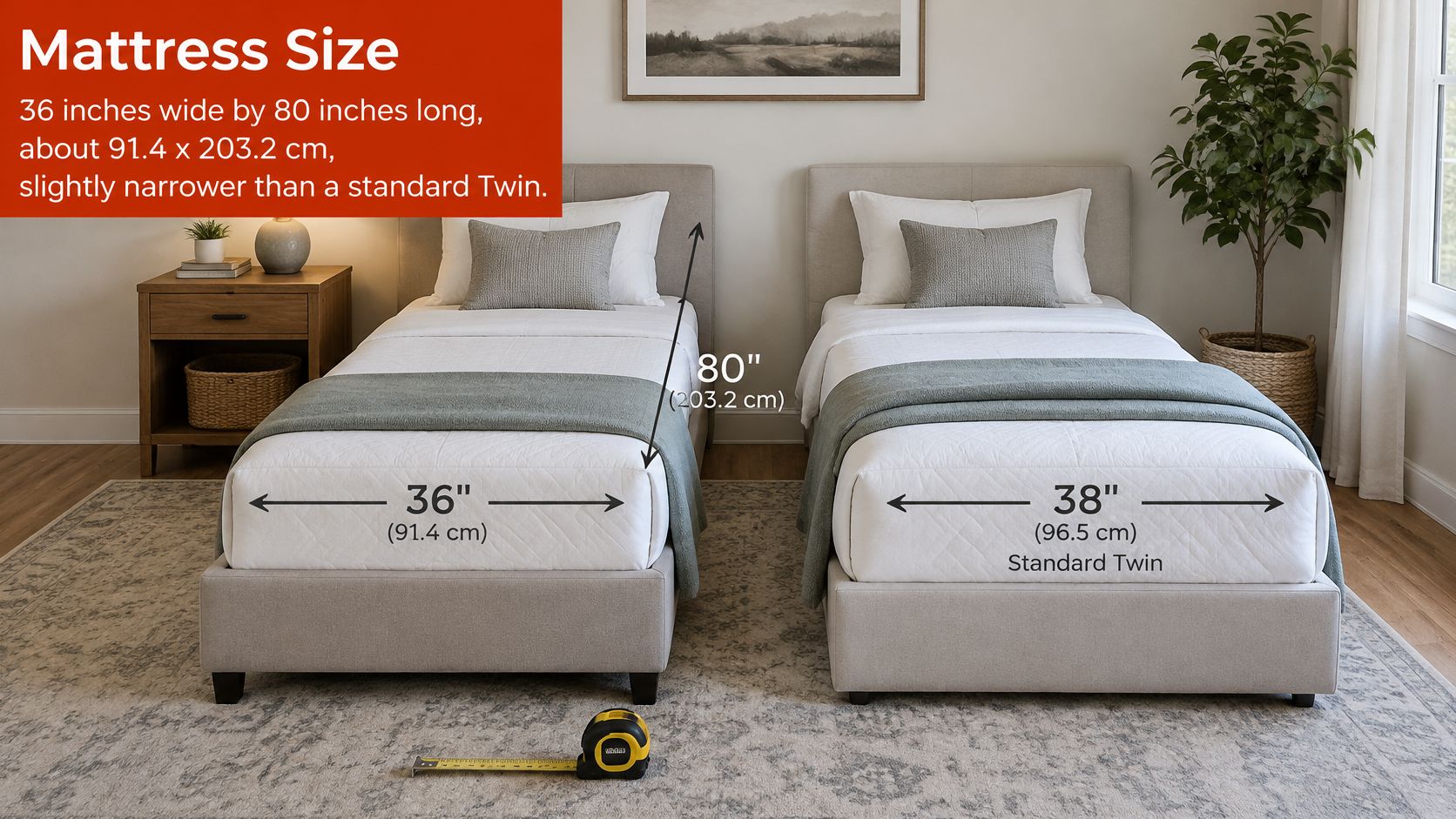
A 36 x 80 mattress is 36 inches wide and 80 inches long, about 2 inches narrower than a standard Twin and 5 inches longer, but its nominal size doesn't guarantee fit. It can be a useful solution for a narrow bedroom, bunk, or RV berth, provided the mattress, platform, rails, and bedding work together.
Perhaps you've lifted an aging camper cushion, measured a guest-room alcove, or discovered that the replacement mattress you expected to fit has a different width. The challenge isn't just finding a comfortable surface. It's choosing a mattress that settles properly into its frame, leaves moving parts unobstructed, and feels inviting when you finally stretch out for the night.
Start with the whole sleeping platform, not the size label. That approach makes the comfort decisions much easier.
What a 36 x 80 Mattress Measures and What It Is Called
A 36 x 80 mattress belongs to the long-twin family, but its narrower width makes the name alone unreliable. The Sleep Foundation's dorm-bed sizing guide distinguishes commonly published retail Twin XL dimensions of approximately 38–39 x 80 inches from institutional versions measuring 36 x 80 inches, including examples used by Ohio State University.
Think of it as a fitted, long-and-slim suit rather than a standard jacket. The overall line looks familiar, but the cut serves a narrower frame. That distinction matters when you're choosing a replacement for an existing bed rather than furnishing an empty room.
Why the name doesn't settle the fit
You may encounter long single, long twin, XL twin, institutional long single, or hospital-style long twin. Treat these as search terms, not interchangeable specifications. In particular, a hospital-style label doesn't establish that a mattress is suitable for a particular medical bed or care need.
Thickness is another independent measurement. A documented institutional foam-core mattress measures 36 x 80 x 6 inches, while other documented models are thicker. A matching footprint therefore tells you nothing definite about the finished sleeping height.
The surface-area comparison can also be misleading. A longer, narrower rectangle can contain slightly more total area without feeling roomier across your shoulders. Usable width and usable length matter more than area alone.
Before shopping, be ready to state the width, length, and maximum acceptable thickness. Use the following specification sheet as a starting point, then replace the thickness examples with the exact model you're considering.
36 x 80 mattress specifications
| Specification | Value | What It Means for Fit |
|---|---|---|
| Width | 36 inches, about 91.4 cm | 2 inches narrower than a standard Twin, so less side-to-side room |
| Length | 80 inches, about 203.2 cm | 5 inches longer than a standard Twin, so more length for taller sleepers |
| Surface area | 2,880 sq in, or 20 sq ft | About 30 sq in more than a 38 x 75 Twin, which has 2,850 sq in |
| Thickness | Model-specific; documented examples include 6 inches and 9 inches | Must clear the frame, rails, and overhead space |
| Common names | Long twin, XL twin, institutional long single | Names aren't standardized, so verify by measurement |
Who Gets the Most From a 36 x 80 Size
Best-fit situations for a 36 x 80 mattress
| Situation | Why the Size Helps | What to Check First |
|---|---|---|
| Taller single sleeper in a small bedroom | Extra 5 inches of length in a narrow footprint | Side-to-side turning room against the wall |
| RV or camper sleeping platform | Suits narrow cabin berths when dimensions match | Cabinet doors, windows, and rail clearance |
| Semi-truck sleeper berth | Long-single format for a slim cab | Thickness, hinge, and lid clearance |
| Bunk or loft platform | Slim footprint with added length | Rail height and guard clearance above the mattress |
| Guest room or office daybed | Can fit a tight wall-and-door arrangement | Matching sheets and protectors |
| Couples or frequent movers | Not a strong fit for shared sleep | A wider single surface, such as a 42 x 80 bunk width, or a Queen for shared sleep |
A narrow room needs more than a bed that technically fits between its walls. You still need to open the door, reach a drawer, change the sheets, and move around without turning sideways. A slim mattress can help preserve those everyday movements, particularly when length matters more than generous turning space.
Institutional use illustrates that purpose. Georgia State University's housing guide identifies its generally 36 x 80-inch mattresses as XL-twin size, showing why a dormitory label may differ from a residential retail label.
Plan the room around the sleeper
For a guest room that doubles as an office, consider where the desk chair travels and whether bedding will brush against it. In a camper, check access to storage rather than assuming a narrow sleeping surface solves the entire layout. For a separate backyard studio, CozyCube's resource on studio tiny house costs and permits offers broader planning context before you commit to the interior arrangement.
Storage platforms can be useful, but drawers require opening space and lift-up lids need unobstructed travel. A low-profile platform may preserve sitting clearance while making it harder to reach underneath for cleaning. Choose the arrangement you can use comfortably, not the one that looks most compact.
Practical rule: Choose this footprint when you sleep alone and need length more than width. If you share the bed or spread out while sleeping, give sleeping width priority over a smaller floor footprint.
A child, occasional guest, or single adult may find the proportions comfortable. Someone who sleeps with elbows extended or changes position frequently should test a similarly narrow surface before committing.
How 36 x 80 Compares With Other Common Sizes
Surface area and footprint of common mattress sizes
| Size | Width x Length | Best Fit |
|---|---|---|
| Twin | 38 x 75 in, about 19.8 sq ft | Shorter single sleeper in a small room |
| Twin XL | 38 x 80 in, about 21.1 sq ft | Taller single sleeper, dormitory bed |
| 36 x 80 mattress | 36 x 80 in, 20 sq ft | Narrow platform, RV, institutional bed |
| 39 x 80 bunk width | 39 x 80 in, about 21.7 sq ft | Bunk or platform needing slightly more width |
| 42 x 80 bunk width | 42 x 80 in, about 23.3 sq ft | Single-sleeper platform where comfort matters more than footprint |
| Full | 54 x 75 in, about 28.1 sq ft | One adult who wants room to stretch |
| Queen | 60 x 80 in, about 33.3 sq ft | Couples and primary bedrooms |
Surface areas are calculated from the nominal dimensions shown.
The useful comparison isn't which rectangle has the largest area. It's which dimension solves your problem. A specialty mattress sizing reference describes the 36 x 80-inch format as approximately 91.4 x 203.2 cm, with a narrower width and longer length than a conventional Twin.
If your feet overhang but you rarely move sideways, additional length may be the more valuable change. If your shoulder meets the wall every time you turn, a longer mattress won't address the discomfort. You need additional width and a platform that supports it.
Compare the frame as well as the mattress
A wider mattress usually requires a different supporting platform. Don't select a broader surface with the intention of letting it hang over an existing bunk or squeezing it between rails. The mattress must sit as its manufacturer intends.
For vehicle interiors, Motor Sportsland's Class B layout guide provides useful context for considering sleeping arrangements within the larger cabin plan. Pay attention to access around the bed, not just the sleeping rectangle.
Nominal U.S. names aren't an international fit standard. When importing a frame or ordering custom bedding, use actual dimensions and ask how the manufacturer measures the finished product. ISO/DIS 24975 is a dimensional-fit reference addressing measurement methods and recommended tolerances, not a reason to assume that similarly named products will match.
Our guide to mattress sizes can help you compare residential alternatives before choosing a frame.
Move toward a wider bunk format when you want more turning space while retaining a long-single arrangement. Consider a Full when one adult wants more room, or a Queen when the room permits and the bed will be shared. Neither choice eliminates the need to check door swings, bedside access, and the finished frame footprint.
Choosing a Mattress Type for a Narrow Platform
On a narrow platform, edge support deserves particular attention. You may sit close to the perimeter while dressing, and you have less room to move inward if the edge compresses significantly. Construction matters, but the finished mattress matters more than its category name.
Mattress types for a narrow 36 x 80 platform
| Type | Feel | Strength on a Narrow Platform | Watch For |
|---|---|---|---|
| Memory foam | Close contouring with a slow response | Quiet feel, pressure relief, and potential for a low profile | Can retain heat; maintain airflow beneath the platform |
| Gel memory foam | Contouring, sometimes with a cooler or more responsive feel | Pressure relief with heat-management features | Gel alone doesn't guarantee cool sleep; check cover breathability and support |
| Hybrid | Coil support with foam comfort layers | Potential for supportive edges and airflow | Often substantial in height; check rails and overhead space |
| Innerspring | Bouncy, traditional coil feel | Airflow and an easier-to-move-on surface | Pressure relief, weight, and edge quality are model-specific |
Match the surface to your sleeping position
Side sleepers should notice whether their shoulders and hips settle comfortably without leaving the waist unsupported. Back sleepers can assess whether the lower back feels supported without being pushed into an exaggerated arch. Heavier adults should pay close attention to deep compression and whether the perimeter remains stable.
Don't assume a firmer surface automatically provides better ergonomic support. Lie in your usual position, turn naturally, and sit on the edge. Compare how the centre and perimeter respond rather than pressing the top with your palm alone.
Our comparison of memory foam, hybrid, and innerspring mattresses explains those construction differences. The Sleep Consultant's resource can also help you compare mattress durability and edge support while forming questions for an in-person test.
Keep Florida moisture in mind
The U.S. Environmental Protection Agency's mold guide recommends indoor relative humidity below 60 percent, ideally between 30 and 50 percent. In a compact sleeping area, leave the intended ventilation paths open, avoid trapping damp bedding beneath cushions, and inspect the mattress underside periodically.
A breathable cover can't compensate for a damp, unventilated compartment.
Choose a construction that feels supportive, then confirm that its thickness and foundation requirements suit the platform. Our broader furniture selections emphasize performance fabrics, genuine leathers, and solid hardwood frames for active Florida living, but those materials don't replace mattress-specific moisture care or support requirements.
How to Measure Your Platform Before Ordering
A mattress can match a berth's advertised size and still fail to fit. Rails, rounded corners, and fixed projections reduce the usable opening, so start with the finished platform rather than the furniture's exterior.
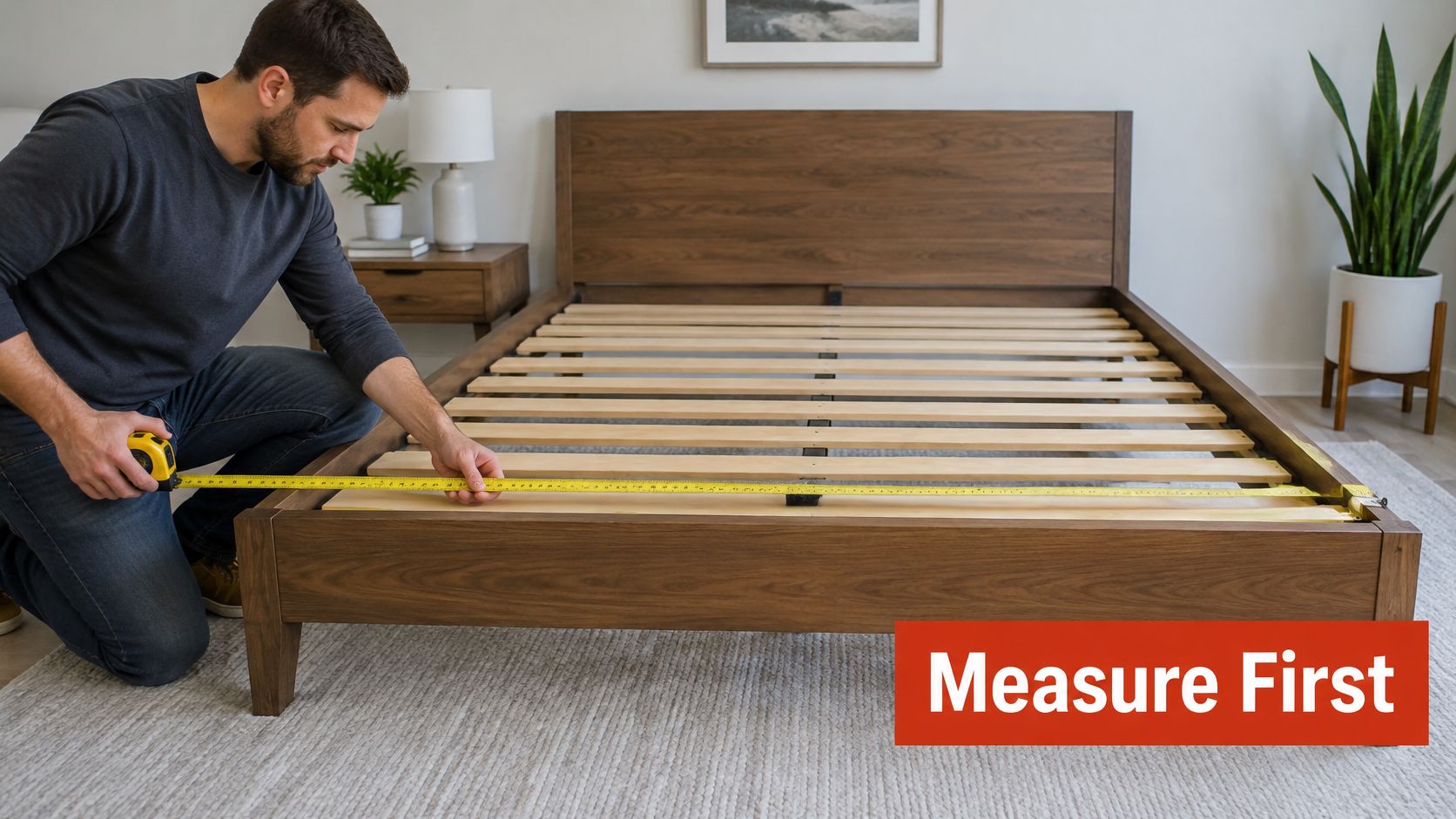
Use a rigid tape measure, a notepad, and photographs taken with the mattress removed. For a moving base, set the deck flat and follow the manufacturer's instructions before checking its movement.
Record the usable opening
Measure across the platform. Take readings at the head, middle, and foot, between the inside faces of any obstructions. Record the narrowest opening, where a mattress is most likely to bind.
Measure the usable length. Run the tape from the headboard or wall to the inside of the footboard or rail. Include fixed projections in your notes.
Sketch corners and moving parts. Mark curved corners, cabinet doors, windows, hinges, and storage lids. A rectangular mattress may not fit a shaped berth.
Check overhead clearance. Note the distance to cabinetry, the bunk above, and protective rails. Ask the platform manufacturer for the permitted mattress height; rail height alone does not establish how thick the mattress can be.
Record the platform's limits. Note any manufacturer specifications for mattress dimensions and height. The separate bedding-depth check belongs with your sheet and protector measurements.
Keep exact readings in both units. Don't round a platform opening upward. If a custom-sheet supplier requests rounding between half-inch increments, apply that instruction to the bedding order only.
Test the result before choosing
Suppose a camper berth's narrowest opening is 35.5 inches. A nominal 36-inch-wide mattress should not be assumed to fit. The platform may need a different mattress size or a manufacturer-confirmed specification.
Use this guide to measuring furniture and surrounding spaces to document the room and delivery route. Keep the platform measurements, corner sketch, and photographs together so the fit can be checked against the complete setup.
Bedding, Frames and Foundations That Fit
A matching label isn't enough for accessories. Fitted sheets and protectors must accommodate the mattress's width, length, and finished depth, while the supporting structure must satisfy its own compatibility requirements.
The sleeper-accessory sizing guidance emphasizes matching those mattress dimensions when selecting custom bedding. If a supplier asks you to round a bedding measurement, retain your original reading alongside the ordering value so it doesn't get mistaken for a platform dimension.
Give each accessory its own fit check
Fitted sheets should settle around the corners without straining or leaving loose folds across the sleeping surface. Include a topper in the depth measurement, and tell the supplier about clipped or rounded corners. A standard Twin sheet shouldn't be chosen just because the mattress looks narrow.
Mattress protectors need the same dimensional check. A protector that pulls tightly across the surface can change the feel, while excess fabric can wrinkle beneath the sheet.
Foundations and frames must support the mattress in the way its manufacturer specifies. Check the clear opening, required slat arrangement or deck type, corner geometry, and weight rating. The loaded total includes the mattress, sleeper, bedding, and anything else the frame supports.
Adjustable bases require explicit compatibility, not just matching length and width. Confirm that the mattress is designed to articulate and that hinges, retaining bars, and nearby furniture remain unobstructed through movement.
Treat rails and gaps as safety issues
A mattress that presses against rails may not seat correctly. One that leaves excessive gaps can be hazardous on a bunk or medical platform. For these beds, use the manufacturer's approved mattress specifications rather than improvising with a nearby size.
RV and truck platforms may also have particular weight and thickness limits. Don't substitute a residential foundation without confirming that the entire installation can support it.
Our explanation of when a bed needs a box spring or foundation helps distinguish support options, but the mattress manufacturer's requirements remain the deciding factor.
Before ordering, check:
- Mattress dimensions: Width, length, thickness, and corner shape.
- Bedding dimensions: Sheet and protector pocket depth.
- Supporting structure: Clear platform opening, approved support type, and loaded weight rating.
- Moving components: Hinges, lids, rails, and adjustment clearance.
Choose the foundation only after confirming the exact mattress specification.
Confirm Your Measurements, Then Visit the Rockledge Showroom
A 36 x 80 mattress only fits well when the whole setup works together: the mattress, platform, rails, and bedding. At Indian River Furniture's 32,000-square-foot Rockledge showroom, you can discuss fit and comfort with a team that treats both as part of the decision.
If you've already made the checks in the measuring section, bring those notes as a reference. Then focus the showroom visit on a question measurements alone can't answer: how the mattress feels in use.

Make the visit hands-on
Lie in your usual sleeping position and notice whether your shoulders and hips feel supported. Try turning, then sit near the edge to assess how it feels under your weight. These checks help you compare comfort, while the mattress's listed dimensions and compatibility determine whether it suits your platform.
Indian River Furniture's ownership team hand-tests mattresses from the brands it offers for lasting support and restorative sleep. The shop also filters options by type, including memory foam, gel memory foam, hybrid, and innerspring. For more on weighing these choices, read the guide to what to consider when buying a mattress.
Bring the room into the decision
A mattress purchase may also affect how a compact bedroom functions. If you are furnishing the rest of the room, Indian River Furniture offers complimentary interior design consultations when you purchase furniture through the store. Consultations can include scale floor planning, fabric and finish selections, and room styling.
Ask the team to confirm the chosen mattress's exact width, length, and thickness before ordering. Indian River Furniture's uniformed, in-house white-glove delivery includes inspection and room setup.
For your next step, contact the Rockledge showroom to ask about testing mattress options in person.