Schedule your Complimentary Design Consultation


What to Consider When Buying a Mattress: A Florida Guide


You've probably had the morning that makes the decision for you. You wake in a warm Florida bedroom, roll your shoulders, and realize you're sleeping better on a guest bed or a vacation rental than in your own home. Your current mattress isn't dramatic enough to condemn outright, just tired, a little saggy at the edge, and warm by 3 a.m. That's exactly when understanding what to consider when buying a mattress matters most, before urgency turns a long-term choice into a rushed one.
Why a Mattress Decision Deserves More Time Than Most
You step into a mattress gallery after weeks of reading reviews, and suddenly you're facing rows of white beds that look nearly identical. The tags promise plush, firm, cooling, and contouring, yet none of them tells you how your shoulders will feel after six hours. That quiet overwhelm is normal, and it's useful information. It means the decision needs a slower method than choosing a lamp or even a dining chair.
A mattress shapes something you do every night, in the dark, without thinking about it until it goes wrong. It supports your spine while you're unconscious, absorbs the movement of a partner turning over, and holds warmth and humidity close to your body. A poor match can leave you waking stiff, tossing to escape a pressure point, or kicking off covers. A good match mostly disappears, which is the point.
Treat this purchase as an investment in the room where you recover, not as a commodity you replace on impulse. You're choosing materials that need to hold their shape under nightly load, in a coastal climate, for years. You're also choosing a surface that has to suit the way you sleep, not the way you think you sleep.
Seven Questions Worth Answering in Order
Start with how firmness supports your body, then look at what the mattress is made of. Next, consider heat and humidity, because a surface that feels fine in an air-conditioned showroom can feel different on a still August night. After that, test in person, confirm the size and ownership terms, and decide how the old mattress will leave your home.
- Firmness and alignment: Does your spine stay close to neutral?
- Materials and feel: Do you prefer cradling, buoyant, or responsive?
- Climate performance: How does the full bedding setup handle warmth?
- Fit and terms: Does the size, foundation, and warranty language suit your room?
- End of life: Have you planned responsible removal before delivery day?
You don't need to answer all seven perfectly on a first visit. You do need to know which question you're answering when you lie down, press a hand into a comfort layer, or ask about a foundation. That focus turns a confusing gallery into a series of small, manageable judgments.
Understanding Firmness as Biomechanics, Not a Feeling
Most shoppers start with a simple preference. You like soft, or you like hard. That instinct isn't wrong, but it's incomplete, because firmness is really about what happens to your spine and pressure points after your weight settles. A systematic review of 24 controlled trials found mattresses subjectively classified as medium-firm, along with self-adjustable mattresses, produced the strongest overall results for sleep comfort, sleep quality, and spinal alignment. That doesn't make medium-firm a prescription for everyone, but it explains why it's a sensible starting point for many sleepers.
Think of the mechanics in plain terms. If a surface is too soft, your pelvis can drop below your torso, bending your spine rather than supporting it. If it's too firm, your shoulder and hip can't sink enough, so pressure concentrates in small areas and you keep shifting to relieve it. The goal is a middle path where bony points receive cushioning and your midsection gets enough resistance.
Your Body Changes the Answer
Body proportions change which surface keeps you level. In a study of 59 healthy participants using visually identical mattresses with soft, medium, and firm spring units, people with higher body weight tended to achieve more neutral spinal alignment on firmer surfaces, while people with lower body weight were better aligned on softer surfaces. Larger hip circumferences also showed greater spinal deviations on softer mattresses in that work. That's why a partner's favorite can be a poor guide for you, even when you share the same bed.
Sleep position adds another layer. Side sleepers usually need more conformability at the shoulder and hip, because those points carry a narrow band of weight. Back and stomach sleepers often need more resistance under the midsection, so the pelvis doesn't sag.
Practical rule: Don't judge a mattress by the first ten seconds of softness. Judge it by whether your spine stays approximately neutral after your hips and shoulders have settled.
Labels won't settle this for you, because firmness names and numbers aren't standardized across manufacturers. Use them to narrow the field, then test with your intended pillow in your normal position. If you want a position-by-position starting point before you visit, this guide to matching a mattress to your sleeping style can help you arrive with a clearer shortlist. And if pain persists, treat the mattress as a comfort and support decision rather than a medical treatment, and talk with a qualified clinician.
Comparing Mattress Materials by How They Actually Feel
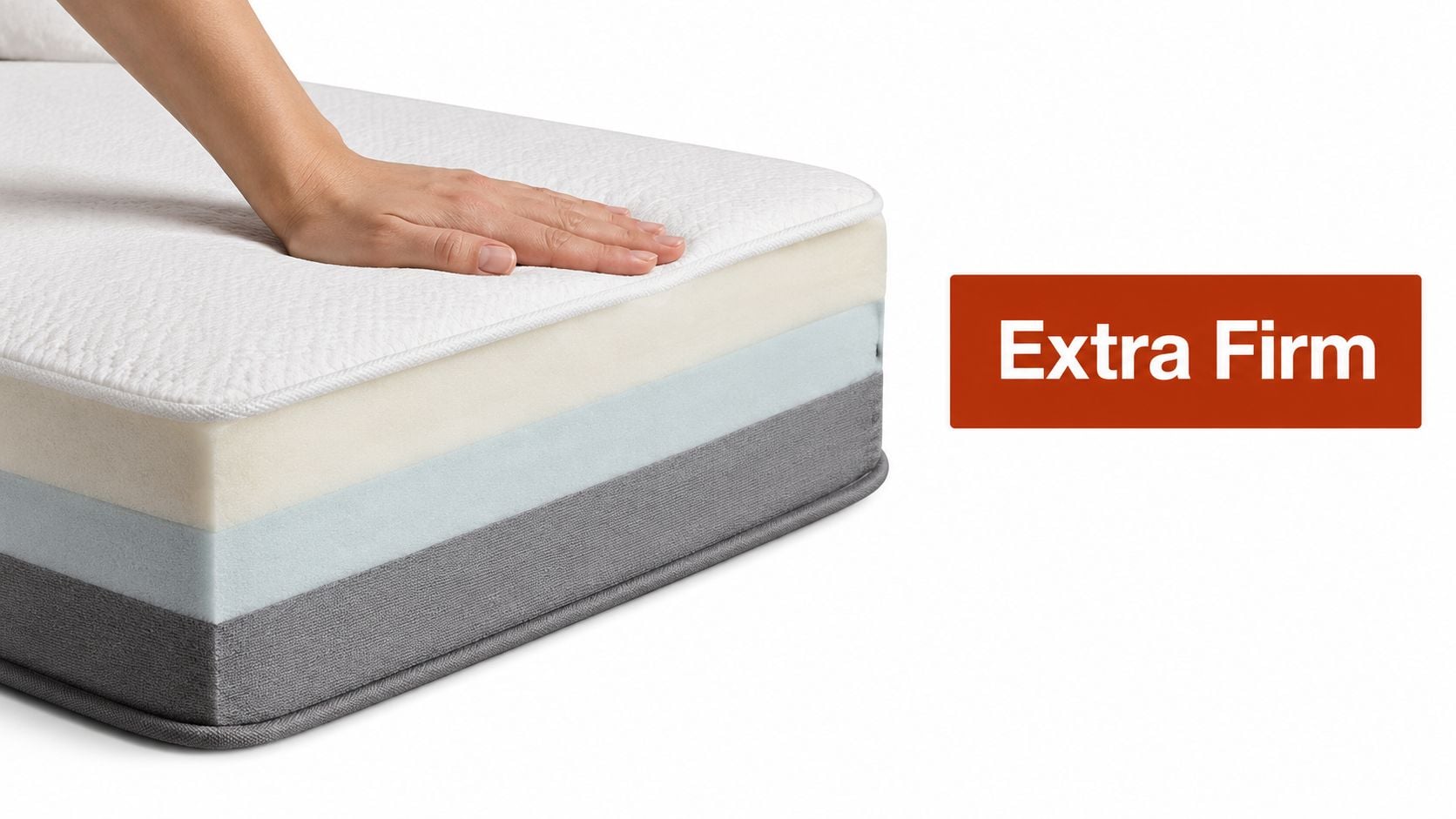
Construction is easier to understand through touch than through a specification sheet. Press your palm into each type, lie down, and notice how quickly the surface responds when you move. That sensory difference is the distinction between foam, coils, latex, and hybrids.
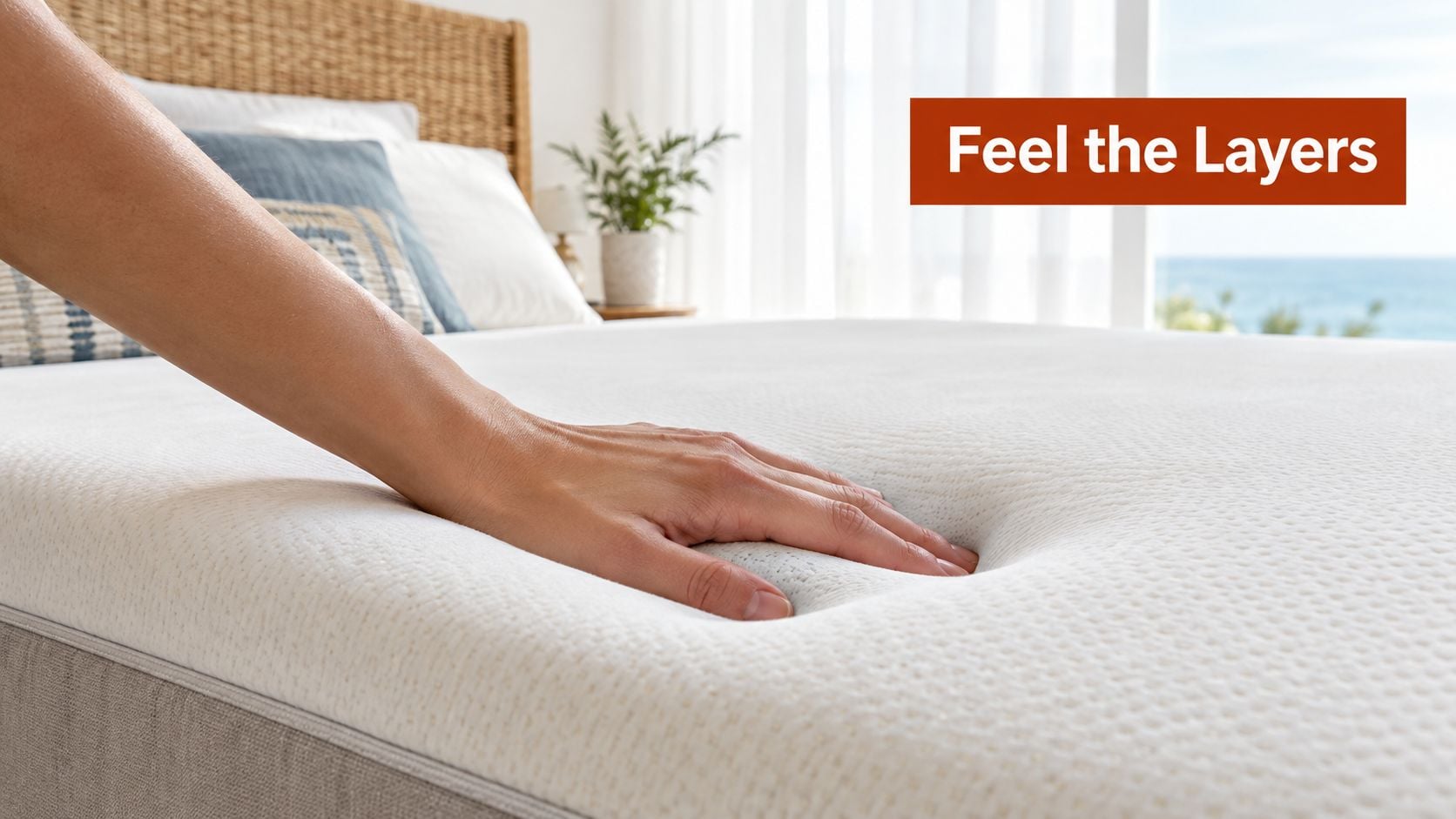
Memory foam feels slow and enveloping. It softens under warmth and weight, cradling curves and spreading pressure, which many side sleepers love at the shoulder. The tradeoff is that dense foam can hold heat and make turning feel effortful, especially if you change positions often. Ask about foam density and layer thickness, because those details say more about durability and support than the softness of the top inch.
An innerspring mattress feels buoyant. Coils push back quickly, the surface is easier to move on, and air can circulate through the support core. Some coil designs transmit more motion than foam, so test with a partner if you share the bed. Coil gauge, coil design, and the quality of the cushioning above the coils matter more than a headline coil count by itself.
Where Latex and Hybrids Fit
Latex sits between those sensations. It contours, but it springs back faster than memory foam, so you feel lifted rather than nestled in. Many sleepers describe it as responsive and resilient, and it tends to hold its shape well over time when the craftsmanship is sound. Ask whether the latex is natural, synthetic, or a blend, and how it's layered, because feel and longevity both depend on that construction.
A hybrid pairs a coil support core with foam or latex comfort layers. Done well, it balances airflow and responsiveness from below with pressure relief on top. Done poorly, it's just a label, so ask what's inside, in what order, and how thick each layer is.
| Construction | What you'll notice first | Watch for |
|---|---|---|
| Foam | Close contouring and quiet motion | Heat retention and slow response |
| Innerspring | Bounce and easier movement | Motion transfer and pressure at bony points |
| Latex | Lifted, springy contouring | A firmer initial feel than expected |
| Hybrid | Cushion over responsive support | Vague layer descriptions |
For a deeper side-by-side comparison before you test in person, this breakdown of memory foam, hybrid, and innerspring options explains how each construction behaves. In a Florida home, also picture the whole bed, not just the mattress. A breathable protector, lighter sheets, and a frame with a solid hardwood structure and proper center support all help the materials perform as intended, night after warm night.
Heat, Humidity, and Florida-Friendly Performance
Cooling is often sold as a single feature, a gel layer or a special cover. In Brevard County and across Central Florida, that's too simple. Temperature during sleep is an environmental and physiological variable shaped by room conditions, humidity, bedding, your body, and the mattress together. A 2025 controlled study found exposure to a 32°C heat night reduced total sleep time by approximately 25 minutes, lowered sleep efficiency and REM duration, and increased waking after sleep onset, while a high-heat-conductivity mattress topper increased total sleep time by about 21 minutes relative to a conventional mattress condition. Heat isn't a minor comfort detail. It can change the night measurably.

Start by naming your actual problem. Do you fall asleep comfortably and wake hot hours later, which suggests heat buildup in the materials? Do you feel clammy, which points toward humidity and bedding that doesn't move moisture well? Or is the room itself warm before you get into bed? Each answer leads to a different fix, and a mattress alone can't correct a bedroom climate problem.
Test the Whole Sleep Setup
Evaluate the mattress with the protector and sheets you plan to use, because a waterproof protector can change both airflow and surface feel. Favor breathable performance fabrics and natural-feeling covers where they suit your needs, keep bedding lighter in summer, and use ceiling fan circulation if you have it. If you're furnishing a guest room or vacation rental, remember guests arrive with different thermal preferences, so layered bedding gives them choices a single heavy comforter doesn't.
Also separate perceived cooling from objective change. Some temperature-controlled covers improve how sleep feels without producing large changes in measured biometrics, which may reflect expectancy as much as physiology. That doesn't make the sensation worthless, since comfort matters, but you shouldn't treat active temperature control as a guaranteed health intervention. It's an emerging category to test carefully.
For seasonal, room-level strategies that work alongside mattress choice, these ideas for staying cool at night in summer are a practical companion. The most Florida-friendly mattress is rarely the one with the boldest cooling claim. It's the one whose materials, cover, and bedding still feel breathable after your body has warmed the surface for hours.
The In-Store Test That Prevents Buyer's Remorse
A good showroom test is a method, not a quick flop onto a bed while fully dressed and distracted. Research on lateral sleeping has found statistically significant differences in spinal angles across soft, firm, and individually customized surfaces, with the customized arrangement bringing frontal-plane alignment closer to neutral than either fixed surface. You can't see your own spinal angle, but you can feel the clues, shoulder pressure, pelvic sinking, and an unsupported curve at your waist.
Bring, or ask for, a pillow similar to the one you'll use at home. Pillow height changes neck and shoulder alignment, so testing a mattress with a completely different pillow can mislead you. Then get into your normal sleep position and stay there for several minutes. Let the materials respond to your weight and warmth before you decide.
A Simple Sequence to Repeat on Each Candidate
- Settle first: Lie still long enough for your hips and shoulders to sink to their natural level.
- Check side alignment: On your side, your spine should feel level, with cushioning at the shoulder and hip.
- Check back support: On your back, notice whether your lumbar area feels supported without being pushed upward.
- Roll over: Turning should feel easy, not like climbing out of a hollow.
- Sit on the edge: Edge support matters if you sit there to dress or sleep near the side.
Pay attention to small signals. Tingling, a shoulder that feels jammed upward, or a need to keep adjusting your hips suggests the surface isn't distributing pressure well for your build. A mattress that feels luxurious at first touch can still be wrong if it lets your midsection sag after five minutes.
A knowledgeable guide should ask how you sleep before steering you anywhere. Your answers about position, warmth, and partner movement are the test criteria.
Couples should test together whenever possible, because motion transfer and edge space only reveal themselves with two bodies. If your needs differ sharply, this advice on shopping as a couple with different sleep needs can help you frame compromises, from construction choices to independent support arrangements. Ask direct questions about layer materials, coil design, foundation requirements, and care. Clear answers are part of ergonomic certainty, and they're a sign you're being guided rather than rushed.
Size, Investment Value, and the Ownership Terms That Matter
Size looks like the easiest decision until the bed arrives and overwhelms the room, or leaves two sleepers negotiating for space. Measure the room, doorways, and any tight turns first, then match the bed to sleeper height, partner movement, and how much walking space you want around it. A Twin or Twin XL suits a single sleeper or a compact guest space, a Full gives one person more width, and a Queen is the common choice for couples in a primary bedroom. King and California King options add width or length, which helps taller sleepers and partners who value separate territory.
For exact dimensions and room pairings, consult this complete guide to mattress sizes before you commit. Then check the foundation. A new mattress on a sagging base or a frame without proper center support won't feel as designed, and the wrong support can affect warranty coverage.
Reading Value Beyond the Tag
Think of value as years of consistent support, not a single transaction. Materials that resist body impressions, covers that handle humidity, and a properly supported foundation protect the investment you've made in rest. The same thinking applies to the bedroom around it, where solid hardwood frames, genuine leathers, and performance fabrics earn their keep in an active coastal household because they tolerate daily use and Florida's climate gracefully.
Terms deserve the same slow reading as materials. For a trial period, ask how long you have, whether there's a required break-in period, and what condition the mattress must be in if you exchange it. For a warranty, look at what's covered, what's prorated, what depth of impression qualifies as a defect, and what can void coverage, such as stains or an unsuitable foundation. A protector is a simple safeguard here, since it helps keep the sleep surface clean and the paperwork straightforward.
- Confirm the foundation: Ask exactly which bases the manufacturer approves.
- Keep records together: Store purchase and warranty documents where you can find them years later.
- Clarify delivery details: Ask what setup includes, before delivery day arrives.
When size, construction quality, and terms align, ownership feels calm. You know what you bought, how to care for it, and what support you can expect if something goes wrong.
Planning for the End of a Mattress's Life
Most shoppers plan carefully for the day a new mattress arrives and give almost no thought to the day the old one leaves. That's understandable, until you're standing in a hallway with a bulky King, a delivery team on the way, and no lawful place for it to go. End-of-life planning belongs in the buying decision, while you still have time and options.
The national picture explains why. U.S. estimates indicate 18 to 20 million mattresses are discarded annually while less than 10 percent are recovered for reuse or recycling nationally, yet roughly 75 to 90 percent of mattress components, including steel, wood, cotton, and foam, may be recyclable, and Massachusetts permitted facilities reported recycling about 398,542 mattresses in 2024, roughly 66% of that state's estimated discarded units. The gap isn't mainly about whether components can be recycled. Mattresses are difficult to transport, easily contaminated when stored improperly, and dependent on uneven local infrastructure.
Questions to Ask Before You Buy
Ask whether delivery includes haul-away, and if so, where the old mattress goes next. Ask what condition it must be in, whether it needs to be bagged, and whether local sanitation or recycling programs require an appointment. If you manage a vacation rental or you're relocating to the Space Coast, coordinate removal with turnover or moving dates so a discarded mattress isn't left in a garage absorbing moisture.
You can protect future options from the first night. Use a protector, keep the mattress dry, and avoid storing it in a damp space if it leaves service temporarily. A clean, dry mattress is far easier to donate or recycle than a stained or water-damaged one. Retain purchase records too, since they help identify materials and age later.
Total ownership should include delivery, setup, removal, and disposal, not just the mattress itself. Choosing a durable, well-made bed extends the interval before disposal, which is both a household and environmental benefit. Responsible removal isn't an afterthought to arrange in a panic. It's the final step of a thoughtful purchase, and planning it early makes replacement day considerably calmer for everyone involved.
Bringing It Together at the Showroom
By now the decision should feel less like a guess and more like a sequence. Firmness keeps your spine close to neutral, materials determine whether you feel cradled or lifted, and Florida heat tests every layer you choose. Size, foundation, and warranty terms shape daily ownership, and a removal plan closes the loop. Each answer narrows the field until a few strong candidates remain.
That's the right moment to experience those candidates in person. In a curated showroom, coastal vignettes help you picture scale, bedding, and bedside furniture together, rather than judging a bare mattress in isolation. You can compare the hand of a cover fabric, sit on an edge, roll from back to side, and talk through foundation choices with someone who knows the construction. Reading a balanced buying framework beforehand can also reduce mattress purchase regret, especially when you arrive knowing which questions matter to you.

At Indian River Furniture, that experience is rooted in a local tradition established in 1939 and continued today in a 32,000 sq ft Rockledge showroom serving Brevard County, the Space Coast, and Central Florida. Under the No Blind Ordering promise, ownership hand-tests every seat, sofa, and recliner for pitch and comfort before it reaches the floor, a standard of care that reflects how seriously the mattress gallery is curated. Complimentary in-house interior design consultations can help you coordinate the bed, bedroom furniture, and fabrics into one relaxed room.
Delivery deserves the same care as selection. A premium, uniform white-glove delivery team can handle inspection, room setup, and placement for the standard $99 delivery fee within the service area, so the mattress starts its life properly supported. Ask during your visit how removal of your current mattress can be coordinated, and leave with the full ownership arc planned.
Visit the Rockledge showroom to hand-test your shortlist in your real sleep position, sit down with a designer for a complimentary consultation, and arrange white-glove delivery for the mattress that fits your body, your bedroom, and Florida's climate.