Schedule your Complimentary Design Consultation


Extra Firm Memory Foam Mattress Guide for Better Sleep

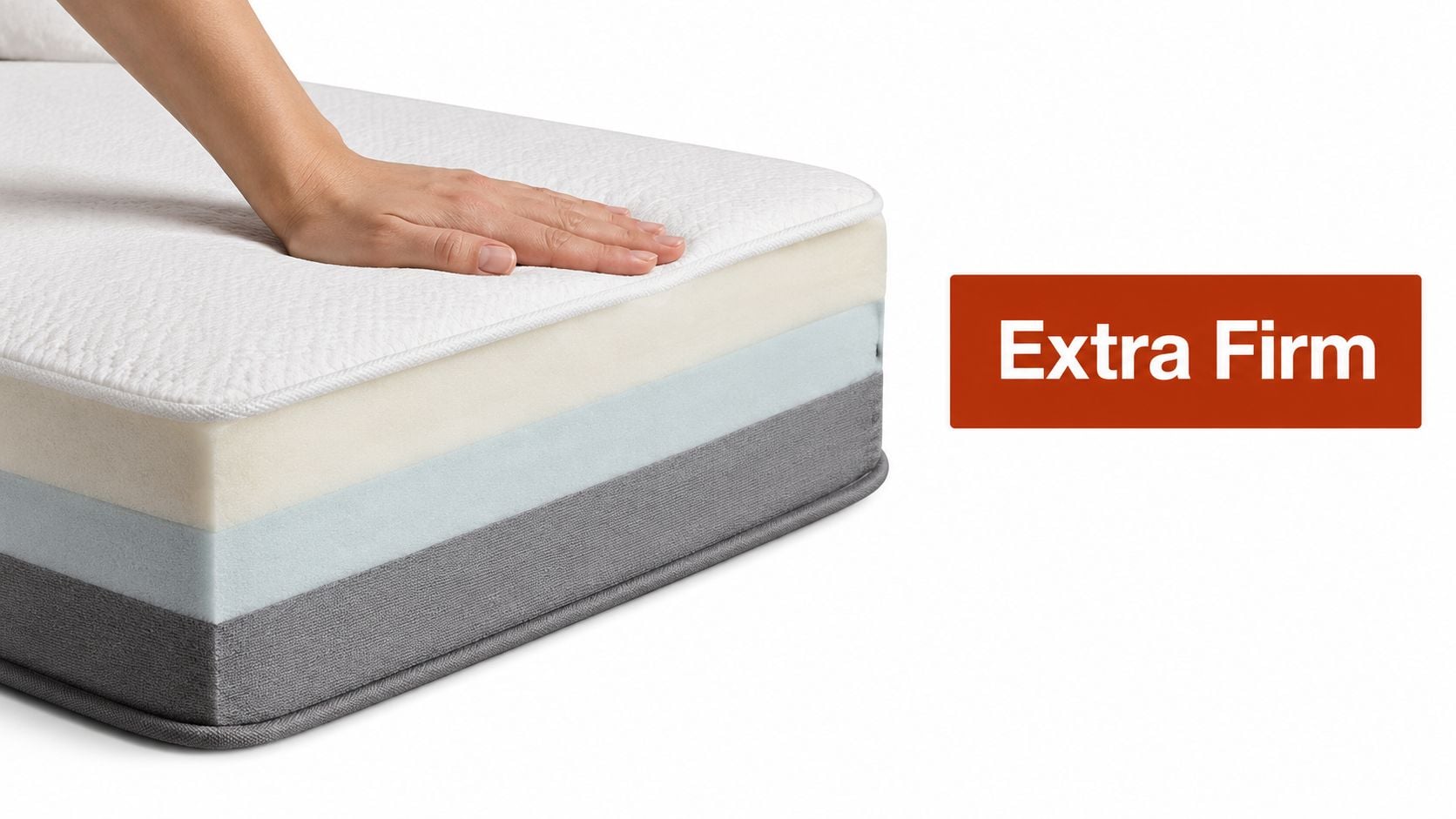
You're standing in a bright bedroom display, your lower back is still stiff from last night, and you're sure the answer must be the firmest bed you can find. Then you press your palm into an extra firm memory foam mattress and pause. It resists you, yes, but it also softens slowly around your hand. That in-between feeling is exactly where most shoppers get confused, and it's where a better decision starts.
Why Extra Firm Feels Different From What Most Shoppers Expect
You expected something close to a board. Instead, the surface gives, just not quickly, and not very far. Your palm sinks a little, the foam holds its shape for a moment, and when you lift your hand away, the outline fades rather than springing back. That patient response is memory foam doing what it was made to do, even in an extra firm design.
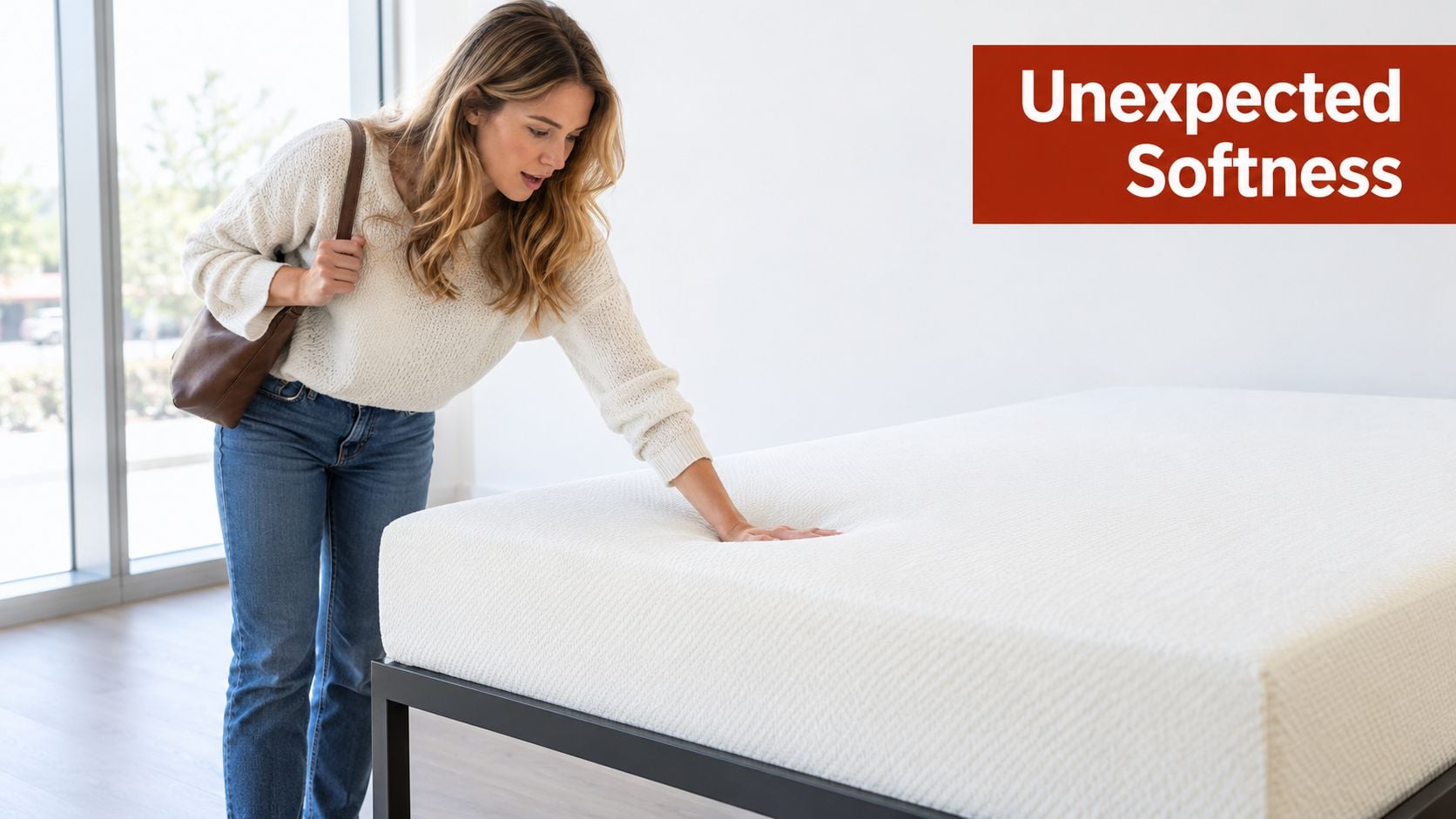
The Question Worth Asking
If memory foam is supposed to contour, what does extra firm change? The honest answer isn't sitting on the surface. Extra firm usually describes how the whole layered construction works together, a thinner or denser comfort layer on top, a transition layer beneath it, and a strong support core that stops your hips from dropping too far.
Picture a well made chair in our Rockledge showroom. The seat can feel composed and upright without feeling punishing, because the frame, the cushion fill, and the pitch are working as one ergonomic system. A mattress works the same way. The top inch tells you very little on its own.
Extra firm is a construction decision, not a surface label. Judge the layers, not the first press of your palm.
Your body changes the equation too. A broader shoulder, a heavier pelvis, or a habit of rolling from back to side will load the foam differently than a lighter, still sleeper does. Sleeping position and body dimensions decide whether that resistance feels like calm support or like pressure building in one spot.
Florida adds one more quiet variable. Warm, humid air can soften viscoelastic foam and slow its recovery, so the bed you test in a cool room may feel a touch less rigid at home on the Space Coast. Once you understand that firmness, body type, and climate all move together, the label on the tag becomes the least interesting part of the bed.
How Memory Foam Actually Behaves Under the Body
Memory foam is a viscoelastic polyurethane foam. In plain language, it behaves partly like a spring and partly like a thick, slow moving material. You press in, it deforms gradually, it conforms to the shape applying pressure, and when the load lifts, it returns slowly rather than bouncing straight back.
Where That Slow Response Came From
The foundational development dates to 1966, when NASA's Ames Research Center sponsored work led by aeronautical engineer Charles Yost, as documented in the Polyurethane Foam Association history of viscoelastic foam development. The goal wasn't a bedroom product. It was energy absorption and pressure distribution for aircraft cushions exposed to high acceleration or impact.
That material became known as slow spring-back foam. Early uses included aircraft seating, medical cushions, wheelchair supports, and hospital mattresses before consumer mattress use became established after technology transfer and manufacturing work in the 1970s and 1980s. If you're comparing constructions while you learn, it can help to browse queen mattress options and notice how layer descriptions differ from one model to the next.
What You Feel in Your Hand
Press an innerspring surface and the pushback arrives almost instantly. Coils compress and return with energy, so you feel lift and bounce. Press memory foam and the response is delayed. The open-cell structure lets air move out gradually as the foam reshapes itself around you.
- Under a shoulder: the foam spreads load over a wider area instead of pushing back at one point.
- Under a hip: it yields more slowly, which is why position changes can feel less springy.
- After you move: the surface takes a moment to recover, holding a brief impression of where you were.
Raising the firmness doesn't erase that behavior. A denser or more supportive formulation offers stronger resistance to compression while retaining pressure conforming behavior. That's why an extra firm memory foam mattress can feel supportive at the surface yet still contour more slowly than an innerspring, a distinction explored in our comparison of memory foam, hybrid, and innerspring designs.
Temperature matters here too, because viscoelastic foam responds to warmth under the body. It softens where you're lying and stays firmer where you aren't. Firmness adjusts how much resistance you meet. It doesn't turn memory foam into a slab, and it shouldn't.
What Extra Firm Really Means on a Firmness Scale
Two mattresses can both carry the words extra firm and feel noticeably different under the same body. That isn't a trick. It's because extra firm is not a universal numerical category across brands, countries, or foam constructions, a point set out in the RTINGS guide to standardized mattress firmness testing.
Firmness Terms and What They Actually Measure
| Term | What it measures | Why it matters |
|---|---|---|
| ILD or IFD | The force required to compress a standardized foam specimen by 25% | Tells you resistance to indentation, layer by layer |
| IPD | Indentation pressure deflection, reported in kilopascals | Normalizes force by contact area for comparison |
| Density | Mass of material in a given volume, in kg/m³ | Relates more closely to durability than to feel |
| Layer thickness | How deep each comfort, transition, and support layer runs | Shapes how quickly you reach the firmer core |
The ASTM D3574-17 test commonly uses a sample measuring 380 millimeters by 380 millimeters by 100 millimeters, compressed by 25% of its original thickness with a 200-millimeter-diameter platen held at target compression for one minute before force is recorded. You don't need to memorize those dimensions. You do need to know that comparisons only make sense when the same test method, compression percentage, sample conditions, and units are used.
Firmness Is Not Density
Shoppers most often get led astray here. Firmness is resistance to indentation. Density describes how much material is packed into a given volume and is more closely associated with durability, as explained in the Bed Guide overview of memory foam firmness and density. A dense foam can still feel soft. A lower density foam can feel firm on day one while wearing more quickly.
A bed can also feel firm for different mechanical reasons. A high resilience support core, a dense comfort layer, and a thin cushioning layer can each produce that first impression, and they'll age differently. Temperature, body weight, sleeping position, and time under load shift perceived firmness further, since viscoelastic foam responds gradually. Our guide to what nobody tells you about mattress firmness before you buy covers that gap between label and lived feel.
Practical rule: ask for both the firmness result and the density, per layer, before you compare two extra firm models side by side.
Who Genuinely Benefits From an Extra Firm Surface
Firmer is not automatically healthier. A systematic review found that medium-firm mattresses generally produced better comfort, sleep quality, spinal alignment, and improvement in nonspecific low-back pain than firm mattresses, as reported in the systematic review of mattress firmness and sleep outcomes. So the question is narrower. When is extra firm appropriate for your body, and when can it work against you?
Profiles That Often Do Well
Back sleepers who feel their pelvis sink below their ribs on softer beds often settle better when the surface limits that drop and keeps lumbar contact even. Stomach sleepers tend to need the same hip lift, because excess pelvic sink can pull the lower back into an uncomfortable arch through the night.
Higher weight sleepers compress softer foams more, so firmer surfaces may help them achieve more neutral alignment. Height and hip circumference influence alignment too, which is why two people of similar weight can still need different surfaces. Combination sleepers sometimes prefer the stable platform for turning, provided the comfort layer still lets a shoulder settle when they roll onto their side.
Profiles That Should Test Carefully
Extra firm construction can reduce excessive hip or shoulder immersion, but excessive surface stiffness can increase localized interface pressure, especially for side sleepers, lighter individuals, and people with prominent bony areas. A controlled clinical study found pressure redistributing foam reduced pressure injury incidence from 10.2% to 1.6% compared with a non-pressure-redistributing foam mattress, and identified thickness, density, firmness, and elasticity as key variables, as detailed in the clinical study of pressure redistributing foam performance.
That study's tested mattress used a 12 cm core with a 90.0 kg/m³ top layer and 55.3 kg/m³ bottom layer. Performance came from engineered layering, not firmness alone. Very firm surfaces may produce pressure peaks at major load bearing regions, while overly soft surfaces can let the pelvis or trunk sink and disturb neutral alignment, as described in research on pressure distribution and spinal alignment across firmness levels.
- Side sleepers: watch for shoulder ache, hip soreness, or arm numbness.
- Lighter sleepers: check whether you compress the comfort layer enough to feel any contour at all.
- Couples: test together, because one firmness level may not distribute pressure equally for both bodies.
Clinical evidence also suggests an excessively firm surface may prevent the shoulders from sinking enough to maintain comfortable neck and upper body support, as summarized in the systematic review of mattress design and spinal alignment. Before you visit, read how to choose the right mattress for your sleeping style and note your dominant position, your pain location, and where pressure builds first.
Reading the Construction Instead of the Label
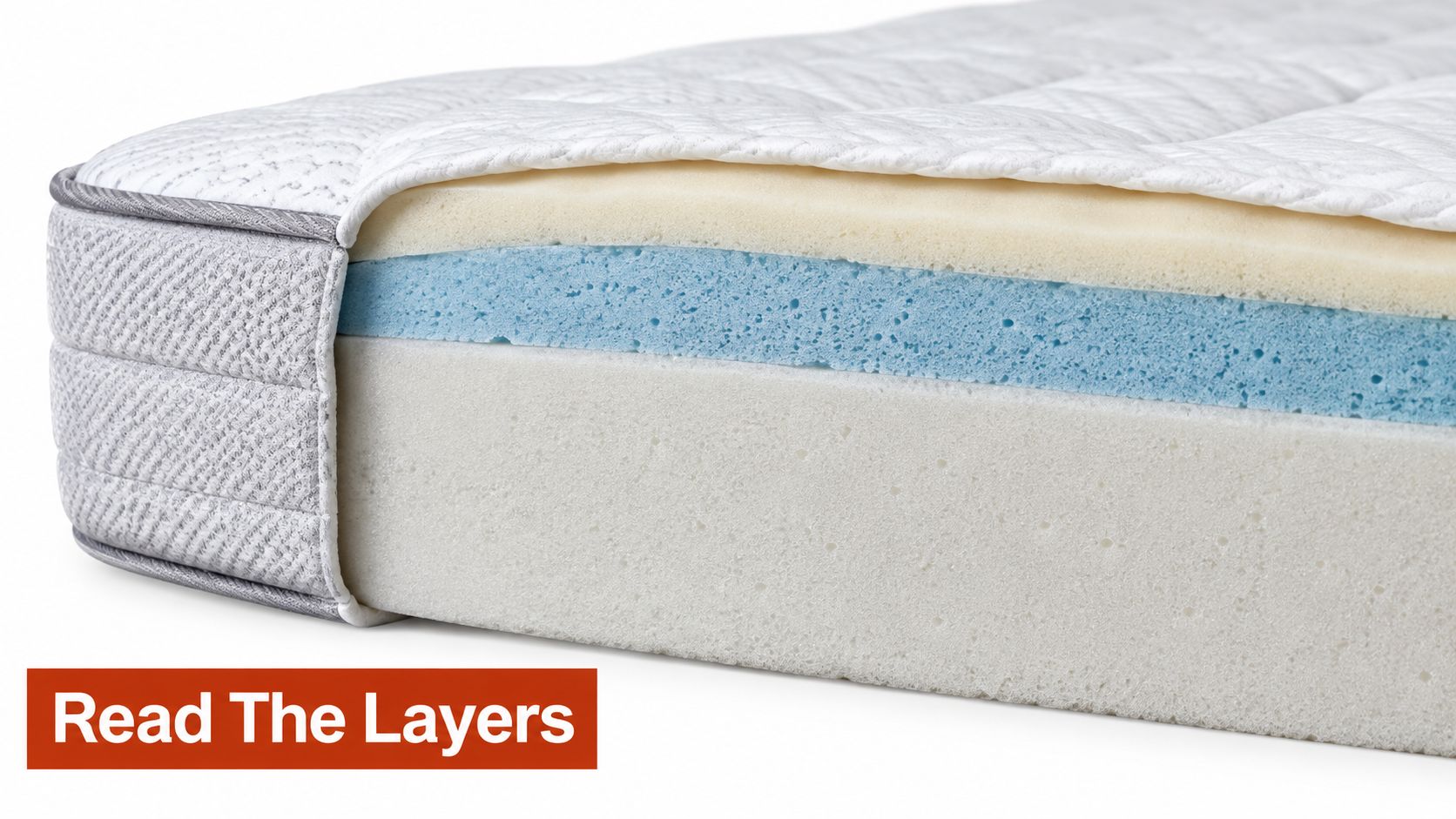
Ask what's inside before you ask how firm it is. A well built extra firm memory foam mattress usually works in three acts, and each layer has a distinct job. When a salesperson can describe those layers clearly, you're evaluating craftsmanship instead of adjectives.
The Three Layers and Their Jobs
The comfort layer meets your body first. In an extra firm build it's often thinner or higher in ILD, so you get modest pressure adaptation without deep immersion. The transition layer beneath it manages the handoff, keeping you from dropping abruptly onto the hard base when you shift weight.
The support core does the long term work. A firmer, higher load bearing base limits pelvic sinking and helps preserve spinal neutrality through the night. A polyurethane foam mattress core specification recommends at least 35 kg/m³ apparent density in heavily loaded zones because higher density generally improves long term service properties, as set out in the technical data sheet for polyurethane mattress cores.
Numbers to Request in the Showroom
- Density per layer: confirm whether a stated figure applies to the memory foam layer or the entire mattress.
- ILD or IFD per layer: request the test method so comparisons stay honest.
- Thickness per layer: a thin comfort layer over a solid core feels very different from thick, dense foam throughout.
Prioritize a support core built for load instead of choosing only the highest density comfort foam. A thin viscoelastic layer can give you contour, while the base carries the load year after year. That balance is what turns a mattress into a long term investment rather than a firm first impression that softens unevenly.
Our ownership team hand tests every seat, sofa, and recliner for pitch and comfort before it reaches the showroom floor, and we bring that same no blind ordering habit to the mattress gallery. It's the standard we've held since 1939 serving Brevard County, the Space Coast, and Central Florida. Pair that testing with our mattress maintenance and cleaning guidance for extending lifespan, and you'll know how the construction you chose should be cared for.
Heat, Humidity, and Longevity in Central Florida
A mattress that feels perfectly firm in an air conditioned showroom can feel a little different in a warm Cocoa Beach or Melbourne bedroom in August. That's not a flaw in the bed. It's the material responding to its environment, and coastal Florida gives it plenty to respond to.
Foam industry guidance states that temperature and humidity can affect firmness, support, and height recovery speed, and that viscoelastic foam tends to soften in more humid conditions, as explained in guidance on mattress moisture, heat, and foam construction. Inadequate ventilation may also slow recovery after compression, so impressions linger longer on still, damp nights.
Managing the Room Around the Bed
Guidance citing the U.S. Environmental Protection Agency recommends keeping indoor relative humidity below 60%, with an ideal range of approximately 30% to 50%, to reduce conditions favorable to mold growth, and a ventilated base can help limit moisture accumulation beneath an extra-firm memory foam mattress, as summarized in Florida indoor humidity guidance citing EPA recommendations. Assess firmness in the climate where the mattress will be used, not only in a cool showroom.
- Choose a breathable foundation: a ventilated base limits moisture under the sleep surface.
- Keep the mattress off the floor: direct floor placement traps damp air beneath dense foam.
- Address leaks promptly: inspect the underside and foundation periodically, especially after storm season.
- Let bedding breathe: pull covers back during routine cleaning so the surface can ventilate.
Bedding choices complete the system. If you're refining the layers above the mattress, these personalized blanket gifting ideas offer a useful look at temperature regulating covers that won't trap unnecessary heat. And for warm sleepers, our guidance on staying cool at night with a summer mattress setup ties foundation and fabric choices together.
Dense foams hold their shape longer, but only when the climate around them is managed with the same care as the bed itself.
We think about durability the same way across the home, from performance fabrics and genuine leathers to solid hardwood frames chosen for Florida's climate and active coastal lifestyles. A mattress deserves that same stewardship. Managed well, an extra firm surface keeps its composed, resilient feel far longer.
Bringing It Together in the Showroom
Bring your body, your sleeping position, and your climate into one visit, and treat the showroom as a working lab rather than a quick stop. Our 32,000 sq ft Rockledge showroom is arranged in curated coastal vignettes for a reason. You can test a mattress in a room setting, then step back and picture the whole bedroom with our complimentary in-house interior design consultations.
A Calm Testing Checklist
- Lie in your normal position for 10 to 15 minutes: brief trials hide the pressure that builds at shoulders and hips.
- Check lumbar contact on your back: your lower back should feel supported, not suspended.
- Roll to your other side: note how easily you move and whether your shoulder settles or jams.
- Ask for the full layer breakdown: thickness, density, and ILD per layer, in writing.
If you're building broader sleep habits alongside a new bed, a science-backed sleep improvement plan can help you separate mattress problems from routine problems. At Indian River Furniture, our premium uniform white-glove delivery team then handles setup in your room, so the foundation and ventilation we discussed are right from the first night.
When extra firm is the correct fit, it feels supportive at the surface, patient in its contour, and stable through changing Florida nights. You won't feel perched, and you won't feel swallowed. You'll feel held level, with pressure spread evenly.
Visit our Rockledge showroom this week, bring your sleep position and your questions about layers, density, and ILD, and spend a full fifteen minutes testing an extra firm memory foam mattress the way you actually sleep. Our design team will walk the vignettes with you, help you pair the right foundation and bedding, and arrange white-glove delivery once you've found the surface your body trusts.