Schedule your Complimentary Design Consultation


Coastal Dining Room Furniture: A Complete Guide


You've found a dining table with the right washed-wood finish, and you can already imagine Sunday brunch stretching into the afternoon. Then the practical questions arrive. Will the chairs stay comfortable, will the surface tolerate everyday spills, and what happens when someone leaves the sliders open to a salt-tinged breeze? Choosing coastal dining room furniture in Florida starts with those questions, not the color swatch.
The Coastal Dining Room, Through a Florida Lens
A Brevard County dining room rarely serves just dinner. It might hold a family breakfast, a visiting grandchild's drawing project, or a leisurely meal after an afternoon near the Banana River. The furniture needs to feel welcoming through all of it, without requiring everyone to treat the room like a display.
That's why it helps to separate coastal appearance from coastal performance. Pale wood and woven textures describe a look. Construction, finish protection, upholstery care, and the room's indoor conditions determine whether that look suits your household.
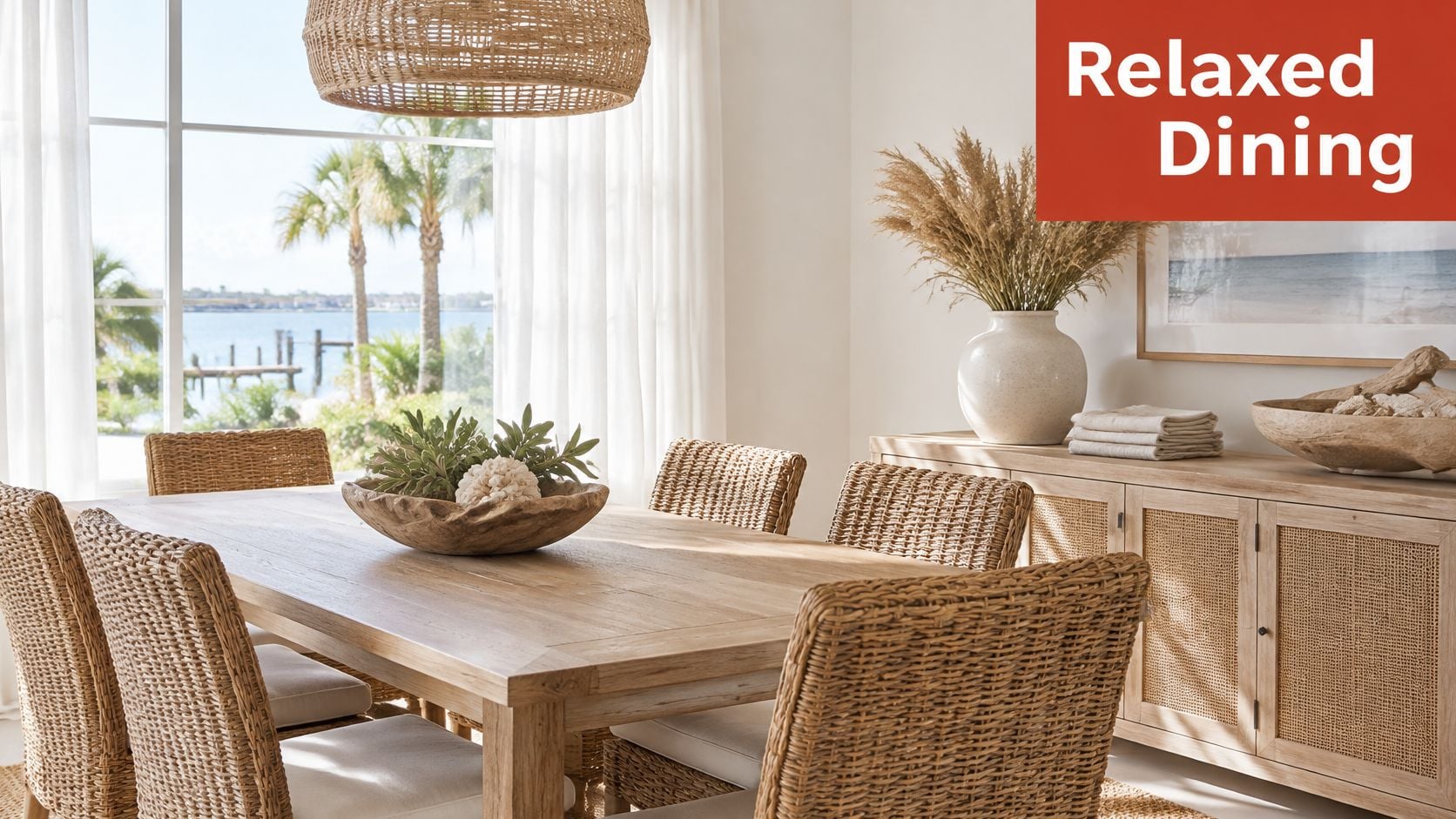
Start With the Room You Actually Have
Before choosing a set, consider where it will live. An enclosed, climate-controlled dining room calls for a different conversation than a screened lanai. A table beside frequently opened sliding doors also deserves different attention than one farther inside the house.
Indoor furniture shouldn't be assumed suitable for outdoor exposure, even when its styling looks perfectly at home beside a pool. Describe the installation location accurately when you speak with a designer, including nearby doors, direct sunlight, and how consistently you use air-conditioning.
Bring the daily routine into that conversation:
- Everyday meals: Think about the foods, spills, and cleaning habits the furniture will encounter.
- Long gatherings: Prioritize seating you enjoy after the plates have been cleared.
- Visiting guests: Consider whether you need flexible seating or a table that extends.
- Storage: Identify what should live near the table rather than across the house.
Start here: Choose furniture for the room's conditions and the household's habits, then refine the coastal look.
The local showroom tradition is useful because these decisions benefit from conversation, not just photographs. In Rockledge, a hands-on visit lets you connect what you see with what you feel: the chair's balance, the table edge beneath your forearm, and the way a cabinet door closes. That's a more dependable starting point than a beautiful image alone.
Defining the Coastal Look Without Falling Into Clichés
Coastal elegance is an atmosphere, not a collection of beach symbols. You don't need a room full of shells, rope details, or matching weathered finishes. A more personal interpretation begins with natural light, comfortable proportions, and surfaces that feel pleasant to use.
Think of the shoreline as a palette rather than a theme. Sand suggests warm neutrals; water offers everything from misty blue to deep green; shaded vegetation introduces richer accents. These references can be subtle enough that the room still feels connected to the rest of your home.
Work With Proportion, Light, Color, and Texture
Start with proportion. A substantial table can look beautifully grounded when the chairs have open backs or slender profiles. Conversely, generous upholstered chairs may benefit from a table with a visually quieter base.
Then study the light. View finish and fabric samples in your own room during different parts of the day, with your usual window treatments in place. In a sun-bright Central Florida interior, a saturated blue chair or green sideboard can be an appealing counterpoint to pale walls, but the combination should feel comfortable to your eye.
- Color: Choose a main neutral, then introduce an accent you'd enjoy beyond the dining room.
- Texture: Pair a smooth tabletop with a tactile upholstery weave or softly textured rug.
- Contrast: Mix light and dark deliberately instead of making every finish nearly match.
- Restraint: Leave some surfaces clear so the furniture's shape and craftsmanship remain visible.
The showroom's coastal design style guidance offers a useful starting point for translating those preferences into a coordinated interior.
Make Room for Hospitality
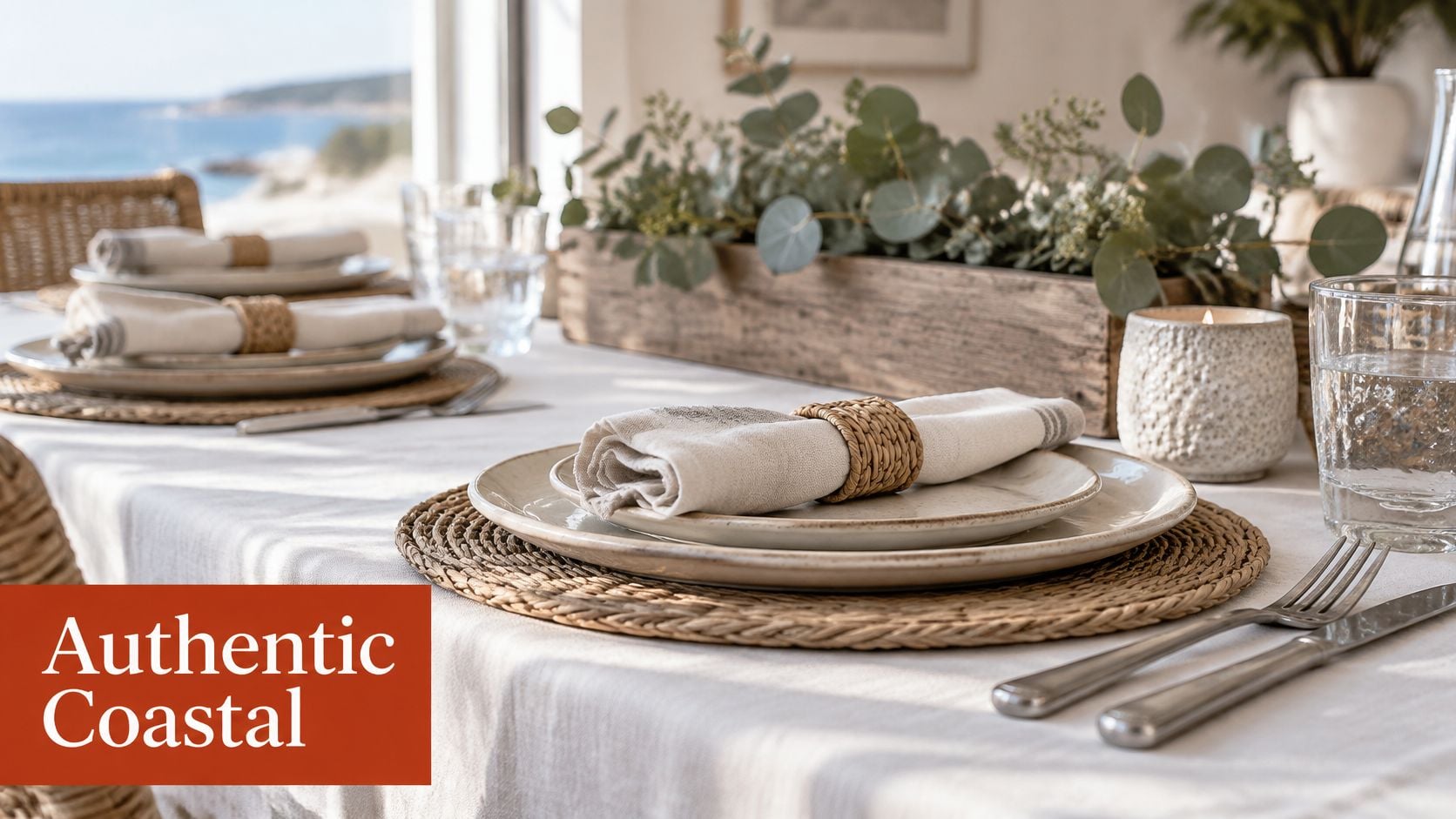
A dining room should still feel inviting when it isn't fully dressed. Try evaluating your proposed furniture with ordinary dishes and a simple bowl of greenery rather than relying on elaborate tabletop styling.
For the entertaining side of that approach, Lello.Store's resource on pantry staples for elegant hosting is a companion to planning a welcoming table. Keep the setting relaxed enough that guests can pass a platter without navigating a centerpiece.
The goal isn't to reproduce a coastal postcard. It's to create a room that feels like your home, with enough visual ease that conversation remains the main event.
Materials and Finishes Built for Salt, Sun, and Air-Conditioning Cycles
A finish name tells you how a table looks. It doesn't tell you how the top is assembled, what lies beneath the surface, or whether the construction accommodates movement. Those are the questions that distinguish a decorative choice from a considered heirloom investment.
Understand What Wood Needs
Wood is hygroscopic, meaning it absorbs and releases moisture as surrounding conditions change. Movement occurs mainly across the grain, so a broad tabletop needs construction that allows it to move without forcing its joints apart. The National Park Service explains that changing relative humidity can cause expansion, splitting, warping, and veneer loss in wood objects, which makes environmental stability an important part of furniture care (wood-object preservation guidance).
For indoor woodworking, lumber moisture content of approximately 8–12% is a common target under average heat and humidity conditions, not a universal specification for every Florida home (wood-movement guidance). Kiln-drying matters, but the lumber must also be appropriately conditioned for its intended environment.
Ask how the top attaches to the base and whether that connection accommodates movement. Finish coverage underneath and around edges matters too. The hardwood selection and longevity guide can help you prepare more useful questions than asking which species is strongest.
Veneer isn't automatically a lesser choice. A well-designed veneered panel can be appropriate, but its substrate, edge protection, and balanced construction deserve scrutiny. Technical guidance identifies balanced construction as the most reliable approach to reducing warping in wood-based panels (dimensional stability guidance).
Material and Finish Options for a Coastal Dining Room
| Material Category | Stability in Humidity | Cleanability | Coastal Suitability |
|---|---|---|---|
| Solid hardwood with a protective finish | Needs appropriate conditioning and movement-friendly joinery | Follow the finish-specific care instructions | A strong candidate for controlled interiors when properly constructed |
| Veneer over an engineered panel | Depends on the substrate and balanced construction | Protect seams and edges from lingering moisture | Appropriate when panel quality and edge protection are documented |
| Performance fabric over a solid hardwood frame | Evaluate frame construction separately from upholstery | Confirm approved cleaning methods for the exact fabric | Useful for active dining spaces when care requirements fit the household |
| Genuine leather upholstery | Evaluate the leather finish, frame, and installation conditions | Use only the recommended leather-care method | A tactile option when its care requirements suit daily use |
Repairability is also product-specific. Ask whether a finish can be touched up, a seat recovered, or a hardware component replaced. Neither solid wood nor a performance label answers those questions by itself.
Performance fabrics, genuine leathers, and solid hardwood frames offer useful options for Florida's active lifestyles, but none makes indoor furniture weatherproof. Handle samples, compare care instructions, and distinguish stain cleanability from resistance to sunlight or moisture.
Mixed-material tables need the same scrutiny. Salt-bearing moisture can encourage corrosion, so protected metal components, intact coatings, and carefully finished recesses matter (coastal hardware and corrosion guidance). Ask about direct-sun exposure rather than assuming a finish or upholstery is fade-resistant.
For everyday surface protection, N-TASH's N-TASH coaster buying advice offers another practical consideration. Choose protective accessories compatible with your tabletop, and don't leave damp items resting against the finish.
Sizing the Room and the Table the Right Way
Measure the room in use, not just the empty floor. A table can fit between the walls and still make dinner awkward if someone can't pull out a chair without blocking the kitchen route.
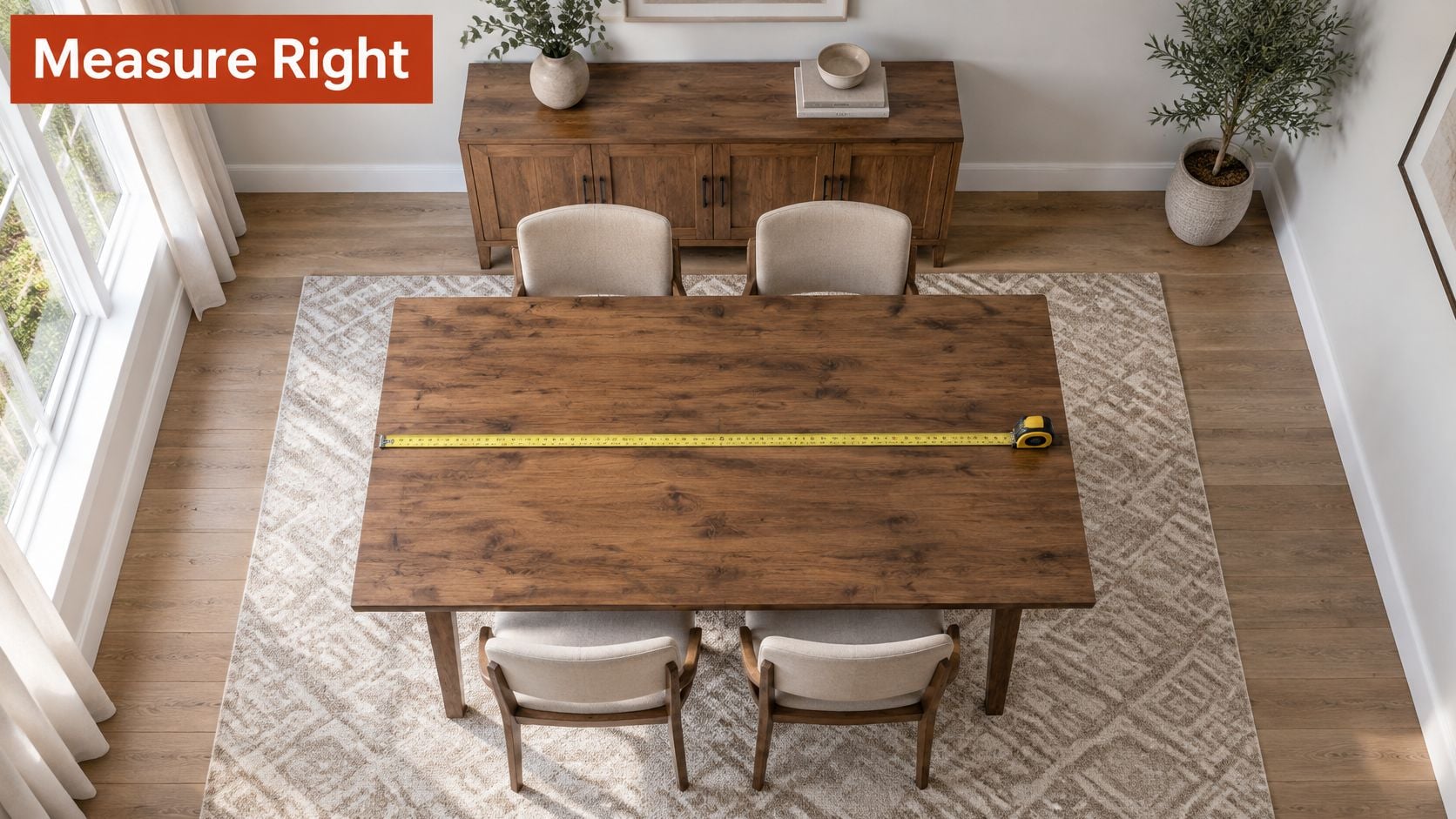
Begin with a tape measure and a simple floor-plan sketch. Record door openings, sliding-door access, fixed cabinetry, and any furniture that will remain. Include the depth of a buffet or sideboard, then consider what happens when its doors or drawers are open.
Test the Full Seating Footprint
Use removable floor tape to mark the proposed tabletop. Then place an actual chair near that outline, sit down, push back, and walk behind it. This reveals more than a tabletop measurement alone.
- Main walkways: Keep the route to the kitchen or patio usable when people are seated.
- Extension leaves: Test the expanded arrangement, including where additional chairs will go.
- Storage access: Allow room to retrieve serving pieces without rearranging the dining area.
- Rugs: Check that chair legs remain supported during ordinary movement.
For a second perspective on circulation, Vizcraft's resource on how to avoid layout mistakes in design can support your sketching process. Bring the measurements and room photographs to your design consultation rather than relying on memory.
Match the Shape to the Household
A round table can feel sociable in a compact dining nook, provided its overall footprint leaves the surrounding routes usable. A rectangular table often relates naturally to a long room and can make furniture placement easier to organize.
An oval table provides a softer outline where corners feel intrusive. A pedestal base may offer flexible chair placement, but inspect its footprint rather than assuming every pedestal provides generous knee space. Trestle supports and corner legs should likewise be tested with the actual chairs you're considering.
Benches and banquettes can help tailor seating to a condo or vacation property, although they aren't automatically more accessible. Consider whether guests can enter and leave independently, especially if someone prefers a supportive armchair.
A dining room fits when people can use it comfortably, not merely when the furniture fits inside its walls.
The guide to table shapes and seating arrangements can help narrow your shortlist. A complimentary room-planning conversation can then resolve the details that a floor plan alone won't show.
Custom Orders, Design Consultations, and White-Glove Delivery
Custom ordering is most useful when it solves a specific mismatch. Perhaps the table proportions are right but the finish feels too cool beside your flooring. Or perhaps you've found a comfortable chair and need upholstery that suits family meals rather than occasional entertaining.
Indian River Furniture, established in 1939, offers custom hardwood dining options alongside its broader dining assortment, giving local households an in-person setting for these decisions (custom hardwood dining table guidance). That long-standing showroom approach is particularly relevant when you want to compare materials together rather than select isolated pieces.
Build the Room Around Its Priorities
The assortment includes dining tables, chairs, benches, buffets, sideboards, and coordinated sets. You can begin with a complete grouping or assemble a combination that suits your space, depending on the room and the options available for each piece.
Customization includes extensive performance fabric and genuine leather selections, along with custom wood finishes. Ask your designer to explain which choices apply to the model you've selected, since upholstery, dimensions, and finish options aren't necessarily interchangeable across collections.
The complimentary in-house interior design consultation helps connect those decisions. Bring flooring samples, photographs of adjoining rooms, and anything you intend to keep. A useful consultation should address the relationship among dining furniture, lighting, storage, and circulation, not whether the chairs match the table.
For example, a designer might help you compare a textured neutral seat with a smoother alternative against the same wood finish. You can then judge the combination by touch, appearance, and care requirements.
Prepare for the Handoff
Ask about premium, uniform, in-house white-glove delivery while planning the room, not after everything has been selected. The service includes unboxing, inspection, and room setup, giving you a clear process for receiving the furniture rather than leaving assembly and packaging questions unresolved.
Discuss entry routes, stairs, building requirements, and the placement of existing furniture beforehand. At delivery, review the finished arrangement and care information, and ask how to request assistance if a concern appears later.
Keep this short preparation list with your room photographs:
- Must-have functions: Everyday dining, occasional expansion, accessible seating, or nearby storage.
- Preferred finishes: Bring samples and identify anything that must coordinate with existing furniture.
- Care expectations: Describe pets, children, frequent guests, and your normal cleaning routine.
- Customization questions: Confirm available choices, care requirements, and replacement options.
- Delivery details: Share access restrictions and ask what needs to be ready before arrival.
The result should feel considered rather than complicated. Customization earns its place when each choice makes the room easier to live with.
How to Hand-Test a Dining Set the Showroom Way
A beautiful dining chair can still be the wrong chair for your body. Seat depth, back pitch, arm position, and the relationship to the tabletop all deserve a real test.
The No Blind Ordering promise reflects that distinction: ownership hand-tests every seat, sofa, and recliner for pitch, structural integrity, and comfort before it reaches the 32,000-square-foot Rockledge showroom floor (explore an upholstered dining armchair). Your own test adds something equally important: whether the furniture fits you.

Begin With Construction, Then Sit
Before sitting, run your hand along accessible edges and look at where the legs, seat, and back meet. Ask how the seat platform is supported and how the frame is joined. Weight alone isn't proof of quality, and visible fasteners aren't enough to judge the whole construction.
Once seated, take your time. Lean toward the table as though cutting food, settle back into conversation, and stand up again. If you use a mobility aid or have difficulty rising, include those ordinary movements in the test rather than judging the chair only while seated.
- Seat depth: Your back should feel supported without pressure behind your knees.
- Arm clearance: Check whether the chair moves close enough to the table.
- Back support: Notice whether you can relax without repeatedly shifting forward.
- Stability: The chair should feel secure during normal sitting and standing.
- Surface comfort: Rest your forearms on the table edge and feel the upholstery through ordinary clothing.
Inspect the Details You'll Maintain
Open cabinet doors and drawers, inspect accessible hardware, and ask how exposed metal components are protected. Look at edges, recesses, and attachment points rather than only the most visible surfaces.
Request a written care routine for the selected finishes and upholstery. Ask how to remove residue, which cleaners to avoid, and what changes should prompt a service request. Gentle care is easier to follow when the instructions identify the actual material rather than just saying “wipe clean.”
A useful showroom habit: Test the chair at the table you intend to pair it with, not by itself across the room.
Curated coastal vignettes provide context, but you don't have to choose a display exactly as shown. Move between your shortlisted pieces with a designer and compare the tactile details. That's how an attractive grouping becomes an ergonomic dining arrangement suited to your household.
Bringing It All Together for a Long-Lasting Coastal Dining Room
The most convincing coastal dining room isn't necessarily the palest or the most weathered-looking. It's the one where the finish, seating, layout, and care requirements make sense together. The relaxed appearance should follow from good decisions, not conceal unanswered questions.
Think of the finished room as an investment in daily use. A table worth gathering around needs more than a handsome top, and an heirloom ambition needs more than a traditional silhouette. Craftsmanship matters most when it supports the way you live.
Keep a Simple Seasonal Routine
Protecting that investment doesn't require treating the room as untouchable. It requires noticing conditions and maintaining the materials you chose.
- During humid periods: Check indoor conditions and investigate persistent dampness rather than ignoring it.
- When rearranging: Inspect accessible joints, hardware, and finish edges while the furniture is easy to reach.
- After gatherings: Follow the approved cleaning instructions and return protective accessories to dry surfaces.
- When questions arise: Use post-purchase support instead of experimenting with an unfamiliar cleaner or repair method.
Make the Final Decision in Person
Carry a simple plan into the showroom: visit, hand-test, and collaborate. Bring your measurements first, experience the shortlisted furniture at a realistic pace, and let the complimentary design team help coordinate the final room.
The family-showroom heritage matters because the relationship shouldn't end at selection. Thoughtful setup, white-glove delivery, and a clear route to post-purchase assistance belong to the same service-first commitment to Brevard County, the Space Coast, and Central Florida.
Visit the Rockledge showroom with room photographs, measurements, and a list of what isn't working in your current dining space. Explore the curated coastal vignettes, sit at the tables, and ask for a complimentary in-house design consultation. You'll leave with a clearer sense of which furniture feels right, fits your home, and deserves a lasting place around your table.