Schedule your Complimentary Design Consultation


Slipcover Dining Chair with Arms: Your Coastal Guide


You've found the table, chosen a finish, and perhaps even saved a photograph of a beautiful coastal dining room. Then one practical question appears: will the chairs actually fit beneath the table, feel comfortable through a long meal, and remain fresh in Florida's humidity?
A slipcover dining chair with arms can answer all three concerns, but only when its proportions, frame, textile, and maintenance requirements work together. The right chair feels pleasantly supportive when you sit down, moves easily when you stand, and keeps its polished appearance after years of family meals, entertaining, and everyday use.
Embracing Coastal Dining with Slipcovered Chairs
A coastal dining room should feel composed without feeling precious. Natural wood, woven texture, soft upholstery, and generous daylight create a setting where breakfast can turn into conversation and a formal dinner can still feel relaxed. In that environment, an armchair at the head or sides of the table does more than complete the arrangement. It establishes the room's posture.
The appeal of a slipcovered armchair is its balance. Upholstery softens the visual weight of the table, while the arms offer a comfortable place to rest during a lingering meal. A removable cover adds practical flexibility. It can be removed for cleaning or replaced when the room's colors, patterns, or seasonal character change.
A relaxed room still needs discipline
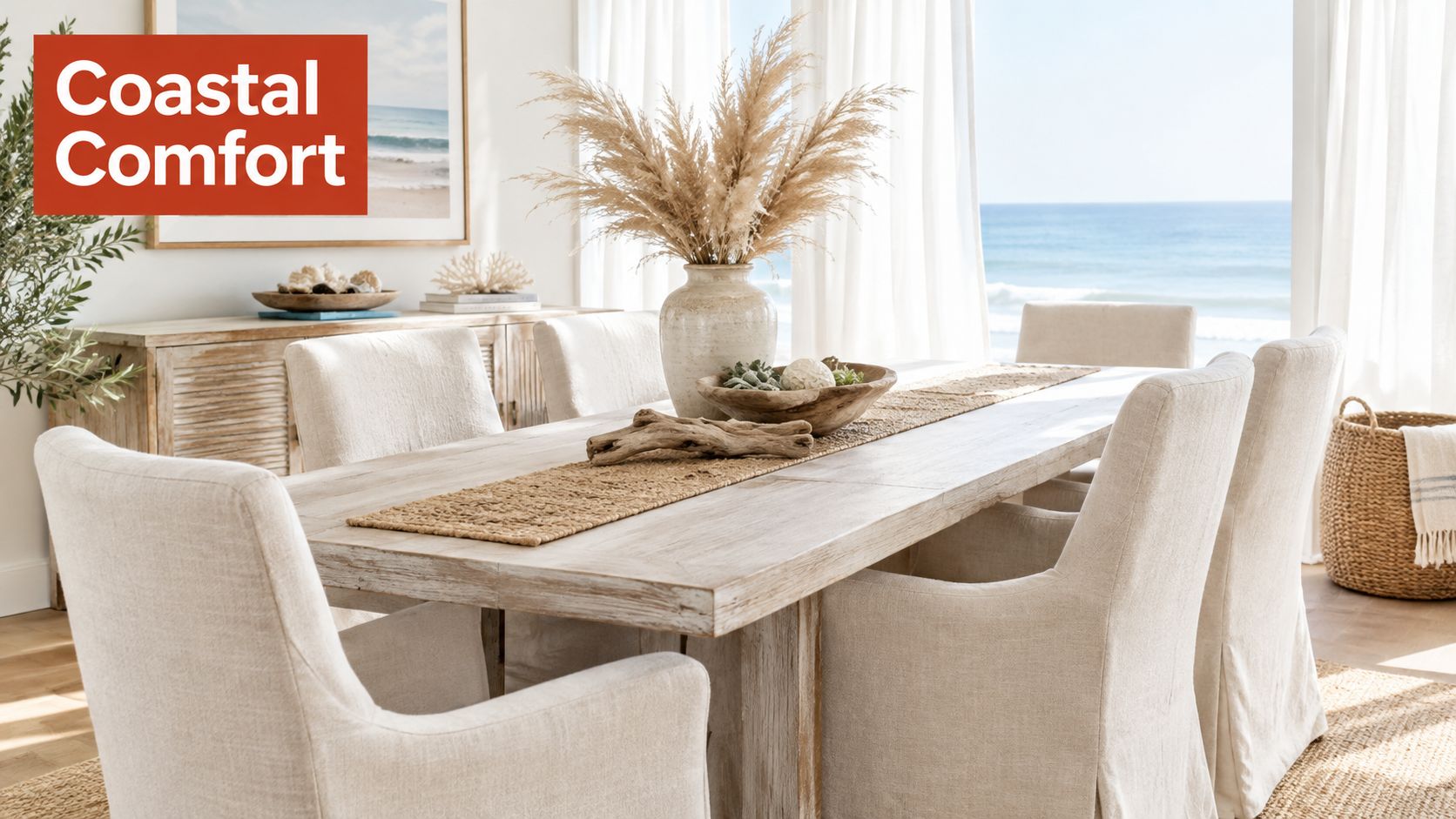
Consider a light oak table surrounded by linen-toned chairs with a clean fit. The covers have enough texture to catch the afternoon light, but the seams remain clean at the arms and front corners. A family can use the room without treating every meal as a ceremony, because a well-made cover is designed for care rather than permanent fragility.
That flexibility suits homes along the Space Coast, where dining areas may host children, pets, visiting relatives, holiday meals, and vacation-rental turnover. The removable layer protects the underlying chair while allowing the room to evolve. Seasonal color can come through a replacement cover, table linens, or ready-to-hang coastal canvas art, rather than through furniture that quickly becomes dated.
The chair as a lasting furnishing
The best coastal interiors aren't assembled from isolated decorative gestures. They rely on a few enduring pieces that make daily life easier. A slipcovered armchair can become one of those pieces when its seat supports upright dining, its arms assist with entry and exit, and its cover can be cleaned without compromising the fit.
That is the difference between a chair chosen only for appearance and one selected as part of the home's infrastructure. The visual language may be relaxed, but the decision should be exact. Explore the principles behind a cohesive coastal design style while keeping comfort, clearance, and care at the center of the selection.
Design perspective: Coastal elegance lasts longer when the furniture feels welcoming on an ordinary Tuesday, not only when the table is fully set.
Understanding the Geometry of Comfort and Fit
A chair can look perfectly scaled in a showroom photograph and still fail at the table. Arms may strike the apron, the seat may push the sitter too far forward, or the outside width may leave too little room to pass behind occupied chairs. Comfort depends on the complete chair-and-table relationship.
Ergonomic evaluations commonly identify a seat height of approximately 40 to 45 cm, a seat depth of about 40 to 48 cm, and a seat width of roughly 42 to 50 cm as relevant dimensions for adult comfort. Backrest heights in reviewed standards and examples range from approximately 38 to 60 cm, depending on chair type and upper-body support. These measurements provide a useful starting point, not a substitute for sitting in the actual chair. (Ergonomic seating dimensions)
Measure the functional envelope
For a practical reference, an approximately 18-inch, or 46 cm, seat height often pairs with a conventional dining table. An armchair may reach about 24 inches, or 61 cm, in overall width, while an armless chair may be roughly 19 inches, or 48 cm, wide. Those differences can change how many chairs fit comfortably and whether the end chairs tuck beneath the table.
Measure the chair's widest point, not merely the width between its legs. Then record:
- Overall outside-arm width, including the fullest part of the slipcover.
- Inside arm width, which determines usable seating space.
- Seat height and depth, checked from the finished, covered surface.
- Arm height from the floor, including the arm cap and any cover padding.
- Floor-to-apron height, measured at the exact location where the chair must slide.
- Clearance between neighboring chairs, especially along walkways.
The relationship between arm width and clearance creates the central trade-off. More substantial arms can improve lateral support and make standing easier, but they also consume space at the table and in the circulation path. A higher arm cap may feel reassuring beside the seat, yet prevent the chair from moving beneath the tabletop.
Test the table, not the photograph
The chair should support an upright eating posture rather than encourage lounge-style sitting. A deep seat or strongly reclined back can feel pleasant for a short trial and awkward during a full meal, particularly when the table is used for writing, serving, or conversation across the room.
Before ordering a fitted cover, test the complete arrangement. Sit down, place both feet comfortably, rest your forearms, pull the chair out, and push it back under the apron. If someone with reduced mobility will use the chair, test whether the arms provide stable support without forcing the body into a narrow opening. Research on seating for older adults found armrests important for entry and exit, with armrests approximately 250 mm above the seat identified as helpful, while seat height, depth, back angle, and under-seat clearance also influenced sit-to-stand performance. (Seating and sit-to-stand research)
A useful dining-table reference is available in this guide to dining table heights. The goal isn't to find the largest, softest armchair. It's to find a chair whose support fits the body and whose dimensions respect the room.
Evaluating Craftsmanship and Structural Foundations
Fabric attracts attention first, but the frame determines whether the chair remains quiet, square, and supportive after repeated use. Every time someone pulls an armchair from the table, sits down, shifts position, or pushes up to stand, the arms and seat rails absorb lateral forces. A beautiful cover can't correct a weak foundation.
Start with the frame. Solid hardwood is a valuable choice for a dining chair intended to become an heirloom, especially in a region where indoor moisture changes throughout the year. Look for arms that connect into the main frame rather than appearing attached only to the upholstered shell. Press gently against each arm and observe whether the chair responds as one stable structure or flexes at the joint.
Examine the joints and rails
Traditional mortise-and-tenon construction joins a projecting piece of wood to a matching socket. Utah State University Extension describes this joint as very strong in chair construction, where it connects the frame and legs to the seat. The same guidance identifies sturdiness as a useful indicator of how long a chair or bench may last. (Mortise-and-tenon furniture construction)
A practical inspection follows the load path:
- Hold the back and arm together. Look for movement where the arm support meets the back post or seat rail.
- Inspect the underside. Seat rails should meet cleanly, with no visible separation, loose fasteners, or uneven movement.
- Check the legs. A chair should sit level and remain stable when weight shifts from one side to the other.
- Feel the seat foundation. The cushion should recover evenly, while the frame beneath it should not creak or bow.
- Study the cover stress points. Arm fronts, front seat corners, and closures receive repeated handling and deserve reinforced construction.
Wood movement deserves particular attention in humid regions. A 2025 study of mortise-and-tenon joints reported greater durability under cyclic loading for glued connections than for knockdown joints, with larger tenons and glued joints achieving higher cyclic durability. It also recommended limiting moisture-content differences to a maximum of 4% for pine joints and 5% for beech joints to reduce stress, cracking, and potential failure. (2025 mortise-and-tenon durability study)
The slipcover should fit the structure rather than disguise it. A fitted cover with secure closures and defined panels will preserve the chair's shape. A loose universal cover may bunch where the arm meets the seat, shift the sitter's position, and create snag points. For a deeper look at choosing wood for longevity and style, review this guide to hardwood furniture construction.
Selecting Performance Fabrics for Coastal Living
“Performance fabric” is a useful category, but it isn't a complete specification. A dining chair textile must handle abrasion, food soils, repeated removal, cleaning, sunlight, and the moisture conditions of a Florida home. Those demands can conflict. A tightly woven fabric may resist wear while absorbing spills, while a treated textile may repel liquid but require careful attention to its finish and cleaning instructions.
Abrasion testing gives buyers a common comparison point. The Wyzenbeek method records repeated back-and-forth abrasion, with one back-and-forth pass counted as one double rub. Published guidance places ordinary residential upholstery broadly around 10,000 to 25,000 double rubs, while medium household use is often described around 12,000 to 20,000 double rubs. Other guidance identifies 9,000 to 15,000 double rubs as medium duty and 15,000 or more for heavier residential use. (Upholstery abrasion guidance)
For a frequently used dining armchair, ACT guidance identifies 30,000 Wyzenbeek double rubs as an appropriate benchmark for heavy-duty woven upholstery, including dining-area applications. The test records cycles until two yarns break or noticeable wear appears. (ACT abrasion testing guidance)
Compare the complete fabric specification
A high rub count doesn't establish stain resistance, seam strength, colorfastness, or washability. Ask for the following information together:
- Test method: Wyzenbeek and Martindale results aren't interchangeable.
- Fiber composition: Cotton, linen, polyester, and blends respond differently to moisture, heat, abrasion, and drying.
- Cleaning code: Confirm whether the cover can be laundered, spot cleaned, or professionally cleaned.
- Lightfastness information: This matters in rooms exposed to strong windows and glazed doors.
- Replacement-cover availability: A replaceable cover can extend the useful life of the frame and cushion.
Cotton and linen offer a natural hand and breathable texture, but absorbency makes prompt blotting important. Polyester and performance blends may offer easier soil management and strong abrasion resistance, though some constructions can feel warmer or show pressure marks. The best choice depends on how the chair is used, not on a single impressive number.
Consider treatments and the room around the chair
Stain and water repellency can involve chemical finishes, including persistent chemicals such as PFAS. Buyers should ask whether a treatment is PFAS-free and whether the manufacturer provides transparent care instructions. A washable, tightly woven removable cover may be the lower-maintenance choice when compared with a treated fabric that cannot be washed. (Upholstery textiles, allergens, and chemical-treatment considerations)
The floor and surrounding surfaces matter too. Dining spills rarely stop at the chair, so a practical guide to stone floor cleaning can help coordinate care across the room without using an unsuitable product on either textile or stone. For Florida-specific fabric selection, see this resource on performance fabrics for spills, splashing, and shedding.
Essential Care Tips for Long-Lasting Beauty
A removable cover only delivers its full benefit when the care routine respects the fabric and the climate. The most common mistake is reinstalling a cover while the fabric, cushion, or frame is still damp. In a humid home, trapped moisture can affect upholstery, wood, and the clean tailored line that made the chair appealing in the first place.
Begin with gentle, regular attention rather than aggressive cleaning after a problem has spread.
A practical maintenance sequence
- Vacuum seams and arm fronts. Use a suitable upholstery attachment and work slowly around piping, closures, and the underside of the cushion. These areas collect crumbs and dust that can work into the weave.
- Blot fresh spills. Lift the liquid with a clean absorbent cloth instead of rubbing it deeper into the fabric. Follow the manufacturer's cleaning code before applying any solution.
- Remove covers carefully. Open closures fully and support the fabric as you pull it away from the arms and corners. Stretching one section can alter the fit.
- Wash or clean as specified. Machine washing is appropriate only when the care instructions allow it. Water temperature, agitation, drying method, and shrinkage control all affect the final fit.
- Dry every component completely. Lay covers flat or use the approved method, and allow cushions and exposed frame areas to air out before reassembly.
- Reinstall without forcing seams. Align corners, panels, and closures gradually. If a cover no longer fits, stop rather than pulling until a seam strains.
The Florida Department of Health advises keeping indoor relative humidity below 60%, with levels below 50% preferable for controlling mold growth and dust mites. That makes a humidity monitor, ventilation during cooking, and reliable air movement sensible parts of furniture care. (Florida indoor humidity guidance)
Protect the structure and textile
Keep upholstered chairs away from strong direct sun where possible, especially when the fabric lacks documented light-stability information. Leave enough space around the chair for air circulation, and pay attention to locations near exterior doors, windows, kitchens, and other moisture-prone areas.
Removing the cover periodically also gives you a chance to inspect the padding, seams, and frame. Extension guidance notes that mold on furniture may involve finished or unfinished wood as well as upholstered components, so the cover should never be treated as a permanent barrier that eliminates inspection. (Florida furniture moisture guidance)
Some households prefer the crisp appearance of light upholstery and worry that it will demand constant vigilance. The same principle applies to other light-colored seating. This guide to white leather chairs offers useful context on maintaining a pale surface, although fabric and leather always require their own care instructions.
Creating a Timeless and Functional Dining Room
The strongest dining rooms are designed as working rooms first and styled rooms second. The table needs enough breathing space for movement. The chairs need to support the body without blocking the apron. The upholstery needs to respond to spills, light, and humidity. When those conditions align, the room feels effortless because the furniture isn't asking the household to work around it.
A slipcover dining chair with arms is particularly effective when treated as a long-term investment. Its removable textile can adapt to a change in color or season, while a well-built frame remains useful through those changes. That combination gives the chair a role beyond decoration. It becomes part of the home's daily rhythm, from morning coffee to a late meal with visiting family.
Build the room around real use
Start with the people who will sit there. A multigenerational household may value arm support for standing. A vacation rental may need removable covers and clear cleaning procedures. A family that entertains frequently may prioritize abrasion resistance and replacement-cover availability. A smaller dining room may need narrower arms and a more disciplined tuck-under fit.
Then consider the visual composition. A custom-fit cover can soften a substantial wood table, while a textured neutral can sit comfortably beside woven lighting, natural flooring, and coastal artwork. The room should feel curated, not coordinated to the point of sterility. Small differences in weave, wood grain, and finish create the relaxed luxury associated with durable coastal interiors.
Use a complete selection checklist
Before committing, confirm:
- Body fit: The seat supports upright dining, and the back angle suits the expected length of use.
- Arm ergonomics: The arms help with rest and entry without narrowing the usable seat excessively.
- Table geometry: The arms clear the apron, and the chair can tuck away without obstructing circulation.
- Structural quality: The frame feels stable, the joints remain quiet, and the arm supports connect securely.
- Textile performance: The fabric has a documented test method, cleaning code, fiber composition, and lightfastness information.
- Humidity routine: The household can remove, clean, dry, and reinstall the cover correctly.
- Future flexibility: Replacement covers or a compatible textile program can support changing décor and long service.
A thoughtful guide to designing a dining room can help organize the broader layout. The essential insight is simple: a beautiful chair becomes a lasting chair only when its comfort, construction, cover, and environment agree.
For homeowners in Brevard County, the Space Coast, and Central Florida, Indian River Furniture brings that evaluation into a hands-on setting. Established in 1939, the Rockledge showroom offers 32,000 square feet of curated coastal vignettes, and the ownership team hand-tests every seat, sofa, and recliner for pitch and comfort before it reaches the showroom floor. Visit to test the actual furniture, explore performance fabrics, genuine leathers, and solid hardwood frames, and use a complementary in-house interior design consultation to check the complete table-and-chair arrangement. When your selection is ready, the uniform in-house white-glove delivery team can handle setup and inspection, including the standard $99 delivery fee within the service area.