Schedule your Complimentary Design Consultation


Power Reclining Sectional Sofa Guide for Coastal Comfort

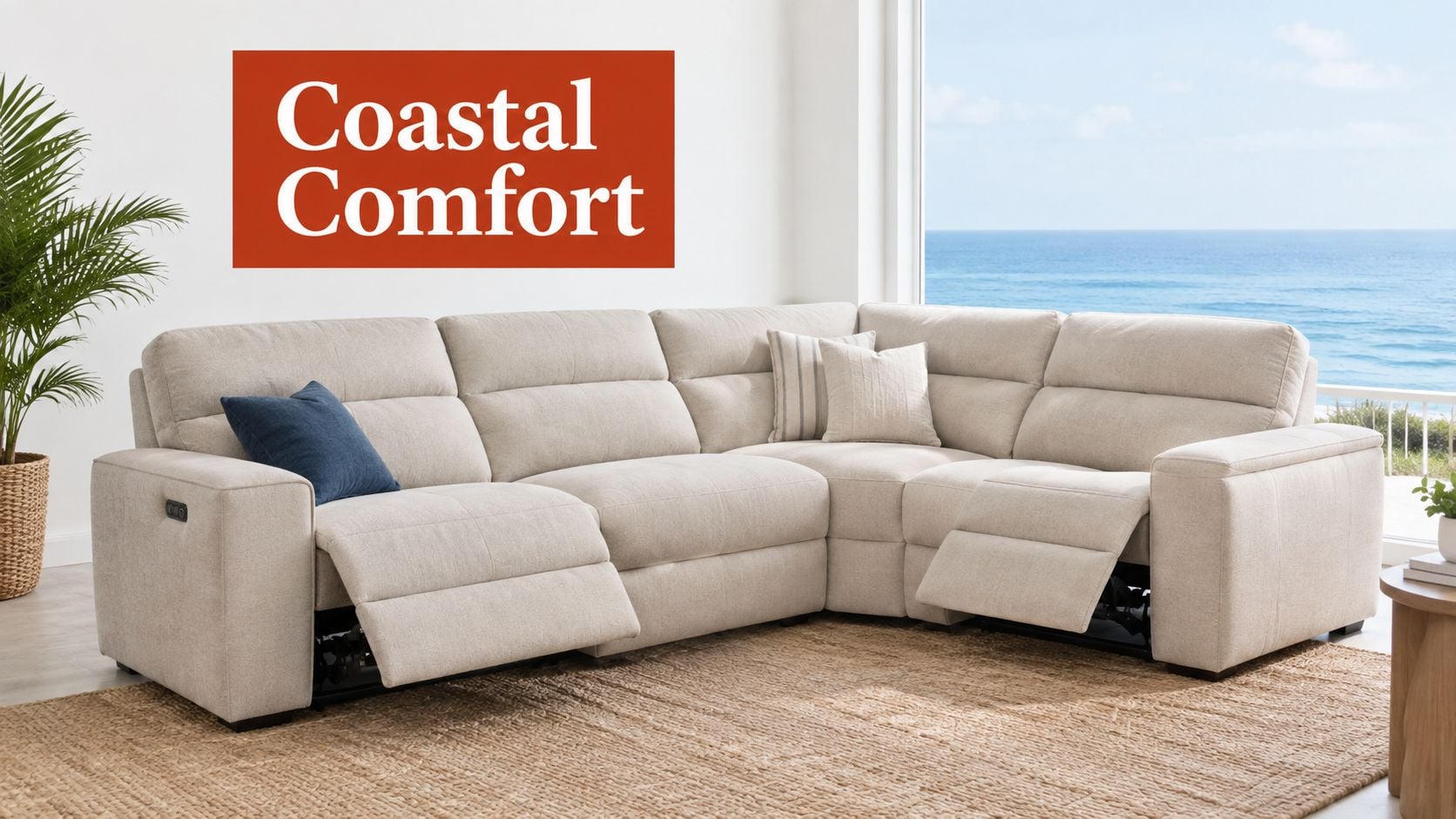
Late afternoon light is pouring across the tile floor. The ceiling fan is moving slowly. Someone has kicked off their sandals, someone else has a book open, and the dog has already claimed the corner cushion. That's the moment when a living room either supports the way you live, or it asks you to keep adjusting yourself to the furniture.
A Power Reclining Sectional Sofa changes that relationship. Instead of one fixed posture for every evening, it lets the room respond to movie nights, visiting family, quiet mornings, and those in-between hours when you want your feet up without losing proper back support. In coastal Florida homes, that flexibility matters even more. Rooms often do double duty. They need to feel polished enough for guests, relaxed enough for daily life, and durable enough for salt air, sunlight, and constant use.
Motorized motion seating is no longer a niche corner of the furniture world. In the global recliner market, power recliners represented 58.3% of unit sales and 63.2% of revenue in 2025, with an estimated value of $17.3 billion, while the overall recliner market reached $27.4 billion in 2025 and is projected to reach $39.8 billion by 2034, implying 5.2% CAGR, according to Market Intelo's recliner market report. For homeowners, that tells us something simple. People are choosing powered comfort in meaningful numbers, and they're often choosing more refined, higher-value designs.
Table of Contents
- Introduction to Power Reclining Sectional Comfort
- What Makes a Power Reclining Sectional Different
- How Motors Controls and Power Needs Work Together
- Planning Power Safety and Placement in Your Living Room
- Craftsmanship That Stands Up to Florida Living
- How to Choose the Right Configuration and Test for Fit
- Bringing Curated Comfort Home With Confidence
Introduction to Power Reclining Sectional Comfort
A power reclining sectional sofa often enters the conversation when a room no longer works the way a family wants it to. A stationary sofa may look crisp, but by the end of the evening everyone is stacked at one end trying to find a comfortable angle. A recliner might feel wonderful for one person, yet it can fragment the room and leave conversation scattered.
That's why so many homeowners start considering a sectional with power motion. It offers the visual calm of a unified seating plan, but with comfort that adjusts seat by seat. One person can sit upright and read. Another can lift the footrest and soften the day out of their lower back. A guest can settle into the corner and still feel part of the room.
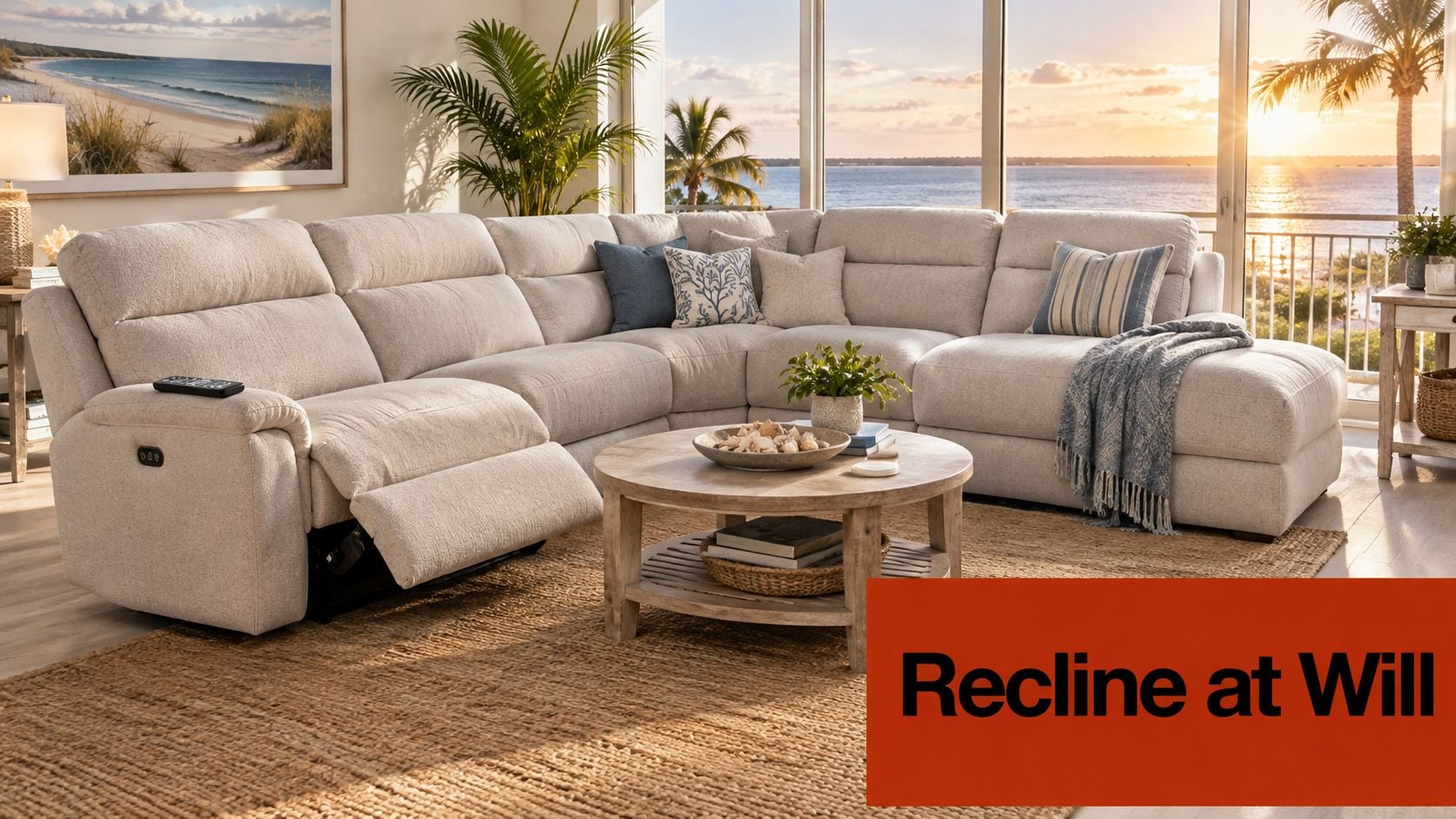
Why this style feels different in daily life
A well-made power sectional doesn't feel like a gadget. It feels composed. The motion should be quiet, the support should feel ergonomic rather than stiff, and the profile should still belong in a thoughtfully designed coastal home.
There's also a strong market reason this category keeps growing. Recliners have been a durable furniture category for decades. A 1975 New York Times report on industry research noted that recliner sales rose about 3% in 1974 even as overall furniture sales value declined 10%, and projected 11.6% annual growth for recliners from 1974 to 1978. That same report noted about 3.8 million chairs worth $250.8 million by 1973. In more recent data, recliner sofas were valued at $6.9 billion in 2020 and are expected to reach $10.4 billion in 2026, then $17.4 billion by 2033 at 7.6% CAGR, while another industry report places the recliner sofa market at $20.15 billion in 2024 and $21.12 billion in 2025, with sectional formats projected to grow from $6.05 billion to $9.8 billion by 2035, according to Market Intelo's reclining sofa market report.
A power sectional works best when comfort, room planning, and craftsmanship are considered together, not as separate decisions.
What thoughtful buyers usually want to know
Most confusion begins in three places:
- How the motion works: Buyers want to know whether power recline means smoother support or just more electronics.
- What it asks of the room: Placement, outlet access, and wall clearance matter more than many people expect.
- How it holds up over time: The upholstery may look beautiful on day one, but the deeper question is whether the frame, joinery, and mechanism are built for years of repeat use.
Those are the practical questions that turn a showroom visit into a confident decision.
What Makes a Power Reclining Sectional Different
A stationary sectional is simple. It gives you shape, scale, and seating capacity, but every cushion stays in one position. A manual recliner changes position through body pressure or a lever. A power reclining sectional sofa uses a motorized mechanism to move the seat in a controlled way.
That difference sounds technical, but it's easy to picture. A manual recline feels a bit like opening a heavy window yourself. A power recline feels more like pressing a well-made shade control and letting the movement happen smoothly and evenly.
The parts that matter most
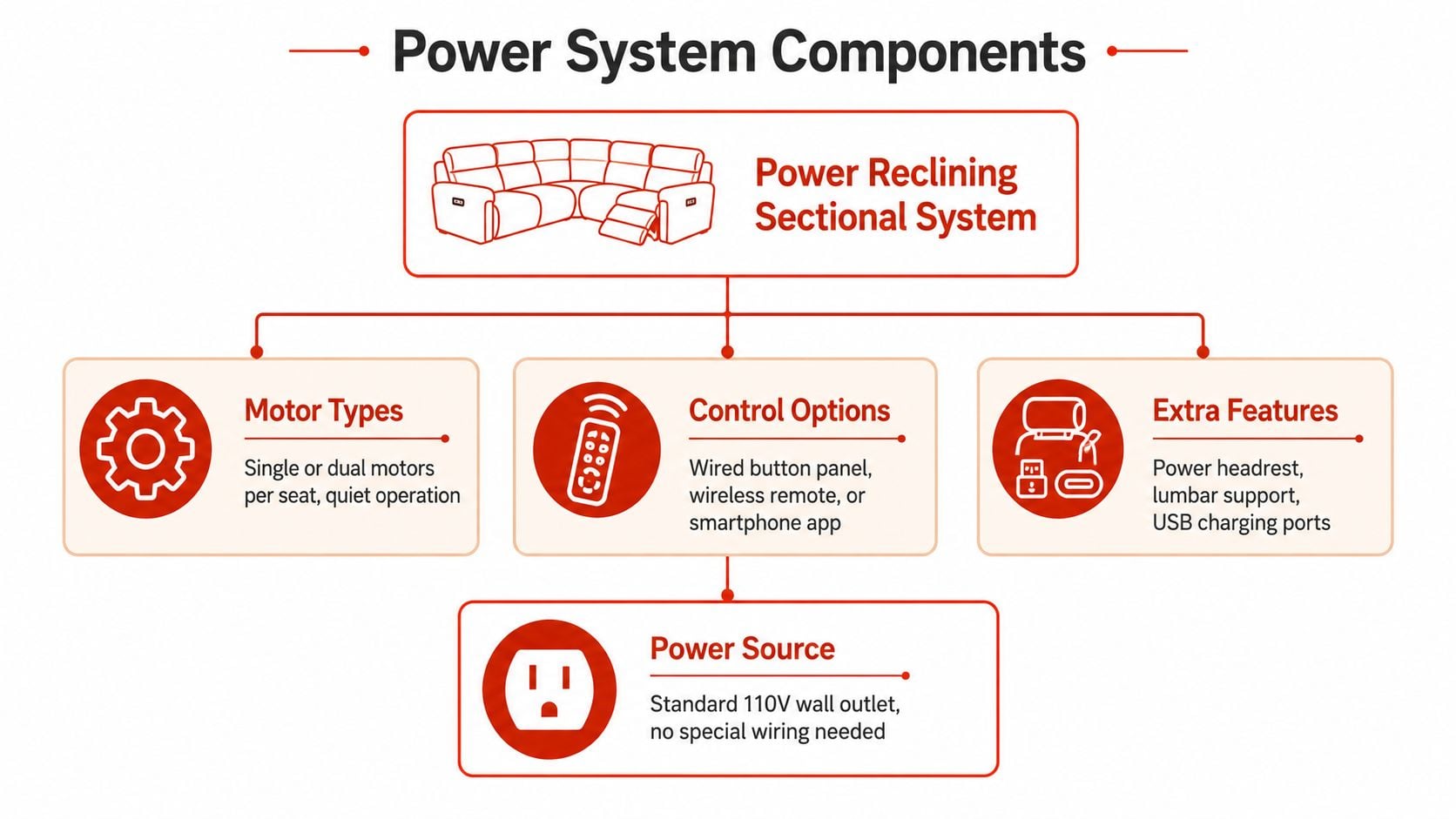
Inside the seat, several components work together:
- Motor: This supplies movement.
- Actuator: This converts motor power into the push or pull that changes position.
- Linkages and hinges: These guide the footrest and back through their travel path.
- Controls: Usually buttons, sometimes a panel, occasionally a remote or app.
- Power source: Most residential models use a standard household outlet.
If you want a simple overview of common motion options, this guide to types of power reclining seating helps clarify how different configurations behave.
Single motor and dual motor
A single-motor design usually moves the back and footrest along one coordinated path. That's often enough for buyers who want straightforward comfort and clean operation.
A dual-motor design allows more adjustment. You may be able to raise your feet while keeping your torso more upright, or fine-tune head and back support separately depending on the model. That added flexibility can make a noticeable difference for readers, nappers, and anyone particular about neck position while watching television.
Practical rule: More motion options only help if the seat fits your body well in the first place.
Why frame strength and mechanism quality aren't the same thing
Many shoppers get tripped up. A sectional can look substantial and still have a weaker reclining system. The seat structure and the power mechanism are related, but they aren't identical.
The strongest pieces pair a stable frame with a reliable mechanism. That means the seat pitch feels balanced when upright, the transition into recline feels composed, and the footrest doesn't seem to strain or wobble under normal use. Good craftsmanship hides the engineering. You shouldn't have to think about it when you sit down.
How Motors Controls and Power Needs Work Together
A power reclining sectional sofa is easiest to understand when you think of it as three systems working together. The motion system moves the seat. The control system tells it what to do. The power system keeps the whole arrangement practical in real life.
When one of those three is poorly considered, the piece may still look attractive on the floor, but it won't feel effortless at home.
What the motor is really doing
The motor isn't there to create comfort by itself. Its job is to deliver movement that feels steady and predictable. A good system starts and stops without a jerk. It should feel controlled at every point, especially near the fully reclined position where lower-grade mechanisms can feel abrupt.
For everyday residential use, a useful engineering benchmark for powered recliners is about 25,000 to 30,000 cycles under roughly 800 to 1,000 N dynamic load, with higher-traffic or contract-grade construction often specified at 50,000 cycles or more, according to MVM Hardware's overview of recliner mechanism load testing. That matters because wear usually concentrates at the mechanism, fasteners, linkages, and actuator mounts rather than the visible upholstery.
Controls should disappear into the experience
The best controls don't call attention to themselves. They sit where your hand naturally falls and become intuitive after a use or two. If buttons are awkwardly placed, too sensitive, or hard to see in lower evening light, the seat can become annoying even if the mechanism itself is sound.
Look closely at a few details in person:
- Button placement: Your hand should find it without twisting your wrist.
- Response: Pressing once should create smooth movement, not hesitation.
- Feature logic: Added headrest or lumbar controls should be easy to understand.
- USB access: Helpful, but only when it doesn't clutter the side profile.
A control layout supports relaxed living. A cluttered one makes the furniture feel overly mechanical.
Power in a real living room
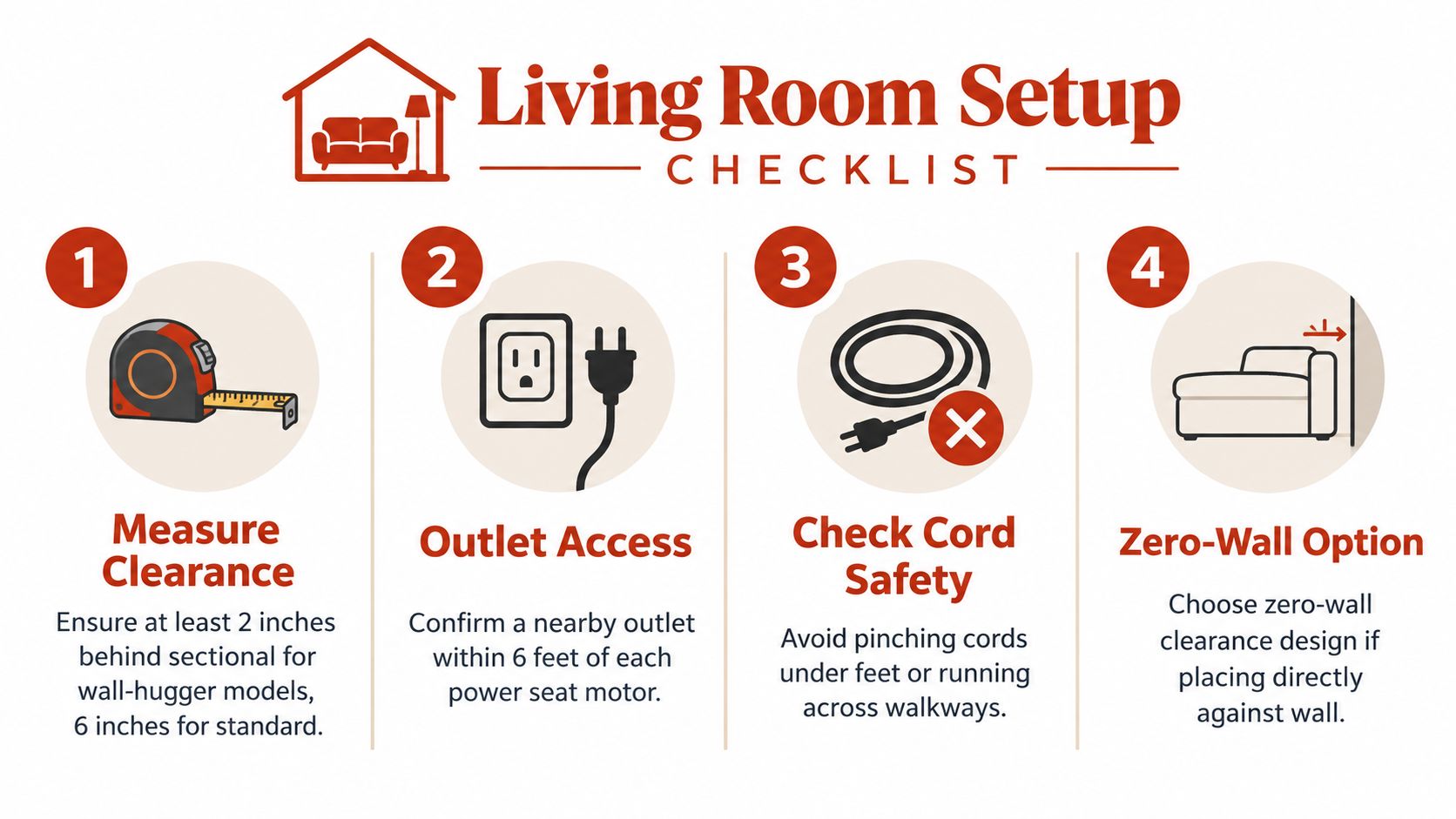
Most residential power sectionals plug into a standard outlet. No special wiring is typically needed. What matters more is how thoughtfully the power is integrated into the room.
Battery packs can help in some layouts, especially when a sectional floats in the room, but many homeowners still prefer the consistency of a direct outlet connection. In either case, cords should stay out of walk paths and away from moving components.
Independent shopping guidance also notes practical tradeoffs. Power models typically require an outlet, add motor and wiring failure points, and often need 4 to 12 inches of wall clearance unless using a wall-hugger design, according to this power reclining sectional guide for family rooms. That's why room planning matters as much as comfort testing.
If your room is calm when the sectional is closed but awkward when the footrests are out, the layout isn't finished yet.
What happens during an outage
This question comes up often. The answer depends on the model. Some seats stop wherever they are until power returns. Others may have backup options. That's less dramatic than it sounds, but it's worth asking before you choose. Reliability is part of comfort.
Planning Power Safety and Placement in Your Living Room
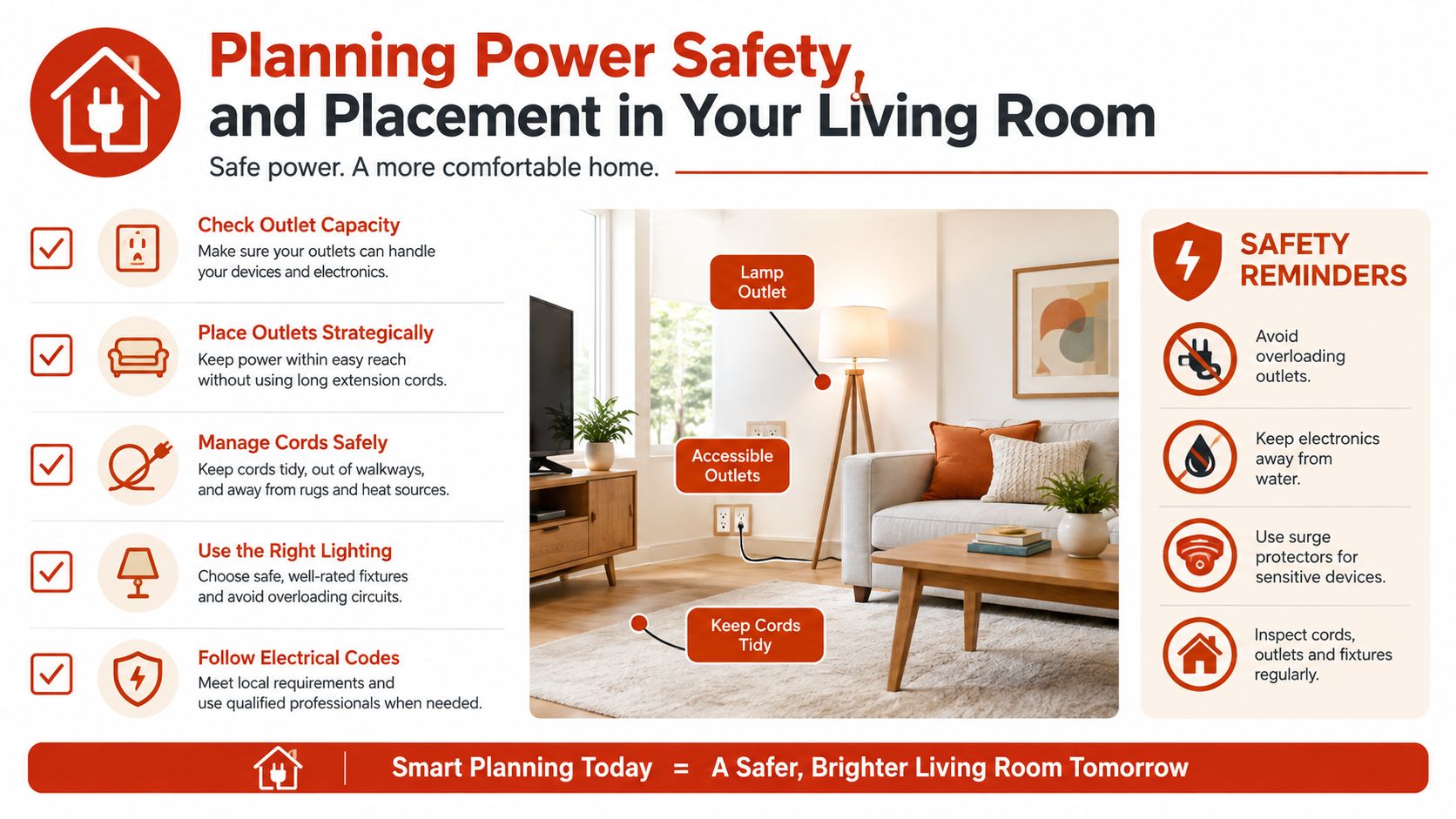
A power reclining sectional sofa asks for a little more planning than a stationary one. The reward is comfort with precision. The responsibility is making sure the room can support the motion safely and gracefully.
In Florida homes, that usually means balancing three things at once. You want a polished seating arrangement, clear walkways for daily living, and enough space for the mechanism to operate without scraping walls or crowding the room.
Start with the room, not the sofa
Before thinking about color or arm shape, measure the wall, nearby pathways, and the distance in front of the seat where the footrest will extend. Power sectionals often need 4 to 12 inches of wall clearance, unless the design uses a wall-hugger or zero-wall mechanism, as noted in the earlier family-room guide.
That range matters because not all reclining motion moves the same way. Some backs tilt directly toward the wall. Others slide the seat slightly forward first, reducing the required clearance.
A practical setup check includes:
- Wall relationship: Confirm whether the model is standard recline, wall-hugger, or zero-wall.
- Outlet access: Place the sectional where power is available without cords crossing traffic paths.
- Footrest travel: Leave enough open floor area so extended seats don't block circulation.
- Nearby tables: Check that end tables or cocktail ottomans won't interfere with moving components.
Safety for active households
Children and pets are part of the room plan too. A power footrest creates moving joints and pinch points. That doesn't make the furniture unsafe by default, but it does mean the motion deserves respect.
Keep cords tidy and protected. Make sure no one stores baskets, toys, or pet beds where a mechanism opens and closes. When a sectional is fully extended, walk through the room and notice whether people naturally reroute around it or keep clipping the corners.
In a busy family room, safe placement feels invisible. You don't notice it because nothing snags, pinches, or interrupts the flow of the room.
Why testing standards matter
Mechanism durability is its own category. The European standard EN 13759:2012 covers durability test methods for hand-operated and power-operated reclining mechanisms and sofa-bed conversion mechanisms, and it explicitly bases those tests on use by a person weighing up to 110 kg, according to Furnitest's explanation of EN 13759:2012.
That distinction matters. A sectional might feel sturdy when you sit on it, yet the moving hardware still needs its own appropriate testing. Buyers should ask whether the mechanism durability and the overall seating structure have both been considered. One doesn't automatically prove the other.
Craftsmanship That Stands Up to Florida Living
The difference between a sectional that merely looks comfortable and one that keeps its poise over years of use comes down to construction. In Florida, that matters even more. Humidity, active households, sandy feet, sunlit rooms, and frequent entertaining all place steady demands on furniture.
A power reclining sectional sofa has to do more than look well-made. It has to carry weight, absorb repeated motion, and still feel supportive at the end of a long day.
Frame, joinery, and the feel of stability
A solid hardwood frame gives the piece its backbone. But the shape of the wood alone isn't the whole story. The connection points matter just as much.
Furniture joinery uses interlocking shapes cut into the wood to distribute stress, resist movement, and hold under daily use, as explained in this overview of furniture joinery and long-term durability. In a motion sectional, that stress is constant. Every recline cycle transfers force through the frame and into the seat structure.
For homeowners comparing silhouettes, it can also help to browse broader references on durable modern sofa styles. Not for trend chasing, but to see how profile, support, and construction often work together.
Upholstery that earns its keep
Performance fabric isn't just a marketing phrase when it's backed by recognized abrasion testing. The two most common methods are Wyzenbeek, often reported in double rubs under ASTM standards, and Martindale, reported in cycles under ISO standards, according to the Association for Contract Textiles guidance on abrasion testing. Higher rub or cycle counts generally indicate stronger resistance to repeated wear.
That makes upholstery comparison more concrete.
- Performance fabrics: Often a smart fit for family rooms, especially when you want texture with resilience.
- Genuine leathers: A strong option for buyers who want a supple, surface that ages with character.
- Tighter weaves and cleaner tailoring: Usually wear more gracefully around moving seat breaks than overly delicate, loose textures.
If you're comparing coverings, this guide to upholstery materials and how they perform is useful for sorting feel, maintenance, and long-term behavior.
The value of hand-tested comfort
Specs tell part of the story. Sitting tells the rest. Ownership hand-testing every seat, sofa, and recliner for pitch and comfort before it reaches the showroom floor is one of the clearest ways to filter out furniture that looks right but doesn't feel right.
That matters because a handsome sectional can still fail the body test. The back angle might push you forward. The headrest may land too low. The cushion may feel lush for thirty seconds and unsupportive after fifteen minutes. Craftsmanship isn't only what you see in the seams. It's what your body notices when the novelty wears off.
How to Choose the Right Configuration and Test for Fit
Most buyers begin by asking which shape they want. L-shaped, U-shaped, chaise end, wedge corner, console seat. Those are useful questions, but they aren't the first questions your body asks.
Your body asks something more direct. Can I sit here comfortably for an hour without shifting? Does the seat support my thighs? Does my lower back feel held, or am I sliding forward?
Configuration follows lifestyle
The right layout depends on how the room is used.
An L-shaped sectional often suits a family room where one side can anchor the television zone while the return softens the edge of the space. A chaise can be lovely for one primary lounger, but reclining end seats may offer better flexibility when multiple people want motion support. Consoles work well when buyers want a place for remotes and everyday items without adding side tables everywhere.
A few useful comparisons:
| Configuration | Often works well for | Watch for |
|---|---|---|
| Chaise end | Stretching out without operating a mechanism | Can dominate floor space visually |
| Dual recliner ends | Shared comfort for couples or family seating | Needs thoughtful front clearance |
| Wedge or curved corner | Softer conversation layout | Can change how TV viewing lines up |
| Console seating | Organized lounging with built-in function | May reduce seat width |
Comfort is about fit, not just motion
Current ergonomic guidance increasingly points buyers back to fundamentals. Comfort depends on seat depth, cushion density, head and neck support, and lumbar alignment, not the motor alone. Guidance around reclining sofas also warns buyers to test for sliding and pressure points, and to judge whether the reclined posture supports the body rather than assuming power automatically means better comfort, as discussed in this look at reclining sofa choices and 2026 use cases.
That's why hand-testing matters.
Sit upright first. If a sectional doesn't feel balanced before you recline it, the motor won't fix the underlying fit.
What to do in the showroom
When you test a power reclining sectional sofa in person, don't just press the buttons and smile because it moves. Stay in the seat long enough to notice what your spine, shoulders, and legs are doing.
Try this sequence:
- Sit naturally: Let your back meet the cushion without forcing posture.
- Check your feet: In the upright position, notice whether your legs feel supported or dangling.
- Recline partway: Many people spend their time here, not fully flat.
- Adjust your gaze: If you watch television, can your neck stay relaxed?
- Stay put for a few minutes: Pressure points often show up after the first impression.
For broader planning help, this living room sofa buying guide is a useful companion when you're narrowing scale, support, and layout.
A design consultation can also make the process easier. Room plans, fabric direction, and module choice often become clearer when someone helps map the sectional to your architecture and daily routines. And when delivery day arrives, a uniform in-house white-glove team handling setup for a $99 flat rate within the service area removes much of the stress from a large, powered piece.
One practical example is Indian River Furniture, which offers power reclining sectional options along with complementary in-house design consultations and in-house white-glove setup. For buyers comparing room layouts, that can be helpful because powered sectionals often need more planning than the photos suggest.
Bringing Curated Comfort Home With Confidence
A power reclining sectional sofa isn't a larger sofa with buttons. It's a long-term investment in how a room supports real life. The right one brings together ergonomic ease, appropriate scale, durable materials, and mechanism quality that feels calm every time you use it.
That's why the smartest decision usually isn't made from a screen. It's made by sitting, reclining, noticing the pitch, feeling the texture, and seeing how the piece lives within a full room setting. In a curated showroom, those details become easier to read. You can compare support, study craftsmanship, and understand whether a sectional feels like relaxed luxury or just visual bulk.
For homeowners across Brevard County, the Space Coast, and Central Florida, trust still matters. Since 1939, Indian River Furniture has served the region with a service-first approach grounded in craftsmanship, comfort, and community. A showroom visit in Rockledge offers more than a row of furniture. It gives you the chance to hand-test seating, explore coastal vignettes, and work with a design team that understands Florida living.
When the frame is solid, the fabric is performance-minded, the leather is genuine, and the fit is right for your body, a motion sectional stops feeling complicated. It becomes the place where evenings land well.
If you're considering a power reclining sectional sofa, Indian River Furniture offers hand-tested motion seating, complementary in-house interior design consultations, and in-house white-glove delivery with full room setup. Visit the Rockledge showroom to compare curated coastal styles, feel performance fabrics and genuine leathers in person, and find a configuration that fits your home with confidence.