Schedule your Complimentary Design Consultation


Beige Leather Sectional Guide for Florida Homes


You're standing in the living room around four, when the west light turns the floor gold and every pale surface tells the truth. The arms of the old sofa have gone shiny. A beige leather sectional looks right beside the white oak, the linen pillows, and the rattan, and it would wipe clean after a sandy afternoon. That calm first look is only half the decision on the Space Coast.
A light hide has to live with ultraviolet, sticky air, and the daily traffic of a Brevard County household. I would judge the piece by finish, frame, and seat fit, not by how soft it feels for the first minute. Since 1939 we've walked Central Florida families through that choice in Rockledge, with genuine leathers and performance fabrics selected for coastal living rather than a catalog photo.
Leather Grades Compared Before You Shop
For a Florida living room I start with pigmented top-grain or a protected full-grain, not the softest hide on the rack. Genuine leather is a broad label, not a grade. The surface treatment decides how a beige leather sectional looks after a year of denim, sunscreen, and late sun.
Color behavior is testable. FILK Freiberg's fastness laboratory measures color change after repeated back-and-forth rubbing under DIN EN ISO 11640, and color migration into polymeric materials under DIN EN ISO 15701. On beige, body oils, damp clothing, and friction at seat fronts and armrests darken the surface long before the same marks would show on a deep brown hide.
Reading the grades in plain language
| Grade | How It Is Made | Florida Strength | Watch For |
|---|---|---|---|
| Full-grain | Unsanded outer hide with natural markings | Ages into patina and wears evenly | Visible variation; more upkeep in direct sun |
| Top-grain | Surface sanded and finished for an even tone | Uniform look with good stain tolerance | Less natural character than full-grain |
| Corrected-grain | Surface embossed and coated for uniform color | Consistent color and easy wipe-down | Less breathable; coating can wear through |
| Split leather | Lower layer of the hide, usually coated | Consistent surface when finished | Less durable than the upper grains; coating can crack |
| Bonded leather | Shredded leather fibers bonded to a backing | Weakest in humid heat | Peels and cracks in heat and humidity; avoid for seating |
Full-grain keeps the outer hide intact, markings and all. It can age into an even patina, but a pale aniline surface will show sun shift and oil marks sooner, so it wants shade and a patient owner.
Top-grain is sanded, then finished for an even tone. A pigmented version gives you the most even beige and better stain tolerance, which is why I reach for it in high-traffic family rooms.
Corrected-grain is embossed and coated so the color stays consistent and wipes clean. The trade-off is breathability. Once the coating wears through at an arm, the repair is obvious.
Split leather comes from the lower layer and is usually coated. A good finish can look tidy at first. It does not match the upper grains for long daily use, and the coating can crack where the seat flexes.
Bonded leather is shredded fiber on a backing. Humid heat is hard on that construction. I would not use it for seating.
Practical rule: Match the grade to sun and traffic. The softest hand in the showroom is not the grade that still looks even in August.
Pigmented finishes lay down a more uniform color and tolerate stains better. Aniline finishes leave more of the hide's variation and will develop patina faster. In a bright Merritt Island or Cocoa Beach room, pigment is the steadier choice.
Before you compare two sectionals, ask for four documents:
- Leather type: Full-grain, top-grain, corrected-grain, or split, written on the spec, not guessed from the hangtag.
- Fastness results: Abrasion, wet-rub, perspiration, and lightfastness, with the test method named.
- Finish type: Pigmented or aniline, so you know how much natural variation you are buying.
- Care code: The maker's approved cleaner, which you will need the first humid week.
Our custom library includes genuine top-grain leathers alongside more than 1,000 performance upholstery options, so the grade can be chosen for the room rather than taken as a single stock color. If pets, a porch, or a west window make hide the wrong call, read leather versus fabric upholstery before you commit.
In person, sight down the seams, welt cords, seat fronts, and chaise contact zones. Those areas take the cyclic load. Grain and dye should match from cushion to cushion. A beautiful center panel does not matter if the front rail is already a different beige.
Why Beige Leather Suits Coastal and Transitional Rooms
A sectional with a broad chaise can dominate a compact living room, so its color needs to work with the room's fixed pieces. Beige keeps the visual weight softer than a dark hide, while still giving white oak, oatmeal linen, and rattan a warm anchor. That balance suits coastal rooms with washed woods and sea-toned accents, as well as transitional rooms with classic lines and warm metal.

One room, two readings
Take a sectional facing a bank of windows, with a low oak coffee table and sea-glass pillows at the corner. A natural-fiber rug and woven textiles give the same beige upholstery a relaxed coastal feel. Swap in a straight track arm, slim metal legs, and a bronze lamp, and the room reads more transitional. The sectional stays; the surrounding materials set the style.
For a family room that also hosts guests, local advice for family beach stays can help clarify how the space needs to function after a day outside. Beige can make a sectional feel less visually heavy, while textured pillows and throws bring in seasonal color. Leather still needs to suit the room's sun exposure and use; color alone does not determine how well it will hold up.
Three styling choices help keep the room airy:
- Ground the sectional: Place a natural-fiber rug under its front legs to soften the transition from leather to floor.
- Layer texture: Combine linen, slub cotton, and a flat-weave throw in a restrained palette for depth without adding visual clutter.
- Show some floor: Slim legs make the sectional feel lighter than a solid base, especially in a smaller room.
Explore coastal design ideas for choosing a palette and proportions before settling on the surrounding finishes. Then judge the leather for the room's actual Florida conditions, including its exposure to sun, heat, and humidity.
How Florida Heat, Sun and Humidity Affect Leather
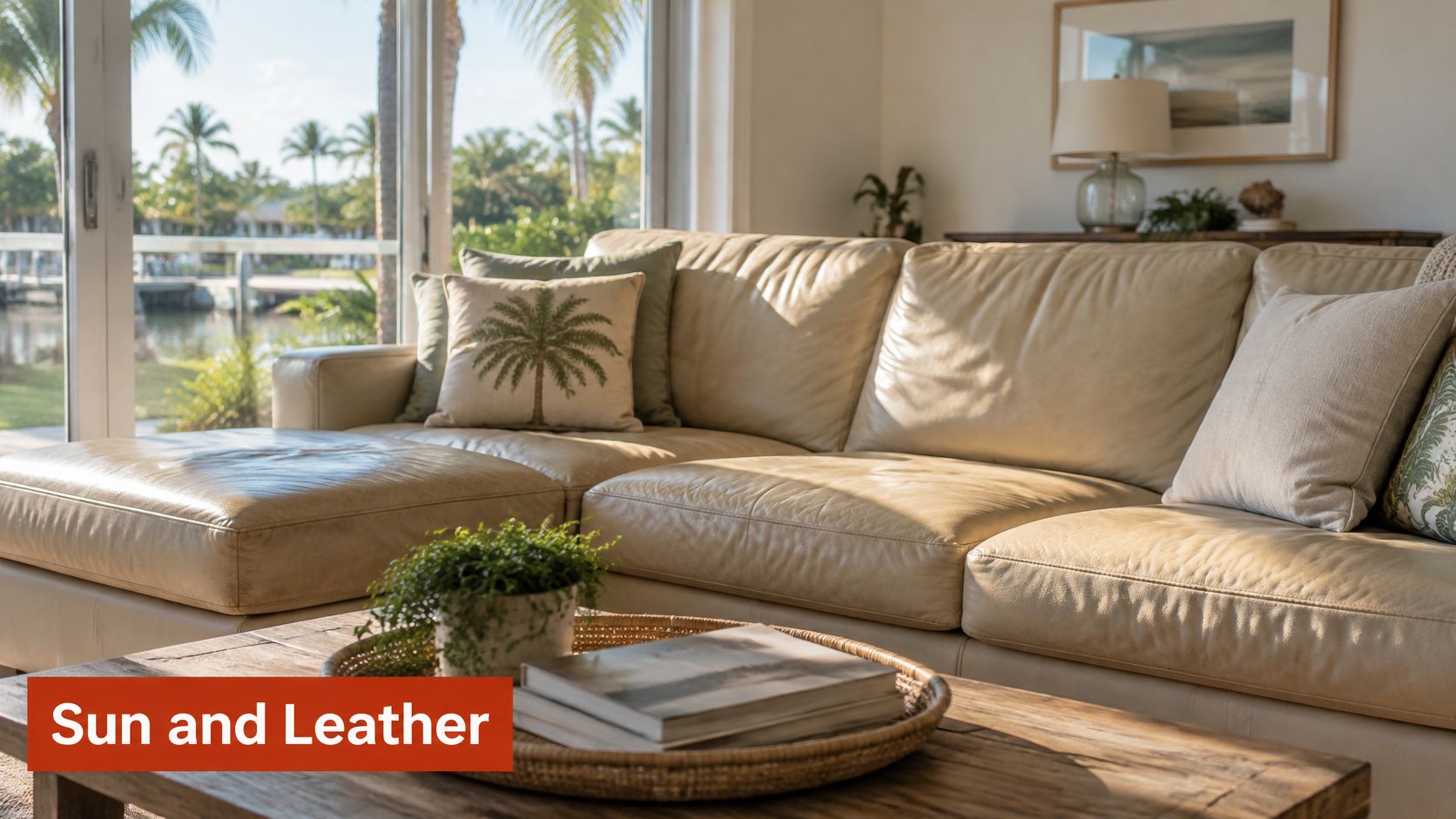
Leather takes daily use well. Central Florida still changes it. Sun, heat, and humidity decide whether a beige leather sectional stays even or fades in patches and dries at the arms. Placement is as much a durability choice as the grade.
Ultraviolet does not fade a whole seat at once. It hits the front rail and the arm that faces the glass, so those panels go lighter while the back cushions stay the original beige. A pale pigment shows that difference early. Moving the sectional a few feet off a west window does more for the color than any later treatment.
Holding the air in a safe band
Leather takes on moisture and gives it back as the room changes. Air that stays too dry desiccates the fibers and contributes to cracking. Air that stays damp raises mold risk and can degrade the material. The Museum of Florida History identifies 35%–65% relative humidity as an accepted control range for preserving leather, and notes that leather can crack when relative humidity falls to 35% or below.
For a Central Florida interior, I aim at about 45%–55% relative humidity. Check it with a hygrometer near the sectional, not directly in front of it, where a vent would lie to you. Leave airflow behind the frame so the back panel is not trapped against a cool, damp wall.
Shade and stable air protect a light hide better than a softer, paler finish ever will.
Place the piece with these four rules:
- Keep it out of direct west-facing sun. Afternoon glass is the fade pattern you will notice first on beige.
- Stay clear of heat registers and vents. Localized heat dries the surface faster than the rest of the room.
- Leave a gap behind the frame. Moving air keeps the back and the floor line from staying damp.
- Run air conditioning or a dehumidifier. Hold the room in that mid range through the wet season, not only on the hottest afternoons.
When fabric is the better investment
Leather is the wrong hero in four situations. A screened porch takes wind-driven rain and salt air. A vacation rental sees unfamiliar cleaners and wet swimsuits. Pets add claws and oils on a pale surface that shows every mark. A room with intense west-facing glass will fade even a pigmented hide if the seat sits in the beam all year.
In those rooms, a performance fabric built for sun and stains is the more honest choice. You still get a coastal neutral. You stop asking a natural hide to do a job the architecture will not allow. If the main living room is shaded, conditioned, and used by the household rather than left open to the porch, leather can be the long piece you keep.
Measuring and Configuring Your Sectional
Start with the room, not the sofa. Measure the wall the sectional will sit on, the walkway you still need to cross, and every doorway, turn, and stair the piece must pass. Mark the footprint on the floor with painter's tape. A beautiful chaise that blocks the path to the kitchen will annoy you every evening.
That tape also shows scale before a delivery truck arrives. A mnml guide to living room staging is a useful companion while you test the footprint, because a staged room only works when the largest piece leaves a clear route around it. If the tape already crowds the door, change the layout on paper.
Choose the shape, then the seat
Pick the layout to match how you sit. A left- or right-facing chaise suits a corner and a view. A corner unit turns two walls into one conversation. A modular arrangement can be reconfigured when the household changes, which is the layout I prefer for a first Space Coast house.
Then check the seat, not the overall width. The Irish Examiner's home and gardens guide reports sofa seat depths commonly ranging from 53 to 72 centimeters, with a typical seat height from the floor to the top of the base cushion of about 43 to 45 centimeters. With your back supported, your knees should stay comfortably bent and your feet should rest securely, not dangle or force you to slide forward.
| Measurement | Typical Range | What to Test |
|---|---|---|
| Seat depth | 53-72 cm | Knees bend comfortably with the back supported |
| Seat height, floor to top of base cushion | 43-45 cm | Stand up without twisting or pushing off the arm |
| Chaise length | Long enough for the calves to rest fully | Feet rest flat with no dangling or sliding forward |
| Arm height | Level with bent elbows while seated | Elbows rest comfortably for reading and conversation |
A deep seat is lovely for lounging and hard on a shorter sitter, who ends up perched. A low, soft seat makes standing harder for older adults. The arm should meet a bent elbow so reading does not turn into a shrug.
A three-part sit test
Run the same test in every position, including the corner, which often sits differently from the end seats.
- Sit back. Your back is supported, your knees bend comfortably, and your feet are planted.
- Stand up. You rise without twisting or pushing off the arm. If you need the arm as a lever, the height or the cushion is wrong.
- Use the chaise. Your feet rest flat. You are not dangling, and you are not sliding forward to find the edge.
Every sofa depth, recliner pitch, and cushion density on our floor has been sat in, evaluated, and approved by the ownership team before it is offered. In the Rockledge showroom you can feel the leathers, touch the solid hardwoods, and compare cushion firmness side by side, which is the only reliable way to judge pitch, compression, and corner placement. Bring a written list: wall length, walkway width, doorway clearance, preferred chaise side, and the sit-test notes from home. Our furniture measuring guide walks through the same sequence if you want it on paper before the visit.
Frame Construction and Modular Layouts
A beige leather sectional can look crisp in the showroom and still struggle after years of Florida heat, sun, and humid conditions. The upholstery gets attention, but frame joints and the ability to replace or reconfigure parts determine whether the piece can adapt as the room or household changes.
A peer-reviewed study of sofa-frame joint types, published in BioResources, reported reliability above 99.99% for mortise-and-tenon and dowel joints under the study conditions. The same study reported 65.74%, 86.51%, and 74.42% reliability for non-glued staple joints at tested gap sizes of 2.5, 5, and 10 millimeters, respectively. These are study results, not a guarantee for a particular sectional. Use them to frame questions about how its joints are built.
| Joint Type | Reported Reliability |
|---|---|
| Mortise-and-tenon | Above 99.99% under study conditions |
| Dowel | Above 99.99% under study conditions |
| Non-glued staple, 2.5 mm gap | 65.74% |
| Non-glued staple, 5 mm gap | 86.51% |
| Non-glued staple, 10 mm gap | 74.42% |
What to look for under the upholstery
Ask whether the frame is solid hardwood and whether its joints are glued and screwed, with reinforced corners. Dowel and mortise-and-tenon joints help resist racking when a sectional is moved or repeatedly loaded from one end. Staple-only connections are a different construction approach, so ask where they are used and how the frame is reinforced.
Modularity is how a piece stays
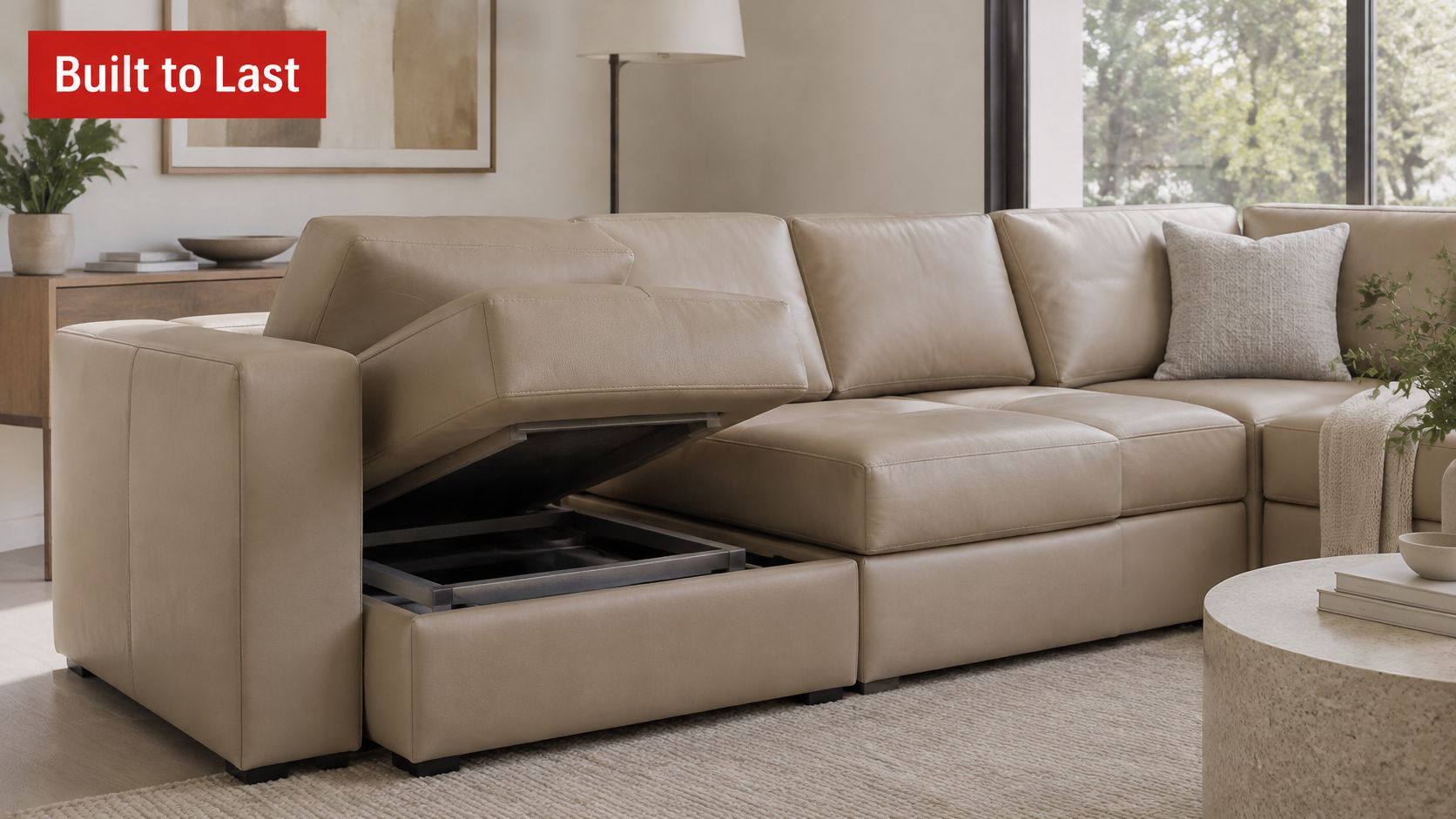
A modular sectional can be rearranged when a room changes, while replaceable components can make repairs more practical. Confirm which sections can be moved, whether the chaise can switch sides, and whether replacement cushions or other parts are available. Reupholstery makes sense only if the frame remains sound.
Proceedings from the 2025 PLATE conference report that 77% of European respondents wanted to repair products before replacing them, while 64% had done so (PLATE 2025 proceedings). For a sectional, a clear repair path and documented frame details help turn that preference into a workable option. Modular sectional layouts for smaller rooms can also help you assess whether a reconfigurable plan suits your floor space.
Before deciding, request three documents: frame construction details, warranty terms, and the repair process for a failed mechanism or cushion. Judge the structure alongside the leather's suitability for Florida conditions. A storage seat or sleeper adds function, but its usefulness still depends on the frame and joints supporting it.
Caring for Beige Leather Through Florida Seasons
Small habits prevent most leather problems, and the routine should fit a normal week. You are not polishing a showroom. You are keeping grit, moisture, and the wrong products off a pale surface that shows every mistake.
| Task | How Often | Florida Note |
|---|---|---|
| Soft-cloth dusting of seams and seat fronts | Weekly | Grit in seams abrades the finish during sitting |
| Inspect high-contact areas | Monthly | Check seat fronts, armrests and chaise for dull or thin spots |
| Blot spills with a dry cloth | Immediately | Do not rub; humidity slows drying |
| Manufacturer-approved cleaning | As the care code directs | Avoid alcohol, bleach and household solvents |
| Conditioning | Every 3-6 months, only if the maker permits | Do not condition unless the care code allows it |
Why the weekly pass matters
Grit trapped in a seam works like sandpaper every time someone sits. A soft, dry cloth along the seat fronts, welts, and arm creases takes that grit away before it polishes a pale patch into the hide. Skip spray products for this pass. Dust first, then decide whether anything else is needed.
Spills want the same restraint. Blot with a dry cloth at once. Rubbing drives liquid into the finish, and humid air slows the dry-down, so a wet spot can sit in a seam overnight. Lift damp cushions so air reaches both faces. Do not leave a wet cushion compressed under another.
Products that help, and products that harm
Clean only with the manufacturer-approved product on the care code. Alcohol, bleach, household solvents, silicone products, and unapproved conditioners can alter the coating or speed discoloration. That list is not fussy. Those products are common under a Florida sink, and they are the usual reason a beige arm goes streaky.
The same patience you would use with care guidance for cashmere accessories applies here. Follow the fiber's own instructions. Do not improvise with a stronger cleaner because the mark is on a light color.
Conditioning is occasional, about every three to six months, and only when the maker permits it, which is the interval noted in our leather reclining sectional care notes. If the care code says not to condition, do not. Extra oil on a coated finish can soften the surface you were trying to protect. Step-by-step cleaning for a finished hide is in our guide to cleaning a real leather sofa.
Watch for three signs that the finish needs attention: dull dry patches, fine surface cracks, or darkening that does not lift with the approved cleaner. Each spring, shift the sectional a few inches, look at the floor line, and check the seat fronts and armrests in daylight. That seasonal reset catches fade and wear while they are still small.
Confirm Your Beige Leather Sectional in Person
A beige hide can look warm beside oak and linen in the showroom, then read differently in the daylight at home. Bring your room measurements, a daylight photo of the wall, and your notes on leather type, finish, fastness, and seat comfort. Those details make it easier to judge the sectional against your actual space and Florida conditions.
Indian River Furniture's Rockledge showroom spans 32,000 square feet, with coastal-inspired room displays. Sit in the corner, chaise, and end seat, and compare how the leather looks alongside different materials. Designers are available on the showroom floor seven days a week to pull swatches, check dimensions, and help you test seat comfort.
Complimentary interior design consultations include scale floor planning, fabric and finish selections, and room styling when you purchase your furniture through Indian River Furniture. Design help can cover one accent chair or furnishings for a full home.
The in-house white-glove delivery team handles unboxing, inspection, and room setup. Delivery is a flat $99 within the service area. Ask about delivery and financing options so you can plan the purchase around your timeline.
Confirm the sectional's specifications, test how its seats feel, and check that its placement will limit exposure to Florida sun and humidity.