Schedule your Complimentary Design Consultation


Upholstered Wingback Chair Style and Selection Guide

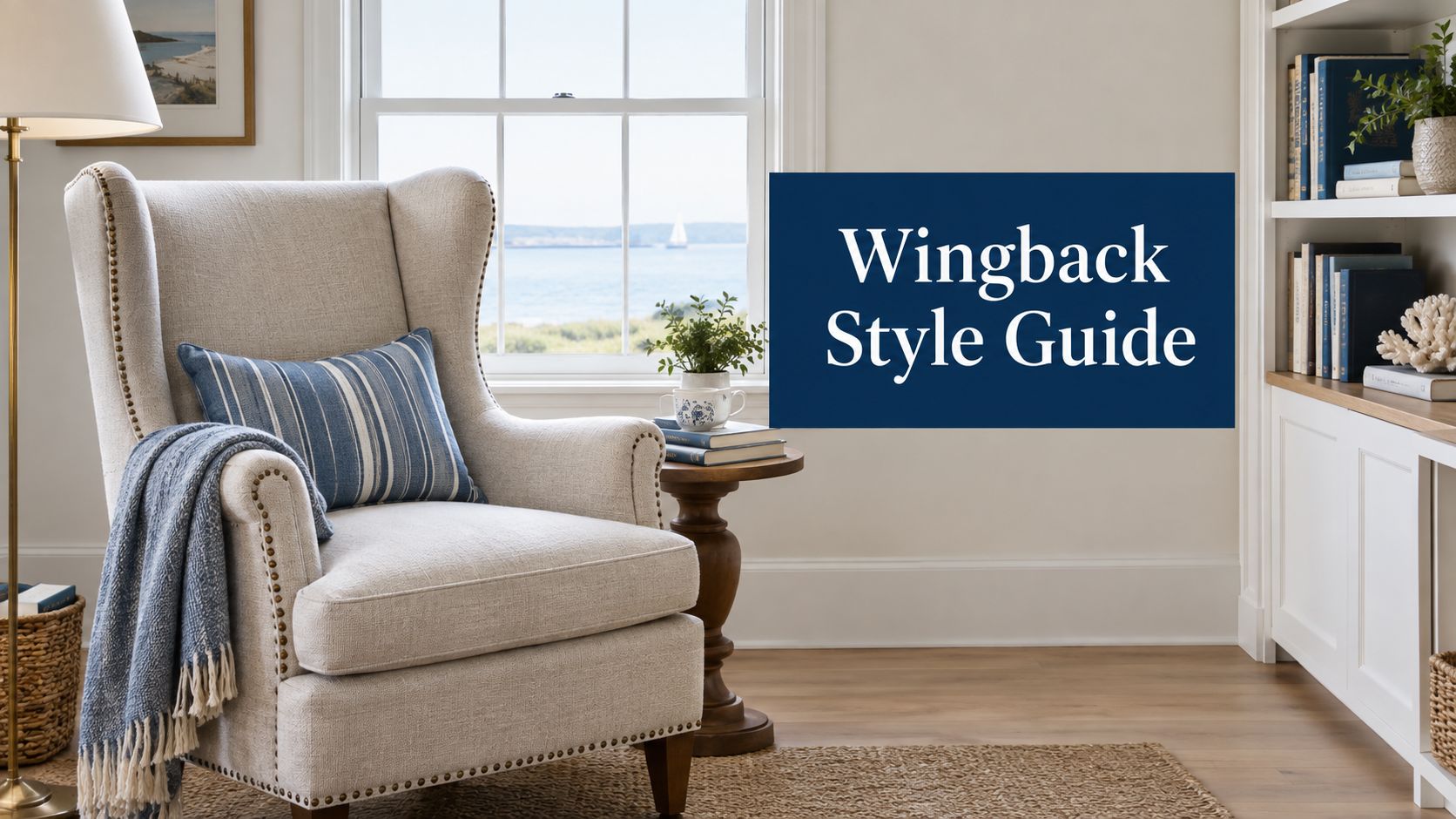
The room usually comes into focus before the chair does. You're standing in a living room that gets beautiful afternoon light, or in a bedroom corner that's missing one settled, comfortable piece. Maybe you want a reading chair by the window. Maybe you need an accent that feels refined instead of trendy. What many homeowners discover is that the answer often has the same outline: a tall back, sheltering wings, and upholstery that invites you to stay a while.
That's why the upholstered wingback chair has lasted. It doesn't just fill a corner. It creates a small retreat inside the room.
In Rockledge and across the Space Coast, that matters. Florida homes need furniture that feels relaxed, looks refined, and stands up to daily life. Since 1939, families have come to Indian River Furniture looking for pieces with staying power, and wingbacks remain one of those dependable forms that still feel current when they're chosen with the right scale, fabric, and craftsmanship.
Table of Contents
- Introduction to the Enduring Appeal of the Wingback
- What Makes an Upholstered Wingback Chair Distinctive
- Finding the Right Scale and Proportion for Your Space
- Choosing Upholstery That Balances Beauty and Florida Durability
- Understanding Craftsmanship That Ensures Lasting Comfort
- Placement and Styling Ideas for Coastal Living
- Experience the Difference in Our Rockledge Showroom
Introduction to the Enduring Appeal of the Wingback
A wingback feels familiar even if you've never owned one. Set one beside a lamp, a small table, and a stack of books, and the whole corner starts to feel quieter. The high back supports your shoulders. The side wings soften the room around you. Upholstery adds that final layer of warmth that makes the chair feel less like an object and more like a place.
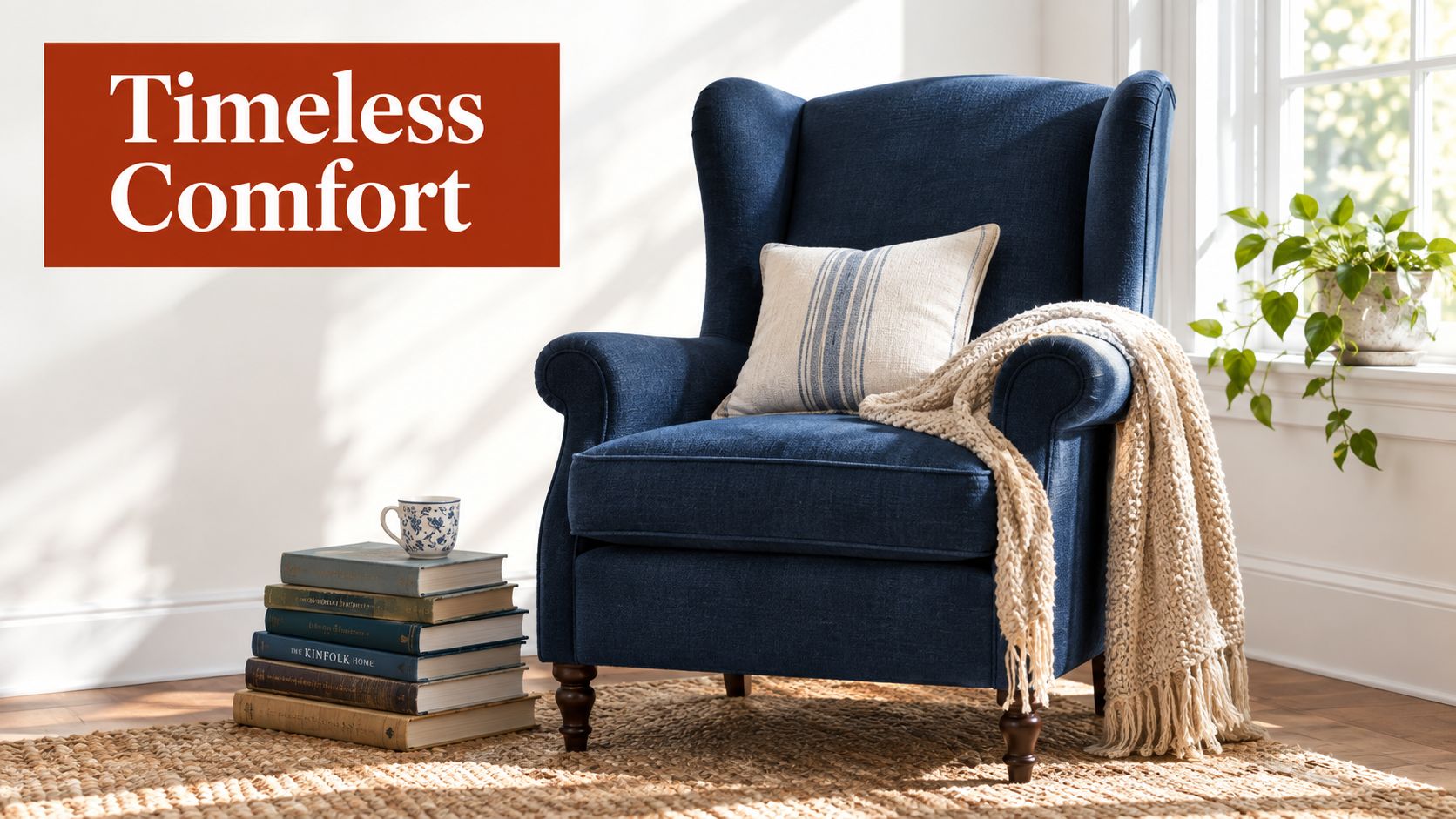
That comfort-first feeling isn't accidental. The wingback chair originated in England in the late 17th century as a practical fireside seat meant to block drafts and trap heat from open fireplaces, with wider adoption after the Restoration between 1660 and 1680. It was already appearing in colonial America soon afterward, and by the 1720s it had become a recognizable English furniture staple, as noted in this history of wing chairs.
Why the shape still works
The reason this silhouette has endured is simple. Its signature details began as solutions.
- High back: Gives the sitter a sense of support and visual shelter.
- Side wings: Originally helped block drafts. Today they still create a cocooning effect.
- Upholstered body: Softens the experience of sitting, reading, or lingering with conversation.
- Defined arms: Give the chair structure and make it feel grounded in the room.
A wingback doesn't ask you to sit upright and leave quickly. It asks you to settle in.
In coastal and transitional homes, that's a useful quality. The profile carries tradition, but the right upholstery can make it feel crisp, airy, and perfectly at home with painted wood finishes, woven textures, or slipcovered seating nearby.
A silhouette with unusual staying power
Many furniture forms arrive with a burst of popularity and fade just as quickly. The wingback didn't. Its long continuity comes from function, not novelty.
That's part of what makes it such a trusted investment. When a chair shape has worked across centuries, it tends to adapt gracefully to changing rooms, changing fabrics, and changing ways of living.
What Makes an Upholstered Wingback Chair Distinctive
Not every high-back accent chair is a wingback. Shoppers often get mixed up. If the outline feels similar, the chairs can blur together online. In person, the differences become much clearer.
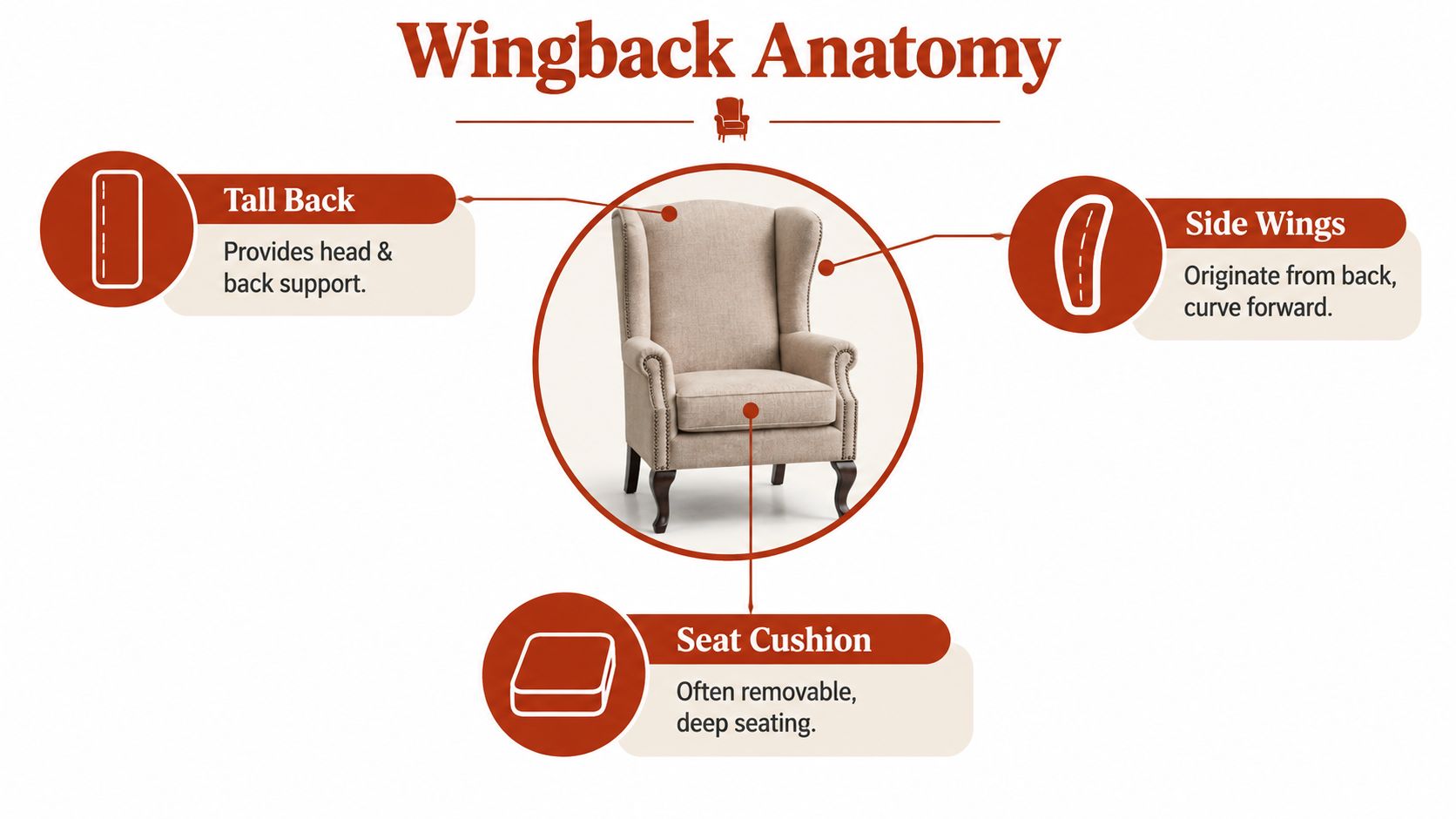
An upholstered wingback chair has four defining parts: a tall back, projecting wings, supportive arms, and a fully upholstered surface. Remove the wings and you may have a handsome accent chair. Lower the back and you may have a lounge chair. Keep all four working together, and you have the classic wingback form.
Start with the back
The back is the chair's anchor. It rises higher than a typical accent chair and changes how the body feels while seated. Your shoulders have a place to rest. Your head feels visually supported, even if you aren't leaning fully back.
That's one reason wingbacks often work well in reading corners and conversation groups. They feel upright enough to stay engaged, but enclosed enough to relax.
Then notice the wings
The wings are what make the silhouette unmistakable. They extend from the back and angle outward or forward, depending on the design. Some are narrow and crisp. Others sweep more generously.
Think of them as the chair's architectural side walls. They frame your upper body and create a sense of privacy without fully closing you in. In a larger room, that helps a single chair hold its own.
Practical rule: If the “wings” look tacked on or too small for the back, the chair usually won't have the visual balance that makes a true wingback feel composed.
Upholstery changes the personality
Early versions began as mostly wooden chairs, but over time the design became more fully upholstered. Historical descriptions note that by the late 18th century upholstery expanded to include leather and studding, and by the early 19th century more varied textiles and patterned coverings were in use. That evolution matters because material became part of the wingback's identity, not just its decoration, as outlined in the world upholstered furniture industry landscape.
That same source notes the global upholstered furniture market is estimated at USD 73 billion, representing about 16% of the total furniture market. Wingbacks live inside that much broader upholstered category, which helps explain why they remain commercially relevant as accent seating with both comfort and presence.
The arms complete the experience
Arms affect more than appearance. They determine how the chair welcomes the body.
A well-shaped arm gives your elbows a natural resting place, helps you sit down with control, and adds to the polished look. If the back and wings create shelter, the arms create ease.
Here's a quick way to identify an authentic piece:
- Look at the outline first. The back should read tall immediately.
- Check the wings next. They should feel integrated, not decorative afterthoughts.
- Study the upholstery lines. A strong wingback looks fitted, not baggy.
- Sit in it if you can. The shape should support you, not just photograph well.
Finding the Right Scale and Proportion for Your Space
A wingback can be beautifully made and still feel wrong if the scale misses the room. This is the part many people underestimate. They focus on fabric first, then bring home a chair that looks too slight beside the sofa or too imposing near a window.
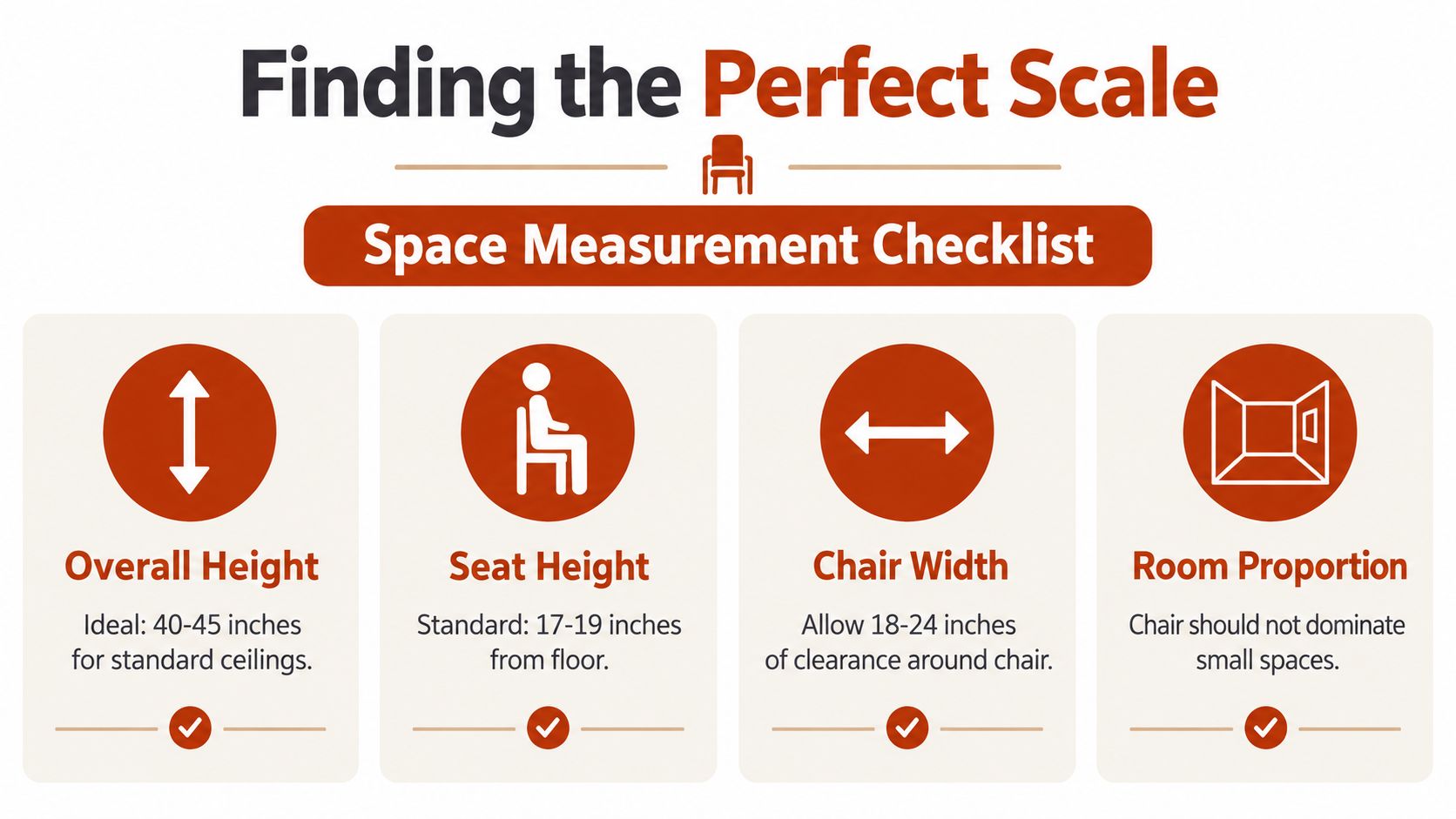
For an upholstered wingback chair, overall height typically lands around 42 to 52 inches with a seat height of 17 to 19 inches, according to Willis Furniture's wingback chair construction guidance. Those proportions help support the head and shoulders while keeping the knees at a practical angle for easier sit-to-stand movement.
What those measurements mean in a real room
Numbers only help if you know what to look for.
A chair near the lower end of that height range often works well in condos, cottages, and rooms where you want an open sightline. A taller wingback can look beautiful in a living room with more visual breathing room, especially when it's acting as an anchor at the end of a seating group.
Seat height matters just as much. Too low, and the chair may feel loungey but harder to rise from. Too high, and it can feel formal or awkward next to softer seating.
Three proportion checks that prevent common mistakes
Before choosing a style name or fabric, check these three things:
- Match the chair to the room's visual weight: If your sofa is broad and clean-lined, a tiny wingback can disappear beside it.
- Check traffic flow: A wingback's wings and arms give it more presence than a slim accent chair, so entry paths and walkways need to stay comfortable.
- Think about use, not just view: A reading chair by a lamp needs enough space for a side table and easy access, not just a nice angle from the doorway.
Bring room measurements, doorway widths, and nearby furniture dimensions with you. That simple prep removes most of the guesswork.
If you need help gathering those dimensions, this guide on how to measure furniture is a practical place to start.
Placement changes how size feels
The same chair can read differently depending on where you place it. Near a fireplace, the wings can feel intimate and traditional. By a large window, they can create a quiet enclosure against bright natural light. In a bedroom corner, the height can add needed vertical structure if the rest of the room is low and soft.
This is also where in-person testing matters. Ownership hand-tests every seat, sofa, and recliner for pitch and comfort before it reaches the 32,000 sq ft Rockledge showroom floor, so homeowners can compare how different wingback proportions feel in the body, not just on paper.
Watch the relationship to nearby pieces
A wingback shouldn't dominate a modest room, but it also shouldn't look timid. The goal is balance.
If the chair will sit with a sofa, look at arm height, back height, and overall visual heft. If it's a standalone accent, consider what will ground it: a rug, a floor lamp, a side table, or art above. Good proportion always looks calm before it looks dramatic.
Choosing Upholstery That Balances Beauty and Florida Durability
A wingback either becomes an heirloom-feeling piece or a chair that starts showing stress too soon. Upholstery isn't only about color. It determines touch, maintenance, heat retention, visual texture, and how gracefully the chair ages in a Florida home.
Sunlight, humidity, pets, sandy clothes after a coastal afternoon, and frequent guests all put demands on a chair. That's why performance fabrics, genuine leathers, and tightly woven textiles each deserve a closer look.
How to compare upholstery in practical terms
Performance starts with suitability. Some fabrics are ideal for occasional use in a quiet bedroom corner. Others are better for family room rotation, reading, and everyday sitting.
Durability in upholstered seating is often measured with abrasion testing. Residential upholstery is frequently grouped into light use under 9,000 rubs, general use from 9,000 to 15,000 rubs, heavy use from 15,000 to 30,000 rubs, and commercial-grade performance at 30,000+ rubs, according to this guide to upholstered chair construction and selection.
Upholstery Performance at a Glance
| Use Level | Abrasion Threshold | Best For |
|---|---|---|
| Light use | Under 9,000 rubs | Guest rooms, occasional seating |
| General use | 9,000 to 15,000 rubs | Reading corners, bedrooms, lower-traffic living spaces |
| Heavy use | 15,000 to 30,000 rubs | Active family rooms, frequent everyday seating |
| Commercial-grade performance | 30,000+ rubs | Very frequent use and high-traffic settings |
Texture matters as much as toughness
A nubby weave may look rich and inviting, but if it pills quickly, the chair can lose its refined appearance. One widely used pilling scale rates fabrics from 1 to 5, where 5 means no pilling and 1 means severe pilling, as shown in Herman Miller's textile quality standards reference.
That gives shoppers a clear benchmark. If you love textured upholstery, ask how it performs over time, not only how it feels on day one.
Which material fits which home
Each upholstery type brings a different strength.
- Performance fabric: Often the easiest fit for busy coastal households. It can deliver a soft hand with better resistance to daily wear and easier upkeep.
- Genuine leather: Beautiful on a wingback because it highlights the defined silhouette. It tends to develop character over time and suits traditional, transitional, and collected interiors.
- Textured woven fabric: Excellent when you want the chair to read as a curated accent. Bouclé-style surfaces, linen-look weaves, and subtle patterns can add dimension without overwhelming the room.
If you're comparing fabric options and want a straightforward primer, this upholstery materials guide is useful for understanding how feel and performance intersect.
In Florida homes, the most successful upholstery choice is usually the one that still looks composed after real life happens to it.
Color and pattern should support the silhouette
Wingbacks already have presence. Upholstery should work with that, not fight it.
A solid performance fabric in a coastal blue, sandy neutral, soft green, or warm ivory lets the shape do the talking. A subtle pattern can be beautiful when the room needs movement, especially in a study, bedroom, or formal sitting area. Leather tends to emphasize structure. Soft woven fabric tends to emphasize comfort.
For day-to-day care, many homeowners appreciate practical maintenance guidance like this Hartford upholstery cleaning advice from J.G. Carpet Cleaning LLC, especially when choosing a fabric for a chair that will see regular use.
Understanding Craftsmanship That Ensures Lasting Comfort
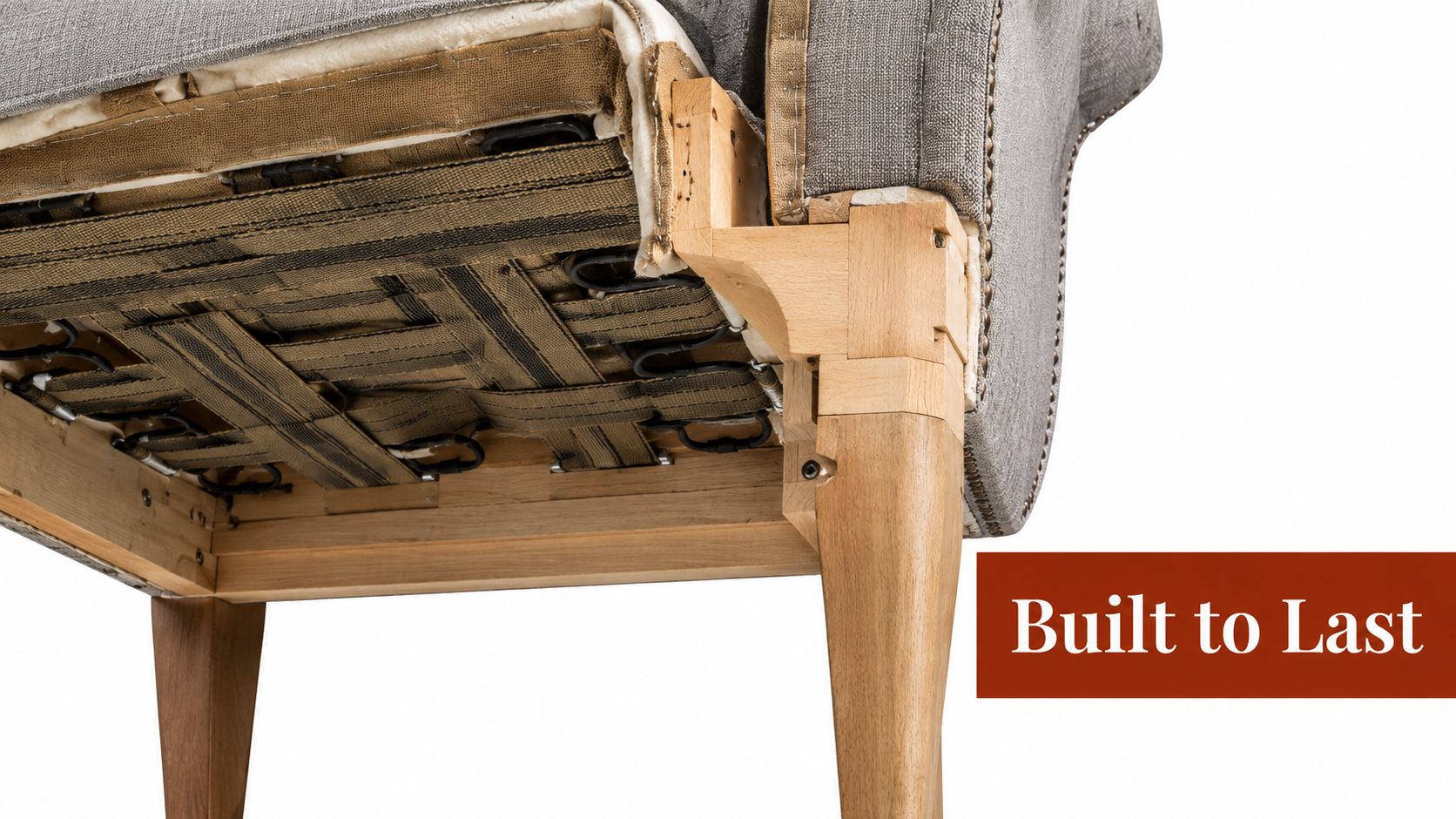
The most important parts of a wingback chair are the parts you don't see. Fabric can attract you from across the room. Construction determines whether the chair still feels supportive years later.
That matters even more with a wingback because the tall back and side wings create leverage. If the frame is weak or the joinery is loose, that extra height can magnify wobble over time.
What to look for under the upholstery
For long-term structural performance, upholstery specifications commonly call for a kiln-dried hardwood frame with strong joinery such as corner-blocking, dowels, or mortise-and-tenon connections, paired with seat foam at or above roughly 30 kg/m³ for residential use and higher-density foams around 35 to 40 kg/m³ for premium or heavier-duty use, according to this upholstered furniture guide on fabric, foam, and wood frames.
Those details aren't fussy technicalities. They have direct consequences.
- Kiln-dried hardwood: Helps the frame stay stable.
- Strong joinery: Reduces looseness at stress points.
- Higher-density foam: Resists permanent compression better than lighter fills.
- A rigid structure: Keeps the chair feeling secure when people sit, lean, and rise repeatedly.
Why seat support changes comfort over time
A chair can feel plush in a showroom and still disappoint later if the support system beneath the cushion is weak.
Industry guidance cites seat webbing tensioned at 80% to 85% of breaking load and high-density foam of at least 2.5 lb/ft³ as benchmarks associated with long-term support and limited seat sag over a 10-year period of typical use, as explained in Tyner Furniture's wingback chair guidance.
That's why well-made seating sometimes feels more supportive than cloud-soft at first. The goal isn't a cushion that collapses. It's a seat that keeps its shape and ergonomic integrity.
A strong wingback should feel settled beneath you, not hollow, springy, or vague at the edges.
For owners who like to maintain upholstered seating carefully, this guide on steam clean office chairs safely from Rubber Ducky Rug Cleaning Birmingham offers useful cleaning considerations that also apply to many upholstered household chairs.
How craftsmanship shows up in a showroom
The No Blind Ordering promise matters. In a curated showroom, you can test pitch, edge support, arm comfort, and how the back receives your shoulders. You can also feel the difference between a chair that looks tailored and one that's built for long-term use.
One local option for that kind of hands-on comparison is Indian River Furniture, where ownership hand-tests every seat before it reaches the floor. That helps remove some of the uncertainty that comes with ordering upholstery from a swatch and a photo alone.
Placement and Styling Ideas for Coastal Living
A wingback is one of the easiest chairs to place well because it brings its own structure. It can soften an empty corner, steady an open-plan room, or add a note of classic tradition in a home that otherwise leans casual.
The key is to style it as part of a lived-in setting, not as a lonely statement piece.
The reading corner that feels complete
A wingback shines beside a window or lamp because its high back makes seated time feel intentional. Add a small drink table, a floor lamp with warm light, and a soft rug underfoot, and the chair becomes a destination.
In Florida homes, this works especially well where the room needs a little enclosure. Open layouts can feel airy and beautiful, but they often benefit from one chair that creates a sense of pause.
A tailored note in the bedroom
Bedrooms often need one item that breaks up the repetition of bed, nightstand, and dresser. A wingback adds height and posture.
Choose a quieter upholstery here. A soft woven neutral, a muted blue, or a refined stripe can make the chair feel collected rather than overly matched. If you enjoy layering ambiance, this guide on how to style coastal lighting from Golden Lighting pairs naturally with the idea of building a calm retreat around the chair.
Practical ways to use one beautifully
Here are a few placements that tend to work well:
- By the fireplace: The historic logic still feels right here. The chair becomes an anchor with a small table and a textured throw.
- In a home office: A wingback can serve as an alternate seat for reading, calls, or a change of posture away from the desk.
- At the end of a living room grouping: This adds architectural shape and can balance a sofa with softer lines.
- In a vacation rental sitting area: A well-scaled wingback photographs beautifully and gives guests one especially comfortable perch.
Good styling leaves enough room for the chair to breathe. A wingback already has personality. It doesn't need clutter to prove it.
If your room leans light, breezy, and layered, this coastal design style inspiration can help connect the chair to a broader look without making the space feel themed.
Use the chair to shape the room
A wingback often works best when it's allowed to define a zone. Turn it slightly toward the sofa. Angle it toward a view. Let it stand near a bookshelf and lamp. It doesn't have to be centered against a wall to make sense.
That's also where complementary in-house interior design consultations can be helpful. Sometimes the right chair is obvious. More often, the right placement is what makes the chair feel exactly right.
Experience the Difference in Our Rockledge Showroom
An upholstered wingback chair is hard to judge from a screen. The silhouette may look perfect online, but comfort lives in the pitch, the arm height, the firmness of the seat, and the way the back supports you after more than a quick sit.
That's why showroom testing matters. In a thoughtfully arranged setting, you can compare proportions, fabrics, and support levels in real time. You can run your hand across a performance weave, feel the cool smoothness of genuine leather, and notice how one chair feels upright while another feels more relaxed.
For homeowners across Brevard County, the Space Coast, and Central Florida, that in-person experience also makes room planning easier. A curated 32,000 sq ft Rockledge showroom gives you the chance to see wingbacks in coastal vignettes, next to sofas, occasional tables, and lighting that make scale easier to understand than measurements alone.
The service side matters too. Complimentary in-house interior design consultations help connect the chair to the rest of the room, whether you're furnishing a condo, a family living room, a bedroom retreat, or a vacation property. White-glove delivery finishes the experience with an in-house uniform team and a flat $99 delivery fee within the service area.
Since 1939, that combination of heritage, craftsmanship, and hands-on comfort testing has given local homeowners a more confident way to choose furniture. You don't have to guess whether a wingback feels supportive, well-fitted, or right for Florida life. You can sit down and know.
If you're looking for an upholstered wingback chair that feels as good as it looks, Indian River Furniture offers hand-tested seating, thousands of performance fabric and genuine leather options, complimentary design guidance, and white-glove delivery. Visit our Rockledge showroom to compare scale, texture, and comfort in person, and find a wingback that suits your home with lasting craftsmanship.