Schedule your Complimentary Design Consultation


Electric Lift Chair Guide for Florida Homes

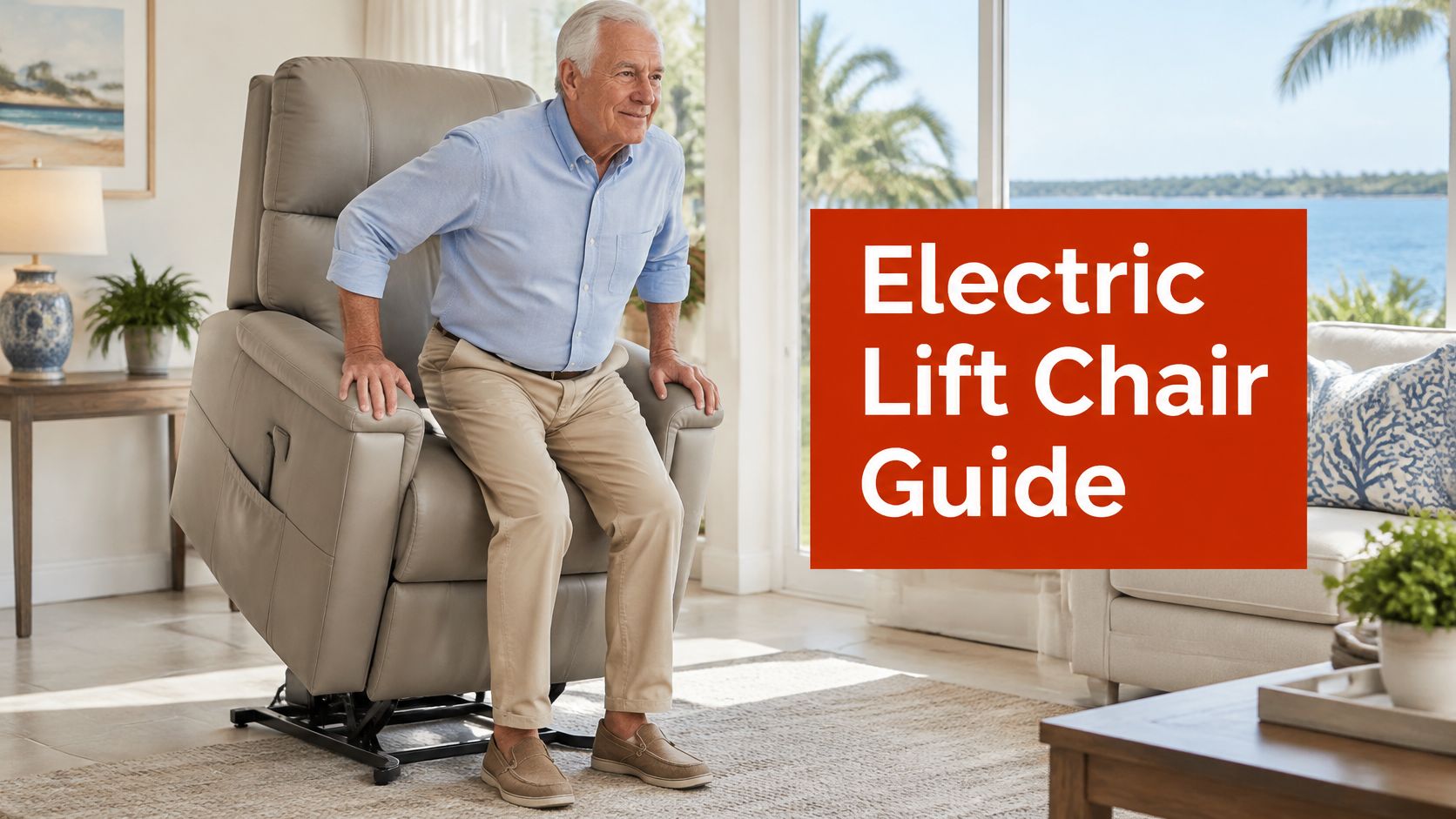
You've settled into your favorite chair with a book and a glass of tea, the afternoon light coming through a coastal window, and then the doorbell rings. Getting up used to be automatic. Now there's a pause at the edge of the seat, a push on both arms, maybe a small rock forward before your feet feel steady. That moment is exactly where an electric lift chair earns its place in a Florida home. It isn't about turning a living room into a clinic. It's about keeping a comfortable, everyday seat that also helps you rise and sit down with more control, so your reading corner, television seat, or morning coffee spot stays yours.
What an Electric Lift Chair Actually Does
Say a homeowner in Rockledge loves an upright chair by the window but dreads the last part of standing. Her knees complain, her shoulders take too much of the push, and she sometimes perches on the cushion edge to gather momentum. A powered lift chair changes that sequence by raising the whole seat and tilting it gently forward, then reversing the motion to lower her back down in a controlled way.
The plain definition helps clear up the most common confusion. A medical policy definition of a seat lift describes it in everyday terms.
A seat lift is an assistive device used in the home "to lift a person's body from a sitting position to a standing position or to lower the individual from a standing to a sitting position."
That language matters because an electric lift chair is a coordinated seating and transfer system, not a recliner with a taller footrest. If you want a sense of how a standard recliner differs in posture and purpose, compare it with a high leg recliner chair and you'll notice the lift chair is designed around the transition itself, not just the seated pose.
The Parts That Have to Work Together
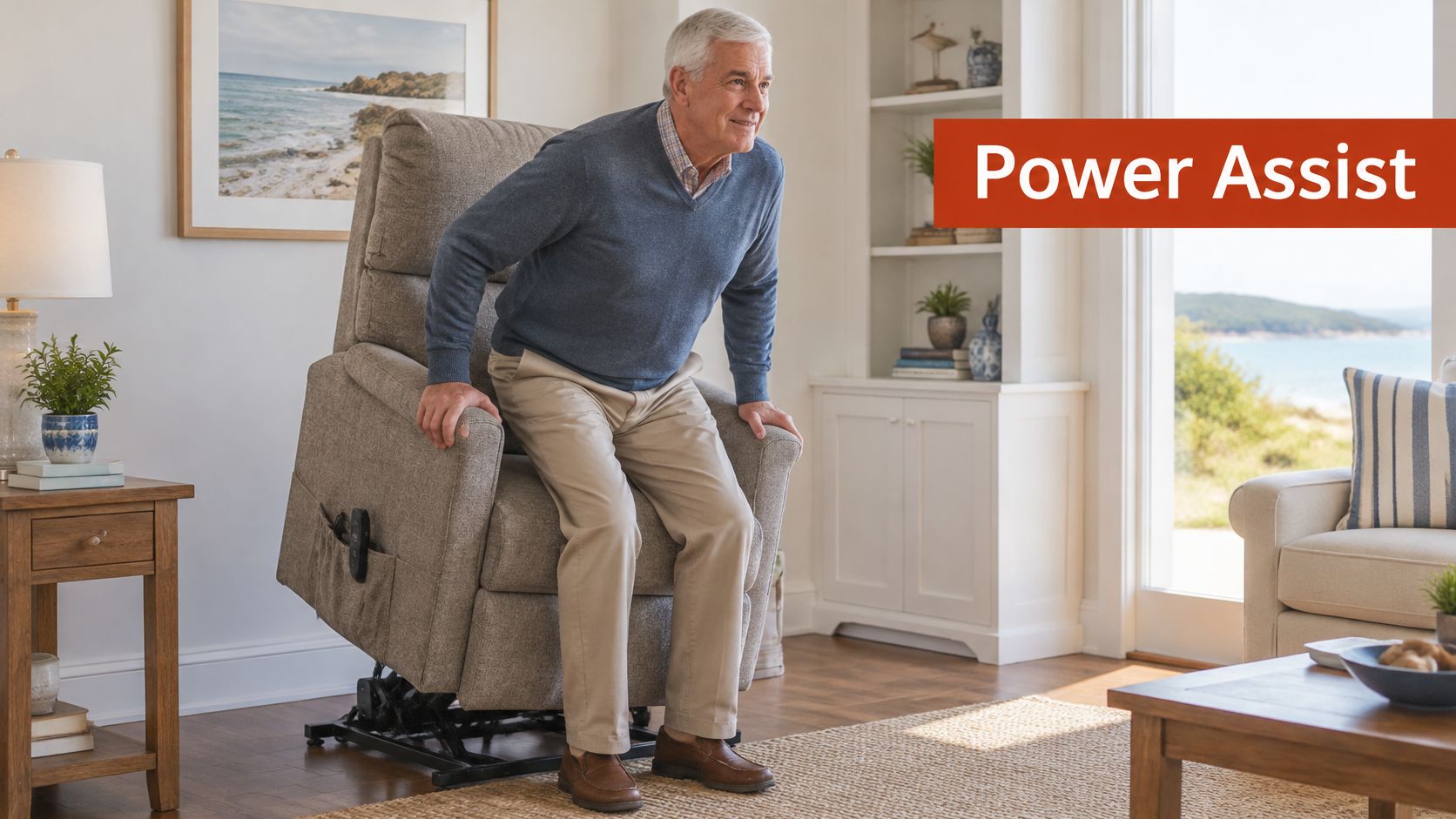
Household power drives an actuator, a small motorized part that changes the chair's geometry in steps. The seat rises, the base tilts forward, and your weight shifts over your feet. Reverse the control and the chair brings you down instead of letting you drop the last few inches.
For that motion to feel steady, five things need to agree. Seat pitch sets the forward angle, seat height lets your feet plant flat, arm support gives your hands a stable place, motor smoothness prevents a jerky start, and hand control placement keeps the button within easy reach. When one of those is off, a knee, hip, or shoulder often ends up at an awkward angle.
Think of it as a steady forearm from a friend. The chair doesn't hoist you or do the standing for you. It meets you partway, supports the middle of the movement, and lets your own legs finish the rise.
A clear boundary: A lift chair can assist a rise from sitting. It isn't a floor lift, it doesn't prevent falls, and it doesn't replace therapy or clinical care.
That's why we separate furniture comfort from medical advice from the start. The chair's job is ergonomic support for a daily transfer. The pause signs in the next section explain when a professional should weigh in before you choose any chair at all.
Who Benefits and When to Pause
The person who tends to benefit most can bear some weight through both feet, place those feet flat, and use the chair arms for balance. What she struggles with is the middle of the movement, the tiring or unsteady stretch between fully seated and fully standing. What helps is a seat that rises to meet her at a better height and angle.
That profile matches who buys these chairs. One market analysis of power lift recliner demand estimated that elderly users accounted for 58.2% of demand and disabled consumers across age groups represented another 28.4%. Those shares describe households solving a sit-to-stand problem that repeats several times a day.
Everyday Coastal Examples
Consider a partner who wants to keep a favorite reading corner by the lanai door instead of moving to a firmer dining chair. Or a guest room where an older parent stays for Space Coast winters and needs a supportive seat that still looks well-fitted next to coastal furnishings. A third example is a homeowner rebuilding routine strength who wants an ergonomic daily seat for television, conversation, and rest, without bracing on a side table every time he stands.
A chair is one piece of a larger picture that may include family help, home routines, and professional guidance. If you're weighing how furniture fits into a broader plan for staying comfortable at home, you can find support for aging in place alongside the seating decision.
When to Pause and Ask First
The boundary set in the first section still applies: the chair assists a rise, nothing more. Equipment alone doesn't create a safe transfer either. Research on assistive lifting and transfer devices found that even trained workers used such equipment for at least half of lifts or transfers only 40% of the time. A well-built chair and a well-practiced routine have to work together.
Pause and talk with an occupational or physical therapist first if you notice any of these signs.
- Sliding forward: The sitter repeatedly slips toward the cushion edge instead of staying centered.
- Feet that won't stay flat: Heels lift, toes point, or one foot drifts during the rise.
- Poor balance or weak ankles: Standing feels wobbly once the chair stops moving.
- Uncontrolled descent: Sitting down ends in a drop rather than a smooth landing.
- Recent surgery or movement restrictions: A care team has limited how a hip, knee, or back should bend.
- A history of falls: Any fall during transfers deserves professional input before new equipment.
This guide isn't medical advice, and a furniture safety mark isn't a medical device certification. When the transfer itself is the risk, a therapist's assessment comes before upholstery, pitch, or style.
How to Match Size Power and Upholstery
Start with the scan, then read the reasons. This table puts the practical checks in the order we'd work through them during a fitting.
| Check | Practical range | Why it matters |
|---|---|---|
| Seat width between arms | About 18 to 20 in petite, 20 to 22 in medium, 23 in or wider broad | Hips should settle without rubbing the arms |
| Seat depth | About 18 to 22 in | Back should meet the backrest with knees comfortable and feet flat |
| User height | Back height and leg support matched to the sitter, not one size | Taller sitters need support that does not leave them perched |
| Lift capacity | Typical bands near 250, 300, 375, and 500 lb, with the chair label governing | Sitting at the posted limit leaves no margin for clothing, posture, or daily use |
| Household power | Many chairs rated up to 250 V AC or DC, including battery-powered furniture | Confirm the complete chair's certification, voltage, and replacement power supply |
| Backup battery | Enough for one return toward seated, not prolonged use | Replace after one use and yearly even if unused |
| Upholstery | Performance fabric or genuine leather suited to sun and active rooms | Florida light, humidity, and daily sitting reward durable, cleanable surfaces |
| Hand control | Reachable seated, usable with one hand, activation at or below 5 lbf (22.2 N), mounted 15 to 48 in above the floor | Arthritis or low grip should not require pinching or twisting |
Width Depth and Height
Seat width is the inside measurement between the arms, not the chair's overall width from outside arm to outside arm. Your hips should settle into the cushion without rubbing, and you shouldn't feel wedged when you shift position. Too wide is its own problem, because you lose the arm support that helps you steady the rise.
Seat depth decides whether your back reaches the backrest. Sit all the way back and check that your knees bend comfortably while both feet stay flat on the floor. If you have to scoot forward to plant your feet, the depth is working against the lift.
User height guides back height and leg support more than any single magic number. A taller sitter needs a back and footrest that support the full leg, while a shorter sitter needs a seat that doesn't leave her perched with feet dangling. Bring the user's height with you and judge the fit seated, not standing beside the chair.
Capacity and Power
Choose a lift capacity rating above the user's clothed weight, with a practical margin of roughly 50 pounds rather than sitting right at the posted limit. Clothing, a blanket, posture shifts, and years of daily cycles all argue for breathing room. The label on the specific chair governs, so read it on the exact frame you're considering.
Power is ordinary household current, and the useful question is how the motor uses it. If you're curious about the broader engineering behind powered lifting equipment, a primer on AC versus DC wheelchair lift motors explains how motor type affects motion and control in related lift systems. For the chair itself, confirm the whole chair's electrical certification, its input voltage, and whether a replacement power supply is available years from now.
The backup battery has a narrow job. It exists to bring the chair back toward a seated position if the power goes out, not to run the chair all day. Treat it as a single rescue transition and plan your outage routine around that limit.
Fabric Leather and the Hand Control
Florida rooms ask a lot of upholstery. Performance fabric resists sun, stains, and the sandy, active rhythm of coastal living, and it usually forgives a spilled drink or a grandchild's visit. Genuine leather offers a different kind of luxury, but you should choose it for how it wears in strong light and how it feels against skin in a warm room. If you're torn between the two, our guide to leather vs fabric upholstery walks through texture, upkeep, and longevity in Florida conditions.
Controls deserve the same scrutiny as cushions. Federal accessibility rules in the electronic Code of Federal Regulations for accessible controls specify that covered controls should sit no higher than 48 inches and no lower than 15 inches above the floor, operate with one hand, and require no greater than 5 lbf, equivalent to 22.2 N, of force. Those rules don't automatically certify a home chair, but they're a smart benchmark. The button should be reachable while seated, clearly distinguishable by touch, and free of tight pinch or wrist twist.
Write down the user's width, depth, height, and clothed weight before your showroom visit. Four numbers on a card turn a vague search into a focused fitting.
Two, Three, and Infinite Position Motion
Position count confuses almost everyone, so let's simplify it. The number describes how the back, seat, and footrest move together. It doesn't describe how strong the lift is, and a bigger number doesn't automatically mean a better chair for your home.
| Motion style | What it does | Best daily use |
|---|---|---|
| Two-position | Upright seat and a lifted forward-tilt stand assist | Getting up and down without a lounge recline |
| Three-position | Upright, lifted stand assist, and a reclined feet-up lounge | Everyday sitting plus one main rest position |
| Infinite-position | Back and footrest adjust through many angles rather than a few presets | Reading, napping, and changing leg position through the day |
A two-position chair suits a sunroom seat used mainly for conversation, coffee, and rising to greet visitors at the door. The owner wants help getting up and down, not a long afternoon recline. Simple motion also means fewer buttons to learn.
A three-position chair fits the evening living room. One seat handles upright television time, a feet-up lounge after dinner, and the standing assist when it's time for bed. For many Brevard County homes, that single main rest position covers the daily routine.
An infinite-position chair earns its keep in a reading corner by a window, where the sitter wants a reading angle in the morning, a nap angle after lunch, and a more upright leg position later. The back and footrest adjust independently, so posture can change through the day instead of settling into one preset. If you want to see how these motion families relate to other powered seating, our overview of the types of power reclining seating lays out the options.
More positions add mechanism, weight, and more to learn on the hand control. Heat, massage, or a power headrest can be pleasant comfort layers, but they should never distract from pitch, foot placement, and a smooth lift. Ask which daily postures the user really lives in, because a chair offering angles nobody will use isn't a smarter investment.
The right motion is the one the user can enter and leave without bracing awkwardly. A position name on a tag can't confirm that. Sitting in the chair can.
Safety Outages and Simple Upkeep
Certification answers one narrow question: was this chair assessed for electrical and mechanical hazards? The international standard IEC 60335-2-116:2025 for electrically motorized furniture covers household furniture with electrically motorized parts, including electrically adjustable seating supplied at up to 250 V AC or DC and battery-powered furniture. Ask whether the complete chair has been assessed against an applicable furniture safety standard, since a certified actuator inside an untested frame tells you far less.
UL 962 is the other benchmark worth naming, since its scope includes motor-operated furniture such as chairs and their motorized drives. A certified chair has cleared defined tests around wiring, moving parts, and powered motion. Comfort, durability, and clinical suitability remain your job to judge in the showroom, and medical electrical equipment rules such as IEC 60601-1 are a separate question from furniture certification.
Checks to Ask About Before Delivery
Work through these points with the showroom team and note the answers.
- Pinch points: Where could fingers, clothing, or a pet get caught during motion?
- Unintended movement: Does the control include a safe stop or obstruction response?
- Insulation and stability: Is the chair assessed as a complete unit, and does it feel planted during the lift?
- Listed voltage: Does the input rating match your home's supply?
- Replaceable power supply: Can you get a new one without replacing the chair?
- Manual release: Ask whether the chair can be released if household power fails, and confirm the answer in writing before it goes home.
The Florida Outage Limit Stated Plainly
A backup battery generally has enough energy to return a chair from reclined toward seated. Plan on one transition, not hours of operation, and never count on the chair as an evacuation device. Manufacturer guidance for powered lift chairs calls for fresh backup batteries after any outage use and on a regular replacement schedule even when they go unused.
Use this calm pre-storm routine.
- Test the backup while someone is nearby, well before a storm is forecast.
- Leave the chair seated in a stable, upright position before an expected outage.
- Keep a caregiver plan for transfers if power stays out longer than one transition.
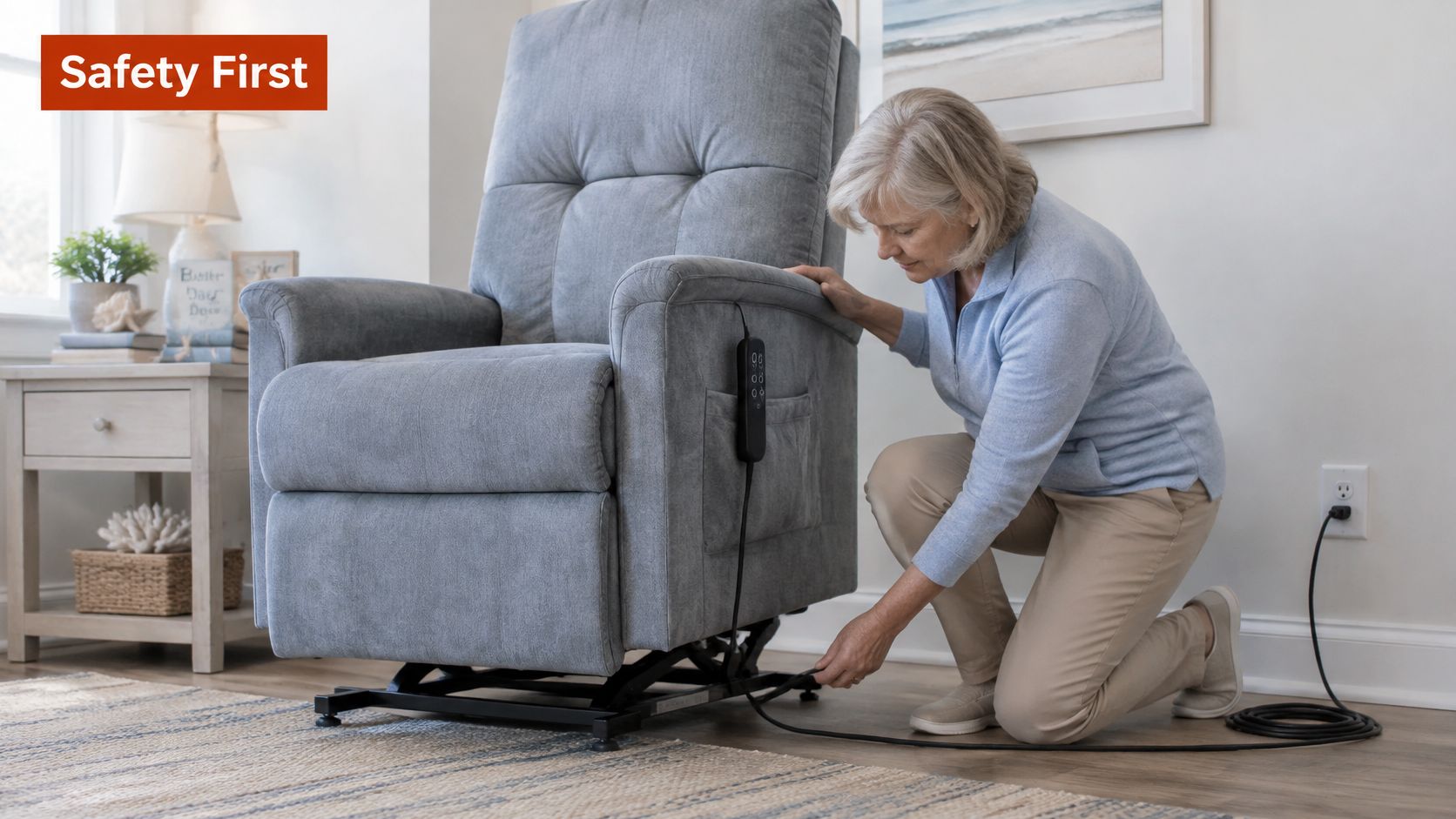
- Protect the cord and avoid running the chair from a damaged cord or a casual extension setup.
- Follow the maker's guidance on generators rather than improvising a power source.
Storm season planning reaches past the chair. A practical guide to what to do during a power outage can help you sort lighting, communication, and comfort for the rest of the home. On delivery day, our white glove delivery team carries the chair into your room of choice and works with you on clear pathways and a proper outlet before they leave.
Simple Upkeep
Keep the area around the base clear, wipe performance fabric or condition leather as its care guide directs, and listen to the mechanism. A smooth, quiet cycle is normal. A chair that hesitates, leans, or pinches should be stopped and serviced rather than forced through one more rise.
How to Test the Rise in Person
A slow test matters because powered help changes the whole transfer, from ankle balance to how the hips unload at the top. In a controlled study of lifting seats in adults aged 65 and older, 28 healthy adults showed significantly reduced peak hip and knee joint moments with lifting seats, with no significant reduction in sit-to-stand duration; one powered condition increased stand-to-sit duration, and ankle joint moments and required ankle strength rose compared with an unassisted seat.
Read that as a fitting clue, not a verdict. A chair can spare the hips and knees while asking more from the ankles, so the right rise depends on the person, the seat height, and the control of the descent. Easier on one joint is not automatically easier everywhere, and a taller seat can trade one problem for another.
A Seven Step Showroom Test
Bring the person who'll use the chair whenever you can, and don't rush these steps.
- Sit fully back with your back supported and both feet flat on the floor.
- Check foot placement before the lift starts, since stable feet anchor everything that follows.
- Rise once slowly and watch the knees, hips, and shoulders for awkward angles or bracing.
- Lower once and notice whether the descent feels controlled or like a drop at the end.
- Try the hand control with the weaker hand, because that's the hand that may need it on a tired evening.
- Check the approach space for a walker or wheelchair, using about 30 by 48 inches of clear room as your guide.
- Sit a while to judge cushion feel, lumbar support, and the fabric or leather under your hand as well as under your eye.
If balance, ankle strength, or controlling the descent is already a concern, get therapy input before the test rather than after a purchase. For Florida homes, ask how the chair settles if power fails, then keep that answer with your storm plan. A good fitting confirms comfort. It doesn't diagnose why a transfer feels hard.
Why We Insist on Sitting First
At Indian River Furniture, ownership personally hand-tests every sofa, recliner, and chair for pitch and comfort before it reaches our 32,000 square foot Rockledge showroom floor. Every sofa depth, recliner pitch, and cushion density has been sat in, evaluated, and approved by the ownership team. That no blind ordering promise means you can feel leathers, touch solid hardwoods, and compare cushion firmness in person, with designers on hand to check dimensions against your room.
A photograph can show you a silhouette. Only your own rise and descent can tell you whether this pitch helps this person.
Plan a Rockledge Fitting Visit
Everything up to this point has been homework. The fitting visit is where the chair earns its place, because a lift chair works as a small sit-to-stand system: the seat, the hand control, the approach space, and a power plan that has to survive a Florida storm season. In the Rockledge showroom you can feel leathers, touch solid hardwoods, and compare cushion firmness side by side, with designers on the floor seven days a week to pull swatches and check dimensions against your room.
Come with the person who will use the chair, since the rise and descent checks only matter with the actual user in the seat. A rough doorway and room measurement helps the team confirm your choice travels through the hallway without drama. Design help scales from a single accent chair to a full-home plan, and full interior design consultations, covering scale floor planning, fabric and finish selections, and room styling, are complimentary when you purchase through Indian River Furniture.
When you have chosen, delivery stays in our hands. The in-house team delivers, assembles, and places the chair in the exact spot you want for a flat $99 rate across Brevard County, handling structural setup, hardware, and fine adjustments so the room is complete before they leave. Nothing sits on a porch or waits in a garage. Flexible financing questions can be settled during the same visit.
Two questions are worth asking before you leave. First, get the warranty terms in writing for the motor, actuator, battery, and upholstery. Second, ask how the chair releases if power fails mid-rise during a storm, and note the answer next to your battery check reminder. Those five minutes remove most of the uncertainty that tends to follow a high-consideration purchase home.
We would love to help you find the chair whose rise, descent, and fabric feel right in the room where it will live. Sit in every candidate on your list, then schedule an appointment with our design team so we can set aside unhurried fitting time, pull performance fabric and leather swatches in your coastal palette, and map out delivery and outage planning before your new electric lift chair leaves the floor.