Schedule your Complimentary Design Consultation


Sectional Leather Sofas with Chaise: Florida Buyer’s Guide


You've found a leather sectional you can already picture in your living room, feet up on the chaise, afternoon light coming through the sliders. Then the practical questions arrive. Will the chaise crowd the doorway, will everyone find a comfortable seat, and will that beautiful leather tolerate a Florida home that sometimes sits empty?
Sectional leather sofas with chaise deserve more than a colour-and-size decision. The right choice combines a workable floor plan, supportive seating, sound craftsmanship, and a finish you can care for in coastal conditions. A softer hide isn't automatically the better investment, and a longer chaise isn't automatically more comfortable.
Chaise Layouts and How Each One Fits a Room
A chaise adds a stretched-out lounging position without a separate recliner or daybed. That makes it useful in family rooms, condos, and vacation rentals where another freestanding piece would interrupt circulation. The modular seating context described in the sofa market analysis helps explain the format's appeal: seating components can work around the room rather than forcing every room into the same arrangement.
Start with orientation, but don't order from a left or right label alone. For the table below, use your seated perspective, with your back against the cushions: the left-arm chaise is on your left, and the right-arm chaise is on your right. When you stand facing the sofa, those positions reverse, so confirm the manufacturer's labelled drawing before approving an order.
Chaise layouts and where each one fits
| Layout | Chaise position | Best room fit | Seating impact |
|---|---|---|---|
| Left-arm chaise | Chaise on your left when seated | Long wall with the chaise anchored in a corner | Lounging seat plus full sofa seating |
| Right-arm chaise | Chaise on your right when seated | Mirror image for a doorway on the left | Same seats, reversed footprint |
| Reversible chaise | Chaise moves to either side | Rooms that may be rearranged or furnished in phases | Flexible placement on either wall |
| Corner chaise sectional | Chaise and sofa meet in an L | Open-plan rooms with a corner to fill | Most seats per corner, needs a clear corner |
| Chaise with armless chair | Chaise plus a separate chair | Family rooms and frequent entertaining | Extra seat without enlarging the sofa itself |
| One-piece chaise sofa | Fixed chaise extension | Compact rooms and apartments | Lounging in a single unit |
A reversible chaise makes sense when furniture may move between walls or when you're furnishing in phases. Confirm what reverses, including the cushion, base, and connectors. A sectional that separates into pieces isn't necessarily reversible.
Corner arrangements give an open-plan room a defined gathering area, but the inner seat can be awkward for someone who needs an easy exit. A separate armless chair offers more conversational flexibility, although it still needs floor space and a clear approach.
Practical rule: Place the chaise where resting feet won't become an obstacle between the entrance and the room's everyday destinations.
Use our sectional layout rules for tight living rooms to refine the arrangement, then make the decision deliberately:
- Sketch the room, marking the television wall, main walkway, and primary view.
- Choose the chaise's role, anchored against a wall or opening toward the view.
- Shortlist two layouts and sit in both arrangements before choosing.
Measuring Your Room Before You Choose a Size
Say you're planning a 14-by-18-foot living room, and the chaise points toward the front door. In this hypothetical layout, the distance from the proposed sofa back to the opposite obstruction is 108 inches. A chaise projecting 75 inches leaves 33 inches for passage, before accounting for a projecting handle, curtain, or door swing.
That subtraction matters more than the room's total area. A spacious living room can still have a narrow pinch point exactly where someone carries groceries through the door. Measure the actual route, not just the empty rectangle between the walls.
Room measurements to check before you buy
The numerical ranges below are illustrative planning allowances for that example, not universal fit or accessibility standards. Replace them with the shortlisted model's dimensions and the space your household needs.
| Measurement | Reference range | Why it matters |
|---|---|---|
| Walkway clearance | Illustrative allowance of 30 to 36 inches | Keeps traffic moving past the chaise |
| Coffee table gap | Illustrative allowance of 14 to 18 inches | Puts drinks within reach from the seat |
| Chaise projection | Illustrative model allowance of 60 to 75 inches | Needs the full length clear of doors and vents |
| Seat height | Illustrative comparison range of 17 to 19 inches | Affects how easily someone sits down and stands up |
| Overall depth | Manufacturer's back-to-front dimension, including projecting cushions | Sets how far the sofa reaches into the room |
Record the usable wall length, then measure from the proposed sofa back to the nearest doorway. Mark the narrowest walkway, the coffee table gap, and the chaise's full projection. Use a tape measure held square to the wall rather than following the angle of an existing sofa.
Overall depth and effective seat depth aren't interchangeable. Overall depth describes the furniture's footprint. Effective seat depth describes the sitting space in front of the back cushion, which changes how your body fits.
Test the footprint in daily life
Lay painter's tape around the entire outline, including the chaise tip and arms. Add boxes where the arms will stand so you notice their volume, and mark the coffee table separately. Leave the arrangement in place for several days.
- Walk normally: Carry a laundry basket past the chaise instead of carefully stepping around the tape.
- Open everything: Check doors, storage drawers, window treatments, and nearby cabinets.
- Check the delivery route: Record entry openings, turns, stairs, and elevator restrictions where applicable.
Our furniture measuring guide helps organise those details. Bring the measurements to the showroom, then test the actual seat before committing.
Comfort and Access for Every Member of the Household
A grandparent visiting a multigenerational home may need a firmer seat and a stable arm to push against, while teenagers may prefer a deep lounging corner. A sectional should accommodate both, so test whether each household member can sit down and stand up comfortably before choosing the layout.
Seat height, effective seat depth, back geometry, cushion firmness, and arm support all affect fit. A long chaise can feel relaxed to a tall adult yet leave a shorter person without comfortable knee support or contact with the lumbar area. Low, yielding cushions pose another trade-off: the sitter may sink below the arm and have to work harder to rise.
Run a household comfort test
- Sit fully back: Let the cushion settle. Check that the backrest supports your lower back without pushing your shoulders forward.
- Check the seat edge: Sit naturally and leave roughly 1 to 2 inches of space behind the knees. If moving forward removes all lumbar support, the seat may be too deep.
- Try the outside seat: Plant your feet securely, use the arm for support, and stand without twisting around the chaise.
- Walk the exit route: Check that another person's extended legs won't block the way out.
Repeat the checks on the chaise and on the outside seat. One seat may suit lounging, while another makes getting up easier. A household needs room for both uses, not just the longest possible stretch-out area.
A chaise paired with a firm, accessible outside seat can serve a household or vacation rental better than a layout that maximises lounging space. If a recliner or lift chair shares the room, leave enough approach and operating space for it rather than squeezing it into whatever remains. Comfort and access are part of the purchase decision, not details to discover after delivery.
Leather Grades and Finishes Worth Investing In
Leather has long occupied a premium position in upholstery. Historical Furniture Today reporting estimated that leather accounted for 34% of U.S. upholstery retail value and 29% of upholstery unit sales in 2009, across multiple furniture categories. That's historical context, not a current sectional-specific measure, but it shows why leather warrants a deliberate material decision.
The important distinction is hide type versus surface finish. Grade descriptions tell you about the underlying material and how its surface has been altered. Finish descriptions tell you more about what your hand touches and what encounters spills, clothing friction, and daylight.
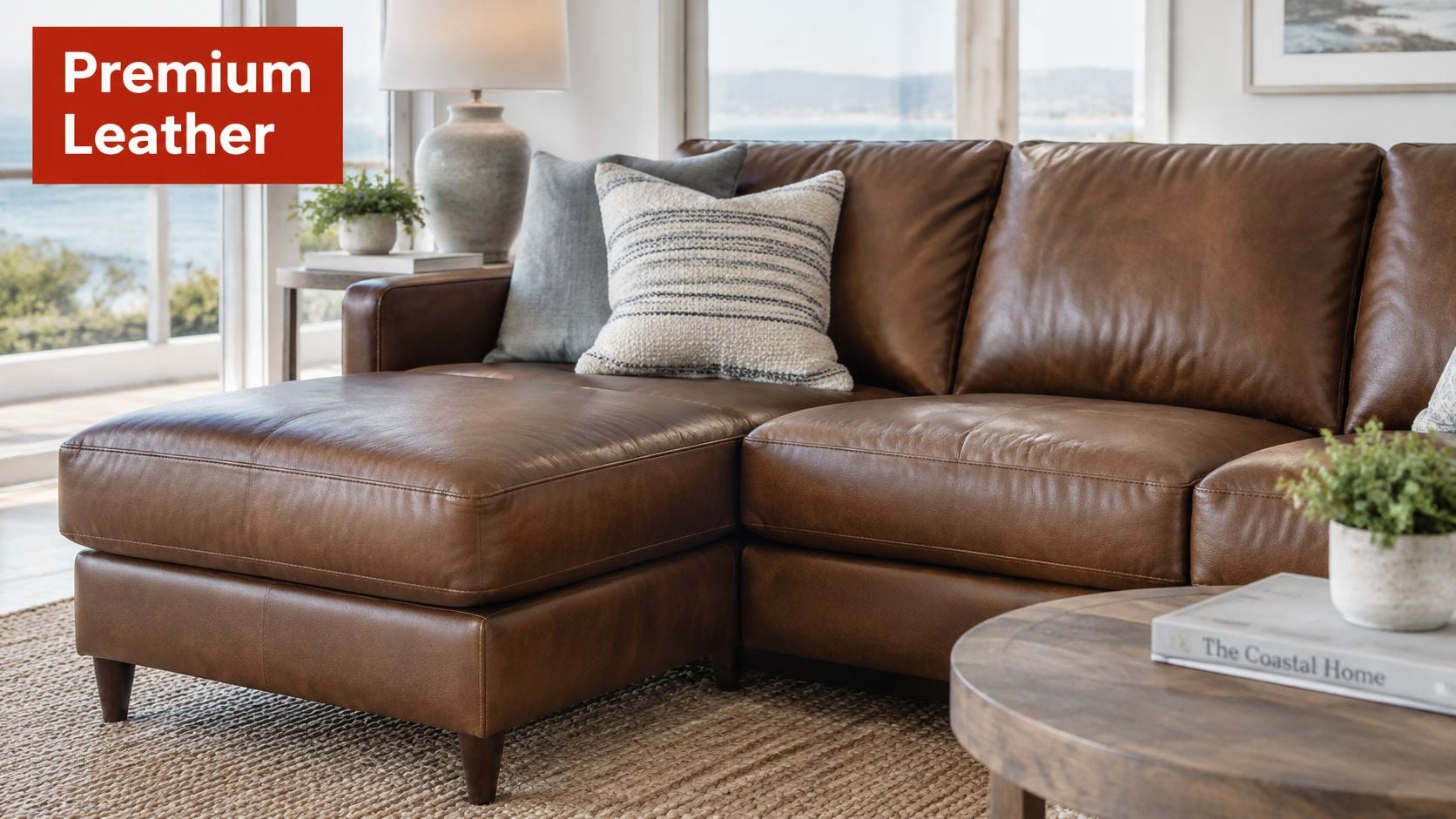
Leather grades compared for a Florida living room
| Leather grade | What it is | Look and feel | Florida note |
|---|---|---|---|
| Full-grain | Natural outer surface, least altered | Shows natural grain and develops a patina | Breathability follows the finish; maintain humidity control and condition only as specified |
| Top-grain | Outer hide layer, often lightly sanded and finished | Can offer uniform colour and a smooth hand | A practical balance of appearance and protection when appropriately finished |
| Corrected-grain | Surface sanded, then coated with an embossed pattern | Even look that conceals natural flaws | Coating quality matters in heat and humidity |
| Bonded leather | Leather fibres bonded to a backing | Leather-look surface over a backing | Treat moisture and sunlight sensitivity as concerns; request aging data |
| Faux leather | Synthetic polymer surface | Consistent colour and often easy to wipe clean | Not genuine leather; ask how the coating ages with heat and light |
Think of full-grain leather as wood with its natural character left visible. Grain variation and healed markings belong to its appearance. Top-grain is a broader category than a promise of light sanding, so ask how the particular hide was processed rather than treating the label as a complete specification.
Corrected-grain leather is still leather beneath its altered surface. Bonded and faux materials aren't equivalent substitutes for a genuine hide, even if a sample has a convincing embossed grain.
Choose the finish for the way you live
Aniline finishes keep natural character prominent and offer a supple, intimate feel. Semi-aniline adds some protection while retaining visible grain. Pigmented finishes generally provide more resistance to staining and fading, but they don't make direct sunlight harmless.
A more open finish can feel less sealed against bare skin, yet it asks for quicker attention to spills and greater acceptance of patina. A protected finish may suit active entertaining better. Neither choice should rest on softness alone.
Our selection includes performance fabrics, genuine leathers, and solid hardwood frames suited to active Florida living. In the Rockledge showroom, you can feel leathers, touch solid hardwoods, and compare cushion firmness side by side.
Our leather-versus-fabric upholstery guide can help clarify the material choice. Before settling on colour, establish how the selected finish was tested and how it must be maintained.
How to Test Leather Durability Before You Buy
A smooth sample and a firm handshake don't establish long-term durability. For a chaise, you need to understand what was tested, how it was tested, and what counted as failure. An impressive abrasion count means little without that context.
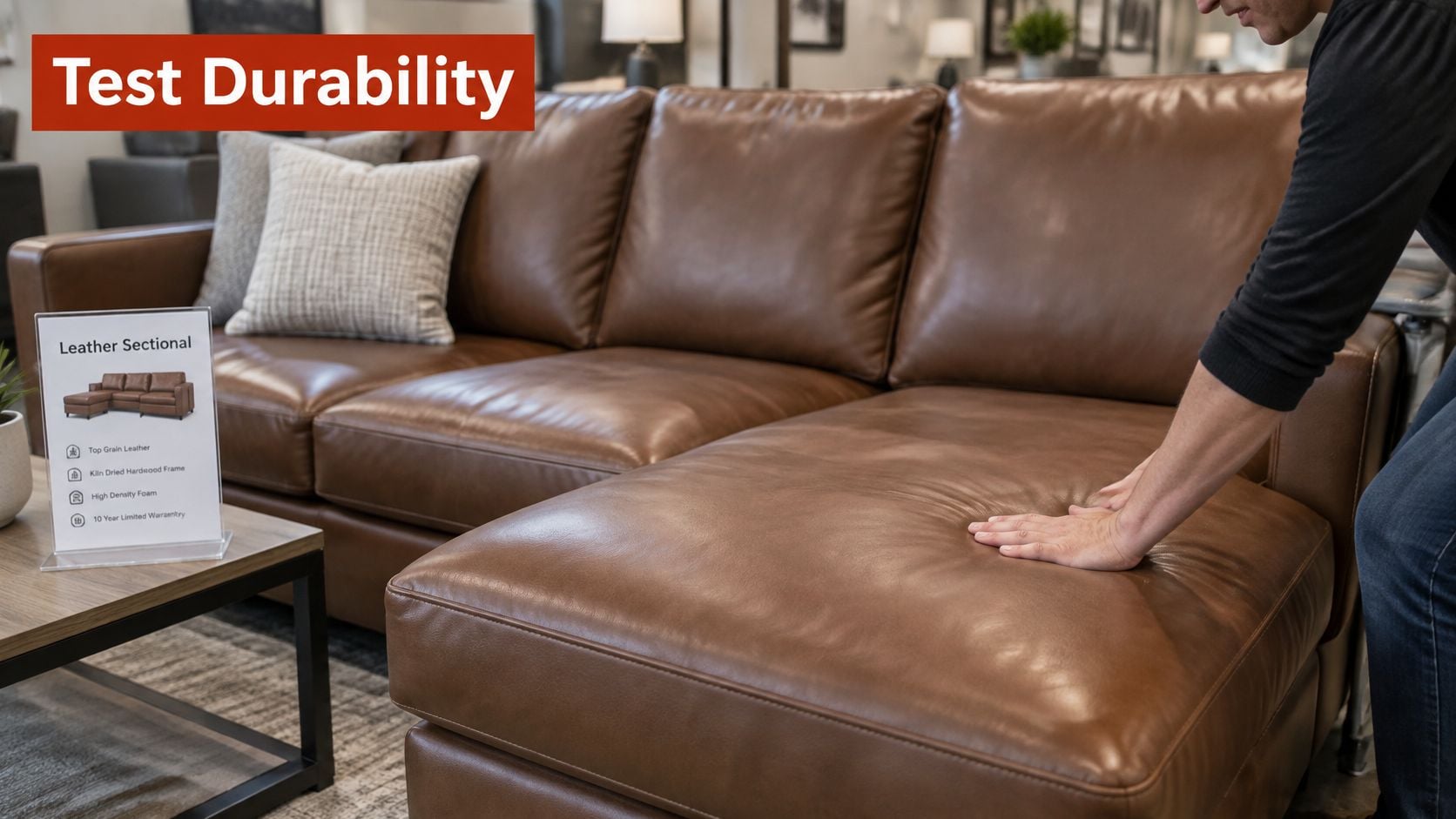
The chaise deserves special scrutiny because people repeatedly slide onto it, bend its seat-back crease, and push against its edges. Body oils, grit, and seam stress meet in the same heavily used area. A finish can resist initial rubbing yet later develop cracking or loss of adhesion.
Use a report-based routine
The leather testing standards catalogue provides the standards context for asking about abrasion, flexing, aging, and surface performance.
Request the applicable report. Ask for documentation covering the selected hide or leather lot, because a general durability statement may describe a different finish.
Confirm the abrasion method. Have the retailer identify the leather abrasion standard and apparatus, including whether the report uses ISO 17076-1 or ISO 5470-1, because counts from different methods aren't directly interchangeable.
Read the endpoint. Check the applied load, cycle count, and whether the recorded result describes visible change or breakthrough, because those endpoints represent different levels of damage.
Ask about repeated flexing. Request the applicable ISO 5402-1 result, because the crease behind the chaise seat repeatedly bends under normal use.
Check aging suitability. For coated materials, ask for relevant heat-and-humidity or hydrolysis testing and clarification of any ISO 188 reference, because aging evidence must apply to the actual coating construction.
Confirm surface care performance. Review colourfastness, rub-fastness, and the maker's specified cleaner, because colour transfer and cleaning damage matter even when abrasion performance looks strong.
Translate the report into a buying decision
You don't need to become a laboratory technician. You need a clear match between the upholstery description, the report, and the material being ordered. If documentation isn't available, treat that as an unanswered question rather than assuming the leather has passed.
Keep the report with the upholstery specification and written care directions. Ask what changes are expected patina and what changes require assessment. Softening and colour development are different from peeling, lifting coating edges, or seams opening under ordinary use.
At the counter: Compare like-for-like test methods, not the largest number printed on a sample tag.
Our No Blind Ordering promise adds a separate, hands-on check. Ownership personally hand-tests every sofa, recliner, and chair for pitch and comfort before it reaches the Rockledge showroom floor or enters a customer's home. That evaluates how furniture sits; the report questions help establish how its upholstery is expected to perform.
Caring for a Leather Chaise in Florida Humidity
Florida ownership changes the durability conversation. The Canadian Conservation Institute's leather-care guidance warns that relative humidity above 65% encourages mould and hydrolytic deterioration, while conditions below 30% can cause moisture loss and embrittlement; its conservation guidance recommends stable conditions around 45% to 55% relative humidity and 18 to 20°C.
Those are conservation conditions, not a requirement to keep a family room uncomfortably cool. The practical household priority is a stable, monitored environment appropriate to the upholstery manufacturer's guidance. Put a hygrometer near the chaise, away from direct supply air, rather than judging moisture by how comfortable the room feels.
Place the furniture before establishing the routine
Keep leather away from direct sun, concentrated HVAC discharge, and moisture entering around sliding doors. Leave breathing room at exterior walls, particularly where condensation or dampness is a concern. Window treatments help manage exposure, but a protected finish still needs sensible placement.
For ongoing care, the leather material-care guidance supports prompt spill removal, manufacturer-approved products, and monthly inspections of vulnerable seating areas.
- Dust weekly: Use a soft cloth and remove grit from seams and the seat-back crease before it becomes abrasive.
- Blot promptly: Lift spills with an absorbent cloth rather than rubbing them across the surface.
- Use the specified cleaner: Avoid household solvents, silicone products, and improvised cleaning mixtures.
- Condition selectively: Follow the maker's schedule and product instructions; don't assume every coated surface needs conditioner.
- Inspect closely: Look for altered gloss, microcracking, colour transfer, or coating edges beginning to lift.
Our real leather sofa cleaning guide helps turn the care instructions into a manageable household routine.
Plan for an unoccupied coastal home
Don't shut down climate management just because the property is empty. Keep air conditioning operating at a steady, appropriate setting and arrange for someone to check the room. If humidity remains difficult to control, Home Dehumidifier Reviews explains whole-home dehumidification as background for a conversation with a qualified HVAC professional.
Before delivery, confirm a stable hygrometer reading, a location clear of vents and direct sun, and a climate-control plan for unoccupied weeks. Seek professional assessment for persistent musty odours, visible mould, spreading cracks, colour transfer, or lifting finish. Applying more conditioner won't correct a failing coating or an unresolved moisture problem.
Book Your Showroom Test Before You Order
Schedule a Rockledge visit before ordering, and bring your room measurements, a photo, and the names and seating needs of everyone who'll use the chaise. A floor plan tells us where furniture can go. Sitting together tells us whether the arrangement works for your household.
Established in 1939, Indian River Furniture remains committed to serving Brevard County, the Space Coast, and Central Florida. Our 32,000-square-foot showroom includes curated coastal vignettes where you can judge scale, texture, and refined details in a furnished setting.
Make the visit useful
Designers are on the showroom floor 7 days a week to pull swatches, check dimensions, and help test seat comfort. Full in-house interior design consultations, including scale floor planning, fabric and finish selection, and room styling, are completely complimentary when you purchase your furniture through us. Assistance can cover an accent chair or a full home.
Confirm access and setup details with our premium, uniform, in-house white-glove delivery team, which unboxes, inspects, and sets up your furniture. An heirloom-minded investment starts with craftsmanship, but it also needs the right fit and dependable care.
Book your showroom appointment and bring your shortlist. Follow this sequence: book the visit, sit in the chaise and run the comfort test, request the report for the exact hide, then place the order. We'll help you choose a sectional that feels at home in your room and comfortable for the people who share it.