Schedule your Complimentary Design Consultation


Lift Recliner Chair Buying Guide for Florida Homes

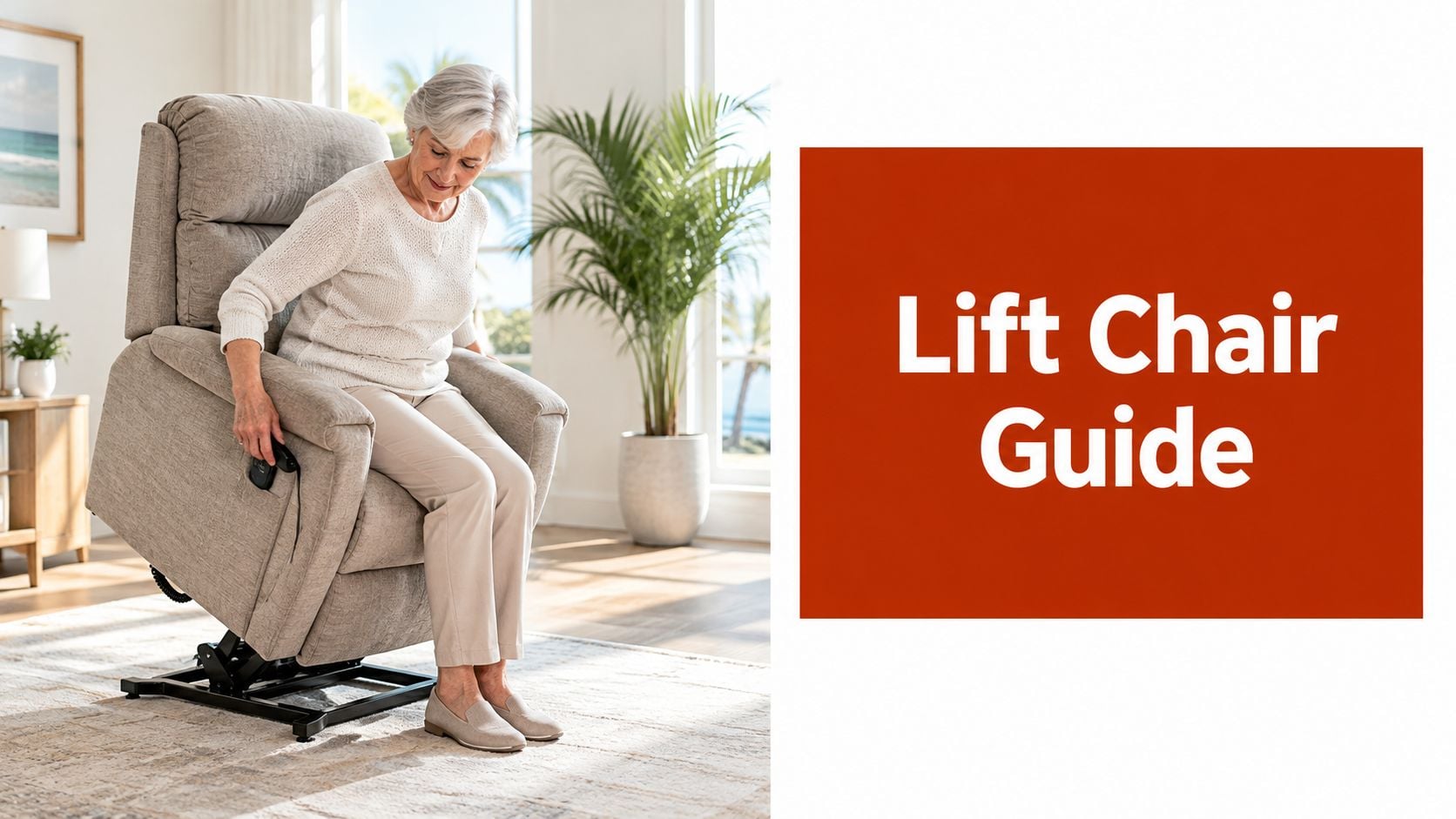
A family often starts looking for a lift recliner chair after a familiar moment: someone eases into a soft seat, reaches for the arms, then hesitates before trying to stand. The chair may look inviting, but if its height, pitch, or support makes getting up harder, plush upholstery won't solve the underlying issue. In Florida homes, the right choice begins with how the chair meets the person's body and works in the room.
At Indian River Furniture, established in 1939 and serving Brevard County, the Space Coast, and Central Florida, we believe a chair should earn its place through fit and craftsmanship, not promises on a tag. Our ownership hand-tests every seat, sofa, and recliner for pitch and comfort before it reaches the 32,000 sq ft Rockledge showroom floor. That matters especially for a lift recliner, where the movement of the chair needs to feel as considered as its upholstery.
Why a Lift Recliner Chair Feels Different the Moment You Try One
You can learn a lot from watching someone use a standard recliner. They settle into the cushions, shift forward, plant their feet, and brace against the arms. If the seat is low or too soft, that simple rise can turn into a struggle. A lift recliner chair changes the movement: its powered seat rises and angles forward, helping the user approach a standing position rather than pushing up from the chair's lowest point.
The sensation should be steady, not startling. As the chair rises, the seat meets the user partway, while the back and footrest move according to the model's design. The right chair doesn't shove someone forward or leave their feet dangling. It supports a controlled transition, and its armrests give the user a stable place to rest their hands.
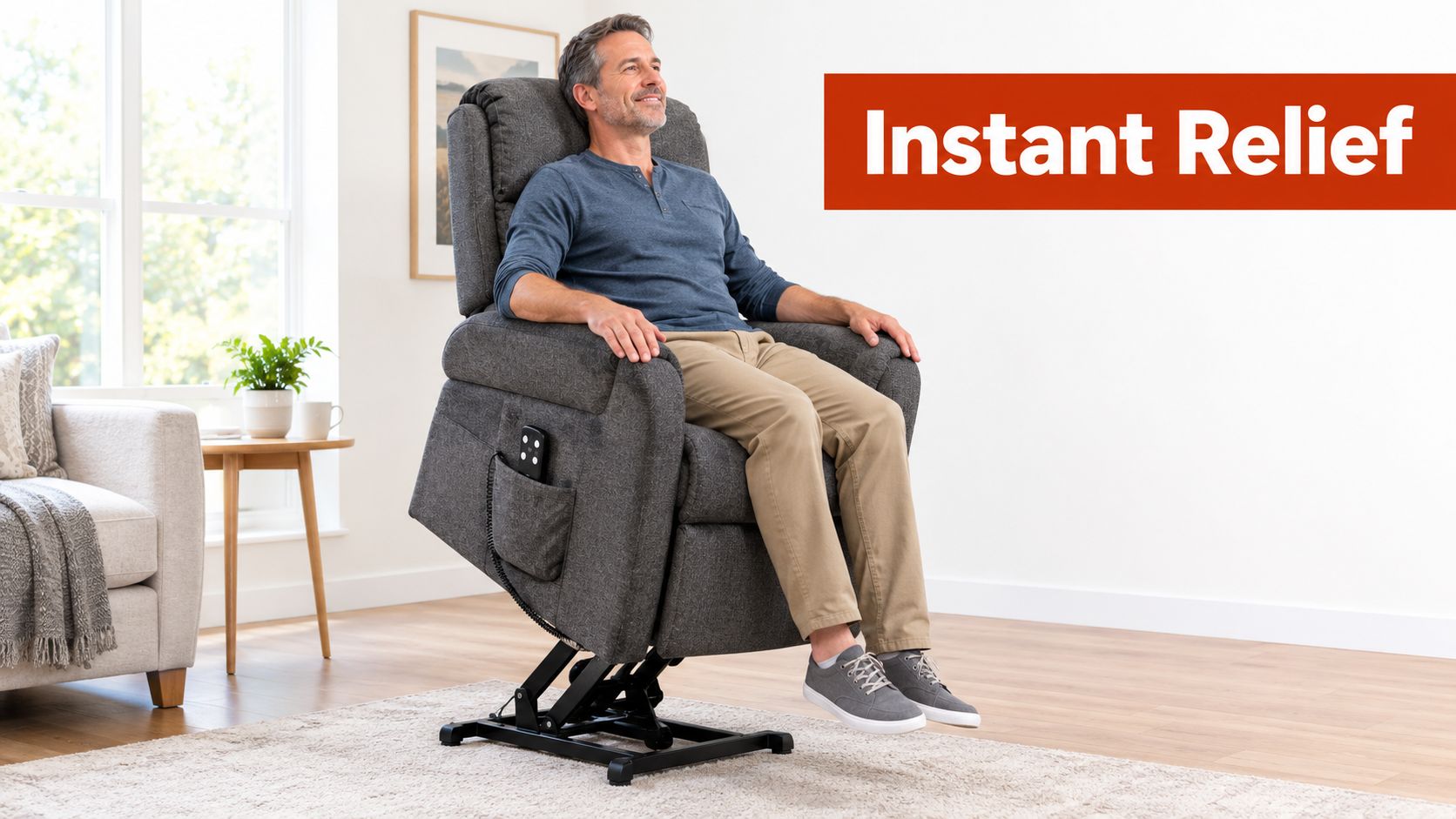
That's why comfort claims aren't enough. A deep cushion might feel wonderfully soft for a few minutes but put the user too far back or too low to rise with confidence. If joint discomfort is part of the picture, a guide to joint support for aging walkers can offer useful context alongside a conversation with a qualified health professional.
What to notice: Does the chair help you move forward into a secure standing position, or does it make you feel pushed or unsteady?
At Indian River Furniture, we test seat pitch and comfort by hand before a chair enters the showroom. Bring the person who'll use the chair, if possible. Their body, balance, and everyday routine are the most useful measures of whether the chair fits.
What a Lift Recliner Chair Actually Is
A lift recliner combines powered reclining with a seat that rises to assist the user as they move between sitting and standing. That makes it different from a conventional recliner, which adjusts the back and footrest but doesn't raise the seat into a forward-tilted position. It's also more than a chair that lifts: a lift recliner may offer multiple reclining positions as well as standing assistance.
The design grew from earlier motorized seating and occupant-assistance technologies. A U.S. patent for a motor-operated reclining chair was issued on January 9, 1962. Later patent records describe occupant-assisting chairs and lift-chair designs, followed by increasingly specialized mechanisms. As controls and microchips became more practical during the 1990s, powered chairs could offer more than a single simple movement. The patent record helps illustrate the engineering lineage behind a category that now serves both comfort and mobility needs.
Understand the movements
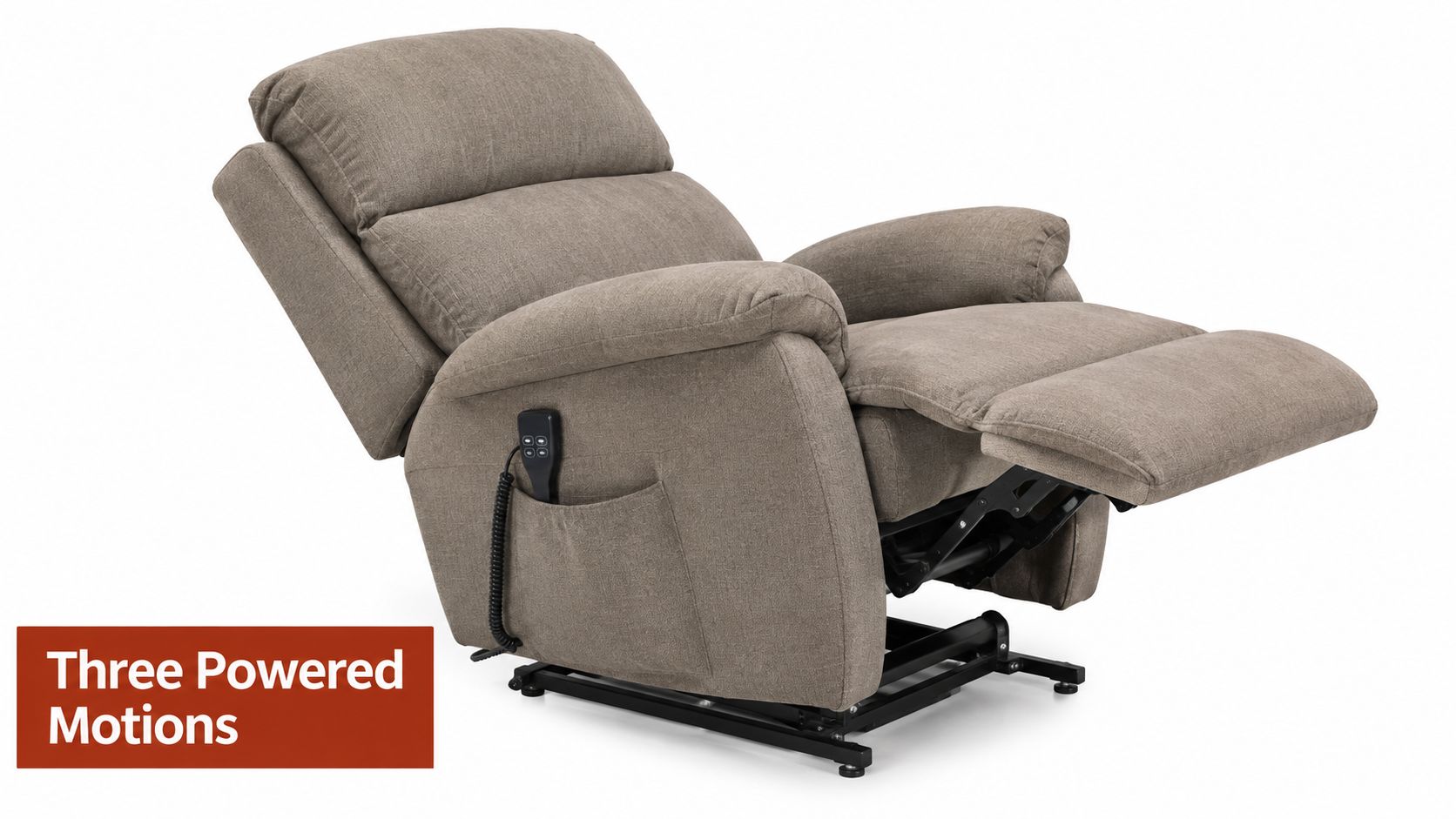
The lift mechanism raises the seat and angles the user forward. Recline changes the back position, while the footrest extends to support the legs. Depending on the chair, the back and footrest may move together or adjust more independently. Ask to see each movement in person rather than relying on a product label.
Position names describe the chair's general reclining range, not a fixed number of exact stopping points. A two-position model usually offers upright sitting and a more relaxed TV-style recline. A three-position model generally reclines farther, while an infinite-position design allows more individualized control over the back and footrest. Features vary, so check what a specific model does.
This distinction matters if the chair will serve as a daily seat, a place to lift the legs, or primarily as assistance during transfers. Don't assume that more adjustment automatically means a better fit. The right motion is the one the user can operate comfortably and use safely.
The Features and Specs That Actually Matter
Start with the body, not the feature list. When the user sits upright, their feet should rest securely on the floor, their back should meet the backrest, and the seat shouldn't force them to slide forward or slump. Check seat height and depth, back height, and armrest position. Armrests should be easy to reach and firm enough to provide dependable support.
Then observe the lift trajectory. The chair should move smoothly and gradually, bringing the user toward standing without throwing their balance forward. Test the control from the person's usual sitting position. Buttons should be clear, reachable, and manageable for the person who'll use them. Ask about motor configuration, emergency return or battery backup, and the space required for full lift and recline. A wall-hugger design may suit a tighter room, but confirm its actual clearance needs.
For further context on matching equipment to everyday routines, see Cream Home Care's 2026 equipment advice. If you're comparing powered seating features, our information on electric recliners with heat and massage can help you think through which functions are useful and which may be unnecessary.
Compare the positioning styles
| Feature | Two-Position | Three-Position | Infinite-Position |
|---|---|---|---|
| General use | Upright sitting and relaxed TV-style reclining | Broader recline for resting and relaxing | More individualized back and footrest positioning |
| Adjustment | Typically coordinated movement | Typically coordinated movement with a deeper range | More independent adjustment, depending on the model |
| Consider if | Standing assistance is the main priority | The user also wants a deeper recline | The user wants greater control over posture |
| Check in person | Whether the seated angle feels natural | Whether the reclined position supports the body | Whether controls are comfortable and understandable |
Weight capacity is essential, but it isn't a complete safety assessment. The frame, base, actuator, and lift linkage must work together under the manufacturer's stated conditions. FDA criteria for motorized positioning chairs address fall prevention after device failure, rated loading, durability, and clear instructions for use and maintenance. Review the manufacturer's documentation, check stability through the full movement, and ask how the chair should be maintained. Some manufacturers also identify electrical compliance standards such as UL 73 and CSA C22.2 No. 68 in their documentation.
Hand-Testing the Chair Before You Commit
A product description can tell you what a chair is designed to do. It can't tell you how your body will feel in it. Sit down, put your feet where they naturally rest, and check whether the seat supports you without forcing your knees or hips into an awkward angle. Then operate the controls yourself. The chair should feel straightforward to use, not like a puzzle you'll need to solve every time you sit.
Test the entire movement, not just the upright position. As the chair reclines, notice whether your back remains supported and whether the footrest meets your legs comfortably. As it rises, keep an eye on your feet and balance. Try stopping and reversing the movement so you know how the chair responds if you change your mind.
Use this short showroom checklist:
- Seat pitch: Does the seat feel level and stable, rather than tipping you back?
- Foot support: Do your feet stay supported through lift and recline?
- Back and lumbar fit: Does the chair support your back without an uncomfortable gap?
- Controls: Can you reach and understand them without twisting?
- Movement: Does the chair lift and recline smoothly, with no nearby obstruction?
A recliner buying guide can help you prepare questions, but your own experience in the chair should carry more weight than a specification sheet. At our Rockledge showroom, ownership hand-tests each seat, sofa, and recliner for pitch and comfort before it reaches the floor. That's our No Blind Ordering promise: the showroom chair has already been assessed before you try it.
Come in with the person who'll use the chair, if you can. Ask to test the controls and full movement at the pace that feels comfortable. A good fit should feel reassuring in your body, not just convincing on paper.
Choosing Fabrics and Finishes for Coastal Living
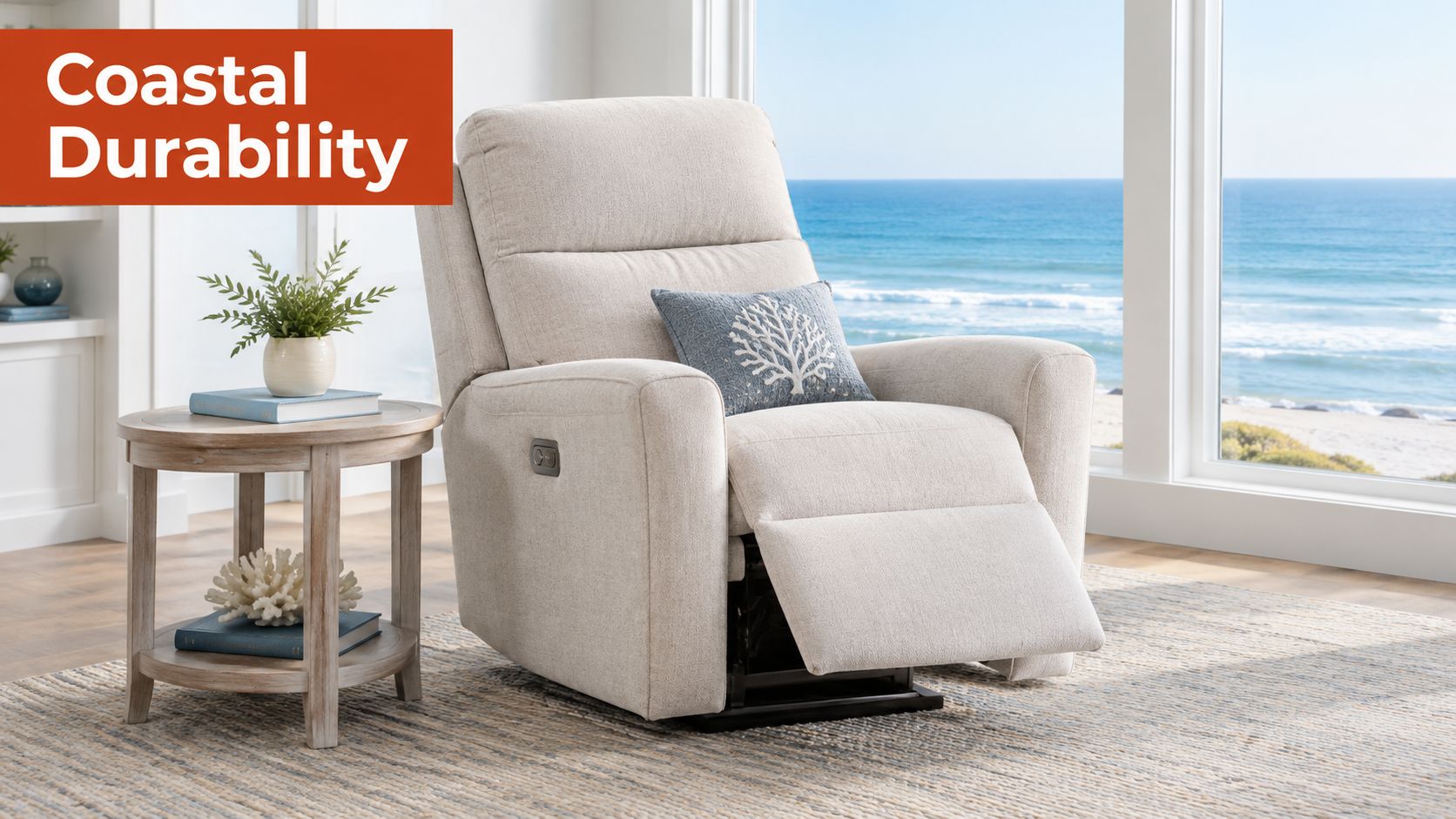
Florida's light, humidity, and active households deserve a little thought when you choose upholstery. A lift recliner may be used daily, so the fabric should suit the room it will live in, the way the household uses it, and the care you're prepared to provide. Don't choose a swatch in isolation. Consider whether the chair will sit in a sunlit great room, a climate-controlled lanai, or a quieter bedroom.
Compare the feel and the care
Performance fabrics are practical for homes where the chair sees regular use. Look for a durable weave with a hand you enjoy, and ask how the material should be cleaned. Breathable fabric can be a sensible choice in a warm room, while a tight, refined texture may suit a more formal coastal interior.
Genuine leather offers a distinctive texture and develops character with attentive care. It's a strong option when you appreciate its natural feel and are willing to follow the care guidance for the particular finish. Direct sun and neglect can take a toll, so think about placement before choosing it.
Traditional weaves and other upholstery finishes can bring softness, color, and pattern into a room. The right choice depends on how the chair will be used and how easily the fabric can be maintained. Our fabric and leather upholstery guide offers a starting point for comparing their look and feel.
A chair's construction matters just as much as its cover. Solid hardwood frames and time-tested joinery support everyday use, while Florida's indoor humidity can affect nearby wood furnishings and finishes. Furniture-care guidance for Florida homes recommends maintaining relative humidity around 45% to 55%, and notes concern about mildew and moisture-related damage when levels stay above 60% (Florida furniture-care guidance). Use stable air conditioning or dehumidification, avoid prolonged direct sun, and keep furniture away from damp areas.
At Indian River Furniture, curated choices include performance fabrics, genuine leathers, and custom wood finishes. Ask to see how a material looks in a coastal vignette and how it feels under your hand. A custom finish should work beautifully in your room and remain practical for the household that lives there.
Measuring Your Space and Planning the Delivery
Measure the route before settling on a chair. Start with the doorway where the recliner will enter, then check hallways, corners, stair turns, and the opening into the intended room. Note anything that could narrow the path, including a handrail, console table, or nearby door swing.
Next, plan the chair's footprint in its everyday position and through its full movement. A recliner needs room for the back and footrest to travel, and a lift model needs a clear path around its base. Ask whether the chair is a wall-hugger design and confirm the clearance requirements for that exact model. Don't estimate from a showroom display: measure the room and compare it with the manufacturer's specifications.
Our furniture measuring guide can help you prepare. For broader planning around staying independent at home, Rx360's guide to aging in place offers another useful perspective.
Prepare for setup
Write down the room measurements, entry route, and location of the nearest suitable outlet. Also consider the person who'll use the chair. Will a caregiver need room to stand beside them? Can the user reach the control without stretching? Are tables, ottomans, rugs, or cords likely to interfere with the chair's movement?
Indian River Furniture provides uniform, in-house white-glove delivery for a flat $99 fee within its service area. The team unboxes and inspects the furniture, then sets it up in the room. That service helps protect the investment and makes it easier to confirm the chair is placed where it can move without obstruction.
If you're furnishing a room over time, ask about available financing options and flexible payment plans as part of your planning conversation. The important thing is to make the decision around fit, room access, and intended use, then arrange delivery so the chair is ready to serve its purpose at home.
Safety, Maintenance, and Honest Limitations
A lift recliner chair can assist with standing, but it isn't automatically suitable for every person. In a biomechanical study of 28 healthy older adults, powered lifting seats significantly reduced knee and hip joint moments during sit-to-stand and stand-to-sit movements, while increasing ankle joint moments. The assistance didn't significantly shorten the time needed to stand, so the benefit was reduced loading at the knee and hip, not a faster transfer (biomechanical study).
That trade-off matters. Someone with limited ankle strength, poor balance, or difficulty bearing weight may need an assessment before using a lift chair. A chair that raises a person toward standing can create risk if they can't maintain their balance once raised. A coroner's review documented three deaths following falls after people with cognitive decline used a power lift chair's remote and attempted to stand. The review recommends including lift recliners in home-safety assessments for people with cognitive decline (coroner's review).
Be candid about the transfer: A lift chair assists movement. It doesn't replace an occupational-therapy assessment or equipment designed for someone who can't stand safely.
Before choosing a chair, consider:
- Cognition: Can the user understand the controls and follow a safe transfer routine?
- Balance and strength: Can they maintain standing once the seat rises?
- Foot placement: Do both feet reach the floor securely at the raised position?
- Remote access: Can the user reach and operate the control, and should access be supervised?
- Caregiver support: Is someone available when the user needs help?
- Emergency plan: Does the household know how to respond if power or movement is interrupted?
Powered mechanisms also create pinch and crush points. Keep hands, feet, clothing, pets, and objects away from moving parts, and keep the travel path clear. Follow the manufacturer's instructions rather than improvising a way to stop or move the chair.
For routine care, vacuum debris from upholstery crevices, check the visible mechanism for obstruction, inspect the power cord, and keep the user manual accessible. If the chair's motion changes or a component appears damaged, stop using it and contact the manufacturer or an appropriate service professional. For additional context on chairs designed for different body needs, see our information on recliners for larger people.
Making the Decision With a Local Specialist
A lift recliner chair is an everyday tool as well as a furniture investment. The right one should fit the user's body, move in a way they can manage, and work within the room without disrupting the household. Upholstery and style matter, but they come after those essentials.
Market estimates reflect growing commercial interest in powered lift seating, although they differ in how they define the category. One estimate values the global electric power lift recliner market at $3.09 billion in 2025 and projects $5.79 billion by 2034, a projected compound annual growth rate of 6.8%. It also estimates that full-power recline systems represented 71.2% of market revenue, suggesting a strong preference for coordinated lift and recline functions. Those figures describe the market, not what any one person needs. Your decision should still come down to fit, movement, control, and daily use.
Bring your measurements and make a note of who will use the chair and what they'll do in it. If possible, have that person try the chair in person. Test the upright seat, the lift movement, the reclined position, and the controls. Ask about materials, frame construction, maintenance, and the model's safety documentation.
Indian River Furniture has served Brevard County, the Space Coast, and Central Florida since 1939. At our 32,000 sq ft Rockledge showroom, you can hand-test seating among curated coastal vignettes and talk through fabric and finish choices with our in-house design team. Complimentary interior design consultations can help you coordinate the chair with the room, whether you're updating one corner or furnishing a home.
Bring your measurements, your questions, and an open mind about fabrics you may not have considered. Visit the Rockledge showroom, test the movement at your own pace, and work with our team to find a chair that feels suited to the person who'll use it.