Schedule your Complimentary Design Consultation


Electric Recliners with Heat and Massage Guide

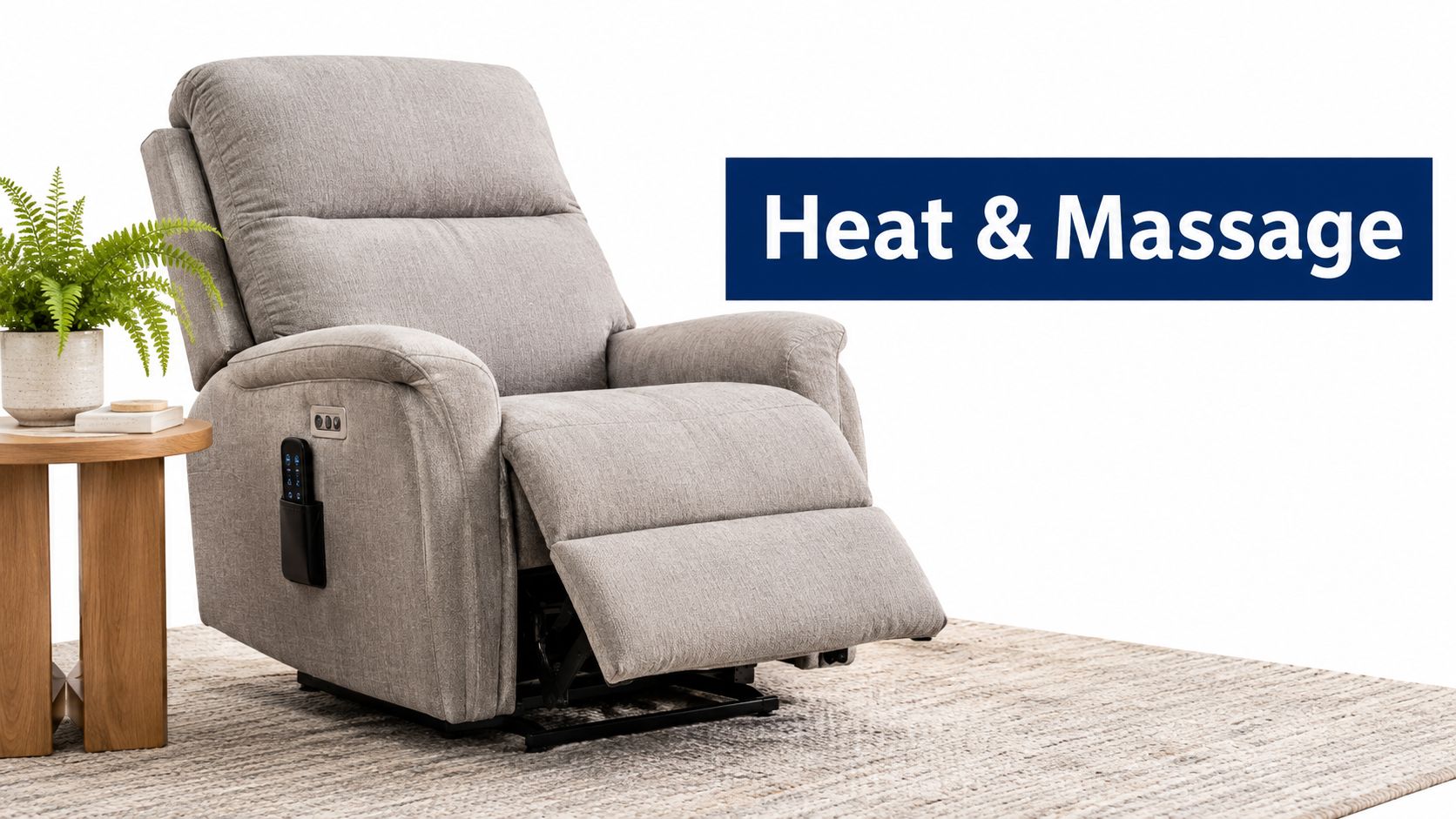
After a long day in the Florida sun, you want more than a chair that just leans back. You want a seat that supports your lower back, raises your legs, brings a gentle warmth to tired muscles, and looks polished enough to belong in a thoughtfully furnished living room. That combination makes electric recliners with heat and massage a serious furniture investment, not a novelty purchase.
The right chair should feel restorative without looking clinical. It should operate softly, fit your proportions, complement a coastal interior, and remain dependable through years of daily use. Most relevantly, you should be able to sit in it before committing. Pitch, cushion firmness, lumbar placement, arm height, and recline geometry are personal details that a product description can't settle for you.
The Evolution of Electric Recliners with Heat and Massage
From powered motion to restorative seating
The modern electric recliner has its roots in a much simpler idea, giving people controlled movement without requiring them to push against a footrest or shift their body weight. A company product timeline records the introduction of electric controls in 1970, followed by recliners with massage and heat in 1993, and motorized massage options by 1999. Those milestones show that therapeutic motion seating grew through steady furniture craftsmanship rather than appearing suddenly with the smart-home era. The documented history of electric recliner development places today's integrated features within decades of product evolution.
That history matters when you're evaluating a chair for your home. Heat, vibration, lift assistance, and independent positioning may sound like a long list of modern conveniences, but they're most useful when they're built into a well-proportioned frame. A chair with impressive controls can still disappoint if the seat pitches your knees too high, the backrest pushes your shoulders forward, or the lumbar support lands above your natural curve.
A client might come home from work, settle into a softly textured recliner, activate a mild lumbar massage, and use targeted warmth while reading. Another household may need a lift function and a simpler handset for an older family member. The features overlap, but the correct configuration depends on the person using the chair and the room around it.
Why the category has moved into the mainstream
Electric motion seating now occupies a central place in many carefully designed living spaces. A 2025 industry report estimates that power recliners account for 58.3% of global recliner unit sales and 63.2% of revenue, while massage-and-heat recliners are identified as the fastest-growing subcategory, with a 9.2% CAGR compared with 5.2% for the overall market. The recliner market analysis also estimates that massage-and-heat models increased their share from 18.2% in 2020 to 26.8% in 2025.
Those figures point to a clear change in buyer priorities. Motorized convenience and wellness-oriented comfort have moved from niche benefits into a major premium segment. Homeowners aren't only looking for a place to watch television. They're choosing seating that supports long evenings, recovery routines, reading, conversation, and relaxed family time.
Design principle: A therapeutic feature should serve the chair's comfort and proportion, not distract from them.
The best electric recliners with heat and massage still look like furniture. They have upholstered surfaces, balanced scale, supportive cushioning, and a silhouette that works beside a sofa or within a coastal vignette. A rigorous selection process should examine the frame, mechanism, fabric, and sitting angle together. That's why zero-gravity positioning deserves consideration as part of the overall comfort equation, not as an isolated feature. Explore zero-gravity motion seating when you want to understand how a more balanced reclining position may fit into a relaxed living room.
Understanding Heat and Massage Mechanics
What the electrical architecture does
A quality chair separates its functions rather than forcing every component through one undifferentiated circuit. The reclining motor system commonly uses a low-voltage DC supply around 24V to 29V, while heat and massage circuits are often designed around 12VDC or similar low-voltage outputs. One power-recliner manual lists a universal input of 100 to 240V AC with a 29V DC, 2A output, while a clinical heat-and-massage unit specifies a low-voltage 12V system with three heat levels and separate massage modes. Review the power-recliner electrical specifications before assuming that every model operates the same way.
This split architecture helps reduce user-accessible mains exposure and allows the reclining, heating, and massage functions to operate independently. It also creates an engineering limit. The system must manage current draw when several functions run simultaneously, so a chair may restrict certain combinations or use controls that prevent excessive demand.
The practical lesson is simple. Don't judge a chair by the number of buttons on its handset. Ask whether the manufacturer explains the power supply, operating limits, heat zones, massage modes, and automatic shutoff behavior in clear language.

Heat needs control, not maximum intensity
Heat should feel even and targeted, never harsh or vague. Safety guidance for heated massage seating focuses on burn risk, heat sensitivity, and circulation concerns, especially when someone has reduced sensation or certain medical conditions. One safety notice warns that prolonged local exposure can cause low-temperature burns even around 104°F to 140°F. Read the heated massage seating safety guidance and follow the manufacturer's instructions instead of assuming warmth is harmless just because it feels gentle.
Built-in timers are an important part of responsible design. A lift-chair manual states that its heating pad averages 41°C to 48°C, or 106°F to 118°F, recommends no more than 20 minutes of continuous heat, and includes an automatic shutoff after 20 minutes. Review the documented heat timing and temperature guidance for a useful example of how a manufacturer can define safe operating boundaries.
Look for lumbar or seat-area heat rather than an indiscriminate hot surface. Targeted warmth can feel more refined and lets users avoid unnecessary exposure across the entire body-contact area. Massage should also offer adjustable intensity and distinct zones, so a gentle vibration pattern can support relaxation without making the seat feel mechanically busy.
Use the chair within its intended limits
Households with older adults, diabetes, neuropathy, poor circulation, heat sensitivity, or implanted medical devices should consult a doctor before using heated massage functions. A chair can provide soothing comfort, but it isn't a substitute for medical advice, and reduced sensation can make it harder to recognize excessive warmth.
Electrical placement matters as well. One operating manual requires a properly grounded outlet, while another recommends a 120-volt GFCI outlet and warns that long-term continuous heat exposure may cause burns. See the electrical and placement safety requirements before positioning the chair near a wet bar, lanai entrance, or other area where outlet protection deserves special attention.
For readers comparing mobility-oriented options, a lift chair with heat and massage can provide useful context about how lift assistance and therapeutic functions may be combined. The same evaluation still applies. Check the handset, transfer height, footrest movement, heat timer, and clearances rather than selecting a model from its feature list alone.
Navigating Motorized Controls and Ergonomic Positioning
A comfortable recliner adapts to your body. It shouldn't require you to adapt your posture to the mechanism.
Match the motor configuration to your routine
A single-motor recliner generally moves the back and leg rest together. That arrangement is straightforward and often intuitive, but it offers less independent control. If you prefer to keep your torso upright while elevating your legs for reading, a single-motor design may feel restrictive.
A dual-motor system separates the backrest from the footrest. You can raise your legs while keeping your shoulders supported, or recline your back without lifting your feet as far. An infinite-position design offers even finer adjustment, which can matter for long sitting sessions, napping, or users who need a precisely customized angle.
Test each movement slowly. Listen for smooth operation, observe whether the chair pauses cleanly, and check whether the footrest closes without forcing your ankles into an uncomfortable position. A motor should feel controlled rather than abrupt.
Evaluate the position, not the label
Zero-gravity positioning can distribute body weight more evenly by elevating the legs and adjusting the back into a more balanced posture. It may reduce pressure at certain contact points, but the label alone doesn't guarantee comfort. Your knees, hips, shoulders, and head should all feel supported when the chair reaches that position.
Lumbar support deserves equal attention. A built-in lumbar pad should meet the natural inward curve of your lower back without pushing you toward the front edge of the seat. If the support sits too high or feels too firm, heat and massage won't correct the underlying fit.
Use this simple showroom test:
- Sit fully back. Make sure your pelvis rests against the rear cushion without leaving a gap behind your lower back.
- Raise the footrest. Check that your heels are supported and your knees aren't sharply bent.
- Recline gradually. Notice whether your head remains aligned for reading or viewing.
- Try every control. A handset should be legible, reachable, and comfortable to use without twisting.
- Test the quiet positions. The chair should feel supportive even with massage and heat switched off.
A side wand may suit someone who wants physical simplicity, while app-connected personalization can appeal to a household that values saved settings and remote control. Choose the interface you'll use most. Review the main types of power reclining seating before deciding which control system belongs in your room.
Evaluating Sizing and Weight Capacity Requirements
A recliner can be beautifully made and still be wrong for you if the seat depth, back height, or arm spacing misses your proportions. Fit affects comfort, motor performance, and how naturally the chair sits within the room.
Compare the main profile options
Standard profiles usually suit average proportions and moderate room footprints. Oversized profiles provide more shoulder and hip room, but they need enough surrounding space to avoid making a coastal room feel crowded. Petite profiles reduce seat depth and overall scale, which can help shorter users keep their feet supported instead of dangling above the floor.
Weight capacity should be treated as a structural specification, not a casual estimate. Ask how the frame, joinery, reclining mechanism, and motor are designed to work together. Solid hardwood frames and time-tested joinery provide a more dependable foundation for daily motion than a chair selected only for its exterior appearance.
| Profile Type | Ideal User Height | Space Clearance Needed |
|---|---|---|
| Petite | Shorter users whose feet need firm floor or footrest contact | Compact clearance, with enough room for full footrest movement |
| Standard | Users with average proportions seeking balanced support | Moderate clearance behind and in front of the chair |
| Oversized | Taller or broader users needing additional seat and shoulder room | Generous clearance for the larger frame and extended recline |
Measure the person and the room
Start with the user, not the wall. Measure seated knee height, approximate shoulder position, and the distance from the back of the hips to the bend of the knees. In the showroom, check whether the headrest supports your head without tilting your chin toward your chest.
Then measure the room's traffic pattern. Account for the chair's full recline, the movement of the footrest, nearby tables, wall openings, and walking paths. A chair that blocks a hallway or presses against a wall will make daily use frustrating, even if its cushions feel wonderful.
A useful test: Recline fully, extend the footrest, and ask someone to walk through the room. If the movement feels awkward, the chair needs a different position or a different scale.
Oversized seating isn't automatically more comfortable, and petite seating isn't automatically less substantial. The correct choice preserves body support and visual balance at the same time. For shoppers who need a roomier frame, review large-person recliner considerations and bring the manufacturer's capacity information into the conversation.
The strongest construction should disappear into the experience. You notice a stable seat, aligned arms, quiet movement, and a comfortable landing point, not the frame itself. That is the mark of craftsmanship doing its job.
Selecting Upholstery for Florida Living
Florida furniture has to handle more than routine wear. Humidity, bright sunlight, sandy feet, pets, guests, and long hours of daily use all put real pressure on upholstery. For electric recliners with heat and massage, the surface also affects how the chair feels during long sessions.
Choose performance where life is active
A well-made performance fabric is my first recommendation for most Florida living rooms. Microfiber and polyester blends resist stains and wear well, which makes them a smart fit for households where the recliner works as a daily seat, not just an accent. This upholstery durability guide identifies microfiber and polyester blends as durable recliner options.
Pay attention to the weave, not just the label. A tightly constructed textile should feel smooth and substantial, while still keeping the relaxed, breathable character that suits a coastal interior. Ask about cleaning instructions, colorfastness, and whether the fabric suits the level of use in your home.
Performance fabric also gives you more freedom with color. Soft sand, oyster, sea-glass, driftwood, and muted blue tones help a motion recliner sit naturally in a curated room instead of reading like equipment. Clean seams and restrained scale let the chair sit comfortably beside linen upholstery, natural wood, and woven accents.
Consider genuine leather as an heirloom surface
Genuine leather brings a different feel. It is supple, architectural, and it gains character with use, which suits a coastal or traditional room that needs depth. The same guide notes that genuine leather can last more than a decade, quality recliners about seven to fifteen years, and leather versions up to 20 years with proper care.
Leather works well when you want the recliner to feel like part of the architecture. Choose a hide with a finish that fits your household, and accept natural variation. That change is part of the appeal, not a flaw.
Keep the material choice tied to how the room functions. A formal sitting area may reward the depth and patina of genuine leather, while a busy family room may benefit from the easier care of performance fabric. Florida-friendly durability starts with honest material information and ends with proper care.
For a broader look at how leather can shape a coordinated room, explore this leather reclining sectional collection. A recliner should not be selected in isolation. Its texture, color, and visual weight should support the full seating arrangement.
The Importance of Hand-Testing Your Investment
A chair is an unusually personal piece of furniture. You can inspect dimensions, read construction details, and compare controls, but only your own body can tell you whether the pitch feels natural and the cushioning stays supportive after several minutes.
What to assess in person
Start with the stationary position. Sit as you would at home, with your shoulders relaxed and your feet supported. Then test the motion slowly. Pay attention to:
- Pitch: Your hips should feel settled rather than tipped forward.
- Lumbar placement: Support should meet your lower back without creating a hard pressure point.
- Head support: Your neck should remain relaxed when the backrest moves.
- Arm position: Controls should be reachable without lifting or twisting your shoulder.
- Footrest alignment: Your heels and calves should feel supported through the full extension.
- Material response: The upholstery should feel comfortable against your skin and maintain a neat appearance as you move.
This is also the moment to evaluate craftsmanship. Look at seam alignment, cushion recovery, frame stability, motor sound, and the way the chair returns to its upright position. An investment piece should feel composed in every position, not only when photographed from its most flattering angle.

Choose guidance that continues beyond the showroom
Since 1939, Indian River Furniture has served Brevard County, the Space Coast, and Central Florida from its Rockledge location. The 32,000-square-foot showroom presents curated room displays and coastal-inspired vignettes, while the ownership team hand-tests every seat, sofa, and recliner for pitch, comfort, and structural integrity before it reaches the showroom floor.
That no-blind-ordering approach is valuable because it connects technical evaluation with lived comfort. You can discuss performance fabrics, genuine leathers, solid hardwood frames, ergonomic positioning, and room scale with a design team that sees the chair as part of a complete home.
Complimentary in-house interior design consultations can help coordinate the recliner with existing sofas, flooring, lighting, and coastal finishes. Premium uniform white-glove delivery adds another layer of care, with an in-house team handling unboxing, inspection, and room setup for a $99 delivery fee within the service area.
Bring your routine with you. If the chair is for evening reading, recovery, television, or mobility support, test it in the position you'll actually use.
Before you make a final decision, learn how to read furniture product descriptions with confidence. Then visit the Rockledge showroom, sit in several profiles, operate the controls, feel the upholstery, and let your body make the final judgment.
Visit the Rockledge showroom to hand-test electric recliners with heat and massage, compare ergonomic positions, and explore curated coastal vignettes with the design team. Bring your room measurements and your preferred daily routine, then schedule a complimentary interior design consultation so your new recliner arrives as a considered part of your home, not an afterthought.