Schedule your Complimentary Design Consultation


Big Man Recliner Guide: Sizes, Weight Ratings and Fit

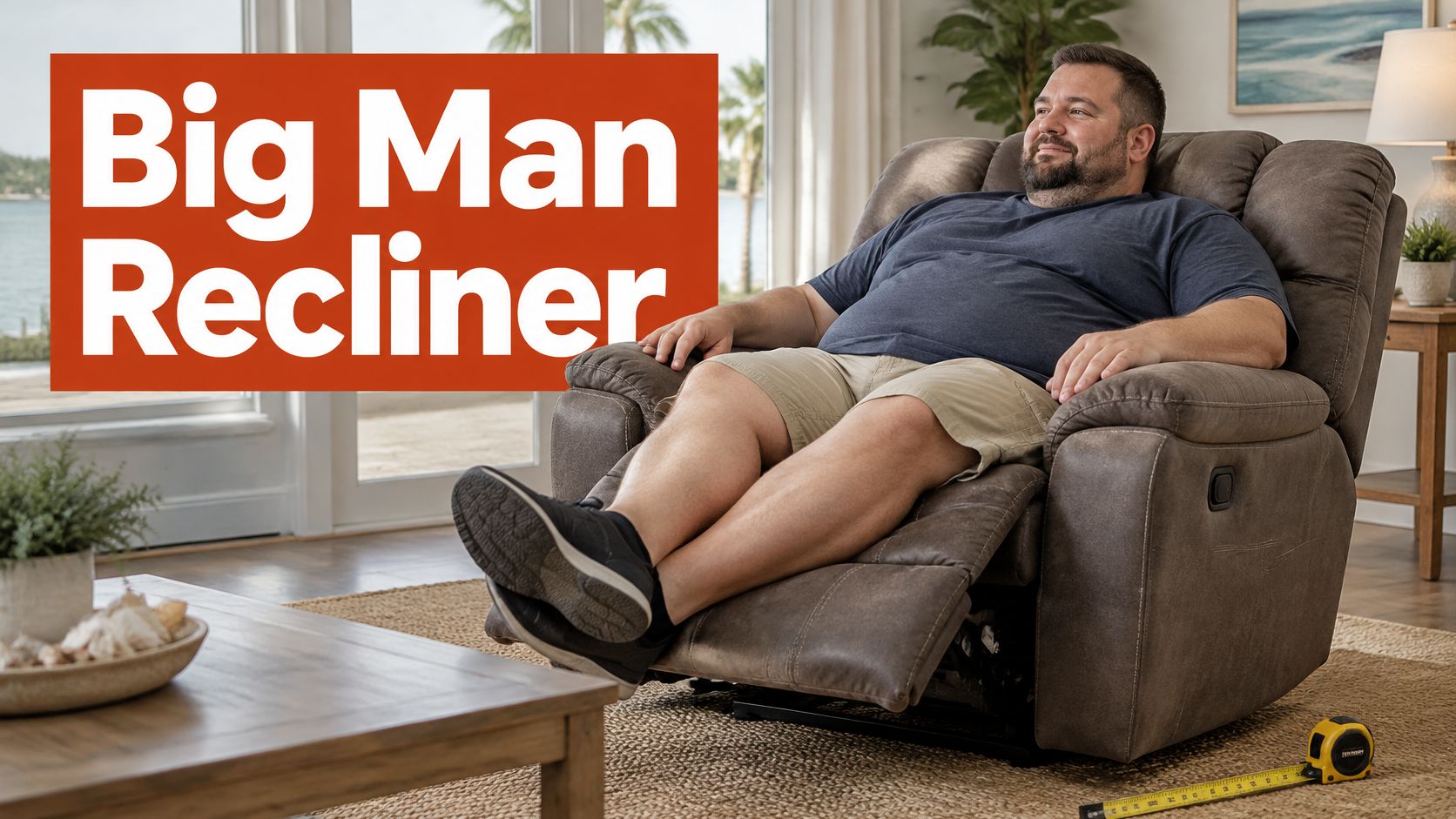
The most common advice for a big man recliner starts and ends with one idea: get the widest seat and the highest weight rating on the tag. That shortcut sounds protective. It is also how a tall or broad sitter ends up in a chair that is roomy and still wrong.
Width does not tell you whether your thighs are supported, whether your lower back meets the cushion, or whether both feet rest flat on the floor. A chair can clear a heavy load rating and still tip you forward, leave a gap at the lumbar area, or lift your heels. In that case the largest model is not the better fit. It is a larger miss.
We have helped households across Brevard County, the Space Coast, and Central Florida choose seating since 1939. Before a recliner reaches our 32,000 square foot Rockledge showroom, ownership sits in it and checks pitch and comfort. Use the figures below as a screen. Trust the sit for the decision.
Recliner Sizes and Weight Ratings at a Glance
| Recliner Type | Rated Weight Capacity | Seat Width | Seat Depth | Seat Height |
|---|---|---|---|---|
| Standard consumer recliner | 250–300 lb | 22–25 in | 22–24 in | 18–20 in |
| Big-and-tall recliner | 350–450 lb (some 500 lb or more) | 24 in or more | 22 in or more | 18–20 in |
| Taller users, any category | Confirm rating separately | 24 in or more | 22 in or more | 21–22 in |
| Heavy-duty recliner | 500 lb or more | 24 in or more | 22 in or more | 18–20 in |
Use the table as a screening tool. Fit is judged by thigh support, lumbar support and feet flat on the floor, not by weight rating or width alone. The largest chair is not automatically the best-fitting one, so check capacity first, then check geometry against your own measurements.
Published buying guidance separates ordinary recliners from big-and-tall models by load and size. Standard consumer recliners are often described as supporting about 250–300 pounds. Big-and-tall models are commonly rated around 350–450 pounds. Some heavy-duty designs are marketed at 500 pounds or more. That same guidance recommends a seat width of at least 22–25 inches, a seat depth of roughly 22–24 inches, and a backrest height from about 28–46 inches, depending on stature. It also treats a published capacity about 50–100 pounds above body weight as a practical safety margin, because sitting down, shifting, reclining, and running a powered mechanism create force beyond a static sit.
Seats of 24 inches or more give a broader frame extra room. Standard seat height is generally 18–20 inches. A depth of at least 22 inches can support longer thighs. Treat those figures as starting points for comparison and confirm each one against your own numbers before you narrow the list.
How each row earns its place
Standard consumer recliner. The 250–300 pound band, with a seat 22–25 inches wide, 22–24 inches deep, and 18–20 inches high, describes many everyday chairs. If you sit near the top of that weight band and recline every evening, treat the row as a comparison point and confirm it against your own numbers.
Big-and-tall recliner. Capacity commonly lands around 350–450 pounds, and some chairs are marketed at 500 pounds or more. Look for 24 inches or more of usable width and 22 inches or more of depth so your back can stay in contact while your thighs are supported. Seat height often stays at 18–20 inches unless your lower leg is long, so match that figure to your tape rather than to the category name.
Taller users, any category. The rating still has to be confirmed on that exact model. Width at 24 inches or more and depth at 22 inches or more remain useful screens, with height matched to lower-leg length.
Heavy-duty recliner. The distinguishing figure is 500 pounds or more. Width, depth, and height do not automatically grow with the rating, so the screen stays 24 inches or more, 22 inches or more, and 18–20 inches, unless your own measurements point higher.
Labels such as oversized, heavy-duty, or big-and-tall are not uniform across brands. Like shoe sizes that vary by maker, the same word can mean different dimensions. On any spec sheet, confirm four things before you compare models.
- Exact weight rating: Read the number for that model, not the category name.
- Usable seat width: Measure the sitting surface, not the outside of the arms.
- Seat-to-floor height: Match it to your lower leg, not to a style photo.
- Fully reclined clearance: Include the wall behind the chair and the floor in front of the footrest.
Homeowners and vacation-rental operators should compare the occupant's expected weight and body dimensions with those certified specs. Write the four figures down. Short list only the rows that clear both load and body fit, then carry those numbers into measuring and test-sitting.
How to Measure Your Body and Room
The largest big man recliner on the floor is often the wrong place to start. Fit depends on three contact points: thighs supported along the cushion, the lumbar curve met by the back, and both feet flat on the floor. A chair can be generous in width and still leave your legs dangling or your lower back unsupported. Too much depth pushes the backrest away from your spine. Too much height lifts your heels and makes standing harder.
Oversized marketing tends to stop at weight capacity and exterior width. Seat height, seat depth, armrest position, and footrest length have to match your body. Measure in this order, then repeat each one so a tilted tape does not become the spec.
- Hip to knee. Sit upright in a chair of similar height. Measure from the back of the hip to the back of the knee. That length is your seat-depth limit. You want cushion under the thigh and a little clearance behind the knee, so the front edge does not press.
- Lower-leg length. Measure from the floor to the back of the knee. This sets seat height. If the seat is taller than this length, your heels come up and standing gets harder.
- Seated shoulder height. Measure from the seat to the top of the shoulder. The back cushion should meet the lumbar area and support the shoulder blades without shoving your head forward.
- Hip width. Measure at the widest point while seated, not standing. Usable seat width has to clear that number with a little ease. The outside width of the chair does not.
- Room depth. Measure from the wall to where the front of the chair will sit. Add the space a full recline needs in front. A deep seat that cannot open fully is just a deep chair.
- The delivery path. Measure doorways, hall corners, and stairs. A chair that fits the sitter and misses the turn at the landing never becomes the chair you use.
Leave a little space behind the knees and keep the back in contact. If you can only have one of those, the chair is the wrong depth.
Our furniture measuring walkthrough is a useful companion while you sketch the room, especially when a tall frame and a broad hip measurement pull in different directions. Take each measurement twice and write both numbers. Bring the sheet to the showroom so the sit is compared with your body, not with the biggest silhouette on the floor.
Weight Ratings, Frame and Mechanism for Repeated Use
A published weight rating is a structural threshold that applies to the whole chair. Seating standard EN 12520 evaluates adult seating for users up to 110 kg (242.5 lb), and bariatric or substantially heavier users need increased test loads. A person above the stated rating can create disproportionately higher stress at the seat-to-back joint, the recliner linkage, the footrest pivot, and the frame connections. Sitting down and standing up amplify static weight through impact and force.
Start with a model whose capacity sits comfortably above the heaviest person who will use it. Then ask a narrower question. Does that number cover the complete chair, including the mechanism and the footrest, or only the seat frame? A wider cushion improves fit, but it says nothing about whether the reclining hardware, the base, or an actuator was engineered for a higher load. For a rental or a house with several daily users, specify an additional margin. Repeated occupancy speeds fatigue, joint loosening, and mechanism wear.
Capacity is one gate. Thigh support, lumbar contact, and feet flat on the floor decide whether the chair suits the body sitting in it, and no rating sheet covers those three.
What the frame does under load
Furniture-quality guidance on frames and joinery treats kiln-dried hardwood, commonly oak, maple, ash, or beech, as the benchmark. Controlled drying lowers the chance of later warping and cracking. Reinforced joinery uses dowels, screws, glue, and corner blocks together, so the load has several paths. Joints that rely only on staples loosen when the same motion repeats.
That difference shows up in a heavy chair. Greater body mass, plus the force of sitting, rising, and extending the footrest, bears on the rails, the arms, the seat supports, and the connection points. Upholstery can look polished on a weak joint. Over time, sound materials are what you feel: quiet travel, stable arms, firm support, and cushions that stay aligned.
Pieces with a sagging frame, leather that does not wear well under Florida sun, or a spring assembly that compromises posture never make it past the showroom doors at Indian River Furniture. The screening is done by hand, on the floor, before anything reaches a customer's home.
Where the mechanism works hardest
Durability belongs to the whole movement: the linkage, the pivot, the motor, and the frame that carries all three. The U.S. General Services Administration upholstered-furniture method defines a recliner cycle as closing the chair, extending it to the television position, extending it to full recline, and returning it to fully closed. The method cycles the chair for 25,000 cycles or until failure, while applying a 200-lb combined occupant load. Peak demand hits at the transitions. The footrest linkage takes bending and torsion as it deploys. The back mechanism reacts as your center of mass shifts on the return to upright.
If the leg rest is long or angled for someone else's shin, pressure can land on the outer foot. Reading Managing outer foot discomfort before you decide a sore foot is normal can spare you months of guessing. For a powered model, confirm the stated duty cycle and the rest the actuator needs. Cycling past that schedule can trip thermal protection and shorten motor life.
Ask what was tested, on which parts, and with what margin, and ask for it in writing.
The full recliner buying guide lines those answers up with pitch and cushion feel. Put three questions on paper before you commit.
- Which tests: Were static, impact, and cyclic tests performed, and at what occupant load?
- Which parts: Does the rating cover the mechanism and footrest, or only the seat frame?
- Which margin: What extra capacity does the maker recommend for heavy daily use or rental occupancy?
Seat width will not answer any of those. The paperwork will.
Safe Sit-to-Stand and Caregiver Considerations
A recliner is often bought for comfort. For a larger adult, and for the person helping them up, the sit-to-stand moment deserves the same attention. U.S. Consumer Product Safety Commission data found 33.8 fall-related emergency-department injuries per 100,000 adults aged 65 and older involving recliner chairs during 2017–2021, versus 2.7 per 100,000 adults aged 25–64. Older adults were 12.5 times more likely to be injured in recliner chairs. Separate case reviews describe fatal falls after cognitively impaired users activated power-lift recliners and were lifted toward standing without supervision. Powered help is not automatically safer.
Check the rise in order. Seat height should let the user push up with both feet flat. The arms should offer a firm grip, not a padded slope. The footrest should deploy smoothly and tuck away before anyone stands. Controls should be easy to reach and hard to trigger by accident, and you should be able to stop a lift at any point. Broader home habits in preventing falls in older adults pair well with that chair-side check. In the showroom, sit and stand several times, once alone and once with a companion, and notice the effort. Our electric lift chairs are there for that supervised trial, especially when balance or memory is part of the household.
Cushions and Fabrics That Keep Their Shape
A good cushion supports the thighs and the lower back without a sharp edge at the front of the seat. After a full day it rebounds, instead of holding a permanent dip where you always sit. Two qualities decide whether that feeling lasts. Resiliency is how the fill returns. Density is how much material is there to resist collapse. A glance at a showroom photo will not reveal either one.
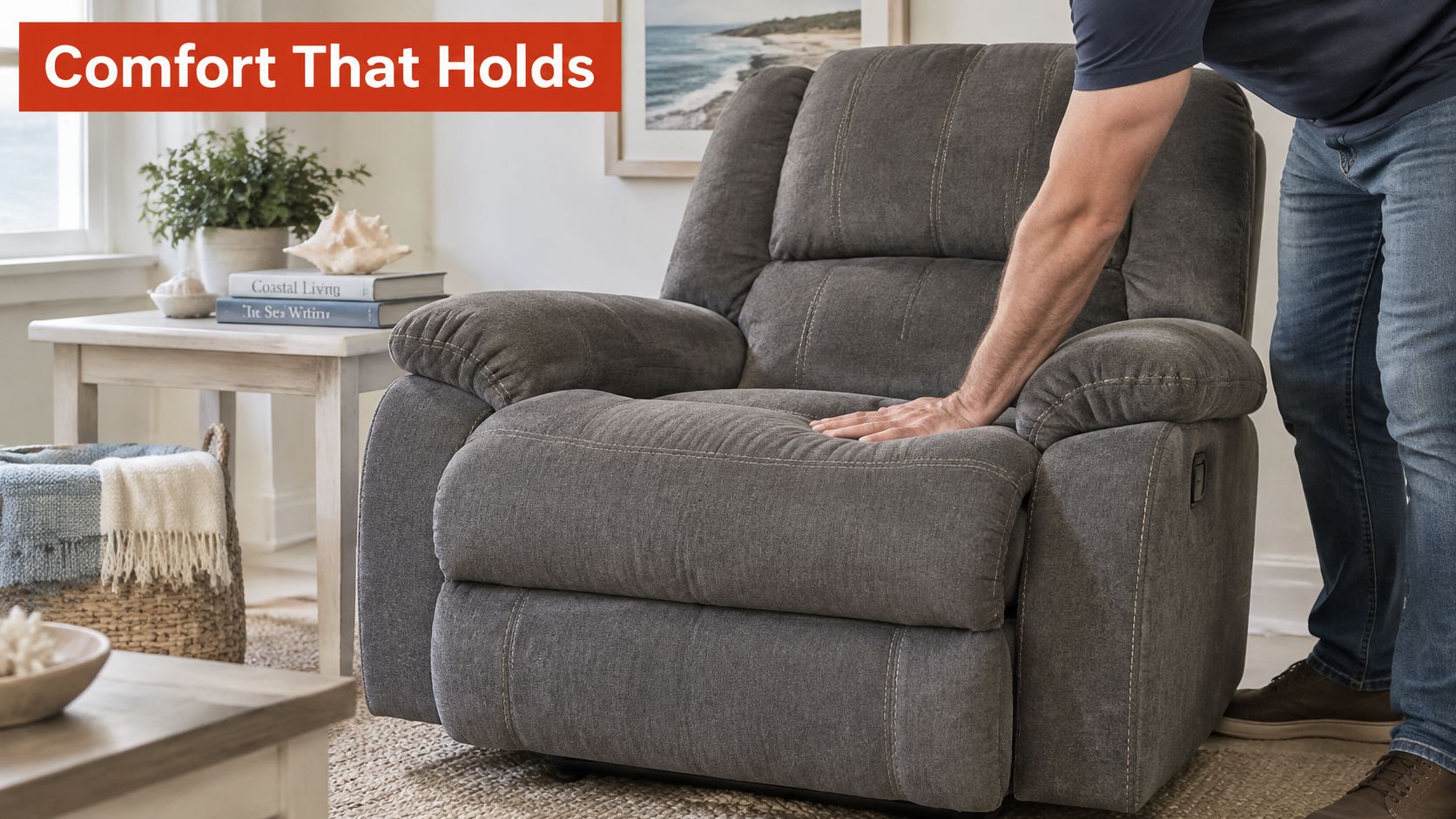
Sit for about ten minutes, then stand and look at the seat. A quality fill settles and recovers. A weak fill keeps your shape. Every sofa depth, recliner pitch, and cushion density in our showroom has been personally sat in, evaluated, and approved by the ownership team, so the sample you test has already survived that kind of sit.
Fabric and leather, side by side
Performance fabric resists wear, stains, and fading, which suits pets, sunny rooms, and active households along the coast. The weave and the rub resistance matter more than the color name. Our performance fabric seating shows how that cloth feels in a full piece, not just on a swatch card.
Genuine top-grain leather develops a richer patina and wipes clean. On a summer afternoon it can feel warm, and direct sun will dry it, so placement matters as much as the hide. Color can run from coastal neutrals to bolder hues. The decision is still the hand. Press the arm, the seat, and the inside back, because each surface can feel different.
Once the chair is home, gentle upkeep protects that hand-feel. Upholstery advice from Renue Systems Four Points is a practical reference for cleaning without flattening the nap or dulling leather.
Before you leave the chair, run a short check.
- Arms: Rest your forearms. The arm should meet them without a shrug in the shoulders.
- Back: The lumbar area should meet the cushion, not a gap or a hard ridge.
- Seat after motion: Recline a few times. The cushion should stay level, not creep forward or bunch at one side.
Comfort, durability, and cloth are one decision. If the fill collapses or the cover fights the climate, the frame's strength never reaches you.
Florida Humidity and Placement for Lasting Comfort
Humidity shapes how a recliner ages on the Space Coast. Solid wood takes in moisture when the air is damp and releases it when the air dries, so a frame expands and contracts through the year. That movement is normal. A wooden door that sticks in a wet week and frees up later behaves the same way: the material is responding to the room. Joints, panels, and finishes feel the strain when the air stays damp or swings hard, and when a heavy chair sits tight against a cool exterior wall.
A moderate indoor humidity range is the goal. Put a simple hygrometer on a shelf near the chair so the room's moisture level is visible instead of guessed. If a corner reads damp, run a dehumidifier and shift the recliner off that wall. Exterior walls that stay cool in summer hold moisture against a back panel, which is why a few inches of air at the back and base matter. That gap lets the piece breathe and keeps damp air from parking behind it. Damp air also makes cushions and covers feel clammy, and it can encourage mildew in the fill, so airflow around the whole piece is worth protecting.
The rainy season can widen the gap between air-conditioned air and a damp evening. A hygrometer shows that swing before the frame does. Keep the room steady rather than pushing one corner very dry and leaving another damp. Placement handles the rest. Keep the recliner out of direct sun, which fades cloth and dries leather. Clear it from a supply vent that blows hot or cold air onto one side of the frame. The guidance on exposed wood frame sofas follows the same idea: natural materials last in Florida when moisture, sun, and airflow are managed.
A coastal room can stay relaxed while it does this work. Neutral textiles, a layered rug under the foot zone, and a warm lamp at the side leave the chair free to recline fully. Performance fabrics, a sound hardwood frame, and thoughtful placement work together. Placement also protects the fit you judged in the showroom. Lumbar support, seat pitch, and cushion resiliency stay truer when the frame is away from a damp wall or a vent. Natural materials can stay in a coastal room when moisture and placement are managed.
Test Your Shortlist in the Rockledge Showroom
The biggest recliner is not automatically the best fit. A chair can have a generous weight rating and still leave your thighs unsupported or your feet short of the floor. In the showroom, check how your body meets the seat, back, and footrest, then compare models by that fit.
At Indian River Furniture's Rockledge showroom, you can feel leathers, touch solid hardwoods, and compare cushion firmness. Ownership hand-tests every recliner on the showroom floor for pitch and comfort before it reaches a customer's home. Designers are there 7 days a week to pull swatches, check dimensions, and help you test seat comfort against your measurements.
A recliner also needs to work in the room, not only under you. Curated displays show furniture in a finished setting, and designers can help with scale floor planning, fabric and finish selections, and room styling. These interior design consultations are completely complimentary when you purchase your furniture through Indian River Furniture.
Bring a photo of the doorway and the route to the chair's intended spot. That helps connect the showroom test with the practical question of getting the recliner into place. White-glove delivery within the service area is a flat $99.
- Your sheet: Bring the body and room measurements from section 2.
- The shortlist: Compare each model's weight rating, usable width, depth, and seat height.
- The room: Show the doorway and route from the entry in a photo.
During each sit, check thigh support, lumbar support, and whether both feet rest flat. Recline fully, then stand and sit again to see whether the chair still feels stable and comfortable. A clear comparison makes it easier to choose for fit and everyday use, rather than being swayed by a larger silhouette or weight rating alone.