Schedule your Complimentary Design Consultation


Rocking Recliner Loveseat Guide for Florida Homes

You settle in for the evening with a book, your partner wants the game on, and the sofa you share gives neither of you what you need. One person is perched upright with a cushion tucked behind the back. The other is slumped sideways with feet that never quite find support. A rocking recliner loveseat solves that shared discomfort when it's chosen well, because each seat can move on its own while you still sit close. The difference between a piece you'll love for years and one you'll work around comes down to pitch, mechanism, and footprint, and those are things you can only judge by testing the seat itself.
What a Rocking Recliner Loveseat Is and Who It Suits
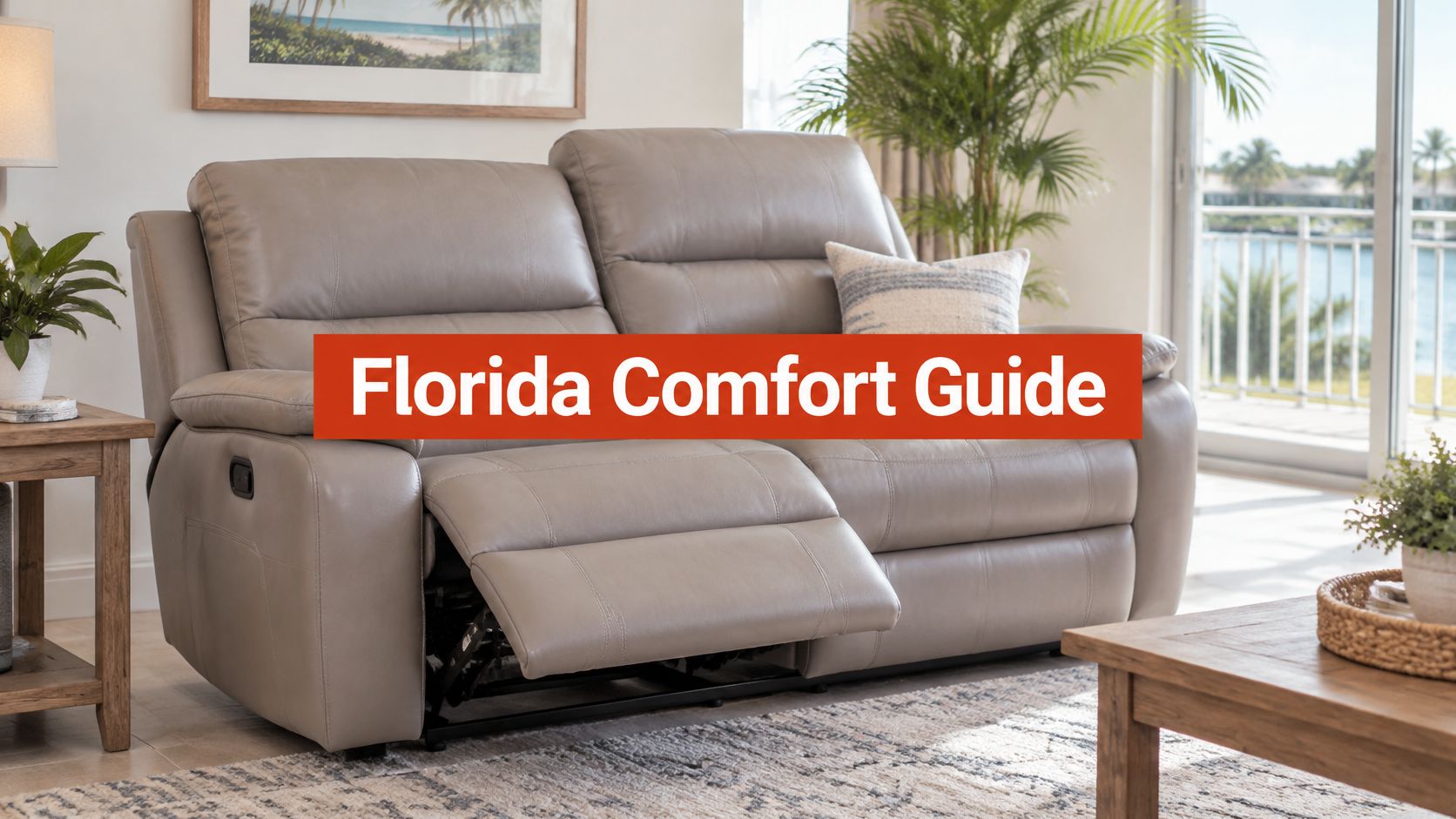
Two people share one frame, yet each person controls a separate seat. That's the plain definition. A rocking recliner loveseat is a two-seat sofa on one shared frame, where each seat reclines and the base can rock, so you get closeness without giving up individual comfort.
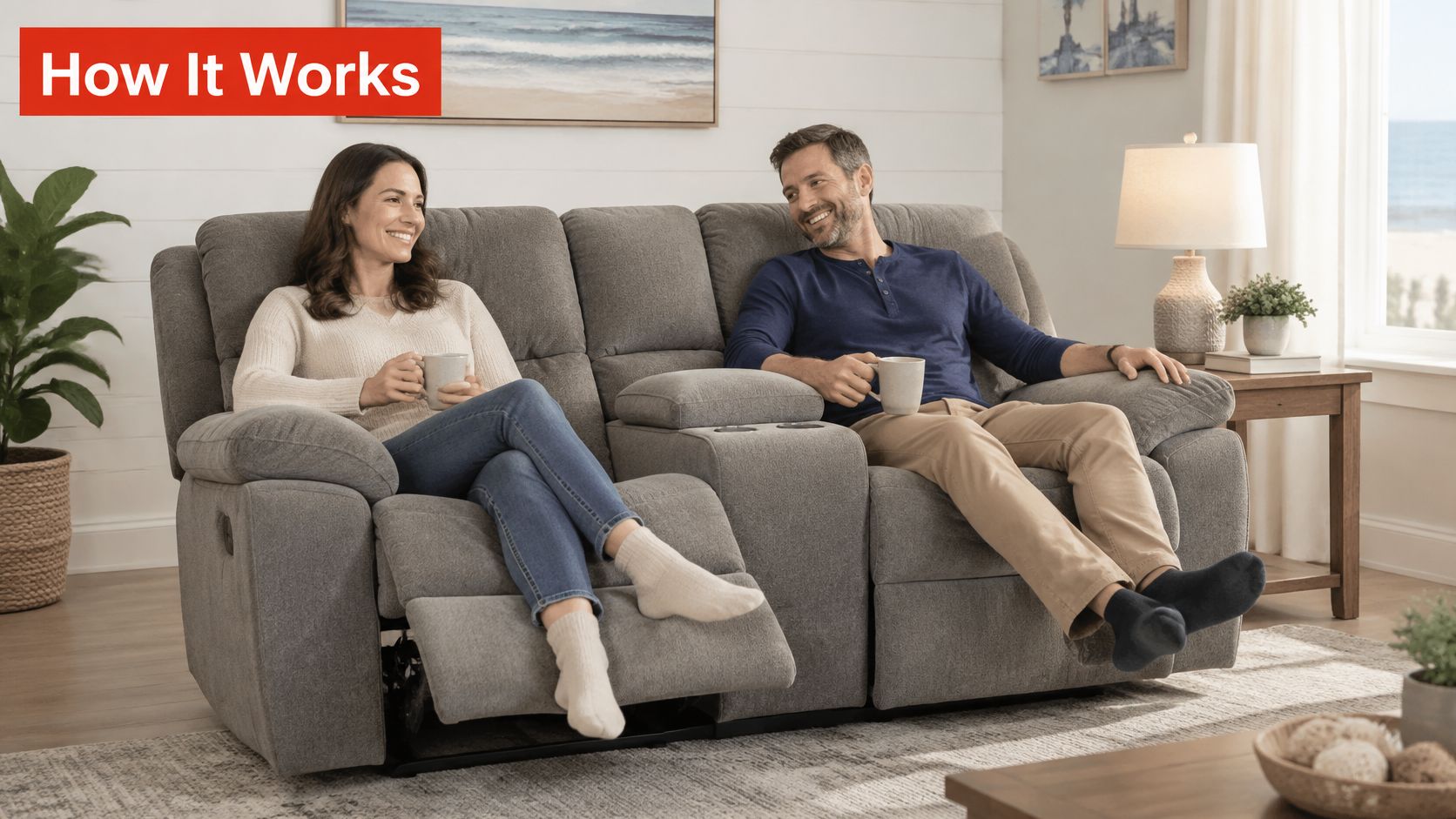
Two Motions Working Together
Rocking and reclining do different jobs. Rocking uses a curved or pivoting base that lets the seat sway gently, the kind of slow movement that settles you while you read or talk. Reclining uses a linkage that lifts the footrest and tilts the back, changing your posture from upright sitting to supported rest. Many models combine both, so a seat can rock while held reclined, and that combination is what gives the piece its relaxed, coastal feel.
This isn't a new idea. The historical record in Google Patents shows reclining rocking-chair engineering was documented in the United States by September 18, 1877, when patent US195395, titled "Improvement in reclining rocking-chairs," was issued. A patent for a combination reclining-and-rocking chair with a fixed base and track was filed in 1947 and issued in 1952, and a 1979 patent introduced a rocker-recliner control system that prevented rocking until the chair reached a defined forward position. That long history matters because it reflects decades of work on stability and user control, not just softness.
Why Two Seats Are Harder to Build Well
Think of a two-berth sailboat. Each berth should feel steady on its own, and one person shifting shouldn't rock the other awake. A loveseat faces the same challenge. Two seats share one frame while each keeps its own footrest, recline, and stability, with safe clearance for moving backs. When that engineering is right, you don't notice it. When it isn't, you feel your partner's every adjustment through the frame.
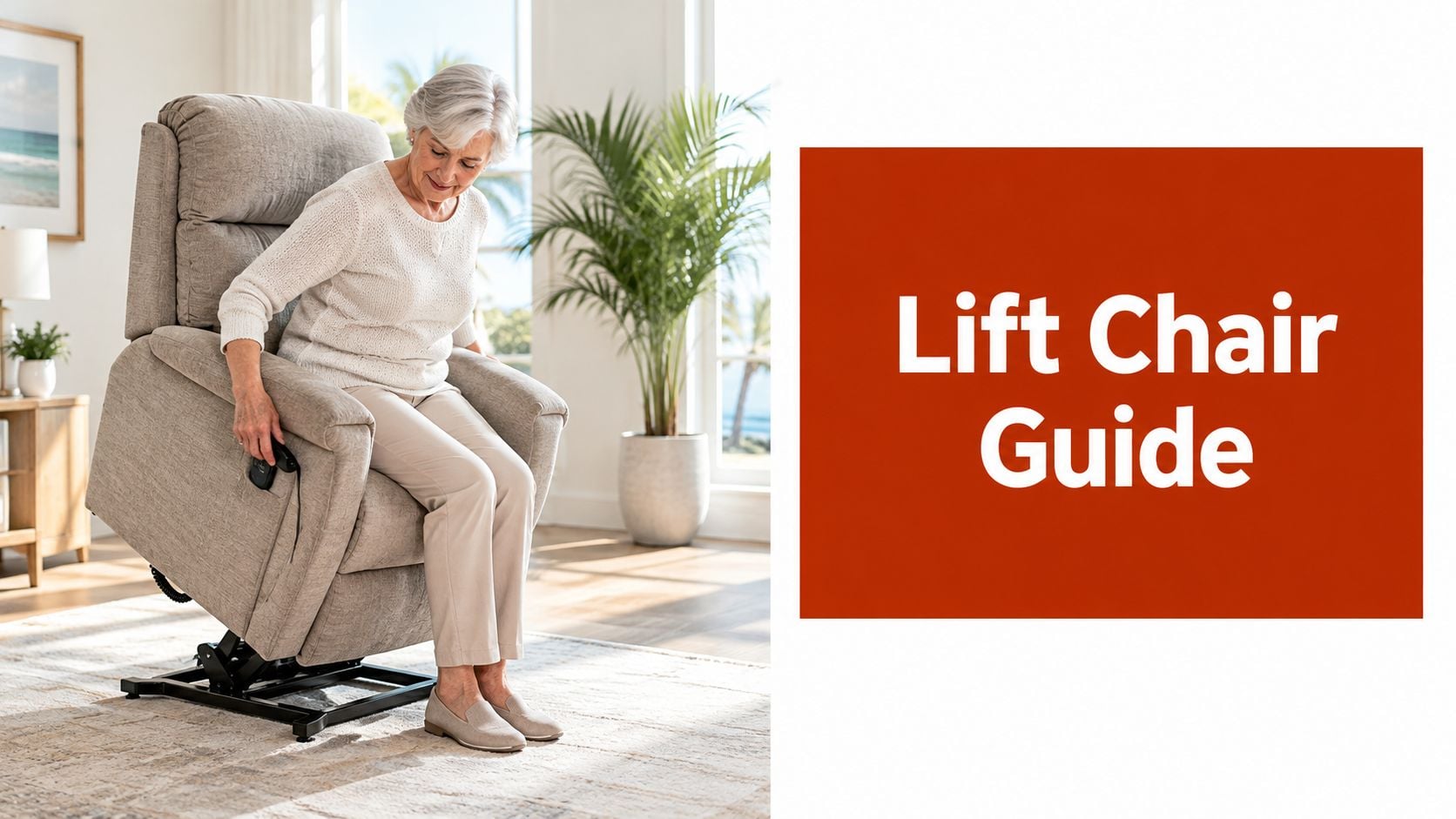
This style suits small living rooms where a full recliner would crowd the walkways, and it suits homeowners who want ergonomic seating for reading, television, and daily rest. It also helps caregivers who need a seat that reclines for rest with a footrest that supports the legs. If ease of standing is part of your decision, DME Superstore's 2026 buyer's guide offers useful context on how lift assistance differs from a standard recline.
In a showroom, identify the motion type three ways. Sit down and check whether the seat offers rock only, recline only, or a combined motion. That quick test tells you what you're buying before upholstery and styling enter the conversation.
Features to Compare Before You Choose
Start with the whole picture, then narrow to the details that change how you feel after an hour in the seat.
| Feature | What to Look For | Why It Matters |
|---|---|---|
| Recline mechanism | Independent controls for each seat | Each sitter sets their own recline |
| Rocking mechanism | Adjustable or lockable rocking arc | Controls stability and clearance |
| Frame | Solid hardwood with joinery | Holds the mechanism under repeated motion |
| Seat pitch and depth | Depth matched to typical leg length | Affects support and ease of standing |
| Cushion firmness | Dense core with resilient layer | Supports the lower back and holds its shape |
| Upholstery | Performance fabric or top-grain leather | Resists wear, sun and everyday cleaning |
| Footrest | Full support along the lower legs when extended | Prevents pressure behind the calves |
The Frame Carries Everything
A motion piece asks more of its frame than a stationary sofa does. Solid hardwood with time-tested joinery holds the mechanism steady under repeated opening, closing, and rocking. The frame should carry the mechanism and both seats without flex, creak, or twist when one side moves and the other doesn't. At Indian River Furniture, our furniture is built with solid wood construction and eight-way hand-tied springs, and that foundation is what keeps the seat feeling even over years of daily use.
Pitch Decides Whether You Can Stand Easily
Seat pitch is the angle of the seat, and depth determines where your knees bend. A seat pitched too far back feels wonderful for ten minutes, then makes standing a real effort. A shallow pitch does the opposite, leaving you feeling perched and unsupported. I recommend judging pitch with your feet flat on the floor in your usual shoes, because that's the position you'll push up from every day.
A seat that feels perfect while reclined but strands you when you try to stand hasn't done its job.
Cushions That Hold Their Shape
Look for a dense core with a resilient layer over it. That pairing gives you a supportive surface for the lower back that recovers after you stand. Very soft fill feels inviting on first contact, but it can sag under daily use and leave you sitting in a hollow. Press the cushion firmly with your hand, then watch how quickly it returns. Good craftsmanship shows in that recovery.
Controls, the rocking lock, and footrest support deserve their own careful questions, and the durability guidance below covers exactly what to ask.
Measuring the Full Footprint Before You Order
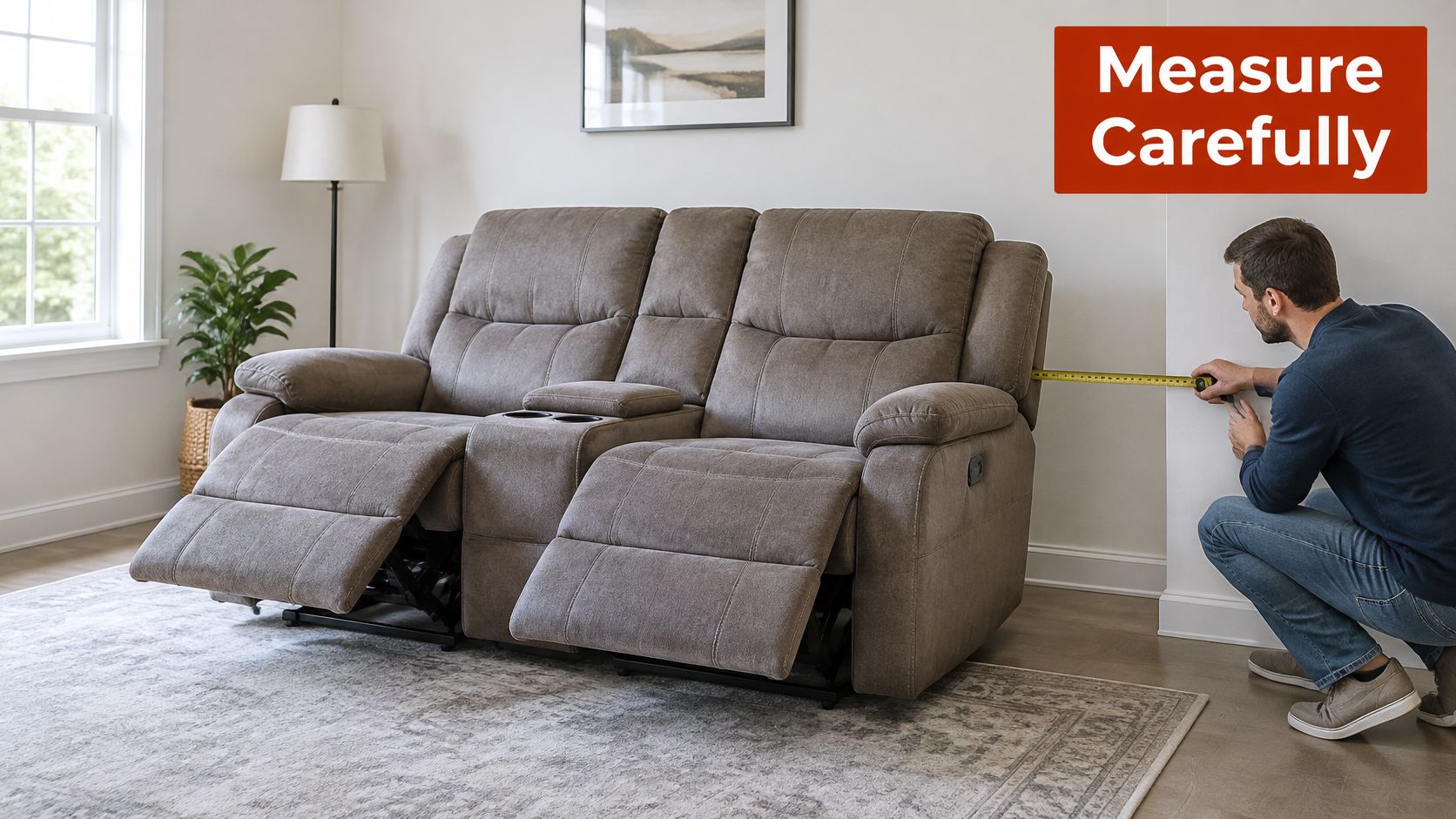
The closed width on a spec sheet is only the first number. A loveseat needs room for its footrests to extend, its back to recline, and two people to sit, rise, and leave without crossing each other's leg space. Plan the occupied footprint, not just the furniture footprint.
| Measurement | Where to Measure | Why It Matters |
|---|---|---|
| Closed width and depth | Full width of both seats and front to back | Confirms the wall space available |
| Fully reclined depth | Wall to footrest tip when extended | Shows how far into the room it reaches |
| Rear clearance | Wall to backrest when reclined | Confirms room for the back to move |
| Walkway width | Clear path beside the loveseat | Keeps traffic moving when footrests are out |
| Doorway and hallway turns | Narrowest point on the delivery route | Confirms the piece can reach the room |
| Two-person exit space | Space in front of both seats to stand | Confirms both occupants can rise safely |
Mark It on the Floor
Use painter's tape to mark the closed footprint first. Then add a second outline for the fully reclined depth, from the wall to where the footrest tips will land. Sit in chairs placed inside that outline, stretch your legs out, and stand up the way you would with a cup in hand. You'll feel immediately whether the layout works.
Next, walk the route someone else would take through the room. Can a person pass in front of extended footrests without turning sideways. Can both occupants rise at the same time without stepping into each other. Those answers matter more in a Florida condo or an open-plan living room than any single dimension, and our guide to measuring furniture for your space walks through the same steps in detail.
Practical rule: If the taped outline blocks a path you use every day, the loveseat will too, no matter how comfortable it feels in the showroom.
Watch the Delivery Route Too
Measure the narrowest doorway, the tightest hallway turn, and any stair landing between the front door and the room. A piece that fits the wall beautifully still has to reach that wall. Write every number down and bring the list with you.
Don't assume a space-saving label solves the layout. A forward-moving mechanism may sit close to the wall, yet the extended footrests can still block traffic in front. Our designers are on the showroom floor 7 days a week to pull swatches, check dimensions, and help customers test seat comfort, so you can compare your taped outline against the actual piece before you commit. That conversation, with tape measurements in hand, prevents most placement regrets.
How to Test Pitch and Comfort in Person
Sit down and let the back settle before judging the fit. Comfort depends on how seat pitch, back angle, lumbar contour, and footrest length work together under your weight.
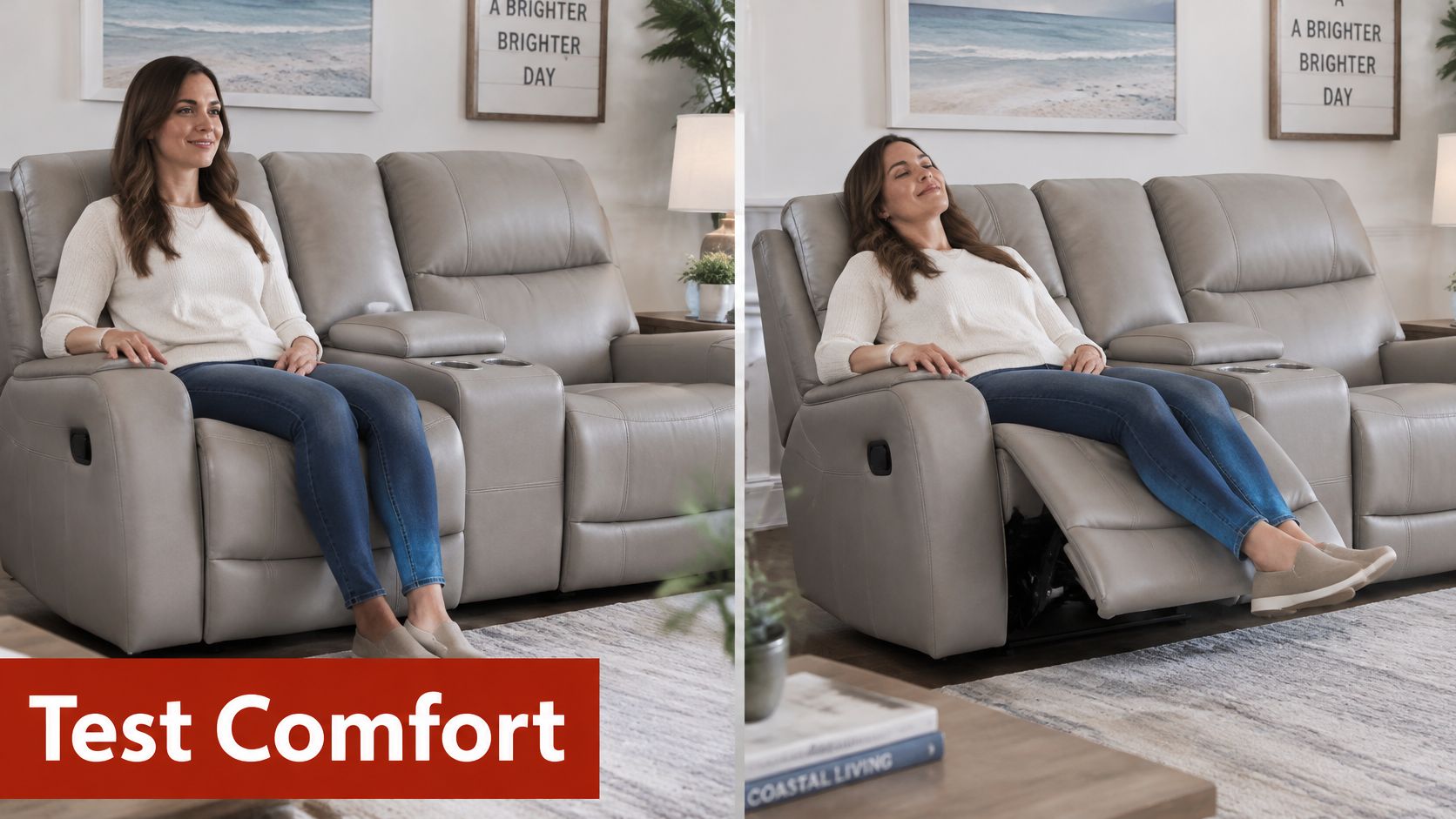
Controlled seating research published in Applied Sciences found that reclining increased backrest contact area and reduced peak pressure on the middle and rear portions of the seat pan, while pressure increased in the lower backrest region. Use that as a reminder to assess lumbar support in every position. Body height, hip mobility, and whether you plan to read or nap all affect what feels comfortable.
A Seat Test Worth Your Time
- Sit in ordinary shoes and let the back settle. Give the cushions a moment to respond before judging the fit.
- Stay several minutes in each position. Try upright, rocking, television, and full recline. Notice where pressure builds as the back opens.
- Check your lower back and head. Your lumbar area should feel supported, and your head should rest without your neck bending forward.
- Check your heels. They should rest on the footrest without pressure behind your calves.
- Open and close the recliner several times. Pay attention to the effort, the movement, and whether the rocking arc feels controlled.
- Have the second sitter repeat the test. Different proportions can change the fit, and each seat should feel comfortable to its occupant.
Give the lower back a few minutes in each reclined position. A concentrated pressure point may not show up during a quick sit. For a compact room, compare the pitch and movement with the options in our guide to swivel recliners for small spaces.
Why the Showroom Matters
A photograph cannot show how a seat carries your weight. Every sofa, recliner, and chair on the showroom floor is personally hand-tested by ownership before it enters a customer's home. In the Rockledge showroom, you can feel leathers, touch solid hardwoods, and compare cushion firmness in person. Testing both seats gives you a clearer sense of fit before choosing.
Checking Mechanism Durability for Two Seats
A rocking recliner loveseat has one shared frame supporting two moving seats. Judge its durability by how both mechanisms work together: their mounting points and synchronized movement affect how the frame handles repeated use.
The U.S. General Services Administration's upholstered furniture test method defines a recliner cycle as moving from closed to television position, then to full recline and back to closed. Its procedure cycles the mechanism for 25,000 cycles or until failure, with visual inspections every 2,000 cycles. Ask whether a loveseat's mechanism has been tested to a stated cycle count, and whether the test covered both seats operating at once.
Where Stress Collects
Repeated movement puts strain on specific parts:
- Pivot joints and linkage pins: These guide the back and footrest as they move.
- Springs and footrest supports: These handle the opening and closing effort, along with the weight of the sitter's legs.
- Frame-to-mechanism attachment points: These secure the moving hardware to the frame. Looseness can show up as sway or noise.
Questions to Ask Before You Decide
Ask about the mechanism's tested cycle count, intended user-weight range, and which components can be serviced if they wear. A published load limit is an engineering boundary, not a guarantee that the seat will feel comfortable for every sitter.
For a loveseat used often, ask whether the rocking motion can be locked or restricted. A lock can steady the seat when needed, while the rocking arc requires clearance from walls, tables, and nearby furniture.
The frame and its connections matter as much as the mechanism itself. Indian River Furniture carries pieces with solid wood construction and eight-way hand-tied springs. Pieces with a sagging frame, leather that does not wear well under Florida sun, or a spring assembly that compromises posture never make it past the showroom doors.
Choosing Upholstery That Lasts in Florida
A loveseat beside a bright window can show fading on its arms before the rest of the upholstery changes. In Florida, compare sunlight exposure, fabric construction, and cleaning needs alongside abrasion ratings. Upholstery is engineered for Florida sun and active coastal living, but placement and care still affect how it looks over time.
The Association for Contract Textiles identifies ASTM D4157's Wyzenbeek test and ASTM D4966's Martindale test as commonly used abrasion methods in its abrasion performance guidelines. Wyzenbeek rubs fabric with an abradant in an elliptical motion under 12 kPa of pressure; one double rub records a back-and-forth movement. The figures below are typical benchmarks for the two standards, not guarantees of service life.
| Use Level | Wyzenbeek (double rubs) | Martindale (cycles) |
|---|---|---|
| Low-traffic or private use | 15,000 | 20,000 |
| High-traffic or public use | 30,000 | 40,000 |
What the Numbers Don't Tell You
A fabric can meet an abrasion benchmark and still disappoint in a real room. A stiff textile with a high rub count, for example, may pill on an arm that faces the sun and gets frequent contact. Fiber content, weave, finishes, furniture design, cleaning, maintenance, and use all affect how upholstery feels and ages.
Compare the fabric's hand and surface, not just its rating. A soft, tightly woven performance fabric may suit an active household better than a stiffer option with a higher test figure. Ask how the material should be cleaned, and consider how a performance-fabric loveseat fits your room and routine. Our performance fabric sectional guide explains considerations for active households.
Sunlight and Window Placement
Where the loveseat sits matters. Keep it out of direct window light where practical, and rotate cushions to even out exposure. Clean, well-maintained glass helps manage glare and heat; Meath window advice from Eco Clean Solutions covers care for windows exposed to strong weather. Check leather arms and seat edges regularly for fading or drying, since these areas get frequent contact.
Humidity and a Monthly Routine
Coastal humidity can linger where air does not circulate. Leave a little space behind the loveseat so air can move around the back and base. Wipe spills promptly to reduce the chance of staining or mildew in seams.
A monthly check helps keep upholstery and moving parts in good condition:
- Vacuum seams and crevices: Grit trapped in folds can wear fibers and leather finishes.
- Spot clean gently: Use a mild solution suited to the material, testing it in a hidden spot first.
- Condition leather as directed: Choose a product matched to its finish to help keep the surface supple.
- Check pivot points and footrest supports: Look for loosening fasteners that could affect smooth, quiet movement.
Customizing Your Loveseat with Our Design Team
The right custom choices make a loveseat work with the room and the people who use it. Indian River Furniture's custom fabric and leather library offers over 1,000 performance upholstery options, genuine top-grain leathers, and hand-finished wood swatches. Compare colors and textures with your flooring, lighting, and existing tables to see what suits the room.
Matching Material to Daily Life
Performance fabric can suit family use, frequent guests, and pets when easy care matters. Genuine leather offers a smooth surface and a distinct finish. Choose a wood tone that complements nearby coffee and side tables, so the loveseat fits the room's scale and light.
Designers are on the showroom floor 7 days a week to pull swatches, check dimensions, and help you test seat comfort. For details on selecting custom options, see how to get started with a custom order.
Specifying for the People Who'll Sit Most
Customization also involves how the seat feels and moves. Compare seat pitch and footrest length for the people who will use the loveseat most, and test whether the rocking motion suits them. If stability matters more than motion, ask about a rocking arc that can be locked.
If a move or property transition is shaping your timing, account for the key deadlines for 1031 exchanges as you plan the order.
Visit the Rockledge Showroom and Delivery
Since 1939, Indian River Furniture has served Brevard County and Central Florida from Rockledge. The 32,000-square-foot showroom is open for walk-ins 7 days a week, with designers available to help check dimensions and room fit.
What to Bring With You
- Your footprint measurements: Bring the loveseat's closed and reclined outlines, walkway width, and delivery-route measurements. These help distinguish the advertised furniture dimensions from the space the loveseat and its two occupants will use.
- The second sitter: Have both people try their own seats and operate each side's mechanism. Check whether one person can recline or rock without disturbing the other.
- A short use list: Note whether the loveseat is mainly for reading, television, guests, daily rest, or caregiving. Those habits help guide choices such as pitch and footrest position.
Try the upright, rocking, television, and full-recline positions in the showroom. Compare fabric and leather samples in the room's light, and use the displays to judge how the loveseat's scale and color might work in a furnished space.
For a flat rate of $99 within its service area, Indian River Furniture's in-house delivery team handles unboxing, inspection, and full-room setup. See the white-glove delivery details for what that service includes.