Schedule your Complimentary Design Consultation

Stain Resistant Couch Fabric: Types, Tests and Trade-offs

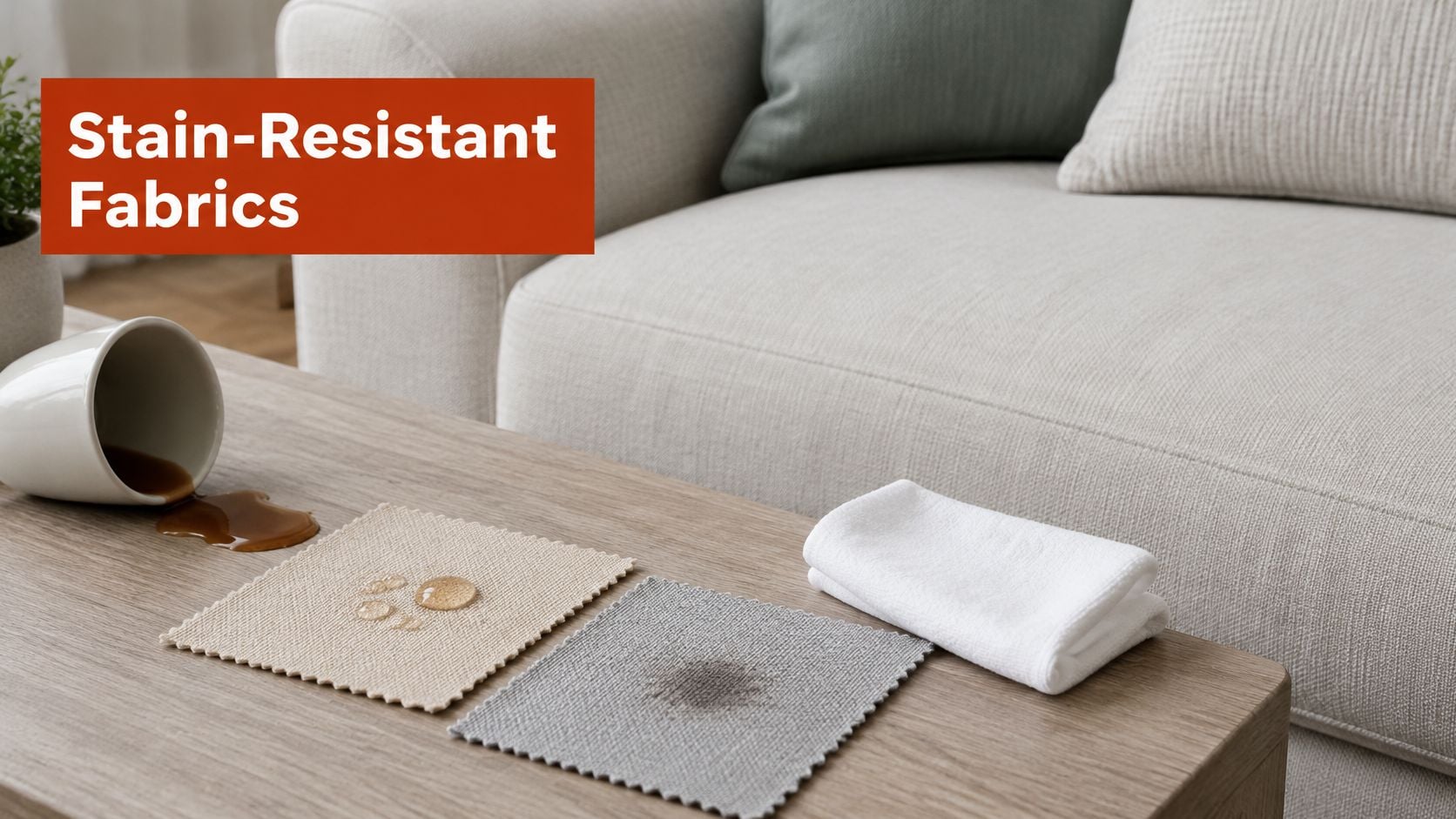
The sofa has been in the living room three weeks when the first real test arrives. A bowl of chili, a glass of iced tea, a dog with damp paws, and a friend who rests a mug on the arm. You chose the fabric carefully, and now you're not entirely sure what it will do.
You're in good company. The global stain-resistant fabric market was valued at USD 14.2 billion in 2024, according to Market.us, and nearly every yard of it carries the same vague promise on the tag. What that promise means in your home depends on three things: where the resistance was built, which test the fabric passed, and how it behaved after the fifth cleaning.
The tag is the least useful line on a spec sheet. A fabric's fiber, weave and care code tell you more about year six than any hangtag ever will, and this guide reads all three the way a showroom designer does when a friend asks for a straight answer.
Stain Resistant Couch Fabric Types Compared
Start with the answer. For everyday life with children, pets, sunscreen and iced drinks, the fabrics that handle spills best are performance woven textiles, not the softest natural fibers on the rack.
The table below sorts the six fabric families you're most likely to meet by where the resistance comes from. Read that second column before you fall for the swatch. A fiber that resists on its own keeps working after years of cleaning. A surface finish is a coating, and coatings have a service life.
| Fabric type | How stain resistance is built | Best for | Main trade-off |
|---|---|---|---|
| Solution-dyed acrylic performance fabric | Color built into the fiber; spills sit on the surface and release with prompt cleaning | Sun-facing rooms, pets, active households | Firmer hand than soft blends; confirm the care code |
| Tightly woven performance fabric with durable finish | Dense weave plus a finish that repels liquids and eases cleaning | Families, rentals, heavy daily use | Finish depends on approved cleaners; test before any aggressive spot cleaning |
| Polyester blend with topical repellent | Surface treatment repels initial spills | Moderate-use living rooms | Repellency can weaken after repeated cleaning |
| Performance microfiber | Dense synthetic fiber sheds liquids; many styles suit removable covers | Casual family rooms | Texture can change under abrasion; check the rub rating |
| Top-grain leather | Dense sealed surface wipes clean without a textile finish | Long-lived heirloom pieces, pets | Can scratch or fade; needs leather-specific care |
| Boucle, velvet or linen | Natural or textured fibers with limited inherent repellency | Formal or low-traffic rooms | Requires fast blotting and specialist cleaning |
Six plain sentences, one per row. Solution-dyed acrylic is the one I'd put in a sun-facing Florida room without hesitation, because the color lives inside the fiber and doesn't wash out in a bright window. A tightly woven performance fabric with a finish is the all-rounder for a family room, and the finish is really a purchase of minutes rather than a promise of immunity. Polyester with a topical repellent handles the first spill beautifully and gets quieter about it after repeated cleaning.
Performance microfiber sheds liquid readily and often arrives as a removable cover, which changes the whole maintenance story; check the rub rating before you fall for the texture. Top-grain leather wipes clean with a damp cloth and needs no textile finish at all, and it earns its keep as an heirloom piece, though it records every cat, key and buckle. Boucle, velvet and linen are the beautiful low-traffic choices, where the plan is fast blotting and a specialist when something sets.
Three rules cover most of the decision:
- Favor fiber-level protection or a tight weave for high-traffic rooms. Sunrooms, rentals and rooms with pets and toddlers punish surface coatings faster than anything else in the house.
- Treat finish-based protection as a standing commitment. It works when you clean with the approved chemistry and stops working when you improvise.
- Expect leather to wipe clean and to show its history. Patina is the trade you make for a surface that never needed a finish.
If the vocabulary is new, our guide to upholstery materials covers how fiber, weave and backing interact before a finish enters the picture. Two ideas sit underneath everything above: the difference between repelling a spill and releasing it, and why the care code on the spec sheet matters as much as the fabric name.
What Stain Resistant Really Means for Your Sofa
A glass of red wine tips over on a pale sofa during a Sunday gathering. Everyone freezes, someone grabs a napkin, and the owner says what every owner says: it's supposed to be stain resistant.
That hope is understandable and mostly misplaced. Think of the finish as a raincoat. It handles a light drizzle and keeps you dry on the walk to the car. Stand in a downpour for twenty minutes, or wear that coat for three seasons until the coating thins at the shoulders, and you get soaked anyway. Stain resistance is a window of time, not a shield.
Marketing collapses five separate questions into one word: water repellency, stain release, abrasion resistance, chemical resistance and lightfastness. A fabric can score well on one and badly on the next, and the label won't tell you which is which.
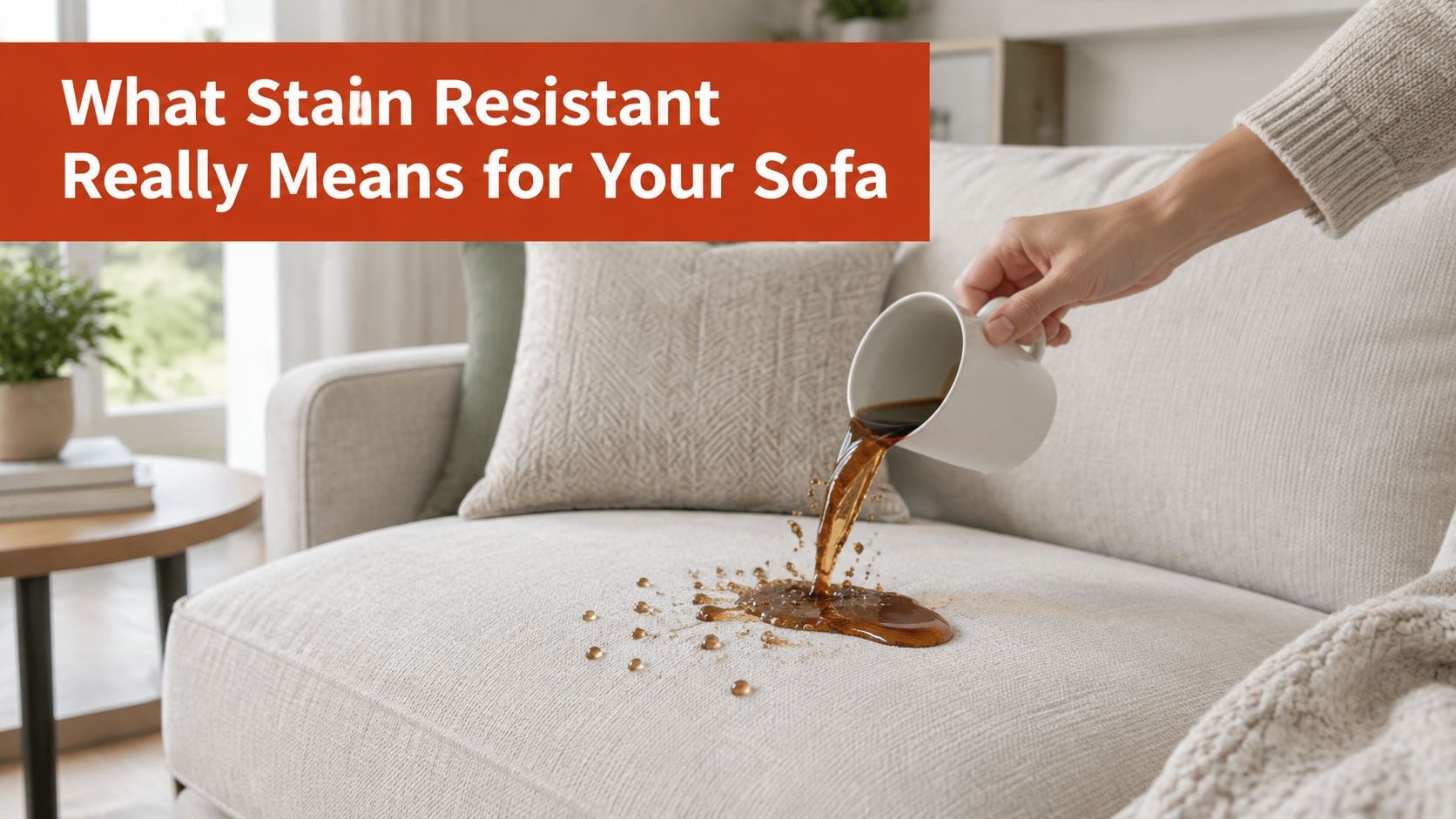
The independent testing is sobering. Fabric-performance testing in healthcare settings reported by Interiors & Sources found that 50% of evaluated fabrics appeared vulnerable to alcohol-based hand sanitizer or supposedly non-oxidizing cleaning chemicals, while some polymers degraded rapidly under daylight and oxidizing chemicals. That testing used a 48-hour stain dwell time, far longer than the common two-hour test, and it included sunscreen, baby oil, moisturizers, lipstick, nail-polish remover and hair conditioner. Those are the substances of a coastal household, not a laboratory curiosity.
The question worth carrying into the store: will this fabric survive the cleaning method I actually use, and the stains my household actually makes?
| Stain or cleaner | What the independent testing found | Question for the maker |
|---|---|---|
| Sunscreen, baby oil and lipstick | Used as test stains with a 48-hour dwell time | Did the fabric discolor after the dwell test? |
| Nail-polish remover and hair conditioner | Used as test stains | Does solvent-based remover affect the finish? |
| Alcohol-based hand sanitizer | About half of evaluated fabrics appeared vulnerable | Is this cleaner on the approved list? |
| Non-oxidizing cleaners | Part of the same vulnerable group of fabrics | Which cleaners does the maker approve? |
| Oxidizing chemicals and daylight | Some polymers degraded rapidly | What is the colorfastness to light result? |
One fabric can do several contradictory things at once. It can repel coffee yet discolor from sunscreen, soften after a season of disinfecting wipes, or fade in strong afternoon sun. Aggressive spot cleaning can damage a finish even when the original spill would never have stained the textile, which is why removable, washable covers and treated upholstery are different products rather than two versions of the same one.
Before you weigh a performance weave against a leather, our comparison of leather versus fabric upholstery puts the cleaning question side by side with the comfort question.
How Stain Resistance Gets Tested and What the Results Mean
No credible spec sheet claims a single stain-proof rating, because no single test produces one. What you get is a list of named tests, each answering a narrower question, and the comparison only becomes meaningful when you know which test produced which number.
| Test | What it measures | How to read the result |
|---|---|---|
| AATCC TM22 | Water wetting in a spray test | Higher rating means better wetting resistance; ask the maker for the scale used |
| AATCC TM70 | Water repellency by dynamic absorption | Compare the reported absorption result between fabrics tested the same way |
| AATCC TM193 | Resistance to water and alcohol solutions of varying surface tension | Shows how liquids behave; ask which mixture was used |
| AATCC TM107 | Color change and dye transfer caused by water | Read with the AATCC Gray Scale; especially useful for bright, sunlit rooms |
| ASTM D4852 | Upholstery performance before and after the specified cleaning | Most useful for buyers; compare post-cleaning results, not only initial results |
| AATCC TM130 | Oily stain release during laundering, established 1969 | Measures release of oily stains rather than repellency alone |
The water and alcohol work is catalogued by the American Association of Textile Chemists and Colorists, which documents TM22 for spray wetting, TM70 for dynamic absorption and TM193 for aqueous solutions at varying water-and-alcohol concentrations. The before-and-after cleaning procedure comes from ASTM D4852, which evaluates attached upholstery fabrics before and after the cleaning or refurbishing steps named in the care instructions. Oily stain release has a longer pedigree: TM130 was created in 1969 and is recorded in the AATCC's own history. Water-driven color change and dye transfer fall under AATCC TM107 and the AATCC Gray Scale.
Wetting and penetration are two different events
A fabric can bead a droplet on contact and still let that droplet settle into the yarn twenty minutes later. Surface wetting describes how a liquid behaves at the face of the textile. Penetration describes what happens next, and in a coastal home where spot cleaning is routine, penetration is the one that leaves a mark.
The care code decides what you may safely use
Before any spot cleaning, find the letter code. W permits water-based cleaners. S means solvent-based products only. WS allows either. X means vacuum only, with any real cleaning left to a professional. No spray or aftermarket protector upgrades a code, and using the wrong chemistry on an S-coded fabric can ring or shrink it.
Reading a spec sheet in three steps
- Find the named test. A number without a test name is decoration.
- Check whether the result is before or after cleaning. Post-cleaning performance is what you'll live with.
- Ask which cleaning method was used. A result tied to a method you'd never use tells you little.
Durability Checks Beyond Stain Repellency
Stain resistance is one line on a woven upholstery specification, and it's rarely the line that decides whether a sofa still looks composed in year six.
ASTM's woven-upholstery specification treats colorfastness to water and solvents, surface abrasion, colorfastness to light, ozone, rubbing transfer, dimensional stability, yarn slippage and tear strength as peers of stain behavior, per the American Home Furnishings Alliance fabric standards. Read them as one checklist rather than a menu:
- Abrasion. A rub rating tells you how the face survives friction, which is exactly the force that wears a topical finish away.
- Colorfastness to water and solvents. The test that predicts whether your approved cleaner will pull dye out of the weave.
- Crocking and rubbing transfer. Whether color moves onto a white shirt, a cushion, or the adjacent seat.
- Light and ozone fastness. The Florida check, and the one most showroom conversations skip.
- Dimensional stability, yarn slippage and tear strength. Whether the fabric holds its shape and its seams under real use.
The cause and effect is blunt. Aggressive stain removal can transfer dye, fade a pigment, weaken a backing or distort the weave even when the stain itself disappears completely. That same guidance gives a usable benchmark for color evaluation: a minimum color-change rating of Class 4 and a minimum staining rating of Class 3 for the cited water- and solvent-related tests. Those are test ratings, not guarantees against every household spill, so get the manufacturer's approved chemistry and try it on the underside of a cushion first.
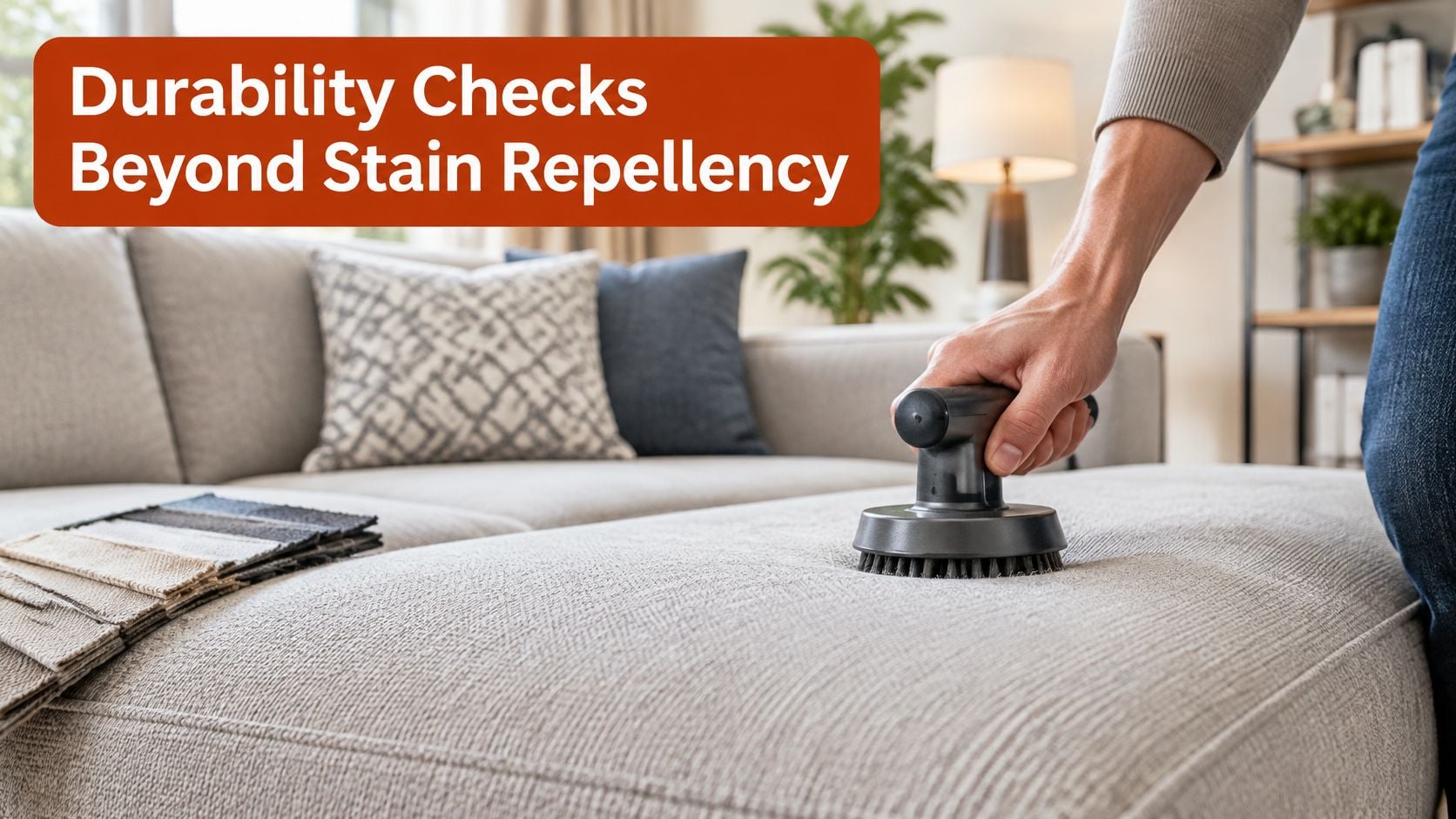
Comfort belongs in this section because durability without it is a wasted purchase. We sit in every sofa, sectional and chair before offering it, testing lumbar support, cushion resiliency and frame pitch, so the piece that survives the abrasion test also has to survive an hour of reading with your feet up.
Practical rule: for a household with kids, pets or renters, ask for a single sheet showing cleanability and wear results together. Two pleasing numbers from two different documents is not a specification.
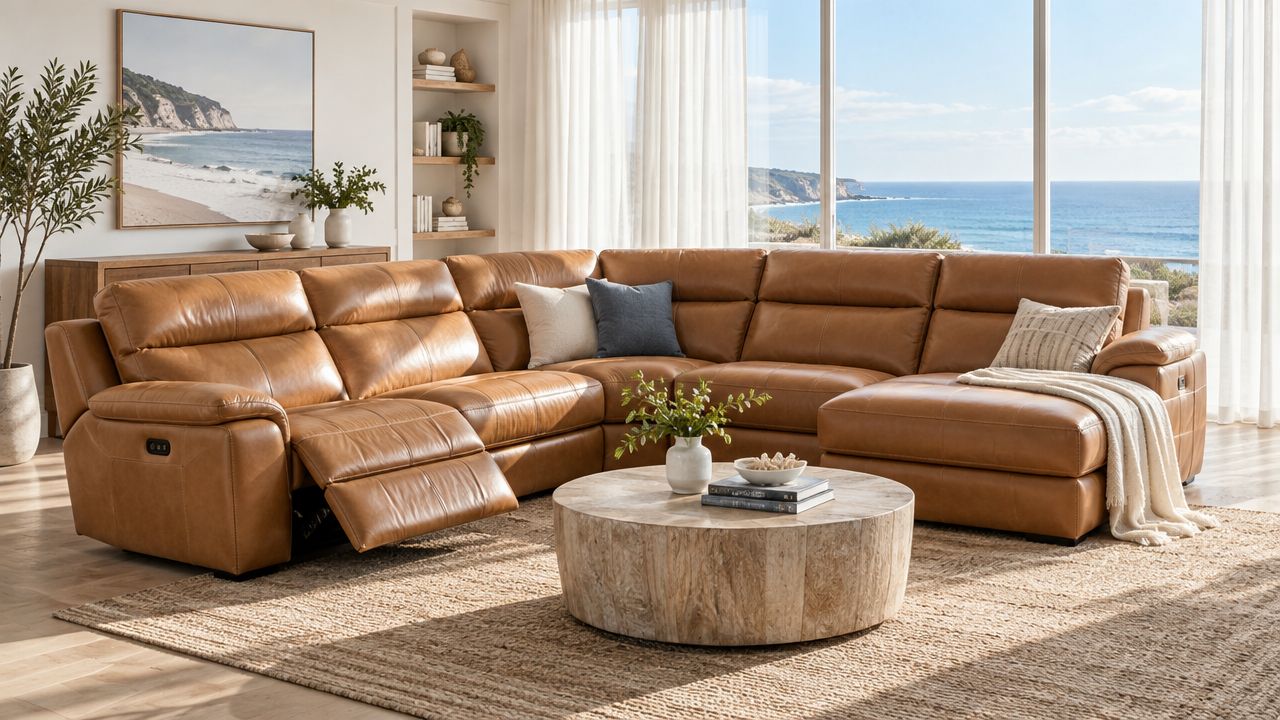
For a room that has to absorb spills, splashing and shedding at once, this performance fabric sectional shows how those requirements translate into an actual piece of furniture. A moderately repellent fabric with strong overall durability will almost always outlast a highly repellent fabric with weak abrasion numbers.
Asking About PFAS-Free Finishes Before You Buy
The PFAS question belongs on every fabric spec sheet, right next to the rub count. The history explains why.
DuPont researchers discovered polytetrafluoroethylene, or PTFE, in 1938, and after the Second World War the material reached the market as Teflon, which pushed fluorinated finishes into nonstick cookware and stain- or water-resistant textiles. The U.S. Environmental Protection Agency's PFAS overview reports that PFAS have been manufactured and used globally, including in the United States, since the 1940s, adopted precisely because they repel water, oil, grease and stains, with applications that include upholstered furniture, carpets, clothing and leather.
That history explains why older stain-resistant fabrics often relied on a chemical surface treatment rather than the weave or the fiber alone. It also explains why asking the question is a specification step rather than a cosmetic preference.
The EPA states that certain PFAS can persist in the environment and remain in the human body for long periods. In 2020, the agency strengthened U.S. oversight by requiring review before certain long-chain PFAS uses could restart, while restrictions also addressed some coated products and carpets. A shopper who wants to avoid the chemistry entirely is not making an eccentric request; they're asking for a documented choice.
Put three questions to the maker, in writing:
- Is the performance finish PFAS-free? Ask for the documentation, not the assurance. A verbal yes from a sales floor isn't a specification.
- Is the stain resistance inherent in the fiber, or added as a finish? Fiber-level resistance and a topical coating behave differently after five cleanings, and only one of them is a permanent property of the textile.
- Can the maker supply written documentation for this specific fabric? Not the collection, not the family of fabrics. The exact pattern and colorway you're ordering.
A fabric can be genuinely excellent and still not be the right fabric for a house with a sunscreen habit and a west-facing window.
PFAS-free is a specification to verify, not a label to admire. If the answer comes back vague, treat that as the answer and move to the next swatch.
Florida Humidity, Cleaning and Keeping Upholstery Dry
Brevard County gives upholstery a workout that most buying guides never address. Sunscreen, food oils, salt air, humidity and frequent spot cleaning all land on the same cushion, often in the same week, and the humidity keeps working long after the spill is gone.
Stain resistance can reduce visible spills without doing anything about odor, mildew or mold when upholstery stays damp. Conservation guidance on textile care associates mold risk with relative humidity from roughly 65% to 100%, especially in warm, still air, while EPA-oriented guidance recommends keeping indoor relative humidity below 60%, with 30% to 50% considered ideal, as outlined in this guide to keeping high-end textiles flawless in a humid climate.
That gap matters because a water-repellent finish can hold a spill near the surface while moisture stays trapped in seams, cushion cores and backing materials. The surface looks dry. The inside doesn't get there.
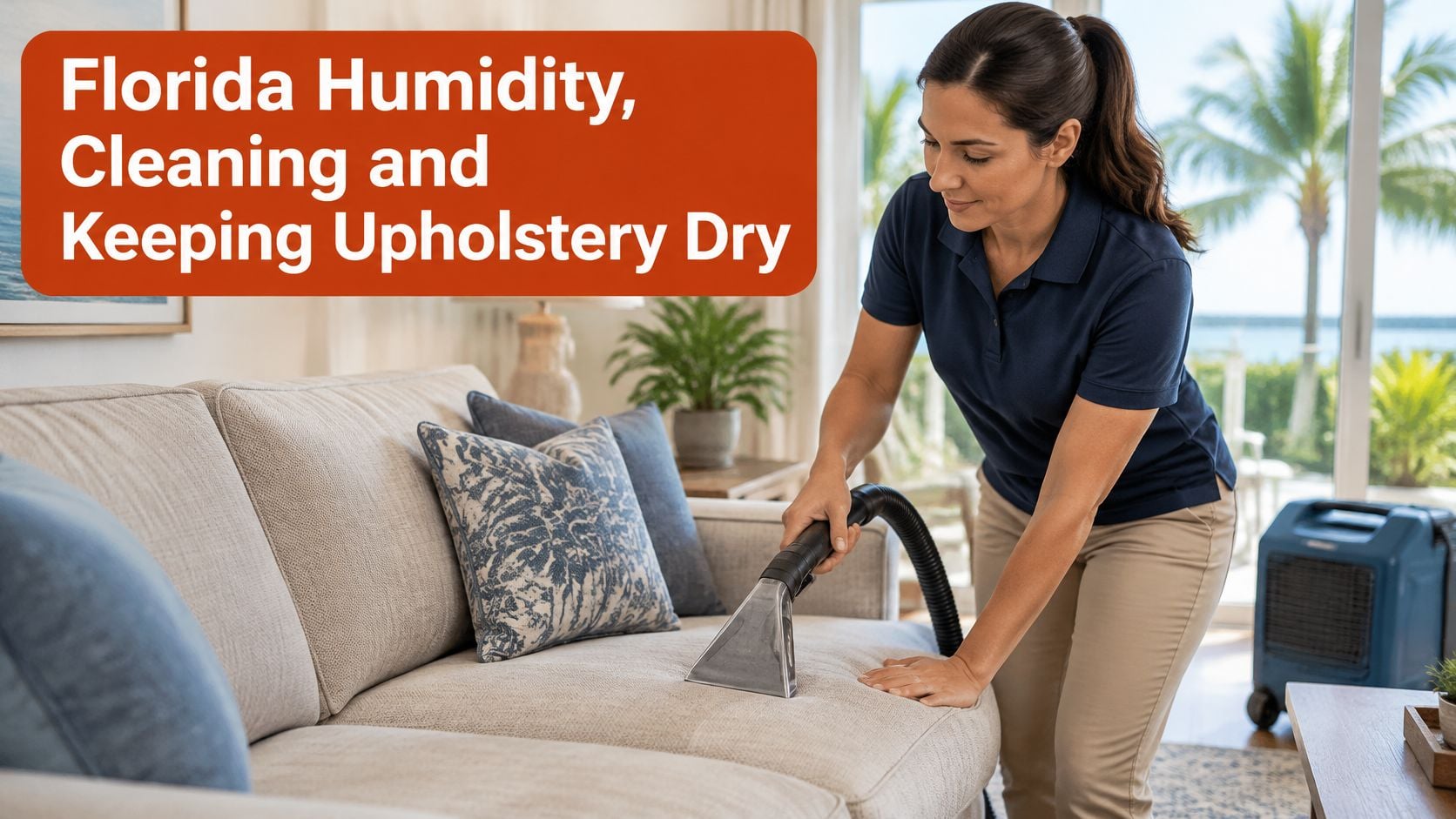
Here's the routine, in the order it should happen:
- Blot within minutes. Pressure pushes liquid into the core; lifting pulls it out. Rubbing is what turns a spill into a permanent mark.
- Test the approved cleaner on a hidden area. The underside of a cushion or the back of a skirt panel. Wait for it to dry before you judge it.
- Don't saturate the cushion. Damp cleaning is the goal. A soaked cushion can take days to dry in a closed house, and those are the days that grow odor.
- Separate removable cushions for airflow. Stand them on edge so air reaches both faces and the seams.
- Run dehumidification when the house is empty. A vacation rental with the air conditioning off in August is the worst-case scenario for any upholstery.
- Inspect enclosed rooms after a vacancy or an AC outage. Run a hand along the seam under the seat cushion. Cool and slightly damp means you caught it in time.
When a deeper reset is due, this guide to deep clean timing from J M Cleaning helps you plan the work around realistic drying windows rather than guessing at a calendar.
The point isn't to choose a performance fabric and stop thinking. It's to choose a fabric and manage the room around it, which is what our notes on summer-proofing furniture against spills, splashing and shedding are built around. Ask whether the sofa dries quickly after cleaning, whether cushions separate, and whether the foam and backing tolerate moisture as well as the face fabric does.
The honest version: there's no such thing as a mold-resistant sofa in a house that sits at 70% humidity with the air off.
Test Your Shortlist in the Showroom Before You Decide
By now the list should be shorter. Two or three fabric types, not twenty. Bring the documentation that got you there: the named test, the post-cleaning result, the care code and the approved cleaning chemistry. That folder is what turns a pleasant conversation into a decision you won't revisit.
A showroom visit does something a swatch card can't. You feel whether a performance weave reads firm or stiff against your arm, how a boucle catches light near a window, whether a leather has enough weight to hold a well-shaped seat cushion. Color behaves differently under a coastal afternoon than it does under showroom lighting, so bring a sample home if the room gets strong sun.
We've served Brevard County, the Space Coast and Central Florida since 1939, and the current showroom in Rockledge runs 32,000 square feet of curated room displays and coastal vignettes. Our No Blind Ordering promise is simple: every sofa, recliner and chair on that floor is hand-tested by ownership for pitch and comfort before it reaches a customer's home. Shoppers can feel leathers, touch solid hardwoods and compare cushion firmness levels side by side rather than guessing from a description.
The design team is on the floor seven days a week and can pull swatches, check dimensions and help you test seat comfort while you're standing there. The design assistance questionnaire is worth five minutes before you arrive, because it captures lifestyle needs up front: kid and pet-friendly performance fabric, top-grain leather, high-traffic and stain-resistant requirements, hypoallergenic options, easy maintenance, and custom sizing or modular layouts.
Bring the stain, if you can. A dab of the sunscreen you actually use, on a hidden corner of the actual fabric, settles more arguments than any brochure.
Pairing a fabric with a room and a household is easier with a second set of eyes, and our complimentary in-house design consultation exists for exactly that. White-glove delivery is handled by our own uniformed team at a flat $99 rate within the service area, including unboxing, inspection and full room setup, so the fabric you tested is the fabric that lands in your living room. If the household includes a toddler and a Labrador, start with our guide to kid-friendly and pet-friendly furniture and narrow from there.
Bring two or three fabric types, your care codes, the post-cleaning results and one real stain from your own kitchen. Then sit on the shortlisted piece, lean back, and judge the pitch with your shoulders against the back. Comfort and cleanability are both physical tests, and neither one can be completed on a screen.
Book a visit to the Rockledge showroom, tell the design team which room you're furnishing and how it gets used, and put your shortlist under your own hands before you decide. The right fabric for a Space Coast living room is the one that still looks considered after a summer of sunscreen, grandchildren and afternoon sun, and that's a judgement worth making in person.