Schedule your Complimentary Design Consultation

Best Sofa Fabric for Pets: Durable Picks for 2026

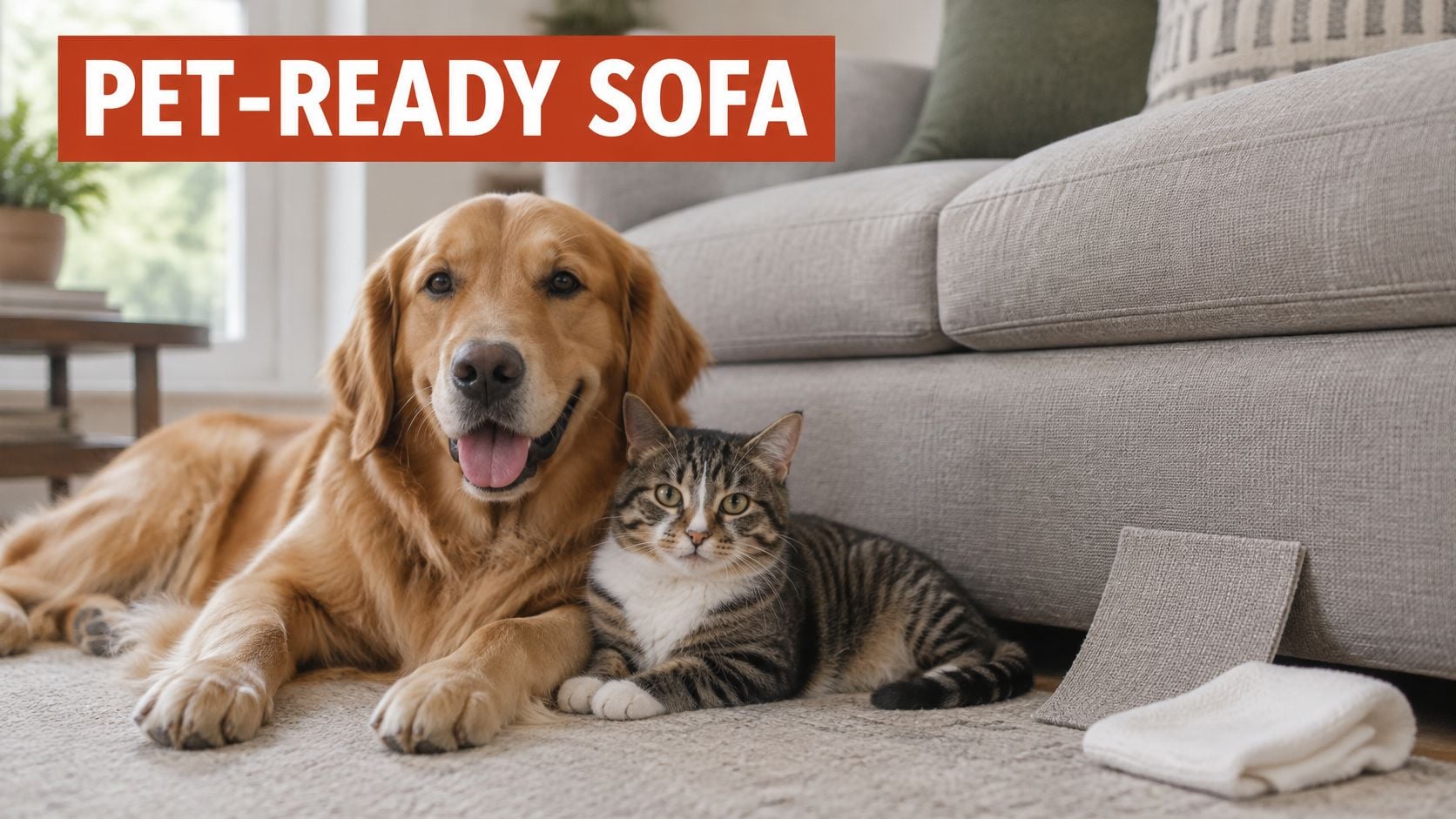
Almost half the pet owners in a 2024 Redecor survey, 48%, said they had discarded a piece of furniture because of a pet, a figure Forbes reported while examining how animals shape home design. That isn't a story about badly behaved animals. It's a story about upholstery chosen under showroom lighting and never tested against how the room is used.
The decision usually collapses into one number. A hang tag says 50,000 double rubs, the label says performance, and the shopper assumes the work is done. Claws, hair, spills and coastal humidity each attack a sofa differently, and a fabric that wins on one front can lose badly on another.
Sorting those fronts before you fall for a texture is the whole job, and it starts with knowing which fabrics have a fighting chance.
Best Sofa Fabrics for Pets at a Glance
For most pet-owning homes the strongest starting point is a tightly woven performance polyester, a polyester blend, or a dense microfiber, with top-grain leather as the durable, wipe-clean alternative. All four share one advantage. The surface is flat and dense, so claws find nothing to hook, hair sits on top where a vacuum reaches it, and most messes stay on the surface long enough for you to blot them.
The scale of pet ownership explains why this stopped being a niche specification. The American Veterinary Medical Association's 2024 pet ownership statistics put dog ownership at 45.5% of U.S. households, about 59.8 million homes, and cat ownership at 32.1%, roughly 42.2 million homes, with an estimated population of 89.7 million dogs and 73.8 million cats. That's a lot of upholstery absorbing daily contact.
The table compares seven common choices on the four things that decide whether a sofa survives.
| Fabric type | Weave and surface | Claw and snag risk | Hair and cleaning | Best fit |
|---|---|---|---|---|
| Performance polyester or polyester blend | Tight, smooth weave | Low | Releases hair; wipes clean | Most pet-owning homes |
| Microfiber performance fabric | Dense, low-pile weave | Low | Releases hair; vacuums well | Cats and dogs in daily use |
| Top-grain leather | Smooth, sealed grain | Low to moderate; scratches can show | Hair releases; wipes clean | Households wanting a long-lived, easy-care surface |
| Tight, short-pile velvet | Dense pile | Moderate; pile can snag | Hair clings; needs regular vacuuming | Lower-traffic rooms with light pet use |
| Chenille | Textured loops | High | Conceals hair; absorbs liquid quickly | Homes where looks matter more than spill risk |
| Bouclé | Looped surface | High | Grit lodges in loops; hair clings | Formal rooms without claw-heavy pets |
| Linen or open-weave tweed | Loose, open weave | High | Hair and grit collect in the weave | Formal rooms without pets |
Two rows tell the story. Bouclé, linen and open tweed look refined in a vignette and catch on a fingernail, which means they'll catch on a claw and then hold grit and shed hair in the same loops. Dense weaves forgive. A mid-tone heathered surface in a tight construction hides more than any stain spray will.
For a close look at what tight means in practice, our brown microfiber couch shows the surface in a finished room rather than on a swatch card. Then check three things on any candidate: the abrasion rating, the weave and stain behaviour, and a physical swatch test you run yourself.
Three Risks Every Pet Sofa Must Handle
A sofa shared with animals has to survive three separate kinds of damage, and only one of them shows up on a spec sheet.
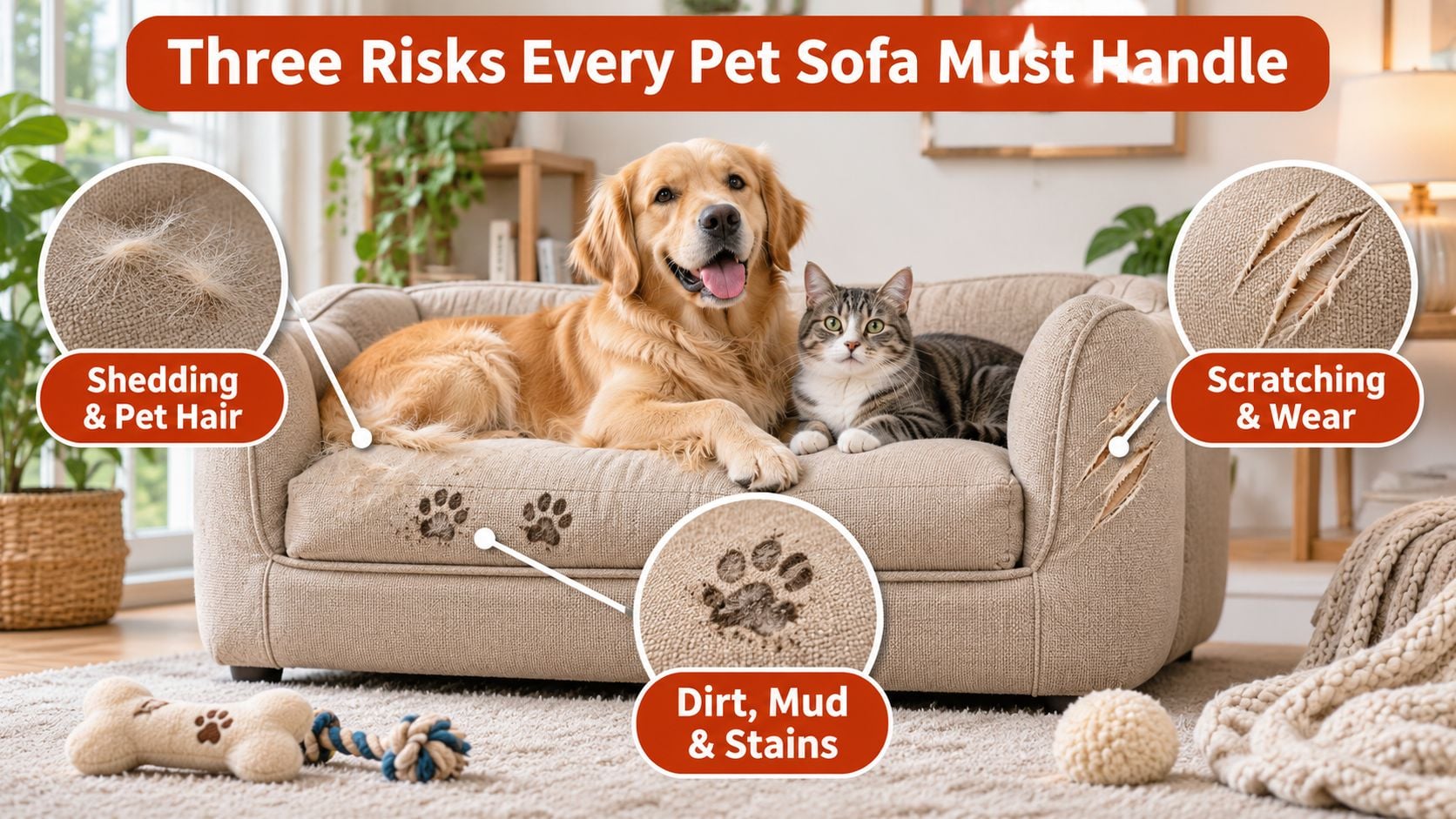
Abrasion is the slow one. Years of sitting, shifting and sliding wear the yarns down until the surface fuzzes or breaks. A double-rub or Martindale figure measures exactly this, and nothing else.
Snagging is the fast one. A claw catches a loop or a loose yarn, pulls it, and leaves a run visible across the room. Even a fabric rated above 200,000 Martindale cycles can snag, pill or stain, because the test rubs a flat surface rather than picking at it. No upholstery fabric is claw-proof, and a large abrasion number was never a claim about claws.
Hair and accidents sit outside wear testing entirely. Liquid either beads and blots away or wicks into the cushion, and hair either clings to texture or releases onto a vacuum.
One evening shows the difference. A cat settles onto the sofa arm, stretches, and hooks a claw through a single loop. By morning the pulled yarn runs halfway down the panel, on a fabric whose abrasion rating may well be outstanding. The rating counted years of sitting. The snag took two seconds.
The test that matters: ask of any sample whether it resists catching, releases hair, and survives a spill. Three yes answers beat one impressive number.
Household mix shifts the priority. A cat-heavy home lives with snag risk first, because kneading and clawing concentrate on the same two corners. A dog-heavy home deals with soil, moisture and odour before anything else, since wet paws carry grit into the weave and damp fur leaves a smell that settles into padding.
That's why a slightly lower-rated, tightly constructed fabric often outlasts a much higher-rated open weave in a claw-heavy household. The rub count still earns its place on the spec sheet. It answers the abrasion question, and snagging was never part of the question.
Reading Abrasion Ratings Without Being Misled
Wyzenbeek and Martindale don't convert into each other, so read each figure against its own scale. Wyzenbeek holds the fabric under tension and rubs it back and forth with an approved cotton-duck abradant. Martindale works in a circular figure-of-eight motion. Both record the cycles before visible wear or specified yarn breakage, which is why a number from one test says nothing about where the fabric would land on the other.
The Association for Contract Textiles performance guidelines set high-traffic upholstery at 30,000 Wyzenbeek double rubs or 40,000 Martindale cycles, and caution that values above 100,000 double rubs may not provide meaningful additional value in use.
| Use level | Wyzenbeek double rubs | Martindale cycles | What it means for a pet sofa |
|---|---|---|---|
| Low-traffic private spaces | 15,000 minimum | 20,000 minimum | Acceptable for occasional-use seating |
| High-traffic upholstery | 30,000 | 40,000 | Defensible target for a sofa used daily by people and pets |
| Above 100,000 double rubs | 100,000+ | Not benchmarked | Diminishing returns in use; not proof of pet performance |
| Claw and snag resistance | Not measured | Not measured | Not tested by rub counts; check the weave by hand |
For a sofa sat on daily by people and pets, treat the high-traffic row as the floor rather than a stretch. Anything in the low-traffic band belongs on a chair nobody claws, and anything far above it is a specification, not a guarantee. An extreme rating makes a strong marketing line and a weak promise about claws, pilling or a tipped glass.
Find the figure on the manufacturer's specification sheet, in the same block as the cleaning code, and read the two together. A performance fabric sectional is only as good as that pairing. A high rub count next to an X cleaning code tells you the fabric tolerates sitting and not much else.
Why Fabric Weave Beats a Stain-Resistant Finish
Coffee stains were driven by fabric choice, not the finish. A peer-reviewed study of PFAS-finished upholstery tested unfinished and finished commercial fabrics with coffee and oil-based salad-dressing stains across different dwell times, application pressures and abrasion levels. Fabric type produced substantially larger differences in stain performance than the finish did.
The result held across both mess types. Water-based coffee tracked the fabric itself, while the PFAS finish provided little or no meaningful benefit for coffee. Oil repellency declined rapidly after abrasion, with some polyester samples losing effective repellency after moderate wear. The finish weakened exactly where a sofa takes the most punishment.
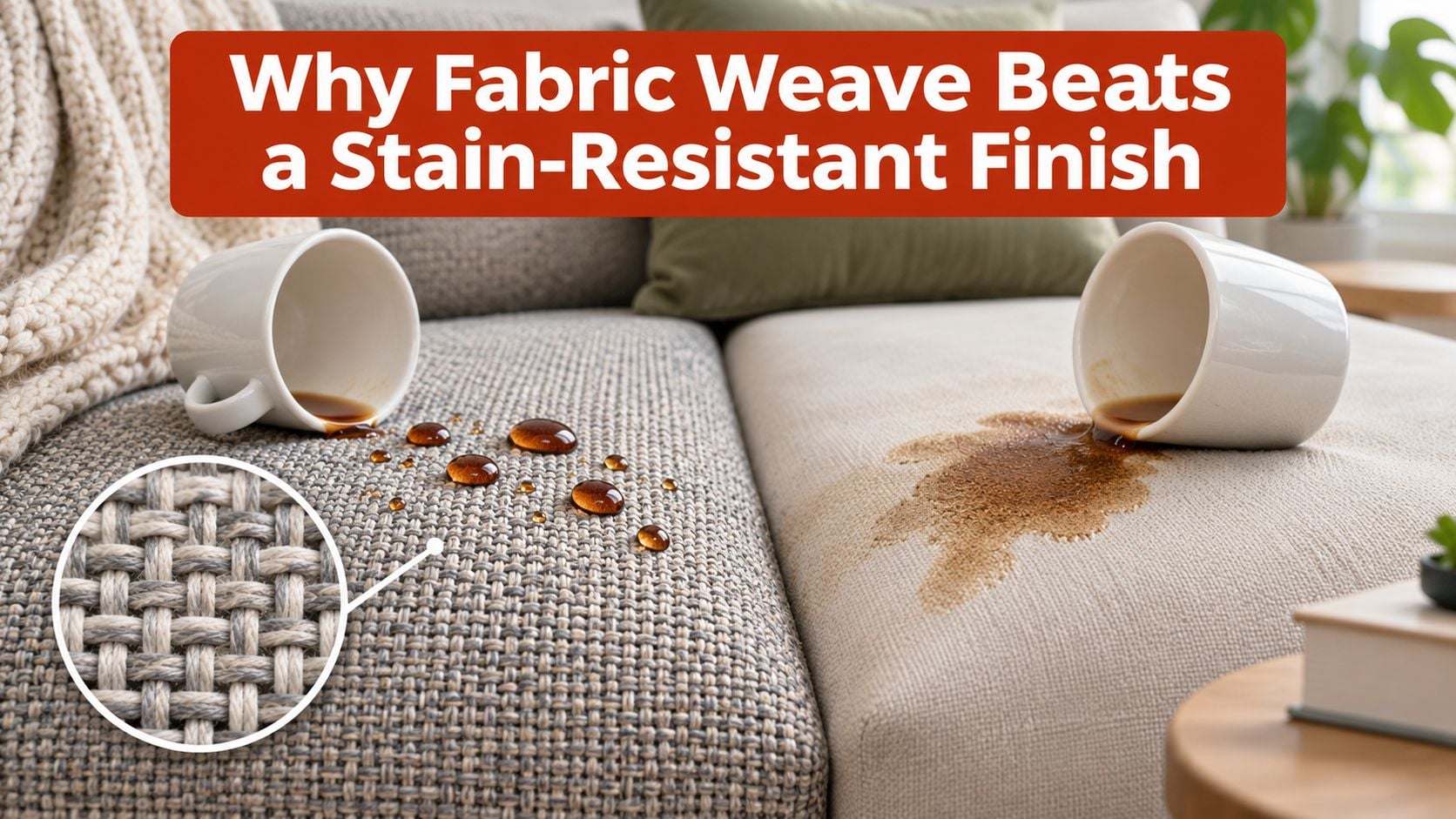
Ask for the weave first and the finish second.
So specify construction first. A smooth, tightly woven polyester or polyester blend resists snagging better than an open weave sold on its stain story, because the yarns sit close enough that a claw slides across the surface instead of hooking a thread. Where a household wants the extra layer, our design services include selecting stain-resistant performance fabrics such as Sunbrella and Crypton, coordinated with custom wood finishes.
Colour and visual texture do quiet work too. A mid-tone heathered surface conceals residual hair and small marks better than a solid pale or solid dark cloth. Before committing, ask for a swatch test with water and a drop of light oil, since pet messes carry both water-based and oil-based soil. Our upholstery materials guide walks through how construction, cleaning code and finish stack up for a room like yours.
Cleaning Codes and Routine Care
The letter on the specification sheet decides which liquids may touch the fabric. W means water-based cleaners only. S means solvent-based cleaners only, and water can leave a ring. WS accepts either. X means vacuum only, no liquid at all, which is a hard limit in a home with pets.
Textile-care guidance for commercial fabrics follows the same sequence regardless of code: remove solids, vacuum or brush the surface, clean with a neutral agent, then rinse. The Steelcase fabric care instructions make the reasoning plain. Regular vacuuming isn't cosmetic, because embedded grit abrades yarns from inside the weave and speeds visible wear.
That's the argument for dense, low-pile woven synthetics and microfiber over loose bouclé, open chenille and long-loop constructions. Claws catch in loops, and grit lodges where a vacuum can't lift it.
- Weekly: vacuum the cushions and the deck beneath them in a pet-heavy home, using a brush attachment rather than a hard nozzle.
- Within the hour: blot a fresh accident, working from the edge inward so the ring doesn't spread.
- Before you buy: confirm the cover is removable and machine-cleanable, and read the care label rather than assuming.
- Before you treat: test any cleaner on a hidden panel so it doesn't fade the dye or flatten the texture.
Keep a labelled cleaner and clean cloths within reach of the sofa, because a spill that waits is a spill that sets. A stain-resistant couch fabric reduces the panic, and the routine still does most of the work. Deep contamination migrates into cushion padding, so fast blotting and periodic extraction cleaning beat repeated surface wiping.
How to Run a Showroom Fabric Stress Test
Weave and hand-feel don't survive a catalogue photo, so the test happens on a physical swatch, ideally with the sofa in front of you. Six steps, five minutes.
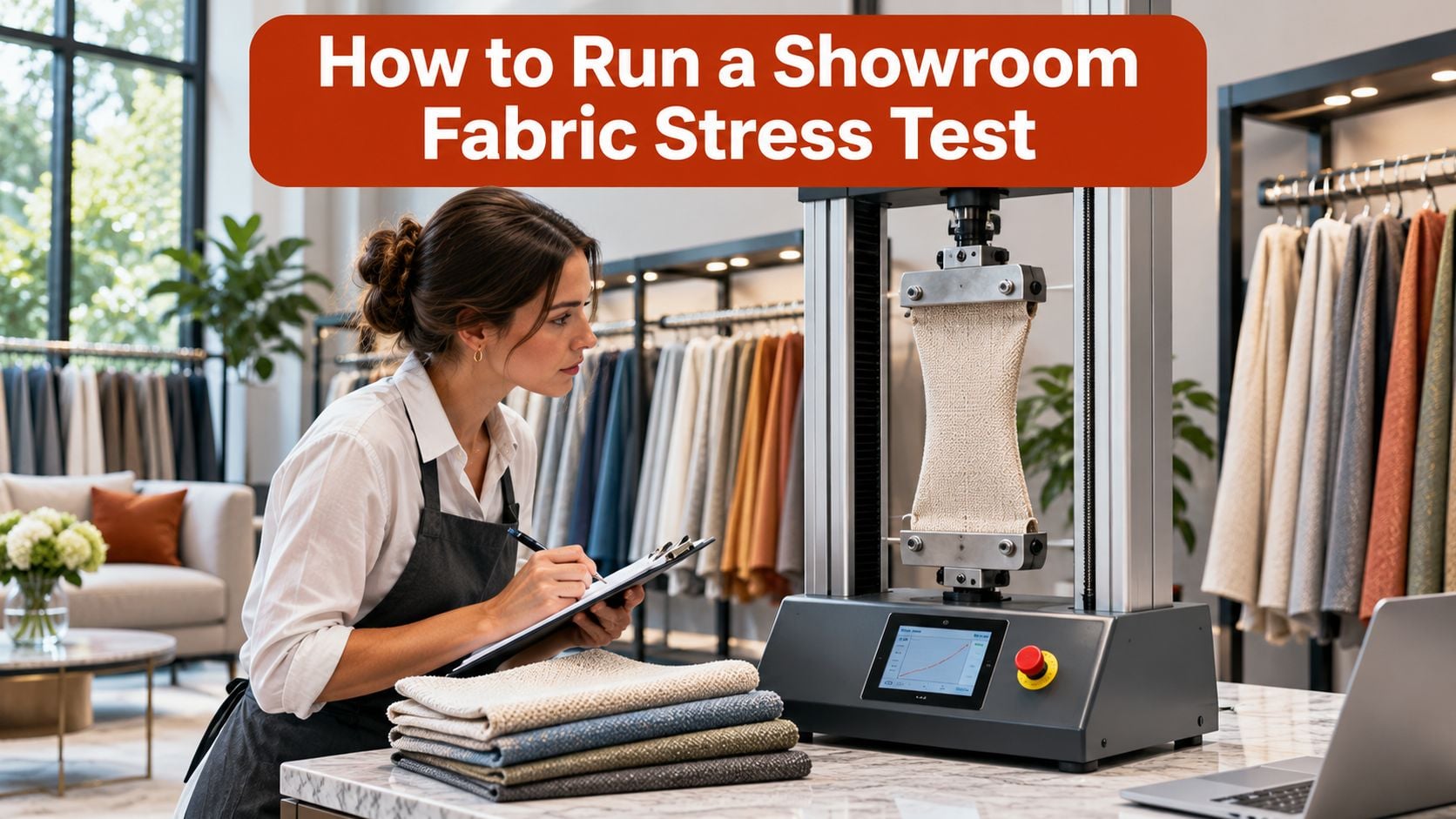
- Drag a fingernail across the surface. Loops, pulls or raised threads are the first signs of claw damage. The common slip is testing one spot instead of the arm, where the fabric wraps and the weave is stressed.
- Rub a pet-hair cloth or a clean upholstery brush over the swatch. Hair that releases onto the cloth stays manageable, while hair that clings means more daily grooming.
- Press dry soil into the surface, wait, then vacuum. Fabric that releases debris without fuzzing suits cats and dogs both.
- Blot a measured drop of water and come back in a few minutes. Darkening or a ring mark tells you how the fabric handles an accident.
- Repeat with a drop of light oil, such as salad dressing. This is the test that separates a tight weave from a coated one.
- Inspect seams, welting and zipper areas. Hair gathers there even when the main panel cleans well.
Then sit down. Every sofa, recliner and chair on our floor is hand-tested by ownership for pitch, cushion resilience and comfort before it reaches a customer's home, so fabric and seat get judged together. In the Rockledge showroom you can feel leathers, touch solid hardwoods and compare cushion firmness levels side by side.
Florida Humidity and Care for Coastal Sofas
Humidity is the variable inland guides ignore. Moisture promotes mould and mildew in upholstery, and once it takes hold the fabric is difficult to clean thoroughly because the material is porous. University of Florida guidance on mould management recommends keeping indoor relative humidity below 60%, with a 30% to 50% range generally advised for moisture control.
Fabric content changes the risk. University of Florida furnishings guidance adds that high humidity can cause both discoloration and fabric deterioration, with cellulose fibres such as cotton, linen and rayon, and protein fibres such as wool and silk, especially susceptible to mould and mildew damage. A linen sofa in a beachside condo is a lovely decision with a maintenance bill attached.
Synthetic performance fabrics handle moisture better, but they aren't immune. Water that sits against a cushion, under a pet bed or inside a seam will find its way into foam.
Where damp collects
Lift the cushions every few weeks and check the deck and seams underneath, particularly on the side facing an exterior wall. Turn or rotate seat cushions so compression and moisture exposure even out. Dry damp pet bedding away from the upholstery instead of letting it sit against it, and blot spills immediately rather than wiping them deeper into the weave.
Coastal habit: run the air conditioning or a dehumidifier through the shoulder seasons, when the house is closed and the air still feels heavy.
Sand and wet paws are the other half of the equation. Coastal living means doors standing open, dogs coming in damp, and grit working into the surface before anyone notices. A low-texture, mid-tone performance surface forgives that pattern and vacuums clean, which is one reason our upholstery is engineered for Florida sun and active coastal living.
Matching Fabric to Your Household and Pets
Start with how the room is really used. In 2024, 60% of surveyed U.S. pet owners said their pets were allowed on the furniture, according to a Houzz survey of 1,165 pet owners. That settles whether the sofa is pet furniture.
- Cat-heavy homes: priority is a tight, low-pile weave with no loops, because claws arrive before spills do. Caveat: even a strong rub count won't save an open basketweave.
- Dog-heavy homes: priority is a removable or machine-cleanable cover plus a surface that releases debris, since soil and moisture arrive together. Caveat: a cover that's spot-clean-only is decoration.
- Allergy-sensitive households: priority is a smooth, vacuum-friendly surface where hair releases instead of hiding. Caveat: skip textured weaves that hold dander deep in the pile.
- Dark or pale pets: priority is a mid-tone heathered surface, which shows fewer hairs than solid dark or solid cream. Caveat: no colour fixes a weave that traps hair.
- Vacation rentals and high-turnover homes: priority is replaceable covers paired with the high-traffic abrasion benchmark, because wear arrives faster. Caveat: guests won't run your cleaning routine.
- Formal rooms without pets: loose bouclé or linen can suit a room no animal climbs on.
Our design assistance questionnaire lets you flag Kid/Pet-Friendly Performance Fabric, Top-Grain Leather, High-Traffic or Stain Resistant, Hypoallergenic, Easy Maintenance and Custom Sizing, so the shortlist starts from behaviour rather than colour. Full interior design consultations, including scale floor planning and fabric selection, are complimentary when you purchase through us. Choosing kid-friendly and pet-friendly furniture covers the rest of the decision.
Confirm Your Pet Sofa Fabric in Rockledge
The last step is physical. Since 1939, Indian River Furniture has served Brevard County and Central Florida from a 32,000-square-foot Rockledge showroom, where the fabric and leather library holds over 1,000 performance upholstery options, genuine top-grain leathers and hand-finished wood swatches. Designers are on the floor seven days a week.
If you want a second opinion on fibre behaviour before you visit, Lewis and Sheron Textiles pet fabrics is a useful read on how weave and pile handle claws.
Four steps for the visit:
- Shortlist two fabrics from the quick-pick table, one performance synthetic and one leather, so you're comparing rather than defaulting.
- Run the swatch stress test on physical samples in the showroom, scoring both candidates the same way so the comparison stays honest.
- Bring your pet's habits and household details to a complimentary in-house design consultation, where a designer pulls swatches and checks dimensions against your room.
- Confirm white-glove delivery. A flat $99 within the service area covers unboxing, inspection and full room setup by the in-house team.
Before you commit, sit in the actual sofas. Feel the leathers, compare cushion firmness between your two finalists, and hold the swatch against the frame to check the colour in real light. A fabric that survives the test and suits the room is the one to order.