Schedule your Complimentary Design Consultation


Coastal Accent Chairs for Living Room: Styles and Sizing


The corner between the sofa and the window gets the best light in the house from about four o'clock on, and it has been empty since you moved in. You haven't measured anything yet, but you know a chair belongs there. That is usually the moment the search starts, and the first mistake comes with it: choosing by photo.
A coastal accent chair is easy to fall for in a photograph and harder to live with when it was built for looks alone. Brevard County raises the stakes: salt air, humidity that swings with the season, and living rooms that take a beating from family, guests, and renters. The 32,000-square-foot Indian River Furniture showroom in Rockledge is built around exactly that gap, because the chair that photographs well and the chair that holds up are rarely the same one.
So this guide holds every chair to three standards. It has to survive Florida moisture, fit the body that will sit in it, and fit the floor it will occupy. Style comes after those three, and it is better for the discipline.
Coastal Accent Chair Styles at a Glance
Five silhouettes cover nearly every living room on the Space Coast, and each one solves a different problem. Choose the shape first, then decide the fabric.
| Style | Silhouette | Coastal Cue | Best Room Fit |
|---|---|---|---|
| Barrel-back swivel | Rounded, enveloping back | Relaxed beach-house warmth | Reading corner or compact living room |
| Slope-arm accent chair | Clean lines, lower-profile arms | Classic coastal tailoring | Conversation seating near a sofa |
| Shelter-back lounge chair | Curved back, upholstered to the floor | Modern coastal polish | Extra seating in open-plan rooms |
| Cane or rattan accent | Open woven texture | Strongest beach cue | Dry, climate-controlled rooms |
| Armless linen-upholstered chair | Light visual weight, slim profile | Airy, understated calm | Small rooms that need visual space |
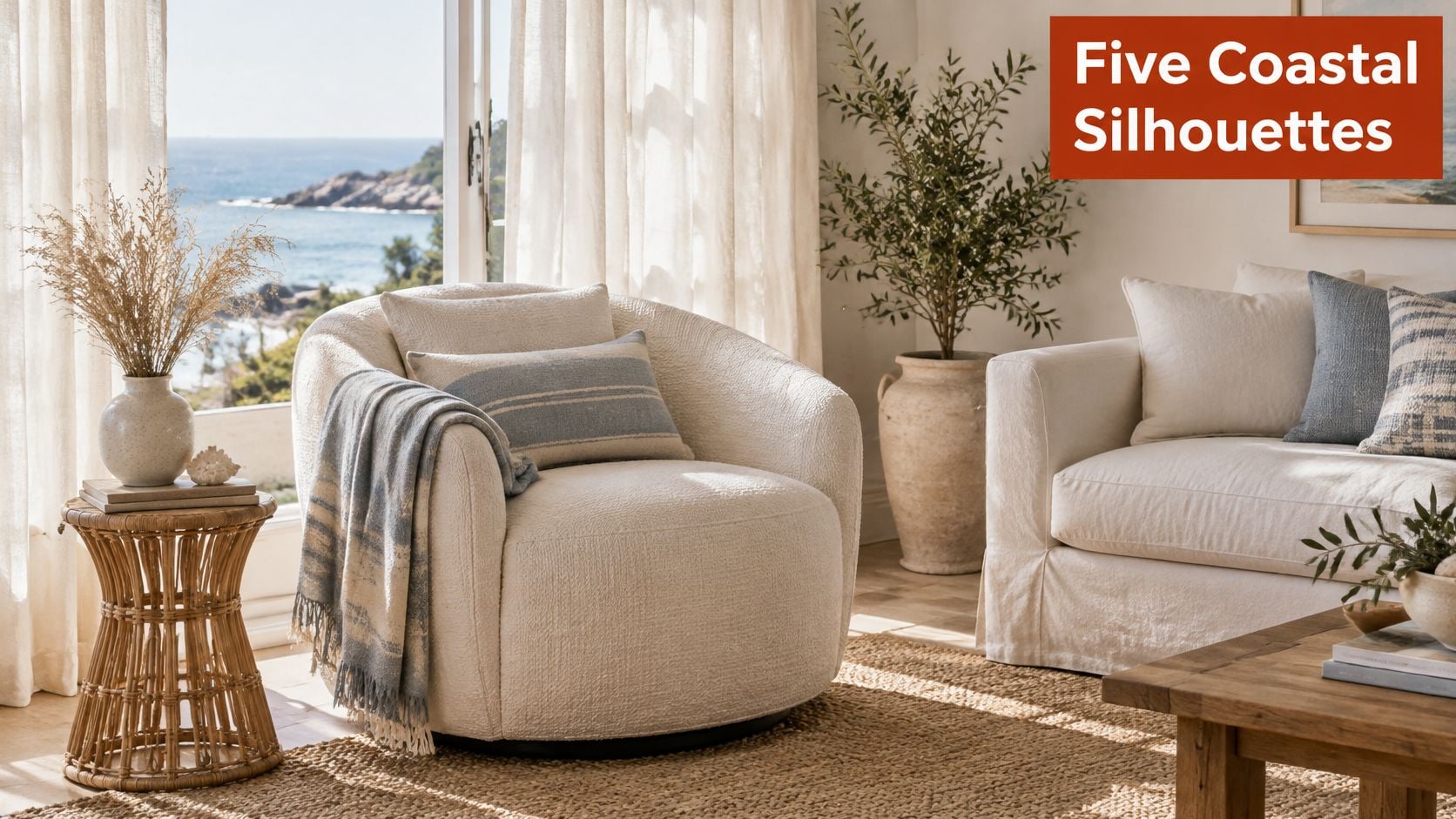
The split that matters most is between open weaves and closed upholstery. Cane and rattan deliver the strongest beach signal and the most maintenance exposure, so they belong where the air stays dry. Barrel, slope-arm, and shelter styles are upholstered pieces, and their long-term behavior depends on what's inside the frame and under the fabric rather than the name on the tag.
Swivel and shelter backs also change how much floor the chair needs. A swivel wants turning room; a shelter back hides its legs and reads heavier, so it needs visual breathing room. That's why style selection and measuring belong in the same conversation instead of two separate appointments.
This isn't a niche vacation-home look. The NOAA Office for Coastal Management reports that coastal counties held approximately 129 million people in 2020, close to 40% of the national population, on less than 10% of the country's land area. Florida's coastal counties alone contained roughly 16.2 million residents, second only to California's 26.8 million. That density is why an accent chair has to work as a focal point and an extra seat at the same time.
Three questions narrow the choice faster than any mood board.
- How many people sit here at once? A pair of chairs beats one oversized lounge in a room that hosts guests.
- How much clear floor has to stay open? Walk the path from the kitchen to the sofa and watch where your shoulder would clip a backrest.
- Where does the light come from? Morning light off the Indian River and afternoon sun through west-facing glass read very differently on the same fabric.
If the room is still on paper, browsing Destin Gulf-front condos for sale is a fast way to study how Gulf-front living rooms handle glass, light, and a tight footprint before you commit to dimensions. For the broader palette, our guide to coastal design style covers the look from wall color to wood finish.
Materials That Hold Up in Florida Humidity
Moisture decides more about a chair's fate here than any style label. The Florida Department of Health in Duval County recommends keeping indoor relative humidity below 60%, with below 50% preferable for controlling mold and dust mites, and advises air conditioning or dehumidification along with drying wet materials quickly. That same guidance points to UF/IFAS research showing humidity around 55% or lower helps protect indoor air quality, furniture, and building materials.
One number reframes every natural-fiber photo on your mood board. A cane chair in a conditioned Rockledge living room is a lovely thing. The same chair in a condo that sits closed up from May to October is an experiment.
| Material | Strength | Watch For | Florida Fit |
|---|---|---|---|
| Performance fabric | Stain resistance and wide color range | Fiber content and finish, not only the rub count | Strong for family rooms and rentals |
| Genuine leather | Ages with character and wipes clean | Can dry and crack under heavy air conditioning and sun | Good in shaded, conditioned rooms |
| Solid hardwood frame | Strong and repairable over decades | Wood moves with humidity; needs dried wood and movement-aware joints | Excellent when the joinery is sound |
| Linen blend | Breathable, relaxed texture | Shows stains and can hold moisture | Best with dehumidification and prompt spill cleanup |
| Cane or rattan | Authentic beach character | Woven gaps trap dust and suffer in damp air | Dry rooms away from humid exposure |
| Sealed wood finish | Shields surfaces from moisture | Finish wear exposes raw grain | Good on arms and legs in humid rooms |
No material on that list is mold-proof, and anyone who tells you otherwise is describing a warranty claim, not a chair. What you can control is how much moisture the piece meets and how fast it dries.
Fabric ratings give you something to compare. The Association for Contract Textiles performance guidelines set 15,000 Wyzenbeek double rubs or 20,000 Martindale cycles as the benchmark for low-traffic or private spaces, and 30,000 double rubs or 40,000 Martindale cycles for high-traffic use. The same guidelines warn that abrasion results don't necessarily predict service life, because fiber content, finish, furniture design, cleaning, and daily use all shape how a fabric performs. Ask for the full specification: fiber, finish, and the cleaning code.
Our upholstery is engineered for Florida sun and active coastal living, and the Rockledge showroom lets you feel leathers, touch solid hardwoods, and compare cushion firmness in person rather than from a photograph. If you're furnishing a whole family room rather than one corner, our guide to performance fabric sectionals applies the same material logic at a larger scale.
Three habits protect any chair you bring home.
- Keep the air moving. Run air conditioning or a dehumidifier rather than shutting the system down.
- Leave a gap. A few inches between the chair back and an exterior wall keeps air flowing behind the frame.
- Dry spills now. Blot, don't soak, and let the cushion dry fully before it goes back on the frame.
Humidity Care, Storms and Vacancy
An empty house is not a neutral house. A condo closed up with the system off for six weeks in July reaches humidity levels no wood finish or textile was designed for, and the damage shows up as a musty smell long before it shows up as visible growth.
The rule for seasonal homes: keep the system running on a dehumidify setting while you're away instead of switching it off. A dry, moving-air house costs far less to protect than a wet one costs to repair.
Line up eyes on the place before you need them. A property manager or a trusted neighbor who checks after heavy rain will catch a roof leak or a failed AC unit while the damage is still a wet patch rather than a ruined chair.
After a storm, a leak, or a plumbing failure, move in order.
- Pull the cushions first. They hold water longest and stop airflow to the frame underneath.
- Dry frames and fabric fast. Fans and dehumidification do more than sun, which can fade and dry leather.
- Inspect the joints. Swollen tenons and loosened leg connections show up as wobble within a week or two.
- Watch for odor and staining. Musty smell or visible growth that persists after thorough drying is a call to a professional, not a second round of spray.
Once a quarter, turn each chair over. Check the underside, the legs, and the seam lines, and note whether it still sits the way it did. A change in how a chair sits is the earliest warning you'll get.
Sizing a Coastal Accent Chair for Your Room
The most common regret isn't color. It's a chair that swallowed the room or blocked a walkway. Fit the floor and the path around it before you fall for the fabric.
| Chair Size | Typical Width | Typical Seat Height | Best Room Size |
|---|---|---|---|
| Petite accent | 26 to 30 inches | 18 to 19 inches | Condo, nook or reading corner |
| Standard accent | 30 to 36 inches | 18 to 20 inches | Average living room |
| Oversized lounge accent | 38 to 45 inches | 16 to 18 inches | Large or open-plan room |
Those are working ranges to confirm against each manufacturer's listed dimensions, not a promise. Measure the actual piece before you commit.
Here's the routine that prevents the mistake.
- Measure the open floor area where the chair will sit, wall to wall and into the room.
- Mark the footprint on the carpet with painter's tape.
- Confirm at least 36 inches of clear walkway around the chair so people pass without turning sideways.
- Check the chair's seat height against the nearby sofa. Close seat heights make conversation feel natural instead of strained.
- Allow turning or reclining room if the chair swivels or moves, so it doesn't hit a side table or wall.
- Keep a margin of several inches from walls and windows for airflow, which matters more here than in a dry climate.
One detail that catches people: cushion foam compresses. A chair listed at 19 inches of seat height may sit closer to 17 after a few months of daily use, which changes how easy it is to stand up from.
Sit in the chair with the tape still on the floor. If the room feels cramped with the footprint marked out, it will feel worse with an actual chair in it.
For a deeper walkthrough on mapping a space, our guide to measuring furniture covers doors, turns, and delivery clearances as well as floor space.
Matching Color and Finish to Your Living Room
Color should coordinate with the room's anchors, not compete with them. Build the palette in three layers and the chair decision gets simpler.
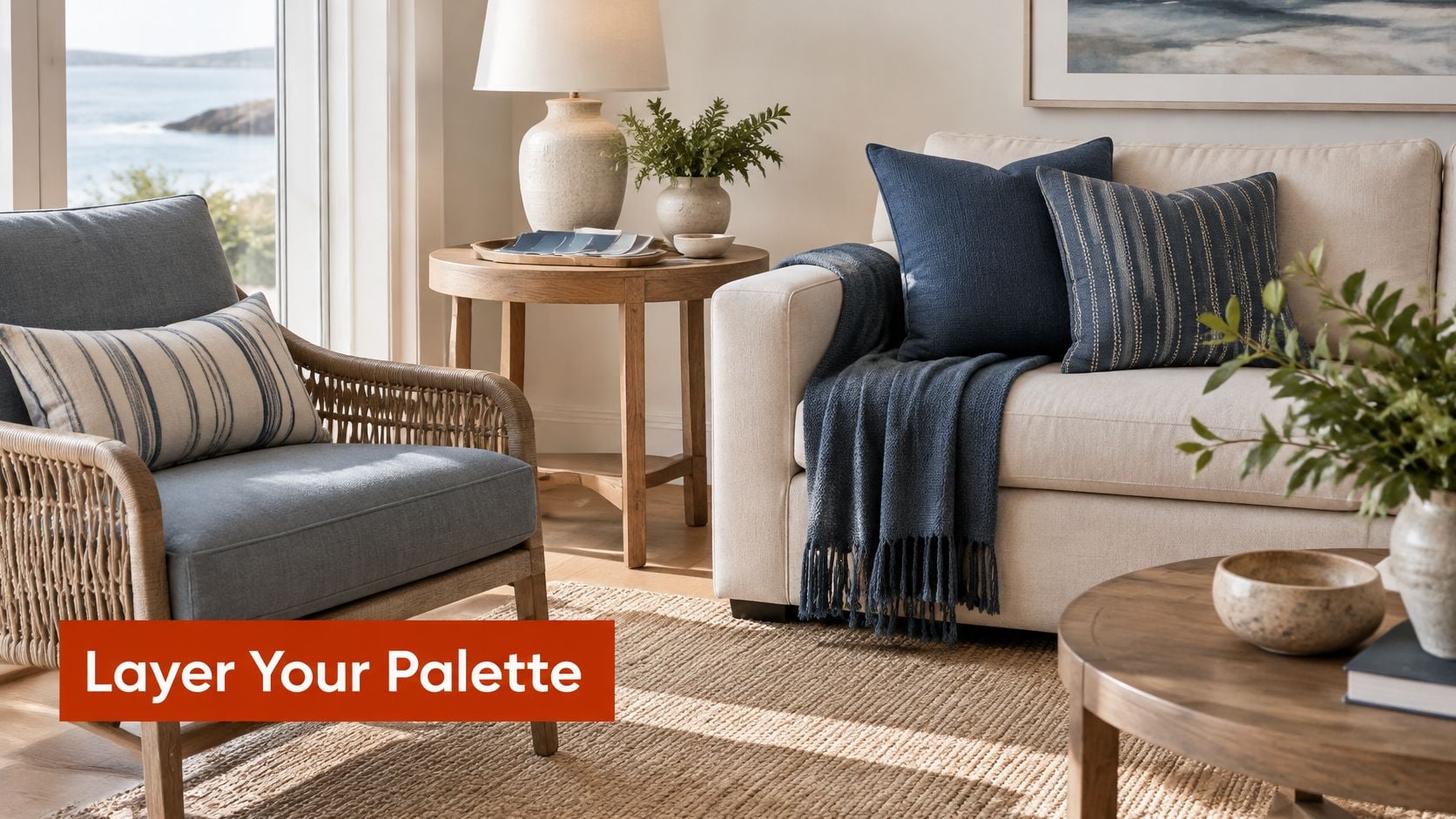
Start with a neutral base in the sofa and rug: oat, sand, ivory, greige. Add one supporting tone from the coastal range, whether sea glass, muted sage, or soft blue, carried through pillows or art. Then let the chair hold a single accent so it reads as deliberate rather than accidental.
Finish coordination follows the same logic. A natural wood chair sits comfortably beside driftwood-toned tables. A polished metal base pairs with glass tops and lighter upholstery. Mixing species is fine; mixing undertones is what looks off.
Three checks before you commit.
- Hold the swatch against the sofa in morning and afternoon light. Florida sun shifts color across the day and a fabric that reads warm at nine can read grey at four.
- Set the sample on the floor next to the wall paint. Upholstery that looks right against the sofa can fight the flooring.
- Decide warm or cool, then stay consistent. A cool grey-blue chair in a room full of warm creams will always look like it arrived from another house.
Build the vignette once the chair is chosen: the chair, a side table, a lamp with a woven shade, and a textured throw. It gives the corner a purpose instead of leaving a lonely seat. If the room is a short-term rental, turning your home into a profitable Airbnb covers the operational side; the design side is about a chair that photographs well and survives guests.
Heirlooms don't have to be excluded. Existing heirloom pieces, cherished antiques, and items you already own can be worked into a new design alongside fresh custom furnishings, and the design team plans projects that range from a single accent chair to full-home furnishing.
Testing Comfort and Ergonomic Fit Before You Buy
A chair is judged by the body in it, not by the dimensions sheet. Seat height, seat depth, backrest height, and recline angle interact, and no single number decides comfort. A computational human-factors study on seating found that medium seat-pan height and depth combined with a medium or high backrest produced the lowest compressive loads on lumbar joints. It also found that adjusting seat or backrest inclination alone doesn't reliably reduce spinal loading unless the other variables move with it.
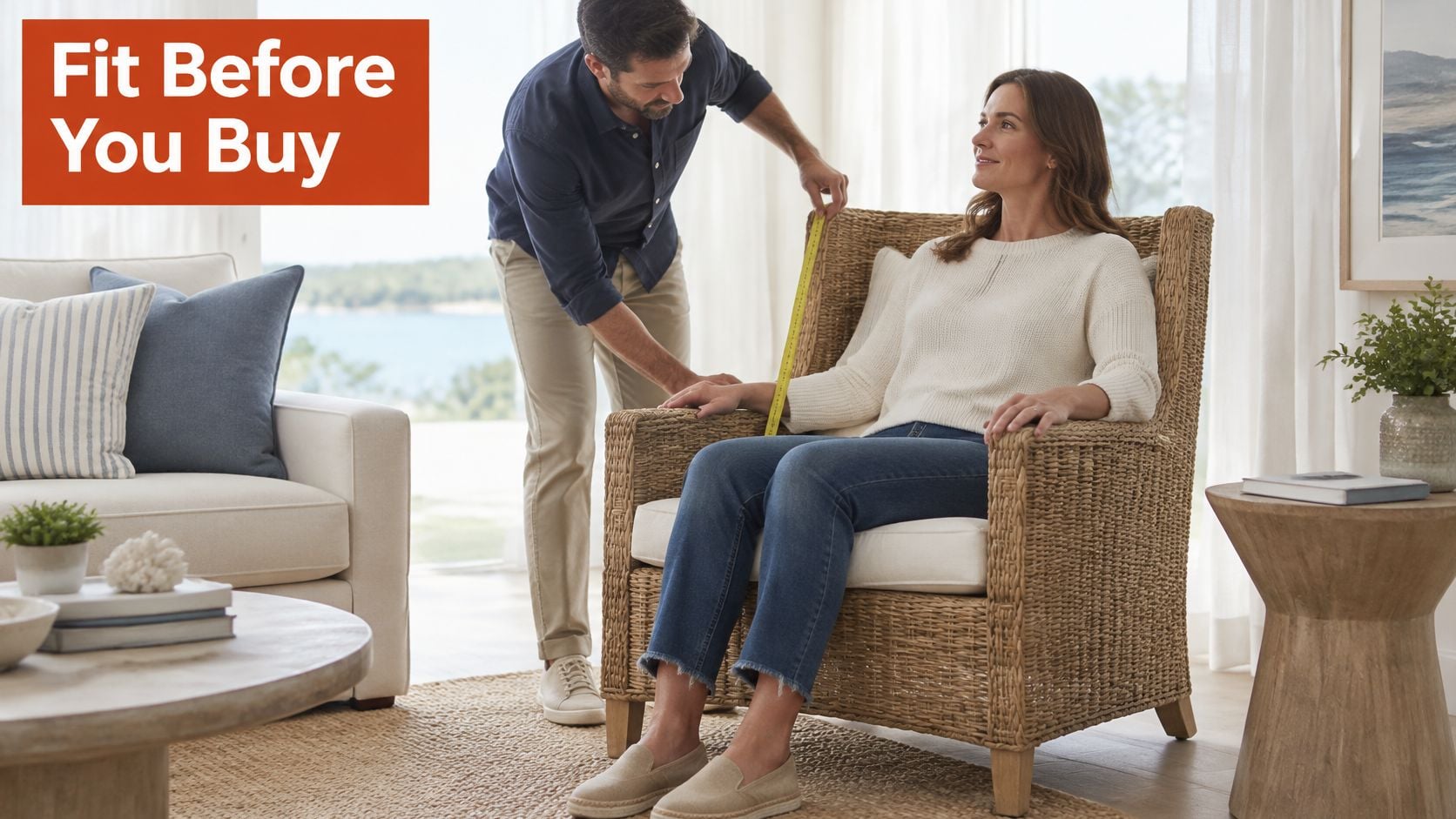
That's why the showroom sit test matters more than any online spec. Sit all the way back. Feet flat on the floor, no pressure behind the knees, pelvis supported without sliding forward, lower back in contact with the backrest. Stay there for several minutes, because the first thirty seconds tell you about softness and the next five tell you about support.
The deep beach-house seat is the trap. A relaxed, deep silhouette can push a shorter sitter into a perched posture on the front edge, and that posture gets painful during a long movie. Go too far the other way and an upright, shallow seat fatigues you during an afternoon of reading.
For older adults and anyone with mobility limits, the priorities shift. Look for a seat high enough to rise from without strain, arms that give a stable push-off point, and a firm rather than sink-in cushion. A swivel is fine if the base stays steady under a hand. In a household with a petite reader, a tall adult, and someone using a cane, choose moderate geometry over an extreme one, because one universal best chair doesn't exist.
Every sofa, recliner, and chair on our floor is personally hand-tested by ownership before it enters a customer's home. Every depth, pitch, and cushion density has been sat in, evaluated, and approved. That's the standard we'd want you to hold any chair to, whether you buy it here or elsewhere. If swivel seating is on your shortlist, our swivel fabric chair selection is worth sitting in before you decide.
The five-point check: feet flat, back supported, arms usable, rise without help, conversation comfortable. Fail any one and keep looking.
Judging Frame Strength and Upholstery Quality
A chair that rocks in the showroom will wobble in your family room within a year. Fabric fades and cushions soften, but most chair failures begin at the joints, so read the construction before the styling.
Joinery decides how a frame handles repeated loading and side-to-side stress. Mortise-and-tenon connections create a mechanical interlock with broad wood-to-wood contact, which resists racking better than assembly held together by screws alone. Run this inspection on any floor model.
- Rock it gently. Side to side, then front to back, and listen for creaks.
- Check the leg attachment. Legs should fasten into reinforced structure, not just into upholstery panels.
- Press the seat deck. It should sit on a rigid platform or properly tensioned webbing.
- Look at the corners. Flush rails and tight corner blocks signal a frame built to stay tight.
The forces only grow once real people drop into the chair every day, which is why a busy household or a rental demands a tighter frame than a guest room does. If you want to see how a visible frame goes together before you shop, our guide to exposed wood frame sofas walks through what to look for.
Then ask for the test basis. The BIFMA standards summary notes that ANSI/BIFMA X5.4 covers structural adequacy, stability, strength, and durability for indoor public and lounge seating, while ISO 7173 provides structural-strength and durability test methods regardless of material or construction method. Residential chairs aren't automatically required to meet either, but the framework is a useful benchmark, and the revised lounge-seating standard raised the basis weight from 253 to 275 pounds and the multi-seat durability test load from 225 to 240 pounds. Ask whether static seat, backrest, arm, leg, stability, drop, and cyclic durability tests were performed, then request the user-weight rating and warranty exclusions.
Ask for the paper: a published test basis tells you more than any "heavy duty" label on a hangtag.
Hardwood is where your money belongs. The same corner blocks and leg-to-frame joints that absorb the stress first are also what a repair shop can re-glue, refinish, or re-upholster years later, and that repairability is what turns a good chair into an heirloom instead of a curb donation.
Book a Showroom Visit to Sit Test Your Chair
Everything above comes down to one afternoon of sitting. Our 32,000-square-foot Rockledge showroom holds curated coastal vignettes, and the team has furnished Brevard County and Central Florida homes since 1939. Treat the visit like a fitting, not a browse.
Here's how to use it:
- Bring a tape measure and a photo of your room from two angles.
- Sit in each shortlisted chair for several minutes, with the person who will use it most.
- Feel the leathers, touch the solid hardwoods, and compare cushion firmness between your two finalists.
- Walk the coastal vignettes to see how each silhouette reads in a finished room.
- Carry fabric swatches to the windows and judge them in natural light.
- Book a complimentary design appointment for a full-room or whole-home project, so the designer can pull swatches in advance and give the project undivided time.
Design help scales from a single accent chair to full-home furnishings, so the same visit works whether you need one chair or a whole room plan. Full interior design consultations, including scale floor planning, fabric and finish selection, and room styling, are complimentary when you purchase your furniture through us. A uniform in-house delivery team handles unboxing, inspection, and full room setup for a flat $99 within our service area, so the chair lands exactly where the tape said it would. And because seating sits styled into finished coastal rooms rather than lined up in rows, the vignettes themselves do half the evaluating for you.
Choose the chair that passes the sit test, fits the measured footprint, and wears fabric suited to Florida air. Then bring your room photo and tape measure to the Rockledge showroom, sit the barrel swivel, the shelter back, and the cane piece back to back, and tell our design team which one you didn't want to get out of. They will map the footprint against your living room and confirm the fabric spec before anything is ordered. Schedule your complimentary consultation and find the chair that earns its corner.