Schedule your Complimentary Design Consultation


Solid Wood vs Veneer Furniture: How to Choose

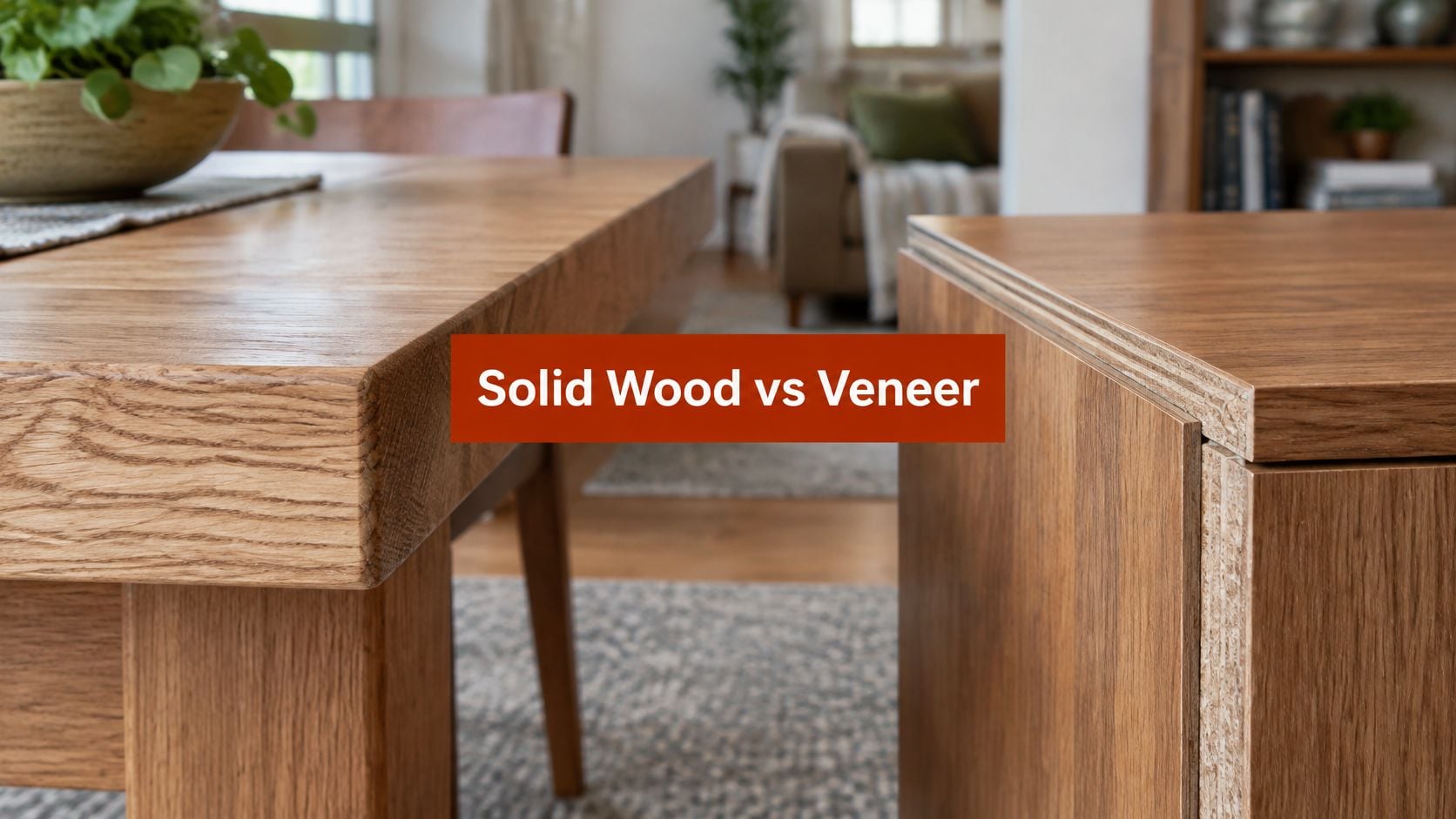
“Always choose solid wood” sounds reassuring, but it isn't a reliable rule for furnishing a coastal home. A beautifully built veneered cabinet can be a better fit for a wide, flat door than a solid board, while a dining tabletop intended for future refinishing may benefit from wood that continues beneath the surface.
The useful comparison in solid wood vs veneer furniture starts with different questions: What's under the face? How does the joinery accommodate humidity? Can the surface be repaired after years of family meals, visiting grandchildren, and everyday use? Those details tell you more about a furniture investment than the material name alone.
What Solid Wood and Veneer Furniture Really Are
Veneer isn't a printed picture of wood. It's a thin sheet of real wood selected for its color and grain, then bonded to a supporting core. Solid wood means the component is lumber through its thickness, whether it's a single board or several boards joined edge to edge.
Say you're standing beside an oak dresser. The drawer fronts have warm, flowing grain, the sides feel smooth, and the top has a substantial edge. None of those observations alone tells you whether the entire dresser is solid oak, oak veneer, or a thoughtful combination.
Follow the Grain Around the Edge
Start where the broad surface meets an exposed end. On a solid component, you may see end grain, the small pores and growth structure revealed when wood is cut across its fibers. Along another edge, the grain should make sense in relation to the face.
An exposed plywood edge shows thin layers. Fiberboard and particleboard usually sit behind edge banding, so a finished edge may conceal the core completely. Don't treat a convincing edge as proof, and don't pry at a seam to investigate.
- Look underneath: An unfinished underside or accessible panel edge may reveal construction more clearly than the polished face.
- Open a drawer: Examine the connections, drawer bottom, and movement rather than judging only the decorative front.
- Confirm the specification: Oak, walnut, and cherry identify a species, not necessarily the material throughout the piece.
Mixed Construction Can Be Intentional
A dining table might combine solid legs and aprons with a veneered top. A cabinet might use solid rails around broad veneered panels. Each material can serve a different purpose without making the piece less authentic.
Our guide to choosing hardwood for longevity and style helps separate species characteristics from construction choices. For quality, look beyond the wood name to joinery, finish, sealed edges, and suitability for daily use. The comparison below gives those observations a practical framework.
Solid Wood and Veneer Compared Side by Side
Solid wood and veneer at a glance
| Feature | Solid wood | Veneer over a stable core |
|---|---|---|
| Visible material | Sawn lumber through the part | Thin real-wood face with authentic grain |
| Typical core | Solid boards or edge-glued lumber | Plywood, MDF, or particleboard |
| Seasonal movement | Greater across the grain | Lower when core layers cross |
| Best surfaces | Tops, legs, rails, heirloom cases | Wide doors, sides, and large flat panels |
| Hand feel | Weight, end grain, and continuous figure | Species color and grain on a flatter panel |
Use this table to match each construction to the part it will serve. A table leg and a broad cabinet door do different jobs, so the construction that suits one may differ from the other.
Solid wood offers continuity between a shaped edge and the surface above it. The figure follows the wood around a rounded corner, and end grain appears where a tabletop is cut to length. Veneer lets a maker arrange grain deliberately, matching patterns across a pair of doors or laying a decorative figure across a wide panel that solid lumber could not cover in one piece.
The Surface and the Structure Are Different Decisions
In a plywood core, each layer is laid with its grain crossing the layers beside it, so every ply holds its neighbors in check. That crossed construction gives broad veneered panels their stability. The USDA Forest Products Laboratory also notes that a properly prepared glue joint can be as strong as the wood it joins under ordinary service conditions.
Adhesive belongs in well-made furniture of both constructions. Makers rely on it in solid edge-glued tops, laminated components, and veneered panels alike. The useful questions are how well the surfaces were prepared, how tightly the parts fit, and whether the joined materials suit each other.
A carefully built plywood-core veneer piece can outlast a poorly joined solid-wood piece. A thin face over a weak core can fail even when its grain looks beautiful.
A smooth surface can sit on either construction. Much of what your hand registers is the finish system: its sheen, its texture, and how thoroughly the grain has been filled. Weight misleads for the same reason, because a substantial engineered panel can feel reassuringly heavy.
Judge the Whole Assembly
Look for even door gaps, drawers that operate without scraping, and joints that remain steady under ordinary handling. Feel along the edges for rough transitions or lifting, and sight across the top under angled light. Attractive grain deserves sound support beneath it.
A moisture meter beside coastal furniture is a useful reminder that the room matters as much as the surface.
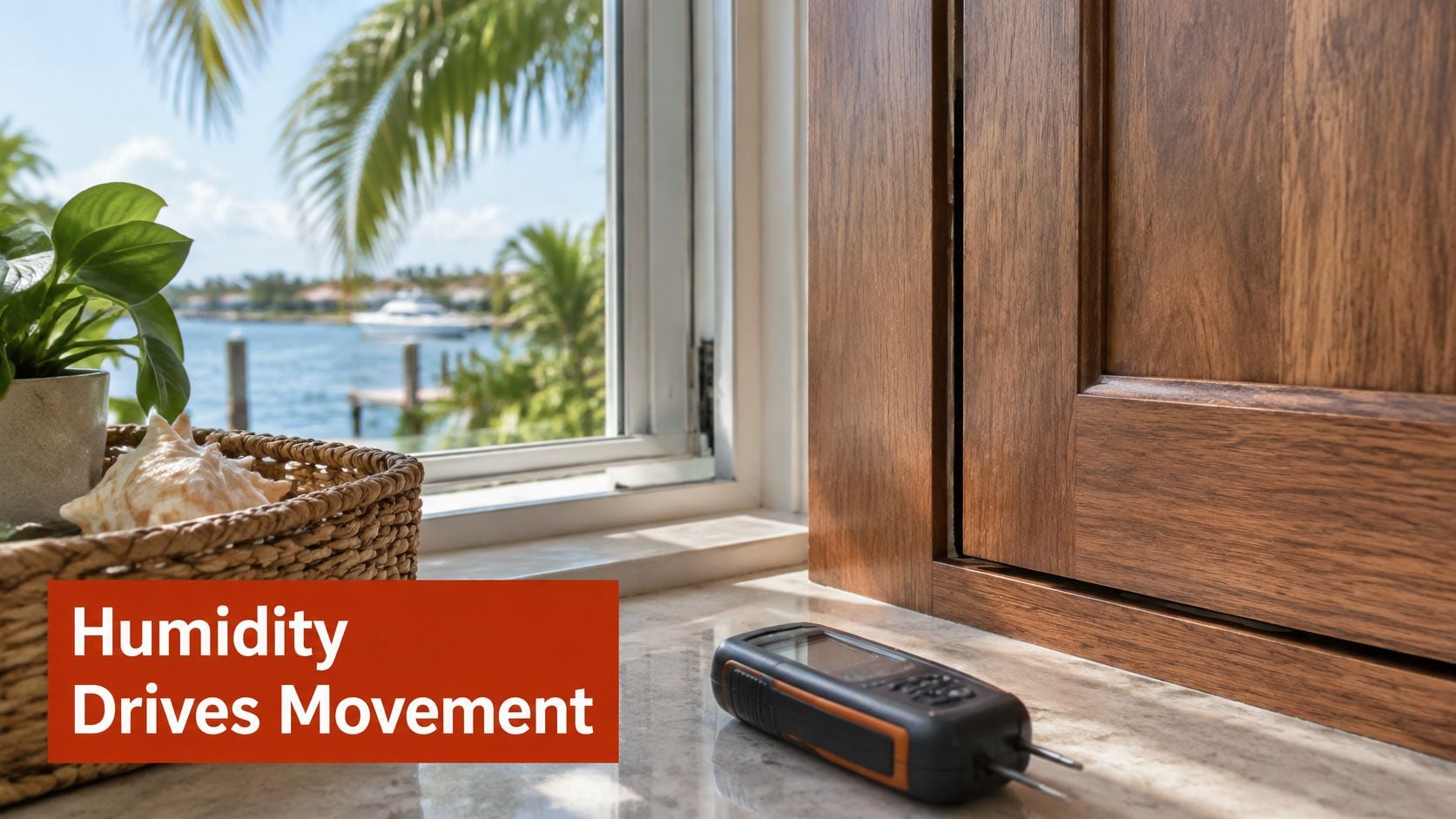
For a dining top, the ability to sand and refinish years from now in a humid coastal home may outweigh the appeal of one uninterrupted panel. For a tall door, staying flat and square inside its opening may matter more. The face tells you which species you are looking at; the construction underneath tells you how the piece will live.
How Florida Humidity Moves Each Construction
Wood shrinks and swells unevenly, and the direction of that change explains most construction choices. Across the full change from fiber saturation to oven-dry conditions, wood's tangential movement is approximately 6–12%, radial movement is about half as much, and movement along the grain is generally less than 1%, according to the USDA Forest Products Laboratory's wood-moisture guidance. Those endpoints describe wood at its wettest and driest possible states, so actual seasonal movement inside an air-conditioned home is much smaller.
The practical lesson is directional. A board works like a sponge across its width, swelling as it takes on moisture and shrinking as it releases it, while its length stays nearly still. A wide solid tabletop therefore needs attachments that hold it securely while permitting that width change. Restrain the panel rigidly around its perimeter and the seasonal pressure has nowhere to go, which can push the top into a cup, open a joint, or start a split.
What That Means for a Table and a Door
Under a well-designed solid top, you may find slotted attachment points or tabletop fasteners. Slotted attachment points let the top expand and contract across its width while staying anchored to the base. The hardware looks loose by design because it is loose by design, and that engineered give is what keeps natural wood serviceable for decades.
A broad veneered door relies on a different strategy. A stable engineered core resists the seasonal movement that could push a wide solid slab out of square, helping the door keep its shape and clearance within the cabinet opening. That advantage depends on sound bonding and appropriate moisture conditions during manufacture, since a stable core cannot rescue a poorly made panel.
The illustration below shows how humidity moves through a Florida home's building envelope, useful context for the room your furniture lives in.
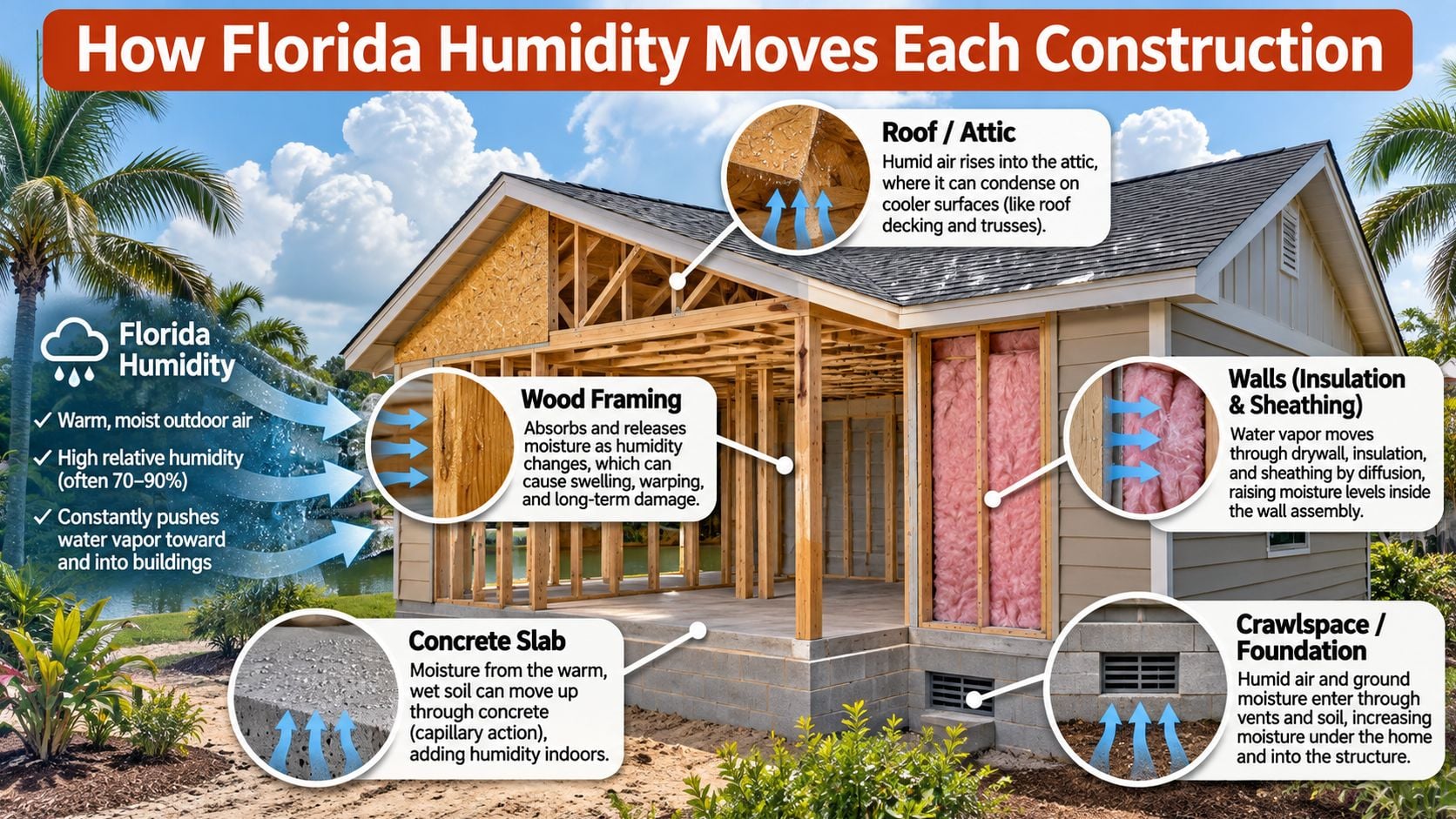
The USDA's guidance on moisture control during fabrication recommends approximately 7–9% moisture content for furniture hardwood lumber, while recognizing that coastal service conditions may require a higher target. The same guidance explains that veneer can buckle or crack when the face and substrate carry mismatched moisture contents at the time of bonding. In a coastal home, the core under the veneer matters as much as the veneer itself.
Make the Room Part of the Specification
Consistent indoor humidity and proper acclimation before assembly matter more than any attempt to make wood impervious to its surroundings. Keep furniture away from persistently damp walls and air-conditioning leaks. A finish slows moisture exchange, and no finish stops it entirely.
- For broad panels: Confirm the core material and whether exposed edges are sealed.
- For solid components: Look for joinery and attachments designed to accommodate movement.
- For visible seating frames: Consider how rails and joints share seasonal stress, as an exposed wood-frame sofa illustrates in a piece built for daily use.
Homeowners repainting interior trim run into the same principle from the finishing side. Alex Trend Painters' explanation of letting timber dry before priming carries over to furniture, because coating over damp wood traps moisture the wood still needs to release.
The simplest starting point costs very little. Set a hygrometer in the room, watch the relative humidity for a week, and let those readings guide the core choice, attachment design, and placement of any piece you expect to refinish and keep for the long term.
Wear, Refinishing and Everyday Care
Sanding depth is the clearest repair difference. A solid top carries real thickness beneath a scratch, while a veneered top gives you only its decorative face, a slice thin enough that careless sanding can pass straight through it. Veneer scratches can still be repaired; the face demands a more cautious approach. Every pass of sandpaper spends material, so the question is always how much material remains to spend.
Damage type decides the repair, not the construction label. A mark confined to the finish calls for a touch-up with a matching stain-and-topcoat; sanding into the wood would exceed the damage. A deep gouge, a damaged edge, or a swollen core sits below the finish entirely, and removing more surface only widens the problem. Identify which layer holds the damage before refinishing anything.
Preserve the Repair Margin
Solid wood tolerates repeated refinishing within limits: heavy sanding still softens molded profiles, alters dimensions, and can expose joinery. Veneer leaves far less room. Aggressive sanding cuts through the face into the substrate, and the resulting patch resists blending even under a matched stain. Where a solid plank can support several lifetimes of renewal, a thin veneer face leaves little margin for even one aggressive refinish.
The USDA-hosted guidance on wood finishes and moisture supports conditioning components near expected service conditions and cautions that thin veneer responds rapidly when moved from roughly 40–50% relative humidity into drier or wetter surroundings. Surface care and environmental care belong together.
The refinishing decision therefore comes down to how much face material a repair can remove before reaching the substrate. A thicker or reconstituted veneer face buys more margin than a thin one, though thickness alone guarantees nothing. Confirm the actual face construction and the allowable refinishing depth before committing a piece to decades of use in a humid coastal home.
A Practical Daily Care Routine
- Use coasters and wipe spills promptly. Lift moisture with a soft cloth rather than letting it sit around a glass base or beneath a serving dish.
- Keep furniture away from standing water. A constantly wet sill, leaking planter, or damp floor can expose vulnerable edges and joints.
- Dust with the grain using a clean microfiber cloth. A lightly damp cloth followed by a dry pass lifts the film that dry dusting merely smears. Apply any cleaner to the cloth, never directly to the surface, and skip abrasive or waxy products that leave residue behind.
- Add protective pads. Place them beneath lamps, bowls, and serving pieces so grit and hard bases don't drag across the top.
- Confirm repair details before choosing a heavily used surface. Establish the core, edge-banding method, finish-repair policy, and how much sanding the face permits.
Our guide to protecting wood furniture from scratches and stains covers everyday prevention in more detail. Small habits demand less intervention than restoring a neglected finish.
Care rule: Neither solid wood nor veneer belongs where liquid water or sustained soaking is expected.
A well-sealed plywood-core panel suits large doors and sides that never need deep surface restoration. A piece intended for renewal years from now deserves a deliberate conversation about repairability.
The Core Under the Veneer
Two veneered dressers can share the same grain pattern and behave very differently, because the core decides how the panel holds screws, resists sag, and accepts repair. Veneer is bonded to several substrates: hardwood plywood in veneer-core or composite-core form, medium-density fiberboard, and particleboard. Establish which one carries the face before comparing anything else.
EPA consumer guidance explains the compliance labeling required for covered composite-wood products sold in the United States since March 22, 2019, including third-party certification of emissions.
Composite-wood emission limits under a veneer, per the EPA's consumer guidance on TSCA Title VI
| Core | Emission limit | What to verify |
|---|---|---|
| Hardwood plywood, veneer-core or composite-core | 0.05 ppm | TSCA Title VI label and sealed edges |
| Medium-density fiberboard | 0.11 ppm | Core disclosure and edge banding |
| Thin MDF | 0.13 ppm | Whether a thin panel is used in doors or backs |
| Particleboard | 0.09 ppm | Edge sealing and moisture exposure |
What the Label Does and Doesn't Establish
The rules cover finished furniture containing regulated composite wood, not just unfinished panels. The label certifies emissions alone. Drawer hardware quality, joint strength, and an exposed edge's resistance to water all sit outside its scope, so a compliant panel still deserves a hands-on inspection.
The three cores diverge most sharply at the screw. Hardwood plywood grips fasteners across alternating grain layers, so hinges and drawer glides stay tight through years of use and even disassembly. MDF's uniform fiber holds well initially but crumbles if a screw is reset repeatedly, and a swollen edge cannot be sanded flat again. Particleboard offers the lightest hold; a stripped hole there usually means a larger screw, an insert, or filler rather than a simple repair. For cabinetry projects that extend beyond freestanding furniture, Jennifer Gilmer Kitchen & Bath's discussion of solid wood cabinet door choices adds context for evaluating door materials. For a custom hardwood dining table, focus the discussion on the top's construction and intended maintenance.
Material Efficiency Needs Context
A comparative furniture carbon-footprint study reported 16.5 kg CO2-equivalent for a solid-wood bedside cupboard versus 12.26 kg CO2-equivalent for a same-sized veneer particleboard model, approximately 34.6% higher for the solid piece. That figure measures material efficiency in two specific products.
Substrate, resin, finish, manufacturing energy, transportation, and service life all shape the outcome. Veneer conserves high-grade timber; solid wood offers more opportunity for future restoration. In a humid coastal home, ask how the edges are sealed and whether a loose hinge or swollen corner can be repaired. That answer usually reveals more than the species name on the tag.
Which Pieces Belong in Which Rooms
Start with what each piece must endure. In a Brevard County dining room, a tabletop may support serving platters, school projects, and regular gatherings. Solid wood or a thick, documented repairable face is a sensible preference when future refinishing matters.
A dresser door has a different assignment. It needs to remain flat, align with neighboring fronts, and open without rubbing. A sealed plywood-core veneered panel can serve that role beautifully without requiring the material depth of a tabletop.
Match Construction to the Job
For legs, stretchers, and bed rails, favor solid hardwood with well-fitted, time-tested joinery. For a media console near a bright window, give the finish and protected edges as much attention as the species name. Placement shapes the answer: electronics concentrate heat, sunlight fades exposed faces, and frequently handled surfaces wear fastest.
Upholstered seating follows a separate logic from case furniture. Our furniture offerings include solid wood construction and eight-way hand-tied springs, yet a spring system belongs to a sofa or chair, not to a dresser. Judge fabric, cushioning, and frame construction each on their own merits. A comfortable seat tells you nothing about how a cabinet is built.
Ask of any piece: what sits under the veneer, how the construction lets wood move, and whether it must be refinished years from now in a humid coastal home.
Plan for the Room You Use
An heirloom cabinet intended for the next generation deserves visible craftsmanship and a finish that can be renewed. We carry the heirloom solid-wood American cabinetmaker Stickley, a meaningful option for homeowners who value that tradition. That standard also fits our ownership's stated commitment: never sell a piece of furniture they would not proudly place in their own home.
For a quieter coastal bedroom, combine functional storage with restrained textures and comfortable proportions. Our bedroom furniture design guidance helps with the furniture plan, while SouthShore Fine Linens offers complementary ideas to create a coastal bedroom vibe. Styling should support the room's use rather than conceal compromises in fit.
Construction to choose by piece
| Piece | Lean toward | Why it fits |
|---|---|---|
| Dining table top | Solid wood or thick repairable veneer | Repeated contact and future refinishing |
| Table legs and aprons | Solid hardwood | Strength and visible joinery |
| Dresser or cabinet doors | Sealed plywood-core veneer | Large panels that should stay flat |
| Case sides and backs | Stable veneered panel with sealed edges | Less need for deep sanding |
| Media console | Either, after checking finish and edges | Heat, light, and daily contact |
| Heirloom case or cabinet | Solid wood with a renewable finish | Grain continuity and long repair life |
| Upholstered seating frame | Solid hardwood frame | Judged separately from case wood |
Bring this shortlist to the showroom alongside room measurements and notes about daily use. It gives your design conversation a clear starting point without forcing every piece into the same material category.
Hand-Test the Choice in Rockledge
A photograph can show grain color. It cannot tell you how a drawer travels, whether a chair supports your posture, or how a finish feels beneath your hand. Those are good reasons to make the final decision in person.
Established in 1939 in Rockledge, Florida, Indian River Furniture serves Brevard County and Central Florida from a 32,000-square-foot showroom of curated coastal vignettes, so you can judge materials in the context of a complete room.
Give the Furniture a Practical Test
Start with the moving parts. Open a drawer and watch how it tracks, then sight along a cabinet door to check that it hangs true. Compare an exposed solid end with a banded panel edge, and ask what core sits beneath the veneer on any wide surface. In a humid coastal home, look for the allowance for wood movement in how the top is attached and the panels are framed.
The same hands-on method applies throughout the showroom, including the mattress gallery.

Our No Blind Ordering promise starts with ownership hand-testing every seat, sofa, and recliner for pitch, structural integrity, and comfort before it reaches the floor. The stated standard is to never sell a piece the owners would not proudly place in their own home. You can make your own assessment with the team's guidance, touching solid hardwoods, feeling leathers and performance fabrics, and comparing cushion firmness.
Bring the Whole Room Together
For a full-room project, schedule ahead so the in-house designers can prepare swatches. Full interior design consultations, including scale floor planning, fabric and finish selections, and room styling, are completely complimentary when you purchase your furniture through us. The team can also incorporate heirlooms you already own into the new plan.
Our in-house delivery team handles unboxing, inspection, and room setup for a flat $99 within our service area.
The decision comes down to what your hands can verify: the core under the veneer, the room left for the wood to move, and whether the surface can be renewed years from now. Test the drawers, the doors, and the cushions, and let the construction answer for itself.