Schedule your Complimentary Design Consultation

Top Grain vs Full Grain Leather: Which Fits Your Home


You're choosing a sofa for a bright Florida living room, and the leather samples both feel lovely. One has a softly irregular grain and a few natural markings. The other looks smoother, with an even color that would sit beautifully beside your pale oak tables and coastal textiles.
Then you turn over the samples and find full grain on one and top grain on the other. The useful question isn't which label ranks higher. It's which leather will feel comfortable, age gracefully, and fit your household's lifestyle.
Top Grain vs Full Grain at a Glance
Full grain keeps the hide's original grain surface intact, while top grain identifies the upper hide layer, usually sanded or buffed and finished in furniture retail terminology. Both can make excellent upholstery, but the surface treatment changes what you'll notice when you touch, clean, and live with the piece.
The everyday distinction is summarized in the Leather Industries of America's explanation of full-grain and top-grain leather. The comparison below describes corrected, finished top grain, not every leather carrying a top-grain label.
Full grain and top grain at a glance
| Feature | Full Grain | Top Grain |
|---|---|---|
| Surface | Original grain left intact | Upper hide layer, usually sanded or buffed, then finished |
| Natural marks | Scars, pores and growth lines stay visible | Largely corrected for an even appearance |
| Texture | Varied and naturally tactile | Smooth and even, often lightly embossed |
| Patina | Develops richer tone and sheen with handling; sunlight can also alter color | Changes less, with a more consistent color |
| Spill response | Less-protected finishes absorb more readily and can show water marks | Protective finish resists spills and scuffs better |
| Color across a set | Natural differences from hide to hide | Easier to match across pieces |
| Care approach | Gentle cleaning and periodic conditioning when approved; avoid persistent dampness | Routine wipe-down with approved products; follow the finish maker's care label |
Choose the aging experience you want
Full grain rewards someone who enjoys individual character. A subtle crease or tonal difference belongs in the design rather than looking out of place. Finished top grain is a sensible choice when you prefer a polished appearance and more forgiving everyday cleanup.
Neither description tells the entire story. Full grain can receive protective finishing, and top grain can receive different degrees of correction. Ask about the actual surface rather than assuming that natural means unprotected or smooth means artificial.
Practical rule: Choose the finish for your routine, then choose the grain character you'll enjoy seeing every day.
Also keep this comparison separate from bonded leather vs genuine leather. That's a different material question, not another name for the choice between these upper-hide leathers.
For a sunlit, humid Florida home, how the piece will live matters more than the label alone. A side-by-side visit to our Rockledge showroom lets you compare the surfaces against your own expectations for comfort and appearance.
How Processing Shapes Texture and Patina
A recliner arm shows how processing affects leather over time. On a lightly protected full-grain surface, repeated contact from a hand or forearm can create a softer sheen and localized darkening. The area you touch most may look different from the outside back.
Follow the hide from structure to surface
Processing decisions shape what you see and feel. After tanning, a hide may retain more of its natural surface character or be corrected for a more even appearance.
Preserve the surface. Full grain retains its original grain face. Pores, growth lines, healed scars, and wrinkles remain visible features of the material.
Correct for greater consistency. Sanding or buffing reduces visible scars, brands, and insect marks. Dye, pigment, and sometimes an embossed pattern can help create a more coordinated look across upholstered panels.
Choose the finish. A protective topcoat changes how the surface responds to liquids and everyday contact. Surface correction and finishing are separate choices, so ask about each.
The relationship between mechanical correction, embossing, and finishing is explained in this guide to leather grain and surface processing. Natural markings create variation; correction and pigment can make a set look more uniform.
The image below uses copper objects as a visual analogy for changing surface texture and patina. It isn't a depiction of leather processing.
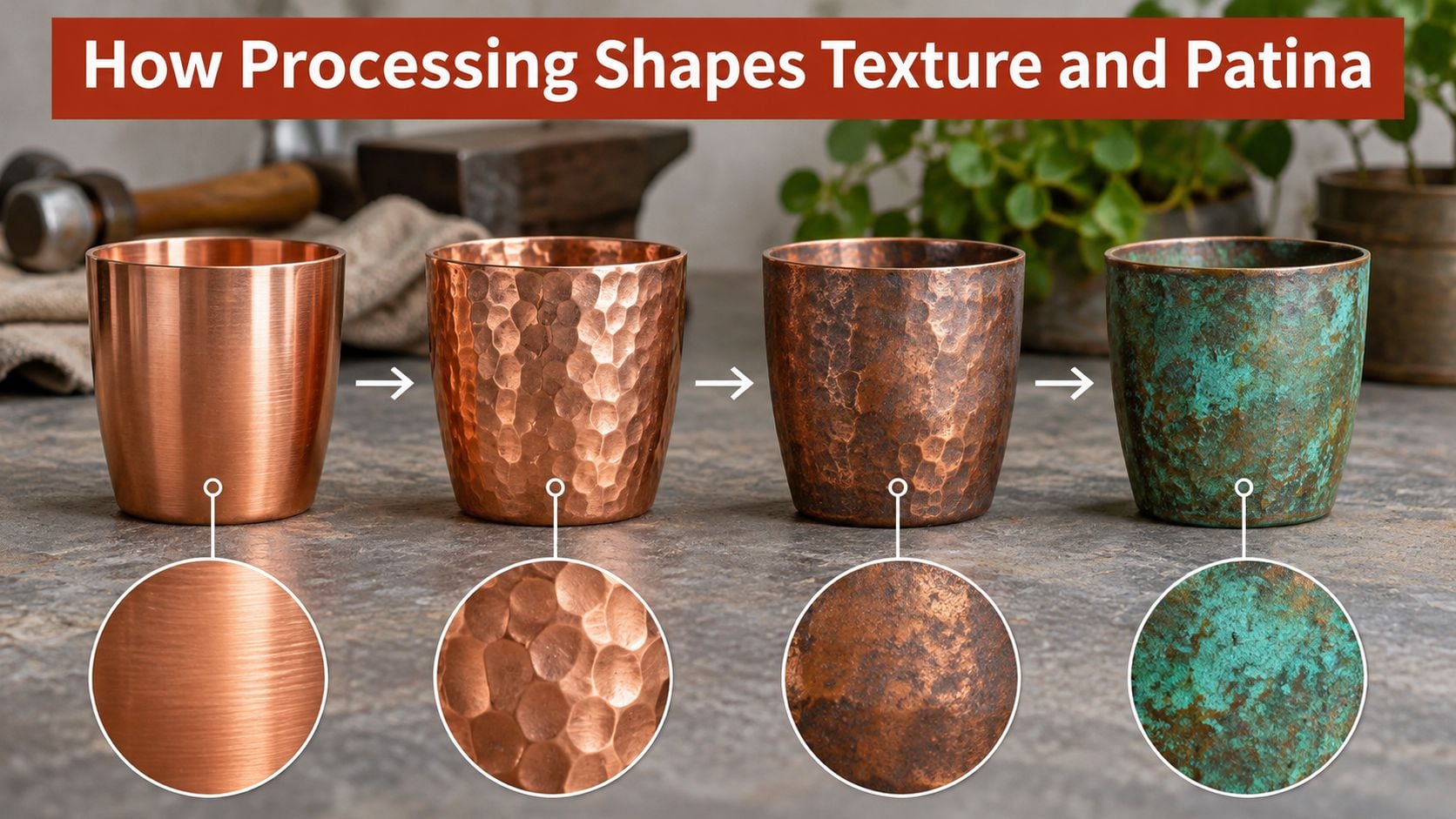
On a recliner in corrected, pigmented leather, the coating can help maintain a more even appearance. Frequent contact may eventually wear the finish, so consider how the piece will be used and cared for.
A dining chair back gets repeated handling too. On full grain, that concentrated contact can become part of the leather's character. On a coated surface, the finish helps preserve a consistent look. Full grain suits someone who enjoys natural variation; a more uniform finish may suit a household that prefers a coordinated appearance.
Sunlight can change leather color, but uneven fading and heat damage are not desirable patina. Keep either type of leather out of harsh sun.
Use your hands before choosing your finish
A photograph shows color, not whether a leather feels supple, slick, or pleasantly textured. Rest your palm on a sample, then move your hand across the grain without scratching it. Look at a broad upholstered panel as well as a small swatch. Natural markings and embossed patterns are easier to assess at furniture scale.
For a beige leather sectional, the large, pale surface becomes part of the room's visual rhythm. Decide whether you prefer gentle tonal variation or a more uniform backdrop for pillows, rugs, and artwork.
In the Rockledge showroom, you can feel leathers, touch solid hardwoods, and compare cushion firmness levels. Consider those elements together: a surface you like still needs to work with the seat's comfort and support.
Durability and Wear Benchmarks Compared
A leather seat can remain structurally sound while its surface shows a mark or its finish changes with use. A coating may make everyday cleanup easier, but it does not determine the strength of the hide beneath it.
Tensile strength describes resistance to pulling, tear strength measures resistance to a tear spreading, and flex endurance records repeated bending under test conditions. These figures can help compare materials, but results vary with hide selection, tanning, thickness, finishing, and test method. Without comparable specifications for the upholstery under consideration, a numeric ranking is not a reliable guide to how a sofa will wear at home.
What those tests mean for a working seat
Tensile strength relates to leather stretched around a shaped arm or fitted across a cushion. The result says little about whether the upholstery was fitted with suitable tension or whether its seams are well placed.
Tear strength matters near stitching and other areas exposed to concentrated force. Neither leather grade is claw-proof. A sharp claw can still puncture the hide.
Flex endurance concerns repeated bending. Seat cushions compress and recover, and recliner upholstery moves as the mechanism opens and closes. Laboratory cycles cannot be translated directly into years of household use.
Corrected top grain has had some of its original surface removed, but it still comes from the upper part of the hide. A protective finish can make it a practical choice for a busy home. Full grain may suit someone who values natural variation and accepts that its surface can change with use. The better fit depends on the household's care routine and expectations, not the grade name alone.
Inspect the support beneath the leather
A comfortable, well-supported seat helps the upholstery do its job. Look beyond the covering to cushion resiliency, seam placement, and the frame and spring construction.
Indian River Furniture lists solid wood construction and eight-way hand-tied springs among its furniture features. When comparing a specific piece, ask what performance information applies to its exact leather, and how the material is finished. A test result without its method and product details is a poor basis for predicting everyday wear.
Florida Humidity, Heat and Everyday Care
Florida living rooms face humid summers, strong sun through large windows, and air conditioning that cycles throughout the day. Both full-grain and top-grain upholstery need protection from persistent dampness and concentrated heat.
The preservation ranges and risk thresholds below come from the Canadian Conservation Institute's guidance on caring for leather. They describe conservation conditions, not a requirement to keep your home at museum settings.
Humidity and temperature targets for leather care
| Condition | Effect on Leather | What to Do |
|---|---|---|
| Relative humidity below 30% | Moisture loss and risk of embrittlement | Use a humidifier when needed and keep pieces away from vents and heat sources |
| Relative humidity 45–55% | Stable, preferred range | Aim for this band with air conditioning and steady airflow |
| Relative humidity above 65% | Mold growth and breakdown of leather fibers | Run a dehumidifier, improve airflow, and dry spills quickly |
| Temperature 18–20°C (64–68°F) | Preservation-friendly range | Keep leather away from hot windows and out of direct sun |
Make care gentle and consistent
Use a small indoor hygrometer to understand the room before changing equipment settings. A room that feels cool can still have excess humidity, particularly when a home sits closed between visits.
- Remove loose dust. Wipe with a clean, soft, dry cloth, including seams and the spaces beside cushions. Don't grind grit into the surface with vigorous rubbing.
- Test before cleaning. Apply a leather-approved cleaner to a concealed area first. Let it dry completely and check for color or texture changes.
- Blot spills promptly. Lift liquid with an absorbent cloth rather than spreading it. Allow gentle air circulation afterward, without a hair dryer or direct heater.
- Condition selectively. Condition full grain periodically only with a product approved for its finish. More conditioner isn't better, and some coated upholstery doesn't need it.
- Skip aggressive products. Avoid harsh solvents, abrasive pads, and household degreasers that aren't intended for the leather.
Our guide to cleaning a real leather sofa offers a useful starting point for building that routine. Keep the furniture's own care instructions with your household maintenance supplies.
Plan placement before delivery
Set seating away from sun-heated glass and direct heat sources. Use window treatments during strong exposure, and rotate or exchange cushions where the furniture's construction permits.
Placement advice: A protective finish is helpful, but it isn't permission to leave leather damp or bake it beside a window.
Our selection process screens out pieces with sagging frames, leather that doesn't wear well under Florida sun, or spring assemblies that compromise posture. Even carefully selected upholstery still benefits from sensible room placement and steady environmental care.
Which Leather Suits Your Home and Routine
A family sofa may face damp beach towels, spilled drinks, and frequent use. A quieter formal room has different demands. Choose leather for how the room is used and cared for, not by grade name alone.
Leather choice by household and setting
| Household or Setting | Better Fit | Reason |
|---|---|---|
| Formal living room with few pets | Full grain | Natural character and patina suit low-traffic seating |
| Family home with children or pets | Finished top grain | A more uniform finish can make spills and scuffs easier to manage |
| Vacation rental or condo | Finished top grain | A consistent appearance and straightforward routine care may suit frequent use |
| Heirloom dining chairs | Full grain | Its character can develop with use when the change is welcome and the leather is cared for |
| Humid room with little airflow | Finished top grain or performance fabric | A suitable protective surface can reduce direct moisture exposure, but airflow still needs attention |
For a busy household, start by comparing finished top-grain leathers and their specific care requirements. Full grain can be a satisfying choice if you welcome natural variation and gradual changes in appearance. If marks would bother you, that character may bring more worry than enjoyment.
For quieter seating, full grain may suit a home where its tactile quality and individuality matter. The leather grade alone does not determine how long a chair lasts; joinery, upholstery construction, and regular care also play a part.
In a persistently humid room, address ventilation and moisture first. Leather and performance fabric both need a suitable indoor environment.
Consider performance fabric without apology
If stain resistance matters more than leather's feel, include performance fabric in the comparison. Our leather and fabric upholstery comparison explains the differences in feel and upkeep.
The design assistance questionnaire lets you identify needs such as Kid/Pet-Friendly Performance Fabric, Top-Grain Leather, High-Traffic / Stain Resistant, Hypoallergenic, Easy Maintenance, and Custom Sizing / Modular. These preferences help narrow the choices to materials that fit your household.
Design assistance can cover a single accent chair or full-home furnishings. Designers can help you compare genuine leathers, stain-resistant performance fabrics, and custom wood finishes. Bring photographs of your windows, flooring, and existing furnishings so the discussion can account for light exposure and layout as well as color.
Our in-house delivery team handles final setup and placement. The goal is seating that suits daily life, not upholstery that makes you anxious about using the room.
Confirm the Grade Before You Order
A clear top grain vs full grain leather decision ends with a specification, not just a label. Before approving upholstery, use this checklist to connect the material description to the complete piece.
- Surface treatment. Is the original grain unaltered, lightly corrected, embossed, or heavily finished?
- Finish type. Is it aniline, semi-aniline, or pigmented, and what protection does that particular finish provide?
- Seat construction. How are the frame, suspension, cushions, and seams built for the piece's intended use?
- Care requirements. Which cleaner and conditioner, if any, are approved, and what exposure should you avoid?
- Hide origin. Where was the hide sourced, and what information is available about its processing and traceability?
Sit before you commit
The grade describes the leather, not the whole seating system. Use our guide to reading furniture product descriptions with confidence to turn broad descriptions into useful questions.
Our No Blind Ordering promise means ownership personally hand-tests every seat, sofa, and recliner for pitch and comfort before it reaches our 32,000-square-foot Rockledge showroom. That hands-on evaluation includes the support and proportions you can't judge from a swatch.
You can then make your own assessment among curated coastal vignettes, with our design team helping compare leathers, fabrics, and wood finishes. A well-designed room should suit your body as naturally as it suits your surroundings.
Visit Indian River Furniture in Rockledge with your room measurements, photographs, and a clear picture of daily life at home. Sit in the furniture, compare leather surfaces by hand, and arrange a complimentary in-house interior design consultation. Established in 1939, we've maintained our commitment to Brevard County, the Space Coast, and Central Florida, helping neighbors choose comfort and craftsmanship with confidence.