Schedule your Complimentary Design Consultation


Leather Reclining Sofa and Loveseat Set: 2026 Guide

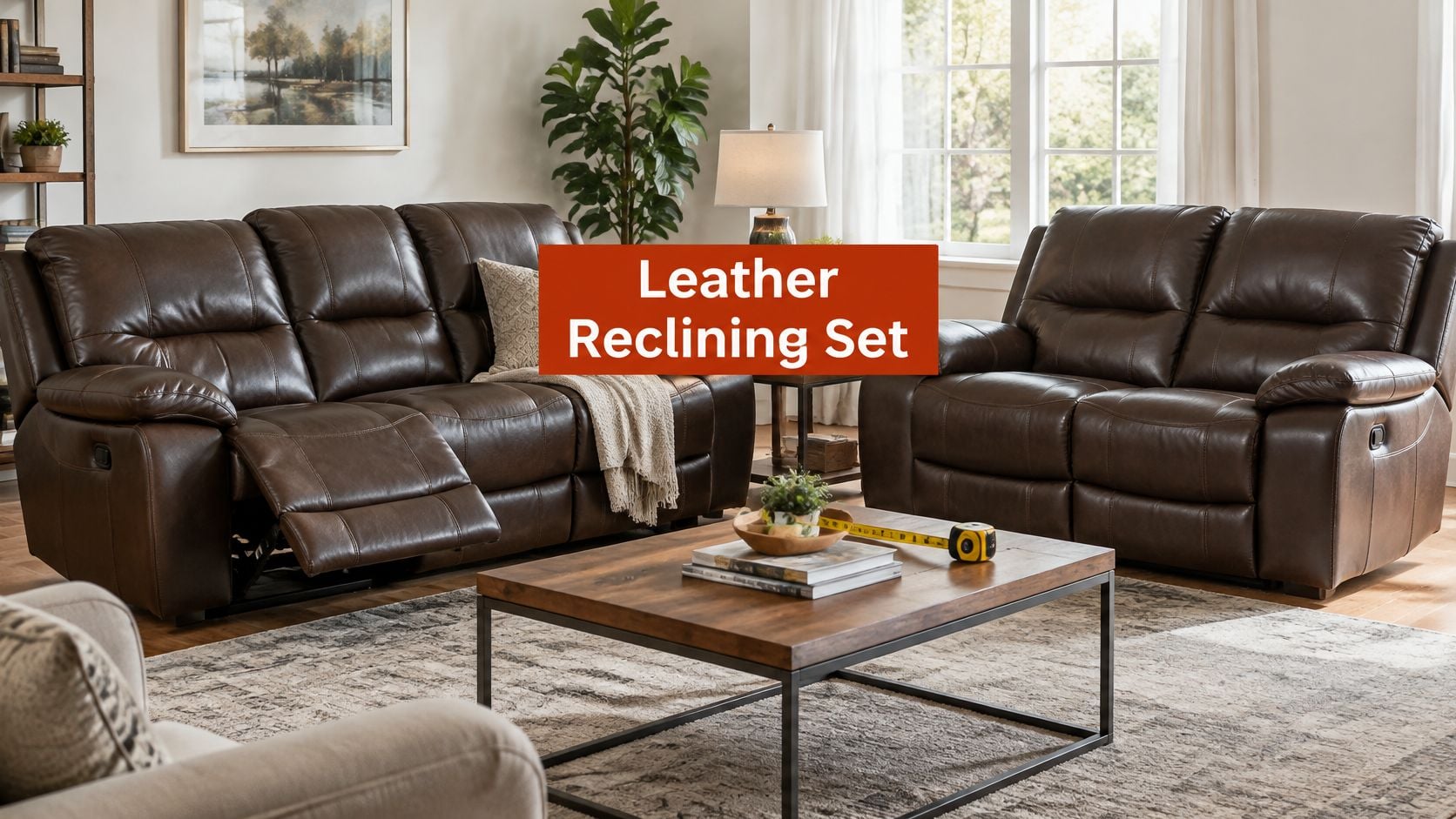
You've found a leather reclining sofa and loveseat set that looks right for your living room. The color works with the floors, the stitching feels refined, and you can already see yourself settling in after a day on the water. Then your partner sits down, reaches for the control, and discovers that the seat that fits you leaves their feet dangling.
That's the purchase to slow down. A matching set should coordinate visually without asking anyone to compromise on everyday comfort. Choose the sofa and loveseat as separate pieces of ergonomic furniture, then bring them together through leather, craftsmanship, and a layout that works in your Florida home.
Five Decisions That Shape a Leather Reclining Set
Say a couple stands between two loveseats in the showroom. One has exactly the warm brown finish they pictured beside their woven rug. The other supports both people properly, but its arms and silhouette weren't what they expected.
My recommendation is straightforward: start with the fit, then refine the appearance. You'll notice an unsupported neck or an awkward footrest every evening. A designer can help reconcile color and proportion without sacrificing the way you sit.

A leather reclining sofa and loveseat set is two seating pieces purchased together, not one comfort decision. Each piece needs to suit every regular user, including the person who usually takes the loveseat when company arrives.
Decisions to settle before shopping
| Decision | Question to settle | Covered in |
|---|---|---|
| Seat fit | Does each seat suit every regular user? | Seat Fit Targets and the Showroom Test |
| Leather grade | Will the finish hold up to daily wear? | Leather Grades and Finishes That Hold Up |
| Reclining mechanism | Manual, power or wall-hugger? | Manual, Power and Wall-Hugger Mechanisms Compared |
| Room and climate | Will the set fit and last in your space? | Room Fit and Humidity in Florida Homes |
| Trial and delivery | Have both seats been tested in person? | Seat Fit Targets and the Showroom Test |
Genuine leather gives a coordinated set its character, from a softly pebbled surface to the subtle variation of a more natural finish. Judge that character by hand, not just under showroom lighting.
At Indian River Furniture, our roots in Rockledge reach back to 1939, with a longstanding commitment to Brevard County and Central Florida families. We encourage a deliberate purchase, beginning with these questions:
- Regular users: Who will sit in each piece most often?
- Daily routines: Is the room for conversation, reading, television, or all three?
- Florida conditions: How will you manage sunlight, humidity, and active coastal living?
Seat Fit Targets and the Showroom Test
Start with dimensions, but let your body make the final decision. The recliner interaction study identifies reference ranges of 40–45 cm for seat height, 15–25 cm for footrest distance, 60–80 cm for legroom, and 65–75 cm for headrest height.
For reclining posture, the functional-recliner assessment and ergonomic discussion provides a 100–110-degree supported-recline range, a 125-degree relaxed reference associated with favorable comfort findings in young adults, and approximately 4 cm of lumbar depth as a support reference. These are starting points, not a prescription for every body.
Seat-fit targets for a reclining sofa and loveseat
| Measurement | Target range from the studies cited above | What it affects |
|---|---|---|
| Seat height | 40–45 cm | Pressure behind the knees and ease of standing |
| Footrest distance | 15–25 cm | Natural foot support when reclined |
| Legroom | 60–80 cm | Full lower-leg support and posture |
| Headrest height | 65–75 cm | Neck support without flexion |
| Supported recline angle | 100–110 degrees | Lower back support when reclined |
| Relaxed recline reference | 125 degrees | Comfort in research on functional recliners |
| Lumbar depth | About 4 cm | Preserving the natural curve of the lower back |
A seat that's too high can press behind the knees and make deploying the footrest feel unnatural. Too little legroom can leave the lower legs poorly supported, encouraging the user to slide forward and slump instead of settling against the backrest.
Test the sofa and loveseat separately
Use this sequence on the sofa first. Wear the shoes you normally wear at home, empty bulky items from your pockets, and give yourself time to settle into the cushion.
Sit upright with your feet flat. Your knees should rest near a right angle without the seat edge digging into the backs of your legs. If you must perch forward to reach the floor, the seat isn't supporting you as intended.
Move your lower back against the backrest. Check whether the lumbar area meets you naturally or leaves a hollow behind your waist. A deep seat can feel inviting at first yet require a shorter user to choose between back support and grounded feet.
Raise the footrest and recline fully. Your head and neck should remain supported without your chin being pushed toward your chest. Notice whether the footrest feels steady, whether your heels have comfortable support, and whether your shoulders can relax.
Operate the mechanism and stand up again. Reach the lever or buttons without twisting. Then return upright and check the effort needed to exit, including whether the armrests provide a useful place for your hands rather than sitting too far back.
Evaluate the cushions and upholstery by hand. Press the cushion and watch how it recovers, then sit again to judge whether it feels resilient or hard. Run your hands over the arm caps and seat fronts, comparing grain, sheen, seam placement, and surface feel across the pieces.
Repeat the complete test on the loveseat. Have another regular user of a different size test both pieces as well. A console, different arm arrangement, or slightly different sitting position can change the experience even within a coordinated collection.
Check the showroom dimensions yourself. Use a tape measure to compare the usable seat depth, seat height, and extended footprint with your notes. Ask where each measurement begins and ends, particularly around padded headrests and footrests.
Choose support rather than an oversized label
A larger seat isn't automatically more comfortable for a taller person. Shoulder support, footrest length, cushion firmness, and the position of the lumbar area all matter, which is why our guide to choosing a larger recliner focuses attention on fit rather than appearance alone.
Practical rule: If either regular user has to rearrange their body to make a seat work, keep testing.
Our No Blind Ordering promise begins before furniture reaches the showroom floor. Ownership personally sits in, evaluates, and approves every sofa depth, recliner pitch, and cushion density, and hand-tests every sofa, recliner, and chair before it enters a customer's home.
That screening doesn't replace your own trial. In our Rockledge showroom, you can feel leathers, touch solid hardwoods, and compare cushion firmness directly. Bring a tape measure and this checklist so your final choice reflects both our evaluation and your own body.
Leather Grades and Finishes That Hold Up
Thicker or shinier leather isn't proof of better durability. A glossy surface tells you something about the finish, but it doesn't tell you how that finish will respond to repeated bending, rubbing, or everyday contact.
Top-grain leather comes from the upper portion of the hide, while split leather comes from the lower layer after separation. Bonded leather is a composite containing leather fibers and binders, not an equivalent substitute for an intact top-grain hide. Even the term genuine leather needs clarification because it doesn't, by itself, identify the leather's construction or protective treatment.
Read the finish, not just the label
Ask whether the upholstery is aniline, semi-aniline, or more heavily pigmented and protected. A more natural surface may offer appealing variation and a soft hand, while a protective finish can make everyday maintenance more manageable. Choose the balance that suits how you use the room.
The leather durability and care-product study discusses Martindale abrasion under ISO 17076 and Taber abrasion under ISO 5470, alongside the importance of flexing, rubbing, and finish compatibility. A surface can resist abrasion yet still crack where a recliner repeatedly bends, so an abrasion claim alone isn't enough.
Inspect the places that receive concentrated contact: seat fronts, arm caps, headrest edges, and footrest areas. Look for even finishing around seams and folds, and confirm which surfaces are leather rather than assuming the back and sides use the same material as the seating areas.
A beautiful grain is worth enjoying. A clearly identified finish is worth understanding before you commit.
Match maintenance to the material
Florida sunlight makes placement and finish performance especially important because prolonged exposure can contribute to fading, drying, and surface deterioration. Incompatible conditioners can also alter a finish, so don't apply a general-purpose leather treatment because its label sounds reassuring.
Our screening standards exclude pieces with sagging frames, leather that doesn't wear well under Florida sun, or spring assemblies that compromise posture. For a tactile comparison, our design team can show genuine leathers and performance fabrics side by side; our leather-versus-fabric upholstery guide also helps clarify the everyday trade-offs.
Before comparing sets, check the specification sheet for:
- Leather category: Identify top-grain, split, bonded, and any matching materials.
- Protective finish: Request the topcoat description and available abrasion, flexing, and rubbing information.
- Care instructions: Obtain written cleaning guidance and the approved cleaner.
- Construction: Confirm frame materials and support details rather than assuming leather guarantees heirloom craftsmanship.
Manual, Power and Wall-Hugger Mechanisms Compared
Reclining mechanisms compared
| Mechanism | Clearance needed | Power need | Best for | Points to check |
|---|---|---|---|---|
| Manual recline | Rear movement clearance plus full extended footprint | None | Simple, dependable operation | Lever reach and exit effort |
| Power recline | Full extended footprint plus safe cord routing | Outlet within reach | Mobility or comfort needs and one-touch control | Controls reachable without twisting and behavior during outages |
| Wall-hugger recline | Less rear clearance because the seat moves forward | None for manual models; outlet for powered models | Rooms where the set sits close to walls | Seat depth and footprint when reclined |
| Mixed mechanisms in one loveseat | Confirm each seat's movement envelope | Outlet for each powered configuration as specified | Households with mixed needs | Coordinated control and care across both pieces |
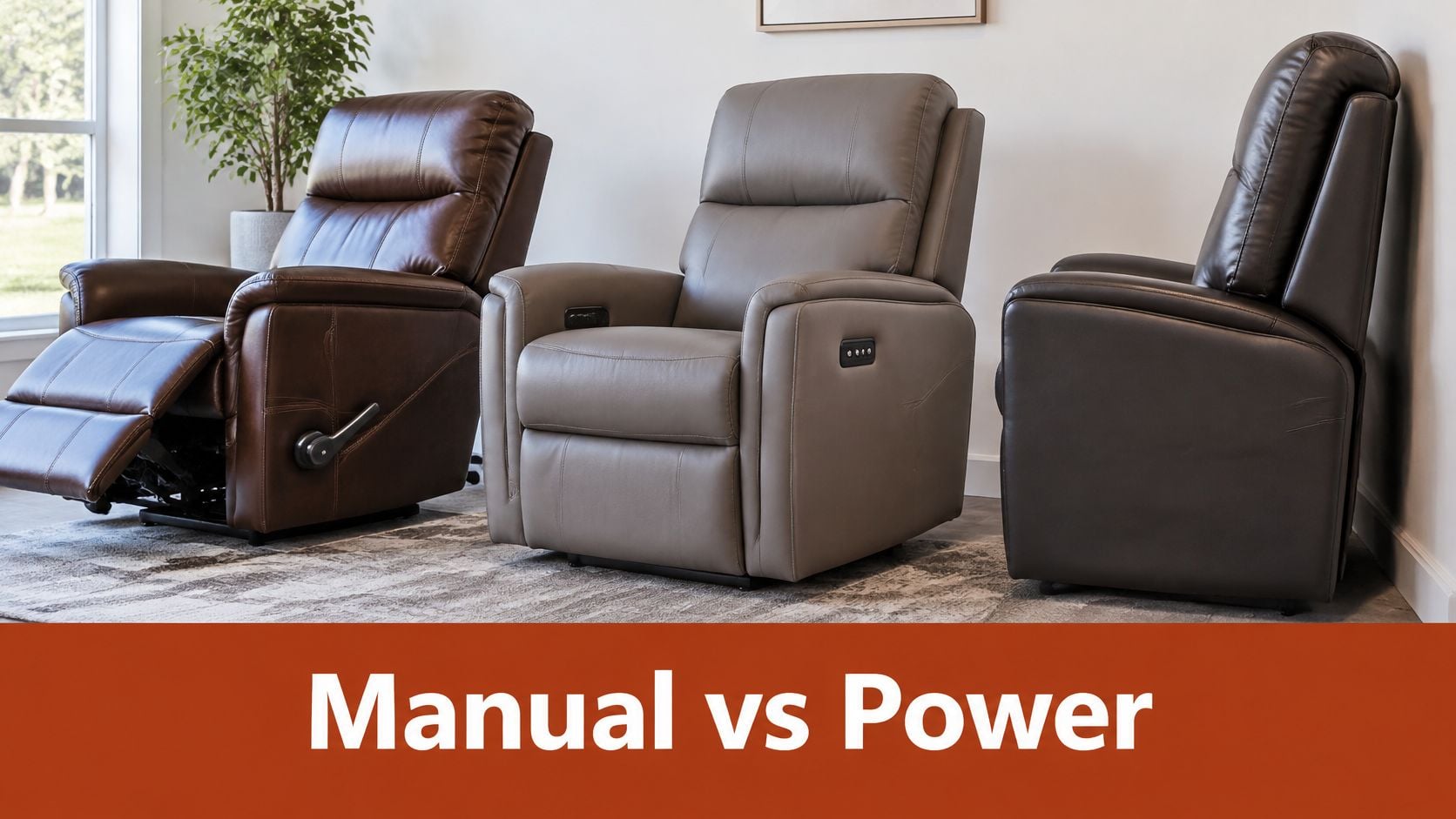
Wall-hugger describes movement geometry, not a separate power source. You can have a manual wall-hugger or a powered wall-hugger, so don't treat those labels as mutually exclusive choices.
Choose the operation your household can use easily
Manual reclining removes outlet placement from the decision. Its appeal is straightforward operation, but the lever may sit low beside the arm, and closing the footrest can require more leg effort than expected. It suits someone who can comfortably reach, release, and close the mechanism without strain.
Power reclining offers controlled adjustment without relying on the same physical push. Check whether the controls require continuous pressure or provide a preset function, and ask what happens if electricity fails while the footrest is raised. It suits users who need easier positioning, provided the specific model also meets their entry and exit needs.
Wall-hugger reclining moves the seat forward as the back reclines, reducing the rear space required. It still needs room in front, and a nearby table can become an obstacle once the footrest rises; our explanation of wall-hugger recliners helps clarify that movement. It suits rooms where rear clearance is tight but the forward footprint remains usable.
Coordinate controls with the whole room
Some collections allow different mechanisms within a loveseat or across the set. Confirm the available configuration rather than assuming every collection offers it, and consider whether matching controls would make daily use and maintenance simpler.
For powered pieces, plan cord routes before deciding where the set will sit. Keep cords away from walking paths and moving components, and check that someone can operate nearby window coverings without stepping around an extended footrest.
That window-access question also matters when coordinating shades with furniture. For readers planning a property in that area, Henson's Designs' Katy window treatment specialists are a relevant resource for discussing treatment access and room planning, not a substitute for testing the recliner itself.
Choose for the person who needs the easiest operation, then confirm that everyone else can use it comfortably.
A motor isn't automatically the right answer, and a manual lever isn't automatically simpler. The right mechanism is the one your household can operate, stop, and exit confidently.
Room Fit and Humidity in Florida Homes
Saturday night, both footrests are up. One person wants the sofa end by the window. The other wants the loveseat facing the TV. If either seat crowds a wall, a register, or the path between them, the set fails the room even when each chair feels right alone.
Measure the sofa and the loveseat as two footprints, fully extended. Mark both with painter's tape. Include the space each back needs so it never touches the wall. Walk the taped layout with a laundry basket or a serving tray. Tables should stay reachable without sitting in a footrest's path, and neither piece should cover an HVAC register. Once the furniture scale is settled, Colorado Art Services' guide to how to size art above sofas helps you match wall art to the width of both pieces, not to an empty wall.
Manage the room, not just the leather
Treat leather preservation and whole-home moisture control as two goals and manage both. Do not raise household humidity to “help” the hide. The Florida humidity and mold guidance cites the U.S. Environmental Protection Agency recommendation to keep indoor humidity below 60%, with 30%–50% generally preferred. Pair that range with the furniture maker's care instructions.
Use a hygrometer in the room where the set will live. Coastal homes, vacation rentals, and walls that face outside need the closest watch. An air-conditioned room can feel fine and still run damp.
Give the frame airflow. Do not press either back against a cool or damp exterior wall. Keep both hides out of prolonged direct sun, heaters, and hard air-conditioning blasts. A lighter hide, including a beige leather sectional, shows fade along the window side first, so give the sofa and the loveseat the same protection from afternoon light. Before you close a seasonal home, confirm the HVAC is running and check moisture in that room.
Respond promptly and plan the delivery route
Blot a spill at once with a clean, absorbent cloth. Work gently. Do not rub liquid into seams. Dry the spot promptly and use only the cleaner the manufacturer approves. Do not wait for a stain to appear.
After a leak, fix the water source and the damp around the set, not only the upholstery. Skip forced heat, improvised solvents, and heavy conditioner. If water reached cushions or the frame, get a professional assessment.
Measure doorways, hallways, stairs, and turns against the delivery configuration of each piece. The sofa and loveseat do not have to pass through the house fully reclined. The destination still has to fit both pieces at full extension, with the clearances you already taped on the floor.
Book Your Showroom Visit to Confirm the Set
Bring your room measurements and have each regular user sit in both pieces before you decide. The sofa and loveseat may share a style, but their seats can feel different, and every person who uses them should be comfortable in each.
In Indian River Furniture's Rockledge showroom, compare the leather in person and view the set in curated room displays. Check how its scale works with your tables, and consider whether the texture suits your household and the room's light.
Bring the details that make the choice personal
Complimentary interior design consultations are available with a furniture purchase. The service covers scale floor planning, fabric and finish selections, and room styling. The custom library includes over 1,000 performance upholstery options, genuine top-grain leathers, and hand-finished wood swatches.
Bring:
- Seat-fit notes: Record each regular user's support preferences.
- Room dimensions: Include the space the recliners need when extended, plus outlets and windows.
- Household priorities: Note who will use the set and what matters most in everyday comfort.
Designers are available on the showroom floor seven days a week to pull swatches, check dimensions, and help you compare options. Use the visit to settle on a leather and configuration that suit both pieces and the people who will sit in them.
Schedule a showroom appointment and bring your measurements. Test the sofa and loveseat separately, then confirm how the set will work in your room.