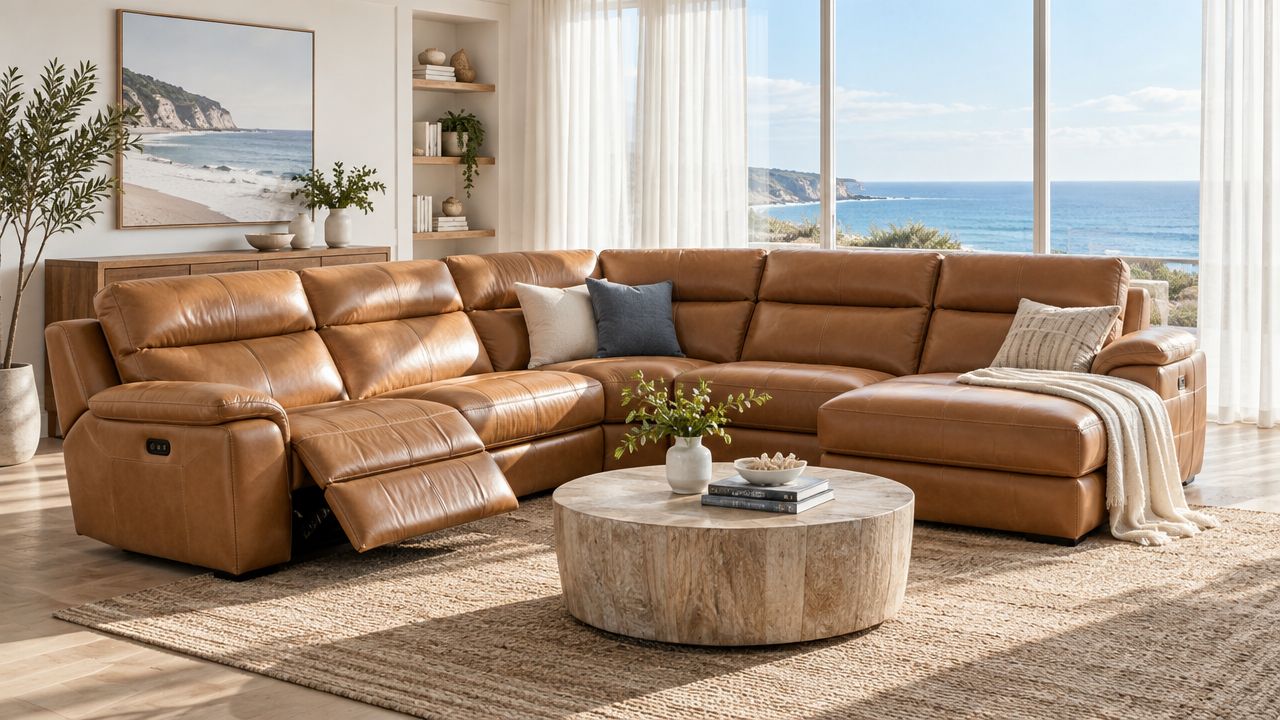
Schedule your Complimentary Design Consultation


Large Round End Tables: A Complete 2026 Guide

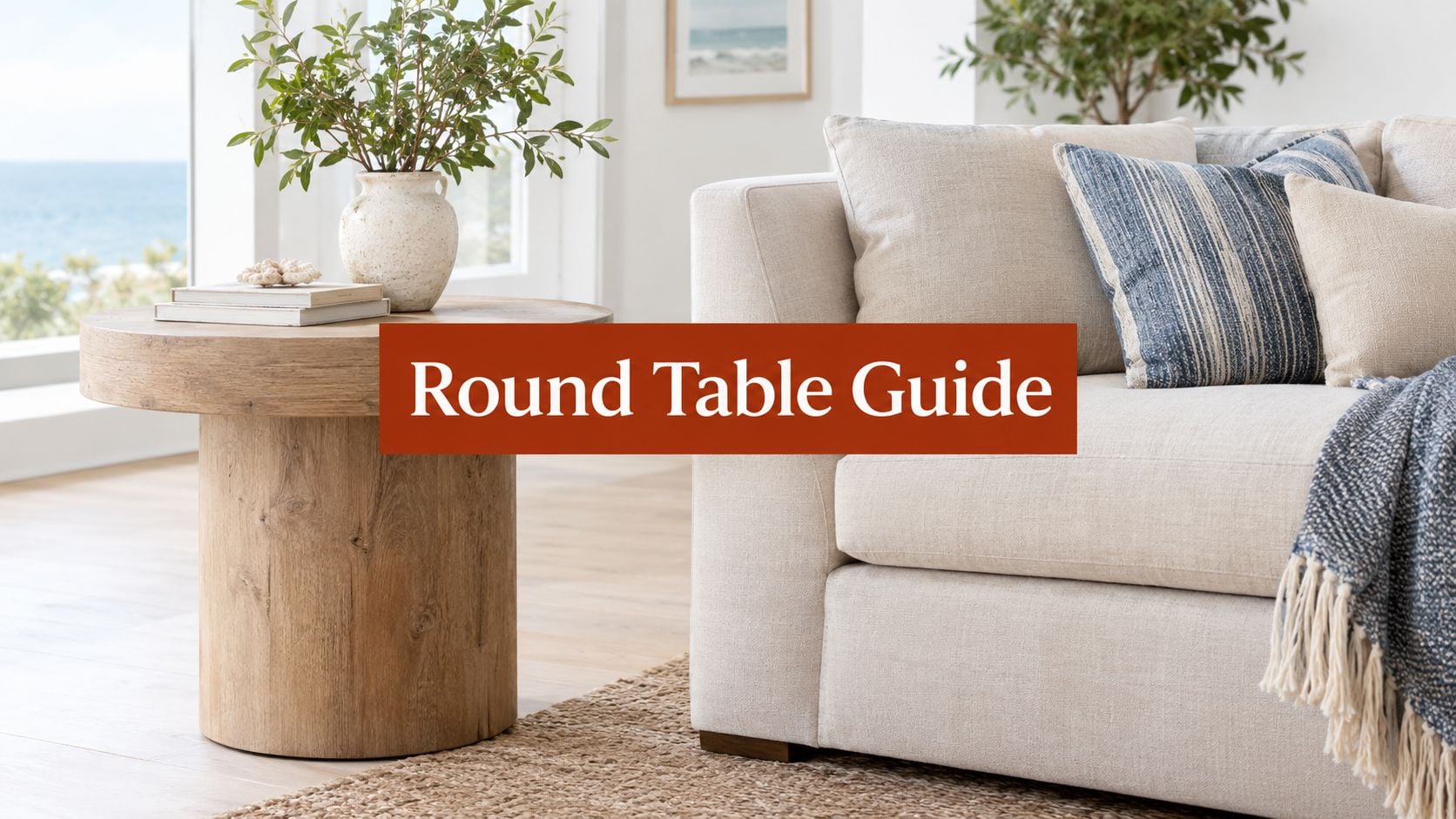
A large round end table works best when its height sits within 1 to 2 inches of your sofa or chair arm and its diameter suits the seating and walking space around it. Common round end-table diameters fall near 18 to 24 inches, but the right choice is defined by proportion, not sheer scale.
You may be looking at a generous sectional, an oversized chair, or an open corner that feels unfinished. The table in your mind probably needs to hold a lamp, a cool drink, a book, and perhaps a woven tray, yet it can't make the room feel crowded. In a Florida home, where doors stay open to bright afternoons and family life often moves between indoors and out, that balance matters.
At Indian River Furniture, proportion is treated as a practical design decision. A table should feel natural beside the seating, steady under an everyday reach, and pleasant to touch. The best way to judge that relationship is to measure carefully, then experience the furniture in person.
The Art of the Large Round End Table
In a coastal living room, late-day light catches the grain of a wooden tabletop and brings out the soft variation in its finish. A broad circular surface rests beside a deep sofa, close enough for a glass of iced tea and a reading lamp. The base feels planted when you place a hand on it, while the rounded edge eases the strong horizontal lines of the sofa, window trim, and woven rug.
That is the quiet power of large round end tables. They offer useful surface area without introducing another hard corner, and they can act as a visual anchor between substantial seating pieces. A well-made table doesn't shout for attention. It gives the room rhythm, makes a seat more convenient, and adds the tactile warmth that photographs rarely capture.
When generous scale becomes too much
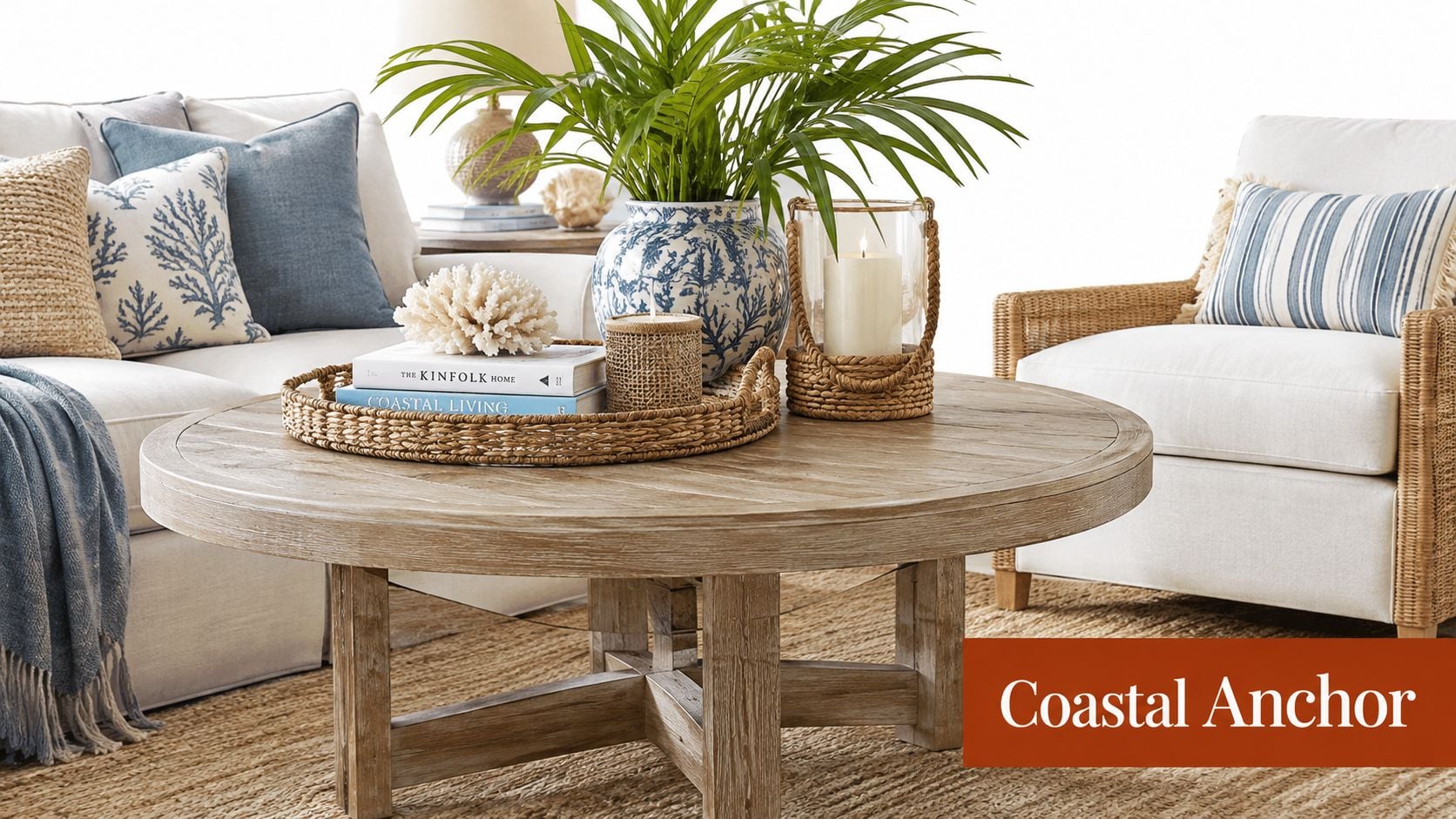
Many homeowners encounter the same frustration. A small table disappears beside a broad sofa, leaving no room for a lamp or anything useful. Then a larger replacement arrives, and its diameter projects into the walkway, crowds the chair, or makes the entire seating group feel heavy.
The solution isn't to choose the largest top available. A round table can be visually generous while remaining considerate of circulation, but only if its height, depth, base, and nearby furniture work together. The right piece should let you pass comfortably, reach from the seat without leaning, and see a clear relationship between the tabletop and the sofa arm.
A useful showroom test: Sit in the place where the table will serve you. Reach naturally toward the tabletop, then walk past it as you would at home.
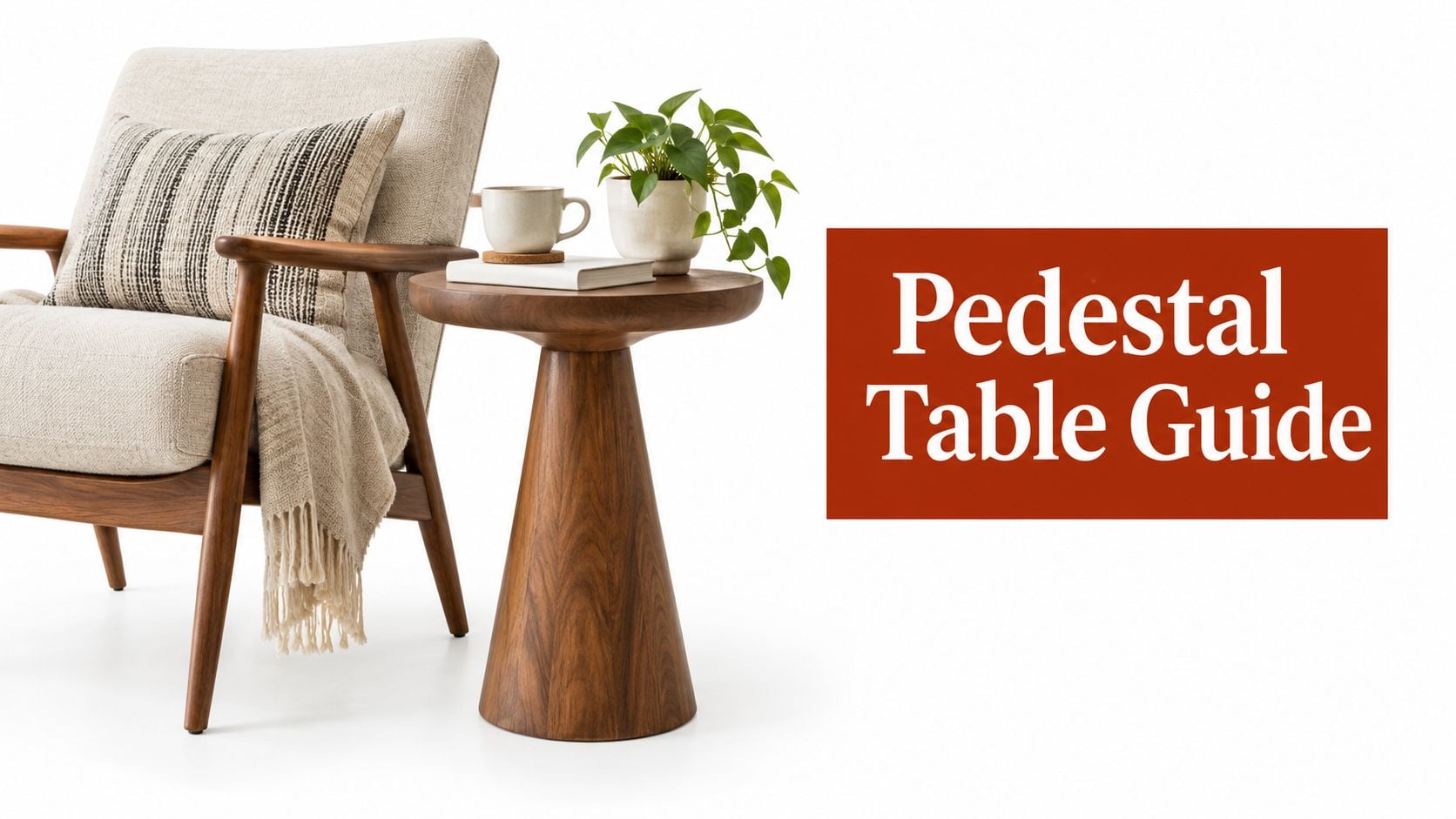
Material changes that experience. A smooth hardwood finish feels warm beneath the fingertips, a substantial pedestal resists a casual nudge, and a carefully softened edge feels comfortable when you're moving around the room barefoot. You can explore the tactile difference between silhouettes and finishes through this pedestal accent table collection, then compare the visual weight of each piece beside your own seating measurements.
A History of Craftsmanship and Design
Round end tables have remained part of home interiors across generations because the shape solves more than one design problem. It provides a practical surface, avoids sharp corners, and adapts to changing styles. A marketplace catalog records examples dating to the 18th century, alongside 902 antique and vintage round end tables and 111 modern editions, evidence of a category that continues to move between heritage craftsmanship and contemporary design. The catalog's round end-table listings include styles such as Mid-Century Modern, Art Deco, and Modern.
That range is useful when you're deciding whether a table should blend into a room or become a collected focal point. An antique-inspired top with visible grain can bring a sense of permanence to a coastal interior. A restrained modern pedestal may feel lighter beside a slipcovered sofa. A sculptural Art Deco reference can add polish without requiring the rest of the room to become formal.
Why the circular form endures
The form also carries a practical history. A round tabletop presents the same general relationship from every direction, which makes it especially flexible between chairs, beside a sectional, or in a corner where furniture approaches from different angles. It doesn't demand the rigid alignment that a rectangular table often does.
The catalog reports an average selling price of $2,278, with listed prices ranging from $200 to $28,500. Those figures are not a recommendation for what anyone should spend, and this guide isn't about price. They do show that round end tables occupy a broad design field, from accessible everyday furnishings to collectible pieces where rarity, materials, and workmanship carry substantial weight.
For large versions, scale deserves special attention. The same catalog notes that smaller round examples can be as narrow as 9.5 inches wide, which helps explain why a table with a much broader diameter can dominate a room if its base and surrounding clearances aren't considered. A large top needs visual breathing room and structural confidence.
Craftsmanship becomes more meaningful when a piece is expected to stay in the family. Look for joinery that feels tight, a finish that invites touch, and a top that doesn't appear visually disconnected from its support. If the role of the table is to gather people around everyday life, this discussion of crafting connections through custom dining tables offers useful context about how furniture can support community and family togetherness.
Mastering the Perfect Proportions
A large round end table should be sized from the seating outward. Start with the sofa or chair arm, then consider the tabletop diameter, the table's projection into the room, and the path people use around it. This order prevents a common mistake, choosing a striking table first and discovering later that it interrupts daily movement.
Measure the relationship first
Measure the arm height. Use a tape measure from the floor to the top of the sofa or chair arm. The tabletop should generally sit within 1 to 2 inches of that arm height, a relationship supported by standard end-table buying guidance. A surface that's close to the arm is easy to reach and looks visually connected to the seating.
Measure the seat length it serves. A practical proportion is for the table to be roughly two-thirds the length of the seat it accompanies, according to round end-table sizing guidance. This isn't a rigid formula, but it helps a generous sofa avoid making a small table look lost.
Confirm the diameter. Round models commonly occupy an 18- to 24-inch diameter band, though other guides describe widths from 12 to 24 inches and depths from 18 to 28 inches. The 18- to 24-inch range is a useful starting point, not an automatic answer. If your seating is deep and the room has open circulation, a larger top may look balanced. If the table sits near a doorway or between two seats, a more restrained footprint may perform better.
Map the floor before ordering. Place painter's tape on the floor to mark the proposed circle. Walk around it while carrying a laundry basket, entering from the hallway, or moving between the sofa and a chair. Product listings don't always make the usable footprint obvious, so this furniture-measuring guide is a helpful companion before you make a selection.
Practical rule: A large table should make a large seating group more usable, not turn its walking path into an obstacle course.
Account for the room beyond the photograph
Open-plan rooms often give a table more visual space than physical space. A piece may look perfectly scaled beside a sectional in a showroom vignette, yet project too far into the route between the seating area and kitchen. The circle softens a corner, but it still occupies real floor area.
Measure with recliners fully extended, doors open, and nearby drawers in use. Check where a lamp cord will run and whether someone seated at the far end can reach the surface. The most elegant proportion is the one that remains comfortable on a busy evening.
Materials and Construction for Durability
Florida furniture has to live with sunlight, changing humidity, sandy feet, pets, guests, and the casual movement of everyday life. That makes the material beneath the finish as important as the finish itself. A table can look coastal at first glance, but its long-term character depends on the frame, joints, top construction, and base design.
Solid hardwood is a strong choice for a furniture piece expected to become an heirloom. Wood does respond to its environment, expanding and contracting across the grain as humidity changes. Care guidance commonly places comfortable indoor humidity for solid wood around 35% to 55% relative humidity, with an ideal target near 45% RH, while another recommendation is 30% to 40% to reduce swelling, warping, and joint gaps. This guide to choosing hardwood for longevity and style explains why species, construction, and care deserve attention together.
Compare the details, not just the finish
| Material or feature | Benefits | Considerations |
|---|---|---|
| Solid hardwood | Warm grain, repairable character, and substantial feel | Needs sensible humidity control and protection from standing moisture |
| Veneered wood | Allows carefully selected grain patterns and stable panel construction | Inspect edge treatment and substrate quality |
| Glass or stone top | Adds visual lightness or a tailored architectural surface | Can show fingerprints, requires careful handling, and may feel less warm to the touch |
| Performance finish | Helps a piece suit active households and the Florida lifestyle | Care instructions still matter, especially near bright windows |
| Genuine leather accents | Develops a natural hand and complements relaxed luxury | Requires conditioning and protection from direct heat and moisture |
| Wide pedestal or leg spread | Improves visual balance and supports a larger top | A broad base still needs correct weight distribution and level placement |
Stability follows engineering logic
A round top can still tip. Independent furniture testing regimes evaluate overturning, edge loading, torsion, and durability because a person may lean on the perimeter rather than place weight at the center. The farther an off-center load sits from the centerline, the greater the overturning moment, so designers manage that force with a wider base, a lower center of gravity, and a support footprint suited to the expected load path. Furniture durability and load-bearing testing guidance provides useful technical context.
In a showroom, place a hand near the edge and apply gentle, ordinary pressure. The table shouldn't rock, skid, or feel top-heavy. Inspect the underside when possible, look for a well-resolved connection between top and base, and ask how the finish should be maintained in a humid home.
A heavier pedestal isn't automatically safer, and extra diameter isn't automatically better. A carefully proportioned base, solid joinery, and level floor matter more than visual mass alone. For upholstery nearby, performance fabrics and genuine leathers can support the same Florida-friendly approach, especially when paired with solid hardwood frames and time-tested joinery.
Styling and Practical Applications
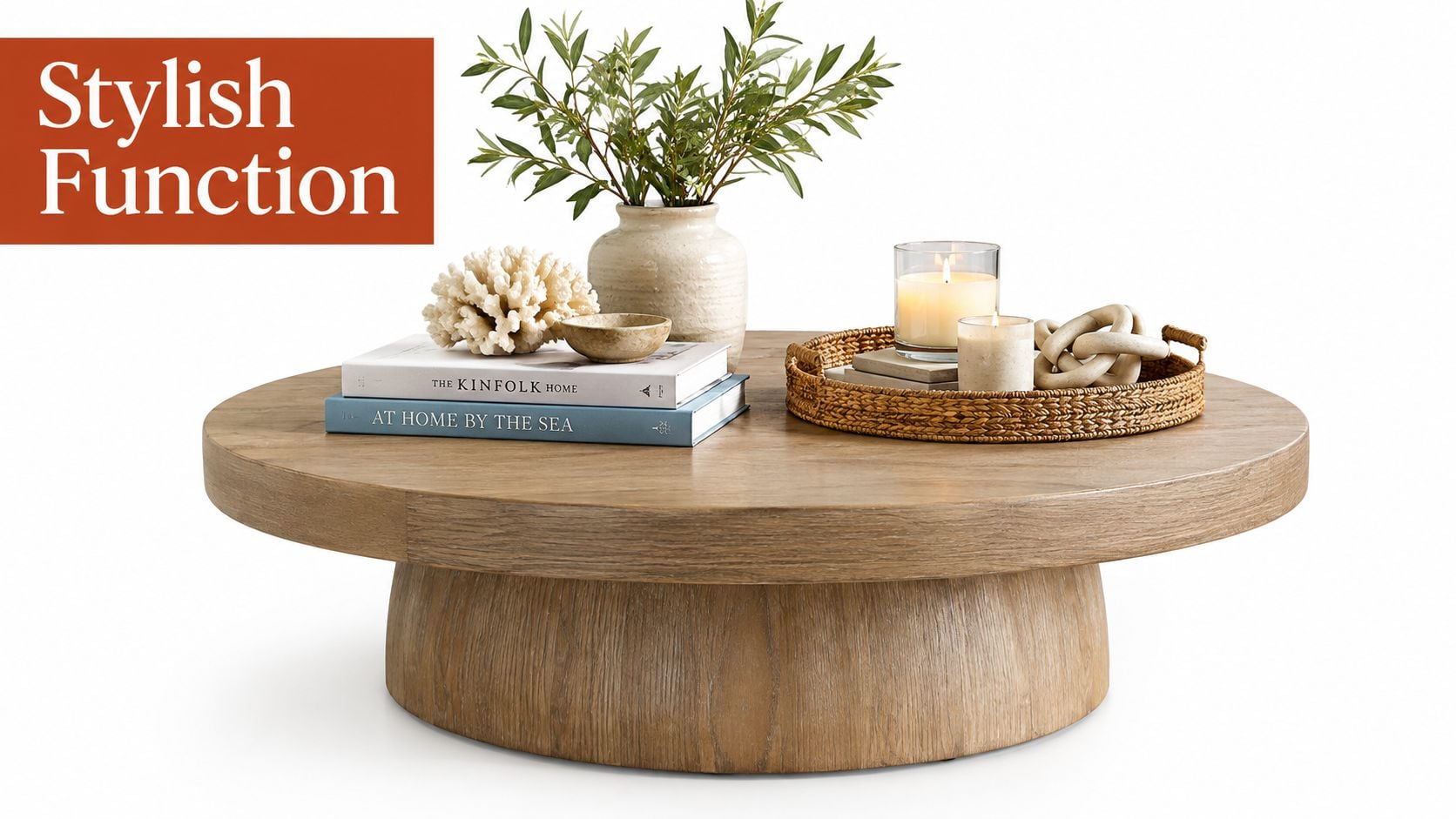
A large round end table earns its place when it serves both the eye and the household. Beside a broad sofa, it can hold a shaded lamp, a small tray, and the book currently being read. Between two chairs, it can create a welcoming shared surface without forcing either person to sit at an awkward angle.
The circle is especially effective in a coastal room filled with linear architecture. It introduces a gentle pause among planked floors, rectangular windows, straight sofa cushions, and woven baskets. Choose a finish that relates to the room's tactile language, such as softly grained wood, a quiet painted surface, or a combination of natural texture and refined metal.
Build a useful surface
Keep the styling edited. A lamp establishes height, a tray gathers smaller objects, and one natural element, such as greenery or a shell-inspired ceramic, adds softness without taking over. Leave a clear landing place for a drink or phone, because an end table that can't be used is only decorative.
In smaller homes and condominiums, the best answer may not be a larger tabletop. Market coverage notes growing interest in accent furniture with storage or transformable features in smaller urban homes, alongside interest in sustainable materials, personalization, and smart integration. That suggests a buyer should compare a broad round table with a nested arrangement or a storage-oriented accent piece according to the work the furniture needs to do, not only the look it creates.
Let function shape the arrangement
Use the table beside the seat that will reach it. At the open end of a sectional, position it where the outside seat can set down a glass without twisting. Near a recliner, check the moving footrest and control area before committing to a deep piece. In a passage, a round outline can make movement feel smoother, but the table still needs adequate clearance.
For a compact room, this small-space furnishing guide can help you think about scale as part of the whole plan. A table shouldn't be judged alone. Its base, lamp, nearby seating, rug, and walking route all contribute to the room's visual balance.
Design observation: The most successful statement piece often looks quieter once it is doing several jobs well.
A curated coastal vignette might pair a warm wood table with linen upholstery, woven shades, and blue accents. Relaxed luxury may call for a more polished silhouette, a considered lamp, and a restrained arrangement of books. In both cases, craftsmanship becomes part of the styling. You notice the smooth edge when you reach for a coaster and the steadiness of the base when a family gathering fills the room.
The Indian River Furniture Difference
Furniture decisions become clearer when you can test the relationship rather than guess from a photograph. Since 1939, Indian River Furniture has served Brevard County, the Space Coast, and Central Florida from its Rockledge location, where a 32,000-square-foot showroom presents curated rooms and coastal-inspired vignettes.
The No Blind Ordering promise reflects a practical belief. Ownership hand-tests every seat, sofa, and recliner for pitch and comfort before it reaches the showroom floor. That same tactile mindset is useful when you're choosing an end table. You can examine the grain, feel the edge, test the steadiness of the base, and stand back to judge whether the scale supports your own seating.
Service that continues after selection
A complementary in-house interior design consultation can help you coordinate table height, finish, lamp scale, upholstery, and the traffic pattern of the room. The conversation is especially valuable when you're furnishing a sectional, a coastal vacation home, or several connected spaces and want a cohesive result rather than unrelated pieces.
Custom ordering also gives you a way to consider performance fabrics, genuine leathers, solid hardwood frames, and wood finishes suited to active Florida households. If you're exploring a more personalized direction, getting started with custom order furniture offers a natural starting point for discussing materials and room needs.
White-glove delivery should feel like part of the furniture experience, not an afterthought. Published delivery checklists describe pre-dispatch validation of dimensions, route planning, in-home placement, assembly, and a post-install inspection that checks surfaces for marks, tests moving parts, and verifies alignment so pieces sit level. Entry clearance, storm-door clearance, hallway width, stair landings, ceiling height on turns, and elevator dimensions also deserve attention before delivery.
Visit the Rockledge showroom with your sofa-arm height, room measurements, and a sense of how you live. Sit, reach, walk the route, compare finishes, and speak with the design team about a large round end table that feels steady, ergonomic, and at home in your Florida rooms.
Bring your measurements to Indian River Furniture in Rockledge and hand-test the table, seating, finishes, and surrounding room combinations in person. Schedule a complementary design consultation to refine the proportions, then ask the team about custom materials and white-glove delivery for a finished setup that feels made for your home.