Schedule your Complimentary Design Consultation


Pedestal Accent Table Guide for Stylish Living Spaces

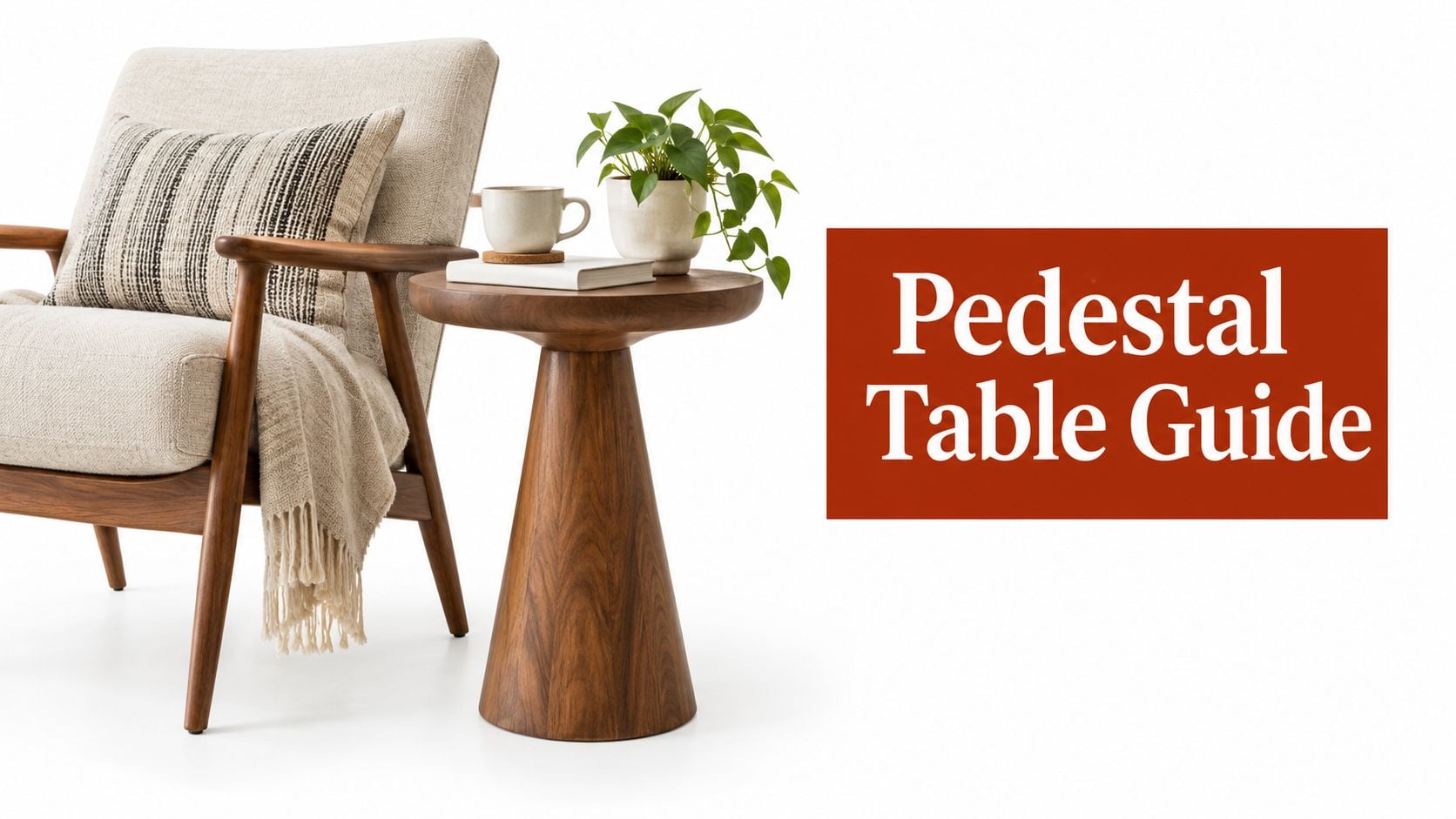
Tuesday evening has a familiar rhythm. A cup of tea, a book, and a phone all need a landing place beside your reading chair, but the room has no appetite for another bulky four-leg table. A pedestal accent table can solve that reach problem while preserving legroom, sightlines, and the relaxed openness that makes a coastal living space feel comfortable.
The right choice starts with space, not a finish sample. Measure the seating, understand how a single central base changes movement, compare materials against Florida's humidity and daily use, then place the table where it will support your routine. Style matters, but proportion and stability determine whether the piece feels natural in the room.
Table of Contents
- Why a Pedestal Accent Table Earns Its Place in the Room
- What Makes a Pedestal Accent Table Different
- Styles and Materials Worth Knowing
- Getting the Proportions Right for Real Rooms
- Choosing Materials That Hold Up to Real Life
- Placement Ideas for Living Rooms and Beyond
- Bringing It All Together with a Trusted Showroom Visit
Why a Pedestal Accent Table Earns Its Place in the Room
A pedestal accent table concentrates function into a focused footprint. Its central support keeps the area beneath and around the top more usable than a design that sends four legs toward the corners. That difference can determine whether a chair remains easy to approach, a sofa end feels crowded, or a narrow condo seating group still has comfortable circulation.
Traditional end tables bring their own strengths, including warmth, storage, and familiar craftsmanship. A drawer or cabinet may matter more than open legroom in a room that needs concealed space.
Start with the job
Begin with the object that will live on the table. A lamp and drink need a stable, reasonably generous top. A phone, remote, or small stack of books may require less surface area, yet the table must still sit close enough to reach without leaning forward.
In a tight room, the open area beneath a pedestal top can help a chair pull closer and give feet more freedom. It also reduces the repeated visual stops created by several short legs. Round and oval tops soften the hard lines of sofas, windows, and architectural corners, while a sculptural base adds texture without the broad mass of a cabinet.
Practical rule: Choose the smallest table that performs the task comfortably, not the smallest table that technically fits.
A narrow top is not automatically the most space-efficient choice. If it cannot hold the lamp, drink, or book you use beside the seat, its small footprint creates an everyday reach problem. Measure the available gap, then compare that space with the tabletop diameter and the base position, because a wide base can affect movement even when the top looks compact.
Think beyond decoration
The form has a long history. Pedestal tables trace their decorative furniture lineage to 17th-century Europe, including candle-stand forms and early guéridons developed in France and England. They became especially popular in the 18th and 19th centuries, when lighter, more space-efficient furniture began replacing visually heavier multi-leg forms in many settings.
That history helps explain the table's familiarity in traditional and contemporary rooms. The form has served dining, display, and occasional-table purposes across the Neoclassical and Victorian eras, then gained a modern expression in mid-century design. Today, the same structural idea can suit a reading chair in a compact apartment, a bedside corner in a coastal home, or a quiet landing spot beside a sofa.
What Makes a Pedestal Accent Table Different
Think of a four-leg side table as a four-legged stool. Its support spreads toward the corners, which can create a broad, familiar stance but also introduces obstacles where knees, feet, bags, and chair legs compete for space. A pedestal table behaves more like a single-trunk tree. The trunk gathers the load into one grounded column, allowing the tabletop to extend outward without placing a support at every corner.
That central support creates three practical effects. First, the continuous vertical line gives the top a visually lifted quality. Second, the open under-edge makes it easier to tuck in a footstool, a small bag, or the front of a chair. Third, a circular base can sit neatly near curved chair arms and sofa ends where a square table would project into the walkway.
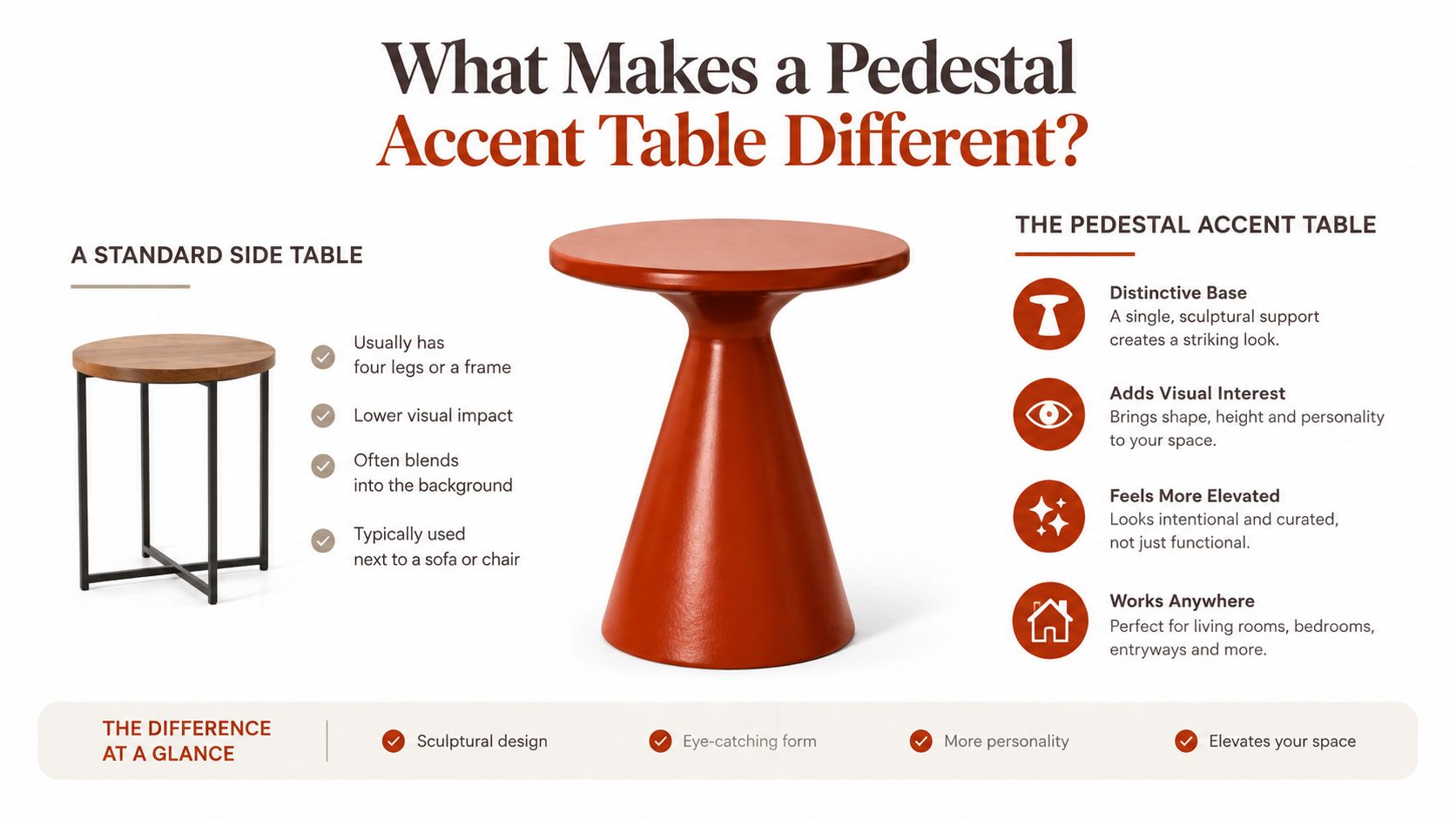
Why the open footprint changes comfort
In a narrow seating area, the table's usability depends on more than the diameter of its top. A four-leg frame can block the route a person takes to sit down or shift position. A central base often gives the same surface function with fewer collision points, which is why a pedestal can feel more spacious even when its top isn't dramatically smaller.
The form became a major modern design language through Eero Saarinen's Pedestal Collection for Knoll, introduced in 1958. Saarinen's stated aim was to “clear up the slum of legs” beneath tables and chairs, a design ambition recorded by the Nationalmuseum in Sweden (Nationalmuseum collection record). The idea moved from high design into broader furniture production, demonstrating how a clean central support could serve both visual clarity and everyday space management.
Styles and Materials Worth Knowing
A pedestal accent table can feel inherited, architectural, organic, or almost weightless. The base usually sets the personality, while the top determines how the piece meets the room's other surfaces.
A turned-pedestal traditional table uses a carved or shaped hardwood column. It suits rooms with crisp upholstery, woven textures, and classic millwork. The visible grain and rounded transitions bring warmth, particularly when the finish is soft rather than overly glossy.
A modern drum pedestal simplifies the form into a lacquered, painted, or veneered cylinder. Its broad visual plane works well with clean-lined sofas and tonal coastal palettes. Because the shape has fewer decorative interruptions, the quality of the finish and the precision of the top-to-base joint become especially important.
A sculptural pedestal may use cast resin, stone, hammered brass, or hand-forged metal. These pieces introduce movement and shadow, much like driftwood or coral-inspired forms, without turning the room into a themed beach interior. A lighter rattan or wrapped silhouette brings breathable texture to sunlit rooms and pairs naturally with linen, performance fabrics, and pale woods.
The most versatile coastal curation uses natural variation with restraint. Travertine, stone inlays, woven cane, antiqued metal, and solid hardwood can all work together when their tones share a quiet relationship. For a closer look at how metal can add structure and contrast, see this guide to metal accents in interior design.
Pedestal accent table style families at a glance
| Style Family | Signature Pedestal Material | Typical Top Material | Best Coastal Context |
|---|---|---|---|
| Turned traditional | Carved hardwood | Solid wood or stone inlay | Layered rooms with classic upholstery and warm natural finishes |
| Modern drum | Veneered cylinder or lacquered composite | Wood veneer, stone, or painted surface | Clean-lined condos and restrained coastal interiors |
| Sculptural | Cast resin, hammered brass, or forged metal | Stone, wood, or mixed material | Rooms needing an artistic focal point without excess ornament |
| Wrapped coastal | Rattan, cane, or woven fiber | Wood, glass, or light stone | Bright rooms with linen, airy textiles, and relaxed texture |
For Florida homes, ask how the finish was selected for the environment. A marine-grade finish can make sense near open doors, screened porches, or bright windows, but construction quality still matters more than a coastal label. The most appealing table is the one whose material story matches how you live.
Getting the Proportions Right for Real Rooms
A pedestal accent table earns its place by fitting the way a room is used. Start with the seated reach. Current proportion guidance places the tabletop within 1 to 2 inches of sofa-arm height or mattress height (current proportion guidance for accent tables). A drink, reading light, or lamp switch should be close enough to reach without lifting the shoulder or twisting the wrist.
Measure the actual arm rather than relying on the sofa's listed height. Cushions compress, chair arms vary, and a folded throw changes the usable level. Sit in the chair, hold a book or cup where you would normally use it, and check whether your shoulder stays relaxed. A table that is too low makes you lean; one that is too high can feel like it is pressing into the seating area.
Size the top around the task
For many pedestal accent tables, a round top in the 14 to 18 inch diameter range provides room for a lamp, drink, and small personal item. The top is generally kept smaller than the depth of the sofa arm (standard proportion guidance for accent tables). The goal is a useful landing spot, not another surface competing with the chair.
Measure the passage around the furniture as carefully as the tabletop. Leave enough room for someone to sit, stand, and adjust position without catching a knee or hip on the edge. In a narrow seating area, a compact top can serve better than a larger one if it preserves a clear route.

Match the base to the movement zone
The smallest-looking table isn't always the best choice. A narrow pedestal can slip between chair legs and give knees and feet more room, while a four-leg table with the same top may occupy more of the movement zone. This makes the base a spatial-efficiency decision before it becomes a style decision.
A slimmer base still needs enough weight and connection strength. Testing references examine edge and vertical loading near the tabletop, where distance from the pedestal increases the mechanical disadvantage. Commercial furniture-testing references show pedestal accent tables commonly in the 23 to 28 inch height range, with tops around 14 to 24 inches. These proportions can suit lamps and décor, while heavier tops require a suitably weighted base and reinforced joint.
For a round table, one design approach places the base at about 55% to 65% of tabletop diameter, while another recommends 60% to 70%. Use these ranges as construction guidance, not as a fixed visual formula. A heavy top, tall column, or busy seating area may call for a larger base, even if a smaller one looks lighter.
Choosing Materials That Hold Up to Real Life
Materials should follow the household, not the photograph. A solid wood top brings warmth, can often be refreshed over time, and feels welcoming beside upholstered seating. It also responds to humidity changes, so Florida homes need a well-sealed surface and sensible protection from standing moisture.
Stone and concrete offer visual weight and a cool tactile quality. They can anchor a sculptural base, but their mass increases the demands on the pedestal and the floor. Metal allows slim profiles and crisp edges, though some finishes show rings, fingerprints, or scratches more readily. Glass keeps a room visually open, but it asks for frequent cleaning and can make every touch visible.
For frequent use, one design guide recommends hardwood tops such as oak, ash, or maple at approximately 1 to 1.25 inches thick, with pedestal construction using laminated hardwood rings, solid wood, or welded steel. The choice changes both the table's feel and its structural confidence.
Match the surface to the household
A home with children, pets, or frequent guests benefits from a surface that tolerates contact and cleans without elaborate rituals. A rental property may favor a sealed wood veneer or powder-coated metal over a highly porous stone. A quiet reading corner can accommodate a more tactile finish if the owner enjoys caring for it.
| Material | Durability | Coastal Climate Fit | Care Level |
|---|---|---|---|
| Solid hardwood | Warm, repairable, and structurally reliable when well constructed | Strong fit with a protective finish and sensible moisture care | Moderate |
| Stone or concrete | Resistant to everyday wear, but heavy and vulnerable to certain stains | Good when properly sealed and kept away from prolonged moisture | Moderate |
| Metal | Strong and visually slim, with finish performance varying by coating | Good with corrosion-conscious finishing | Low to moderate |
| Glass | Visually light and easy to pair with other materials | Suitable indoors, but marks and fingerprints show quickly | Frequent wiping |
| Rattan or cane | Textural and airy, with less resistance to hard impact | Best in protected interiors rather than exposed wet conditions | Gentle, regular care |
The base deserves as much attention as the top. Turned hardwood columns and powder-coated metal generally provide more confidence than soft MDF or hollow cores, particularly where humidity and salt air can expose weak joints. Look for a broad enough foundation, solid attachment points, and a finish that doesn't feel thin at the edges.
For a deeper explanation of wood species, joinery, and long-term selection, read choosing the right hardwood for longevity and style. Catalyzed conversion varnish, marine-grade sealers, and carefully applied hand-rubbed oils can age more gracefully near windows and doorways than a thin lacquer, though every finish still benefits from coasters, prompt wiping, and protection from direct exposure.
Placement Ideas for Living Rooms and Beyond
The classic position is beside a sofa or club chair. Set the pedestal accent table close enough to reach while seated, then check that the top doesn't interfere with the arm cushion or the lamp's shade. A round top often works well beside curved upholstery because it echoes the chair without creating a sharp corner in the walkway.
Behind a reading chair, a pedestal can hold a lamp and a small stack of books without obstructing the chair's pull-out path. Place the light so the shade illuminates the reading shoulder rather than shining directly into the sitter's eyes. The single base helps keep the area beneath the table visually quiet.
Use the base to preserve movement
Between two chairs in a conversation grouping, a narrow pedestal gives both seats access to a shared surface. Keep the top centered between the chairs, and check that each person can stand without brushing against the base. If the chairs angle toward one another, a round top usually accommodates those different approaches better than a square one.
An empty corner may call for a larger drum pedestal with enough visual presence to anchor the area. Pair it with a tall plant, a lamp, or a restrained arrangement of books, but leave breathing room around the silhouette so the corner doesn't become a storage pile.
A table earns its place when people can use it without changing how they walk through the room.
Take the idea beyond the sofa
At the bedside, match the tabletop to the mattress relationship rather than guessing from a standard nightstand. The surface should support a lamp, phone, or book while remaining easy to reach from a resting position. In an entryway, a pedestal can provide a compact drop zone for keys and mail, especially where a full console would narrow the passage. Guidance on balancing function, height, and surrounding clearance appears in this overview of entry table design elements.
Hallway landings benefit from slim profiles, but measure the clear walking route with the table in place. Don't judge the piece against an empty room. Tape the proposed top and base footprint on the floor, walk past it carrying a bag, and pull nearby doors or drawers open. That simple test reveals whether the table supports circulation or disrupts it.
Bringing It All Together with a Trusted Showroom Visit
Bring four decisions into the final selection:
Confirm the location: Know whether the table will serve a sofa, reading chair, bedside, entryway, or hallway.
Measure the relationship: Record the arm or mattress height, top depth, and available clearance together.
Choose the working surface: Decide whether you need room for a lamp, drink, books, or only small daily essentials.
Inspect the construction: Press gently near the edge, study the joint, and check whether the base feels proportionate to the top.
Match the finish to life: Consider humidity, sunlight, pets, children, entertaining, and how often you want to maintain the surface.
A showroom visit makes scale easier to judge than a screen does. At Indian River Furniture, shoppers can see curated coastal vignettes, compare tables beside seating, and use complementary in-house interior design consultations to discuss room dimensions, light, traffic patterns, and daily routines. The ownership team also hand-tests every seat, sofa, and recliner for pitch and comfort before it reaches the 32,000 sq ft Rockledge showroom floor, part of the company's No Blind Ordering approach.

You can also bring a familiar object, such as a throw pillow, book, or lamp, to help judge visual scale and texture. Once those pieces align, the pedestal accent table stops looking like an extra object. It feels inevitable, as though the room had been waiting for that particular height, material, and open footprint.
Visit Indian River Furniture in Rockledge to compare pedestal accent tables within curated coastal room settings and discuss your measurements with the complimentary in-house design team. You can hand-test related seating, explore performance fabrics, genuine leathers, and solid hardwood construction, then arrange the uniform in-house white-glove delivery service when your selection is ready.