Schedule your Complimentary Design Consultation


Solid Wood Bed King: The Complete Coastal Guide


A solid wood king bed requires attention to species, joinery, and Florida humidity control, not just the label. Built around a 76-by-80-inch mattress, a properly engineered frame can outlast engineered-wood alternatives by decades when those three factors are verified before purchase.
You may be standing at the foot of your current bed, noticing the loose rail, the restless mattress, or the way two adults now seem to have less room than they should. Perhaps the bedroom feels crowded despite having a familiar layout, or the frame creaks every time someone turns over. That small frustration often signals a larger decision: the bed has become the weakest part of a room that should feel calm, comfortable, and dependable.
A solid wood bed king configuration can give the room a substantial anchor, but quality isn't guaranteed by appearance alone. Species, construction, mattress support, moisture control, finish, and delivery access all affect whether the bed becomes an heirloom or just a heavy piece of furniture. The best choice combines coastal character with measurable craftsmanship, so the frame feels as reliable at midnight as it looks in daylight.
Why a Solid Wood King Bed Deserves a Longer Look
A couple may start shopping after one person wakes with too little room and the other notices the frame shifting during the night. They measure the mattress first, then discover how much space the headboard, footboard, and side rails add. That measurement often changes the decision. A king bed is not just a larger version of a familiar frame. It is furniture at a different scale, with greater demands on the room, the delivery route, and the structure supporting it.
A standard U.S. king mattress measures 76 by 80 inches, providing 6,080 square inches, or about 42.2 square feet, of sleeping surface. A king is roughly twice the width of a twin mattress and substantially more spacious than a queen. A California king measures approximately 72 by 84 inches, trading some width for extra length. The distinction matters for a tall sleeper, a narrow bedroom, or a coastal home where generous circulation still needs careful planning. RoomSketch3D's bed-size guide explains standard king and California king dimensions.

Space that supports everyday comfort
A well-proportioned king gives two sleepers room to stretch, read, or share the bed with children on a weekend morning. It can also reduce the constant contact caused by a restless sleeper. Comfort depends on more than mattress width. A stable frame limits distracting movement, while a well-designed headboard can support reading or conversation.
The finished frame needs more planning than the mattress footprint suggests. Solid wood frames can approach 80 to 82 inches wide and 84 to 86 inches long because the design must accommodate rails, posts, headboard and footboard components, hardware, and bedding clearance. These exterior frame dimensions are based on the same bed-size guide linked above.
Measure the doorway, stair turns, elevator, and intended wall before ordering. Check the route as carefully as the bedroom itself. Leave space for nightstands, walking paths, rug placement, and nearby drawers. A beautiful frame that cannot reach the room, or leaves no practical circulation once installed, is not a successful design choice.
Designer's rule: Measure the route into the room as carefully as you measure the room itself.
Why material quality changes the room
Solid wood adds tactile depth that printed surfaces and thin decorative layers cannot fully reproduce. Grain varies from board to board, a hand-finished rail can have a softened edge, and the surface may develop character as the bedroom is used. In a relaxed coastal setting, that texture works naturally with linen, woven shades, pale walls, performance upholstery, and warm metal accents.
The phrase solid wood still needs closer examination. It identifies the material form, not the species, moisture preparation, joint design, or support system. In a humid coastal home, ask how the wood was dried and what moisture content was targeted before assembly. Confirm how the rails connect, whether the hardware can be tightened, and how the slats are spaced and supported. These details work like the frame's internal skeleton. They determine how well it handles repeated movement, seasonal swelling, and the broad span of a king mattress.
A finish also deserves practical attention. Its appearance matters, but so does whether it protects exposed surfaces and allows routine cleaning without trapping moisture. Look for clear specifications rather than relying on the label alone.
Indian River Furniture's discussion of the sovereignty of quality reflects a useful buying principle: evaluate furniture as a complete object, not as a photograph or material description. A king bed affects nightly comfort, room balance, delivery planning, and long-term maintenance. When its proportions, construction, and climate requirements suit the home, it can become the quiet centerpiece around which the rest of the bedroom is arranged.
Understanding Solid Wood Construction and Joinery
A king bed can look substantial in a showroom and still develop movement, squeaks, or loose connections after months in a humid coastal home. The label solid wood describes what the parts are made from. It does not explain the species, drying process, joint design, or load path. Those construction details determine whether the frame remains quiet and stable as the room's conditions change.
Solid wood is a material category, not a guarantee of identical performance. Species differ in hardness, density, strength, dimensional stability, and resistance to environmental stress. A furniture-material comparison places commonly used woods across an approximate Janka hardness range of 320 to 3,680 pounds-force, with densities of roughly 0.32 to 1.10 grams per cubic centimeter. Furniture-grade pine commonly falls around 600 to 700 lbf, while oak is approximately 1,200 to 1,300 lbf. The wood standards comparison explains these material differences.
These figures help explain why species selection matters, but they do not make one wood automatically suitable for every bedroom. A dense species may provide a firm, substantial feel. A lighter species may suit a particular finish, design, or weight requirement. Ask the maker to identify the species used for the rails, posts, slats, and headboard, then ask why that species was chosen for each part.
What the joints have to withstand
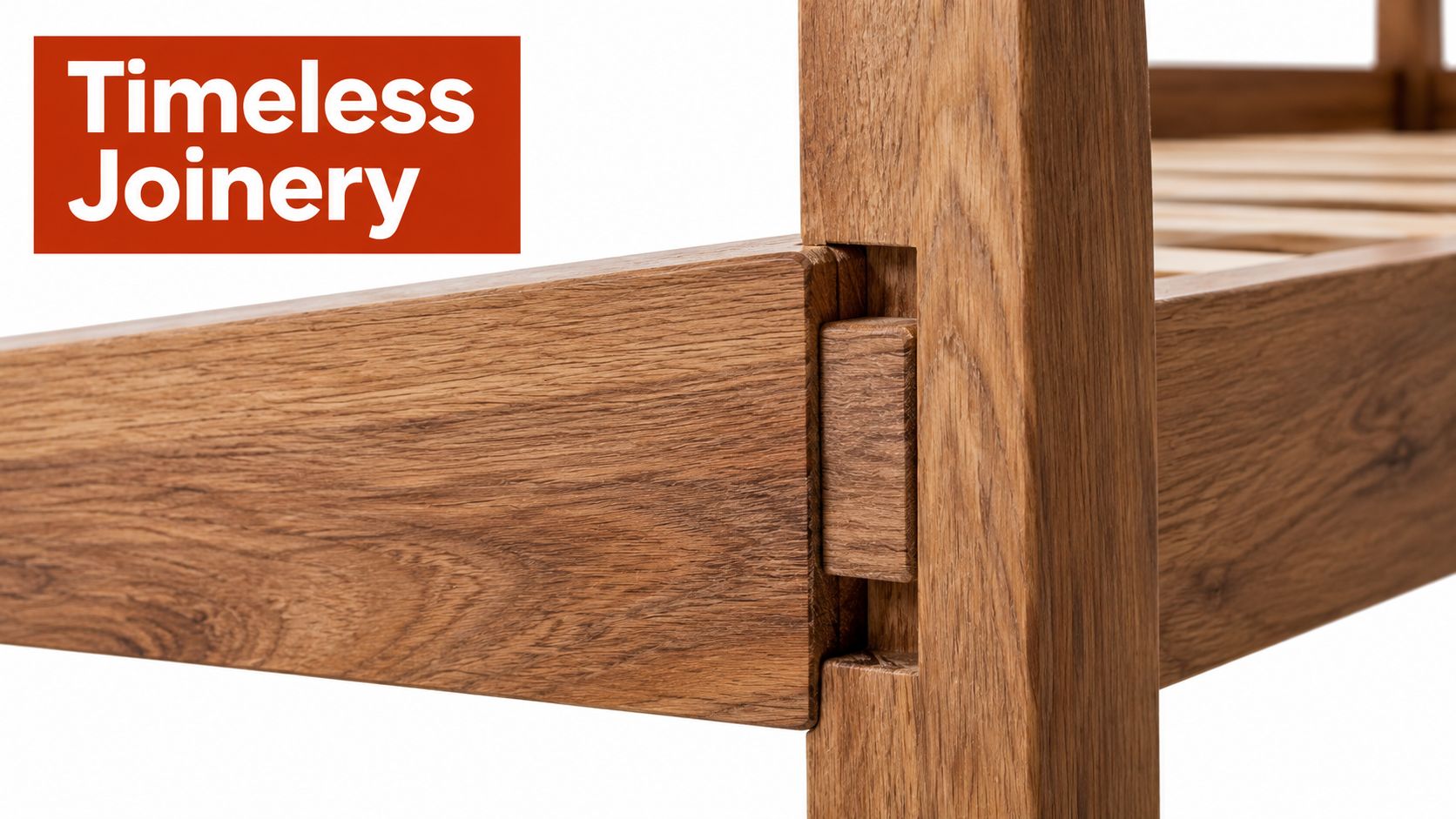
A king frame places repeated stress on its corners and long side rails. Turning in bed, sitting on the edge, and shifting the mattress all send force through the connections. Hardware keeps parts aligned, while well-designed wooden joints help spread those forces through the frame instead of concentrating them at a few screws or bolts.
Mortise-and-tenon construction fits one shaped component into a matching recess. Dowel joints use cylindrical wooden pins to align and reinforce adjoining pieces. Either method can perform well when accurately made and properly supported. Ask whether the frame relies on dowels alone, metal fasteners alone, or a combination of mechanical hardware and traditional joinery. This overview of wood joinery for contractors provides useful terminology for discussing how the rails, posts, and headboard connect.
Testing of white-oak and red-oak T-shaped furniture joints found that white-oak mortise-and-tenon joints reached the highest reported average bending-moment capacity at 436.71 N·m. The lowest tested group, red-oak dowel joints, measured 227.38 N·m. The study concluded that mortise-and-tenon joints generally outperformed dowel joints. The furniture-joint study details those test results and conclusions. These results do not predict the performance of every bed, but they show why joint type deserves more attention than a generic “heavy-duty” description.
Moisture preparation is part of construction
Coastal Florida changes the specification. Wood is hygroscopic, so it absorbs or releases moisture as the surrounding air changes. Technical guidance for furniture wood in damp coastal regions places average moisture content at approximately 11%, with individual boards commonly ranging from 8% to 13%. The moisture-content guidance explains why kiln-drying and acclimation matter.
Ask whether the structural rails and posts were kiln-dried and acclimated to the destination climate. Also ask how wide panels are allowed to move. Floating or slotted connections give broad boards room to expand and contract, much like a door needs clearance around its edges. Without that allowance, panels may cup, finishes may check, and joints may loosen or squeak after delivery.
Before ordering, use this inspection list:
- Species: Request the actual wood species, not only a description such as hardwood.
- Joinery: Ask how the rails meet the posts and how the headboard connects to the frame.
- Moisture preparation: Confirm kiln-drying, acclimation, and the maker's approach to Florida conditions.
- Structural support: Look for a center support system and legs that transfer weight directly to the floor.
- Repairability: Ask whether rails, slats, fasteners, or other serviceable parts can be replaced.
A thick rail can create an impression of strength, but the frame works as a system. The species, joint geometry, moisture preparation, and replaceable hardware must support one another. For a practical discussion of choosing the right hardwood for longevity and style, compare the wood's intended use with the conditions in your home rather than judging by color or weight alone.
Choosing the Right Mattress Foundation and Slat Layout
A solid wood king bed can look substantial and still provide poor support if its foundation does not suit the mattress. The wood species and finish describe the frame. The foundation and slat layout determine how the mattress carries weight night after night, including in a humid coastal home where materials may respond differently to indoor air.
Start with the mattress manufacturer's written foundation requirements. Foam and memory-foam mattresses commonly require gaps no wider than about 3 inches, while some innerspring designs allow gaps up to approximately 2.5 inches. Treat those figures as reference points only. The warranty requirements control whenever they differ. This technical slat guide explains spacing and mattress compatibility.
A simple inspection before delivery
Use a tape measure, or ask the design consultant to measure the display model. Recessed slats can make an opening look smaller than it is, much like a ruler hidden behind a thick frame rail.
- Measure the clear gaps. Measure the open space between adjacent slats, not the slat width. Record the largest gap, since one wider opening can determine whether the setup meets the mattress warranty.
- Check the slat material and span. Press gently near the center of a slat. Slight controlled movement may be normal, but excessive flex can create uneven support beneath the mattress. Ask whether the slats are fixed securely and whether their span matches the frame's center support.
- Locate the center support. A king frame generally needs longitudinal support from the head area toward the foot. Look for a central rail and legs that reach the floor, rather than stopping above it.
- Confirm the mattress footprint. The nominal king size is 76-by-80-inch, but outside dimensions and upholstery can vary by mattress. Confirm that the interior opening matches your specific mattress warranty's slat-gap requirement, then record the measured opening and gaps in writing before delivery. The mattress-size reference explains the relationship between king and queen dimensions.
- Read the warranty language. Keep the written foundation requirements with the purchase documents and compare them with the measurements supplied by the bed maker.
Why the center matters
A king mattress spans a broad surface. Without longitudinal center support, the side rails and slats carry more bending force, while the middle can develop an unsupported zone. Repeated loading may contribute to squeaks, frame deformation, or a mattress that feels uneven from one side to the other.
For foam and hybrid mattresses, closely spaced rigid slats or a continuous platform usually distribute weight more evenly. This reduces the chance of foam pressing between supports. A frame can look heavy and well built while remaining mechanically incompatible with a contemporary mattress.
Some bedrooms need a box spring or foundation, while others are designed for a platform. Choose based on mattress construction, desired bed height, and the frame specifications. This guide to why a box spring may be needed for your bed can clarify the choice before you order.
Before signing off on delivery: Check the slat gaps, press the support points, confirm the center rail reaches the floor, and compare every measurement with the mattress manufacturer's requirements.
Protecting Solid Wood in a Humid Coastal Climate
A solid wood king bed in a Florida bedroom faces a demanding cycle: warm, damp outdoor air enters through daily living, while air conditioning cools and dries the room. The hardwood rails and posts remain strong, but they are not waterproof. Wood exchanges moisture with the air around it, so climate control becomes part of protecting the frame.
Furniture in southern coastal states such as Florida can reach equilibrium moisture contents of at least 12% during the year. A practical example shows the change clearly: equilibrium moisture content rises from 6.9% at 70°F and 35% relative humidity to 15.7% at 80°F and 80% relative humidity. The Purdue guidance explains how temperature and humidity affect wood movement.

Specify the frame for its destination
Ask the maker where the lumber was dried, where the bed was assembled, and what moisture range was recorded before shipment. Properly kiln-dried wood that has acclimated to the destination has a better starting point than material that is substantially wetter or drier than the bedroom.
Request the target equilibrium moisture content on the build sheet. A target of 11%, with an 8% to 13% working range, gives you a documented reference. Compare that figure with Florida coastal conditions, where equilibrium moisture can reach 12% or higher. The goal is not to make the wood immobile. It is to avoid accepting a frame that arrives with a large moisture mismatch.
Joint construction deserves the same inspection. In a recent mortise-and-tenon study, moisture differences of no more than 4 percentage points for pine and 5 percentage points for beech helped improve joint strength and reduce cracking risk. The study describes the relationship between moisture differences and joint behavior. Ask whether the maker checks moisture before assembly, rather than relying only on the phrase “solid wood.”
Keep the bed away from direct air-conditioning blasts, persistent moisture sources, and damp exterior walls when possible. Leave space for air to move beneath the frame, and do not trap wet towels, bedding, or clothing against the rails or headboard. For indoor control, keep relative humidity below 60%, with an ideal range between 30% and 50%. This Florida humidity guidance summarizes those moisture-control recommendations.
Normal movement versus a real problem
A fine finish check, a modest seasonal change in a panel gap, or slight grain movement can be normal. These details reflect wood responding to its surroundings, much like a door that fits differently during a wet season. Ask the seller to explain which changes the warranty treats as expected.
Persistent rocking, a split rail, a joint that keeps separating, or a gap that disrupts structural alignment needs attention. A musty smell or visible growth points to prolonged dampness rather than ordinary seasonal movement. If moisture has affected wood in the home, Eagle Restoration mold removal explains why prompt remediation matters.
Use a simple care routine:
- Keep conditions steady: Run air conditioning or dehumidification consistently instead of allowing large indoor swings.
- Protect the finish: Dust with a soft, dry cloth and use products approved for the finish.
- Inspect connections: Check for rocking, loose hardware, and unusual rail movement during cleaning.
- Address moisture quickly: Repair leaks, dry wet flooring, and move the bed away from persistently damp surfaces.
The same climate-aware principles described in this guide to protecting outdoor wood furniture during summer apply indoors, although indoor exposure and finishes differ. Stable humidity, a recorded moisture target, and early inspection help preserve the surface, joints, and quiet operation of a well-built king bed.
Comparing Solid Hardwood Frames Against Engineered Alternatives
A king bed in a humid coastal home can look sound on delivery day and still reveal weak construction later. The useful comparison is not a simple vote for solid wood or engineered wood. Examine how each frame handles movement, how clearly its materials are disclosed, and whether a damaged component can be repaired instead of forcing replacement.
An engineered-wood frame may use panels made from fibers, particles, or veneers over a composite core. This construction can provide consistent dimensions and efficient material use. A solid hardwood frame uses wood throughout its main structural components, though it may still contain hardware, upholstery, or other materials in selected areas.
The word solid wood does not describe the whole build. Ask for the wood species, the moisture content at manufacture, and the joint type used at the corners. A properly fitted mortise-and-tenon or housed joint gives you different evidence from a corner held together by basic fasteners. Also inspect the center rail, leg support, and slat supports. In a coastal bedroom, these details matter because a frame must tolerate seasonal movement without allowing connections to loosen.
The sustainability question needs the same careful inspection. Consumer research summarized in a 2026 furniture-buying report found that nearly half of recent furniture purchasers considered themselves environmentally conscious, but only 3 percent named furniture among the most sustainable industries, as described in the 2026 furniture sustainability report on consumer perception. The report identified high cost as the leading barrier to sustainable purchases, followed by durability, style, and availability.
A material label cannot settle that question. Check sourcing and certification status, finish type, replaceable hardware, disassembly options, and whether rails or slats can be repaired. A frame that remains useful after a localized failure may offer stronger lifetime value than one that must be discarded because a single panel or connection has failed.
Solid Hardwood versus Engineered Wood King Bed Frames
| Quality | Solid Hardwood Frame | Engineered Wood Frame |
|---|---|---|
| Material disclosure | Should identify the wood species, moisture content, and structural components clearly | May combine panels, veneers, fibers, particles, and other wood-based materials |
| Structural character | Can provide substantial rails, posts, and traditional joinery when well designed | Can provide uniform panels, with performance depending on the core material and connections |
| Repairability | Solid components may allow refinishing, hardware replacement, or rail and slat repair | Damage to a panel or edge can be harder to restore invisibly |
| Moisture response | Moves with humidity and requires suitable kiln-drying, acclimation, and indoor conditions | Also requires moisture protection, especially at exposed edges and panel connections |
| Sourcing evidence | Buyers can ask about species, certification, finish chemistry, and disassembly | Buyers should ask the same questions rather than treating engineered construction as automatically more or less sustainable |
| Long-term use | A repairable frame can remain useful through style changes and room updates | Service life depends heavily on panel quality, edge protection, hardware, and replaceable parts |
Look for evidence instead of broad claims
Ask to see the underside, rail connections, slat supports, and back of the headboard. A smooth finish shows surface preparation, not the strength of the frame beneath it. Look for a reinforced corner, a continuous center rail, and supports that keep the slats from shifting.
Measure the slat spacing as well. The correct spacing depends on the mattress foundation requirements, but a seller should be able to state the specification rather than offer a vague assurance. Closely supported slats can distribute weight more evenly, while unsupported spans may place unnecessary stress on rails and the mattress.
Low-VOC finishes and water-based coatings may matter to buyers concerned about indoor air quality, but the finish chemistry should be disclosed rather than assumed. Certification can clarify responsible sourcing. A replacement-part policy shows whether the maker expects the bed to be maintained.
Disassembly also matters in Florida homes. A king frame that separates into manageable components is easier to move through doorways, relocate between rooms, or service without damaging walls. Repairable construction changes the bed from a disposable backdrop into a crafted piece that can stay useful as the household changes.
Planning a Lasting Solid Wood King Bed Experience
A lasting solid wood king bed starts with more than a finish sample. Bring your mattress specifications, bedroom measurements, doorway clearances, ceiling height, rug position, nightstand width, and air-conditioning vent locations. Online photographs show color and shape, but they cannot reveal a loose rail, poorly fitted joint, flexible slat, or uncomfortable headboard.
Compare the bed's exterior dimensions with your room, not just the mattress footprint. A king frame needs comfortable walking space, clear door swings, and a delivery route that will not scrape walls or force awkward lifting. A frame that separates into manageable sections is easier to move, service, or relocate in a Florida home.
Inspect the construction from below and behind. Ask how the rails join at the corners, whether the center rail runs continuously, and how the slats are supported. Confirm the slat spacing against your mattress foundation requirements. The seller should provide a measurement, not a general assurance. Also ask how the wood was dried and whether its moisture content is suited to a humid coastal climate. These details reveal more than the label “solid wood.”
A local showroom helps you judge wood texture, finish sheen, headboard height, and the visual weight of a king frame. At Indian River Furniture, the Rockledge showroom presents coastal room settings, while the ownership team hand-tests seating for pitch and comfort before display. Its “No Blind Ordering” approach gives shoppers a chance to evaluate comfort and workmanship directly.
The business has served Brevard County, the Space Coast, and Central Florida since 1939. Its in-house design consultations and white-glove delivery can also help coordinate the bed with rugs, lighting, and nearby furnishings. Use a design appointment to discuss wood species, finish, mattress support, and any required dimensions. Getting started with a custom order can organize those details before the final specification.
Visit the Rockledge showroom with your measurements. Hand-test the frame, examine the joints and slat layout, ask about moisture preparation, and arrange delivery and room planning for dependable coastal use.