Schedule your Complimentary Design Consultation


Best Mattress Comfort Level for Side Sleepers Explained


A mattress firmness study involving 128 adults found that firmness significantly affected 9 of 11 major sleep measures, challenging the idea that comfort is a choice between soft and firm (RTI International's controlled mattress study). For side sleepers, the important question isn't which label sounds right. It's whether the mattress cushions the shoulder and hip while keeping the body supported.
The right comfort level depends on your weight, shape, and how a mattress responds to your body. A useful starting point can help, but your posture and pressure points provide the more personal answer. At Indian River Furniture, serving Brevard County and Central Florida since 1939, mattress guidance begins with that practical idea: comfort should be tested, not guessed.
Why Side Sleepers Need More Than a Single Firmness Number
The RTI study found that the least-firm mattress was consistently associated with more pain, poorer sleep, and reduced daytime function than most alternatives. But the firmest mattress also produced more pain and worse self-reported sleep than most mattresses. That's a useful reminder for side sleepers: neither extreme is automatically the comfortable choice.
A firmness label can sound like a clear answer, but it doesn't tell you exactly how a mattress will feel under your shoulder, waist, or pelvis. The same surface can feel plush to one person and firm to another, because body weight and shape affect how far someone sinks into its comfort layers. Researchers in the RTI study also found wide individual variation in which mattress worked best.
The useful question isn't “soft or firm?” It's “Does this mattress cushion my pressure points and support the rest of me?”
For side sleepers, the mattress has to manage two needs at once. The shoulder and hip need enough cushioning to avoid concentrated pressure, while the middle of the body needs support to prevent the pelvis from sinking too far. That balance is why a starting firmness range can help, but it shouldn't replace a personal test.
This guide offers a way to think about pressure relief, a starting point for firmness, and a practical showroom routine. You'll also see why body weight and build can change how the same mattress feels. If you're preparing to shop, this guide to what mattress firmness can't tell you before you buy can help you consider the difference between a label and the feel you experience.
Indian River Furniture has served Brevard County and Central Florida from Rockledge since 1939. That history is rooted in a straightforward approach: help people find comfort that suits their homes and their bodies.
Pressure Relief and Spinal Support Explained
When you lie on your side, your body meets the mattress most strongly at the shoulder and hip. These areas carry concentrated pressure, so a surface that doesn't give enough can feel uncomfortably insistent. The mattress also needs to support your middle, where the waist and pelvis can otherwise dip.
Think of a well-fitted coat. It allows room where you need to move, but it keeps its shape through the seams. A mattress needs a similar balance: enough give at the shoulder and hip, with enough resistance through the deeper support layers to keep the pelvis from dropping.
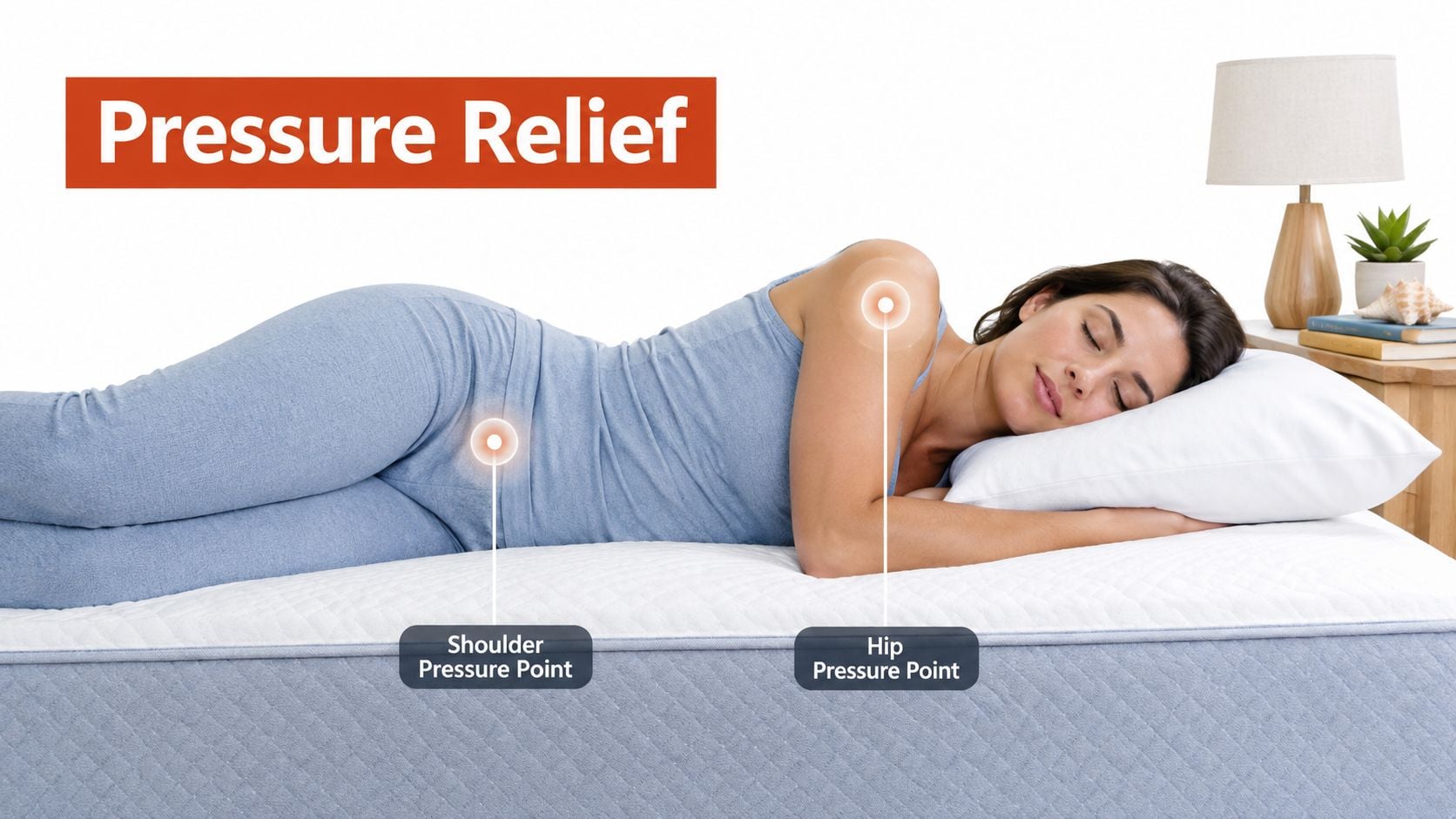
What neutral alignment looks like
When your spine is in a neutral position on your side, your head, neck, upper back, and pelvis should look roughly level rather than bent sharply toward the mattress. If your shoulder can't settle in, the upper body may angle upward. If your pelvis sinks too far, your waist can bow downward and your torso may roll forward.
These cues help distinguish pressure relief from simple sinking. Pressure relief means the mattress gently accommodates the shoulder and hip while the rest of your body stays supported. A deep hammock-like feel can feel soft at first, but it may leave the pelvis and waist unsupported.
A comfortable neck also depends on how your head is supported. For practical guidance on choosing pillow support for neck pain and headaches, consider how pillow height works together with the mattress under your shoulder.
Read the whole posture, not one pressure point
A mattress might feel gentle under the shoulder yet still allow the hips to drop. Or it might keep the pelvis steady but press too firmly against the hip. Notice both ends of the body, and pay attention to the space and support around your waist.
If back discomfort is part of your decision, Indian River Furniture's mattress guidance for back support offers another way to think about how a sleeping surface supports the body. The aim is not to make the bed feel as soft as possible. It's to find a balanced, ergonomic feel that cushions contact points without letting your posture sag.
Ideal Firmness Levels for Side Sleepers
Medium-firm is a useful starting point for side sleepers, though the right feel depends on how your body meets the mattress. A systematic review reported that medium-firm mattresses can support comfort, sleep quality, and spinal alignment. A broader orthopedic literature review also found medium-firm surfaces more consistently associated with improved pressure distribution, reduced morning stiffness, and lower low-back-pain intensity than very soft or very firm surfaces (systematic review of mattress firmness and musculoskeletal support).
A comfort layer that yields reduces pressure at the shoulder and hip; the support core beneath it helps keep the pelvis aligned with the torso. The first layer should cushion your contact points, while the deeper layers should prevent your body from sinking too far.
Start with a range, then read your body
For many side sleepers, medium to medium-firm, around 5–6 on a 10-point scale, is a helpful range to test. Guidance places some lighter side sleepers toward a softer feel, while people with more body weight may need firmer support (guidance on pressure relief and mattress firmness). Treat the number as a starting specification. Firmness labels vary across brands, and body shape changes how much a mattress compresses beneath you.
A plush mattress can feel inviting during a quick test. Stay on your side long enough to notice what happens at your waist and pelvis. If either area feels unsupported as your body settles, the softness may be allowing too much sink. A firm surface can create the opposite problem, pressing against your shoulder or hip before those areas have room to settle.
Start near medium-firm, then adjust toward more cushioning or more resistance based on your posture and pressure points.
The label is only the first clue. Your build affects how much pressure reaches the surface, so two people can experience the same firmness differently.
A mattress biomechanics review reported differing spinal angles on custom, firm, and soft surfaces in one cited study, while noting that the evidence does not establish universal thresholds for ideal alignment or pressure distribution (review of mattress biomechanics and spinal alignment). Use the broader evidence to choose a starting range, then judge how the mattress responds to your body.
Matching Firmness to Body Weight and Build
The same mattress can feel like a different surface to two people. Weight affects how far you sink, while shoulder width, hip shape, height, and mattress materials influence where pressure gathers. Use the ranges below as a first comparison, then check how the mattress responds to your build.
| Sleeper weight | Starting firmness (10-point scale) |
|---|---|
| Under 130 lb | Soft to medium-soft (3–4) |
| 130–230 lb | Medium to medium-firm (5–6) |
| Over 230 lb | Medium-firm to firm (6–8) |
These ranges are starting points, not prescriptions. A heavier sleeper may compress the surface more, making it feel softer; a lighter sleeper may not sink far enough for the mattress to cushion the shoulder and hip. Proportions matter too. A broad shoulder or prominent hip concentrates pressure in a smaller area, much like the edge of a wider object presses differently into a cushion.
For example, a lighter side sleeper testing a medium mattress may find that the shoulder barely settles in. The waist can then feel unsupported because the surface has not conformed to the body's shape. A softer feel may give the shoulder and hip more room, provided the support underneath keeps the pelvis steady.
A heavier sleeper on the same mattress may experience more compression beneath the hip and shoulder. A firmer option can offer more resistance, but the shoulder should still feel comfortably cushioned.
Pair the label with a body-specific trial
A study of side-lying alignment found that firmness interacted with body shape. Higher-weight participants generally aligned more neutrally on firmer surfaces, while lower-weight participants tended to align better on softer ones. Shorter participants also tended to align better on softer surfaces, while medium firmness worked better for taller participants (research on body shape and mattress alignment). These findings support testing for your own build rather than relying on one firmness label.
On the showroom floor, lie on each option in your usual side-sleeping position for several minutes. Notice whether your shoulder and hip settle comfortably, and whether your waist and pelvis still feel supported. Keep your weight range and body proportions in mind as you compare. Guidance on mattress considerations for different body types can also help you prepare for that comparison.
A mattress with the “right” number only works if it gives your body both cushioning and support.
Mattress Constructions That Suit Side Sleeping
Firmness tells you something about the mattress's surface feel. Construction helps explain how that feel is created and where the mattress may yield. For side sleepers, it's useful to separate the cushioning layer from the deeper support beneath it.
The comfort layer is the part that cushions prominent contact points. At the shoulder and hip, it should give enough for those areas to settle without feeling pushed back. The support core sits below and helps resist excessive sinkage, especially around the pelvis and midsection.
Compare what each layer does
| Mattress feature | What to notice as a side sleeper |
|---|---|
| Comfort layer | Does it cushion the shoulder and hip, or do those areas feel pressed against the surface? |
| Support core | Does the pelvis stay supported, or does your middle feel as if it is dropping? |
| Zoned or adaptive construction | Does it accommodate wider pressure points while offering more resistance beneath the midsection? |
Zoned or adaptive construction can provide different levels of response across the mattress. The idea is to offer more gentle accommodation where the shoulder or hip needs it while retaining support under the waist and pelvis. A systematic review noted that customized support may improve spinal support in the side-sleeping position (review of mattress effects on sleep quality and alignment).
No construction label can tell you how a particular mattress will feel under your body. Compare the shoulder, hip, and waist together. If the surface cushions your contact points but the middle feels unstable, the overall balance may not suit you. If the support feels steady but your shoulder stays high, consider a surface with more accommodation.
At Indian River Furniture's Rockledge mattress gallery, in-store guides can help you compare these features side by side. If you're also weighing different mattress structures, the guide to hybrid and innerspring mattress construction can help you understand the design differences without treating one type as a universal answer.
Testing Mattresses in the Showroom
A mattress can feel comfortable in a brief sit or a few seconds on your back, then feel different when you settle into your usual sleeping position. For a side sleeper, the useful test is a timed one that lets you notice pressure and posture together. Bring your normal pillow if you can, since it affects the position of your neck.
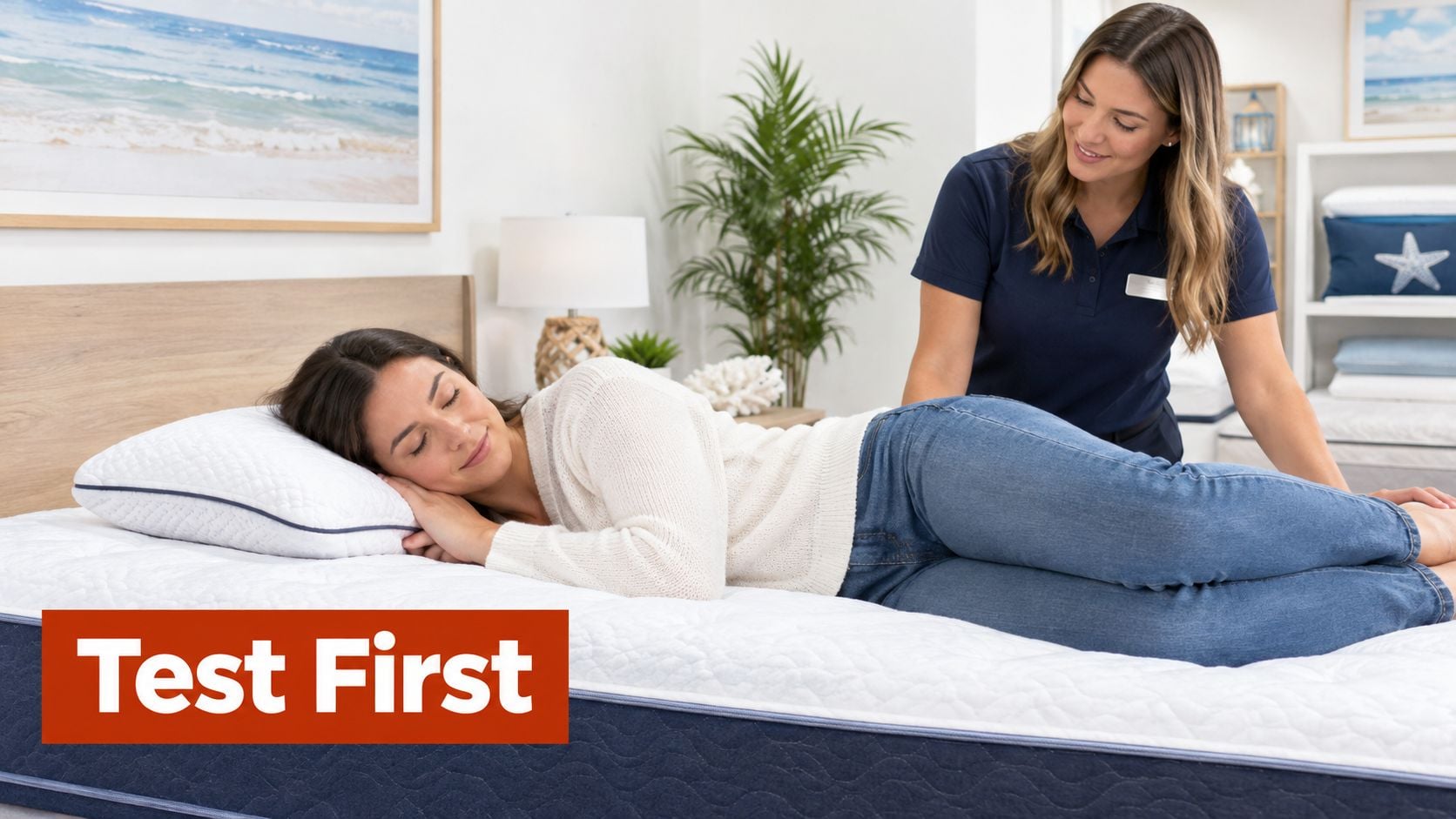
Try a timed, position-specific test
Lie on your side for at least 10–15 minutes, using your usual pillow. That gives you time to notice whether pressure develops at your shoulder or hip and whether your body feels supported once you've settled in. Don't judge the mattress by pressing it with your hand or sitting at the edge. Those actions don't show how it supports your body in bed (showroom testing guidance for mattress pressure relief).
During the test, check your position from head to pelvis. Does your neck feel comfortable with your pillow? Do your upper back and pelvis appear roughly parallel to the mattress? Does your waist feel supported, or does your middle seem to sag? If you're unsure, change to another mattress and compare the sensations while they're fresh.
Then roll toward your back. Notice whether changing position feels easy or whether you feel held in the surface. A softer mattress may relieve pressure but make movement harder for some sleepers; a firmer one may feel easier to move on but leave more pressure at the shoulder or hip.
Give each mattress enough time for your body to settle. First impressions are useful, but they aren't the whole test.
Use the showroom as a comparison space
Indian River Furniture's 32,000-square-foot Rockledge showroom gives you room to compare mattress options and see how they feel in a curated setting. The ownership team hand-tests every seat, sofa, and recliner for pitch and comfort before it reaches the showroom floor. That no-blind-ordering promise reflects a hands-on approach to evaluating comfort, while the in-house design team can help you connect your preferences with the bedroom you're furnishing.
Ask an in-store guide to help you compare the way different comfort layers and support cores respond. You can also review what to consider when buying a mattress before your visit. Take notes on pressure, alignment, and ease of movement, rather than relying on the firmness label alone.
Choosing Your Comfort Level and Next Steps
A clear decision path makes mattress shopping less like guessing and more like a useful fitting. Begin with medium-firm as a reference point, then adjust for your weight, height, shoulder width, and hip shape. Consider whether the construction cushions your shoulder and hip while keeping the middle of your body supported.
Then test the mattress in your natural position. Give your body time to settle on its side, check your posture, and roll toward your back to assess movement. A label can narrow the choices, but your own pressure and alignment provide the more meaningful guidance.
For side sleepers, the best mattress comfort level is the one that balances cushioning with stable support for your particular build. No single firmness rating can make that decision for everyone. A careful, timed trial helps you judge what your body needs.
Visit Indian River Furniture in Rockledge to hand-test mattresses, explore the curated coastal room displays, and speak with the complimentary in-house interior design team. The team can help you consider comfort alongside the feel and look of the bedroom you're furnishing. Indian River Furniture has served Brevard County and Central Florida since 1939; visit Indian River Furniture online for more information, then plan a showroom visit to find a comfort level that feels right for you.